

Coupling of Alzheimer’s Disease Genetic Risk Factors with Viral Susceptibility and Inflammation
Open accessThe DOI matches its Crossref record; 185 of the 185 references it cites were found in a registry or an index; none of the 242 sources its claims cite is checked for support yet.
Abstract
Alzheimer's disease (AD) is a neurodegenerative disease characterized by persistent cognitive decline. Amyloid plaque deposition and neurofibrillary tangles are the main pathological features of AD brain, though mechanisms leading to the formation of lesions remain to be understood. Genetic efforts through genome-wide association studies (GWAS) have identified dozens of risk genes influencing the pathogenesis and progression of AD, some of which have been revealed in close association with increased viral susceptibilities and abnormal inflammatory responses in AD patients. In the present study, we try to present a list of AD candidate genes that have been shown to affect viral infection and inflammatory responses. Understanding of how AD susceptibility genes interact with the viral life cycle and potential inflammatory pathways would provide possible therapeutic targets for both AD and infectious diseases.
Overview
CoChat Summary
TL;DR
This review synthesizes evidence linking Alzheimer’s disease (AD) genetic risk factors to viral susceptibility and inflammation, mapping genes such as APOE, APP, TREM2, CD33, and others to viruses including HSV, HIV, SARS-CoV-2, HCV, EBV, and HBV. It proposes that gene–virus interactions may accelerate AD pathology through Aβ/tau, neuroinflammation, and blood–brain barrier disruption, though the molecular mechanisms remain unresolved.
Key findings
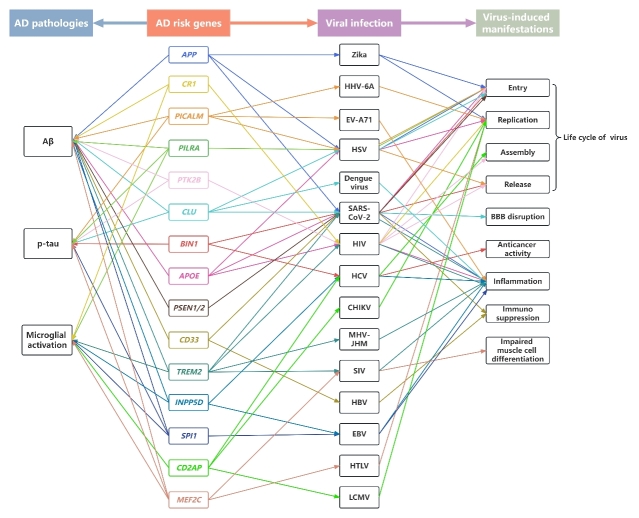
- The review catalogs 15 AD risk genes in Table 1—APOE, APP, CR1, PILRA, CLU, BIN1, PSEN1/2, CD33, SPI1, INPP5D, CD2AP, PTK2B, TREM2, PICALM, and MEF2C—that have reported links to viral infection and/or inflammatory responses; ABCA7 and HLA-DRB5/DRB1 are described as weakly or not clearly linked, while RIN3, CASS4, SORL1, EPHA1, and MS4A lack clear viral investigation.
- APOE ε4 shows dose-dependent AD risk: one copy is associated with a 2- to 3-fold increased risk and two copies with a 12- to 15-fold increased risk compared with noncarriers; APOE ε4 carriers have higher cerebrospinal fluid HSV-1 DNA, APOE ε4 may facilitate HIV entry, and APOE ε4 is associated with increased SARS-CoV-2 susceptibility and elevated serum inflammatory factors.
- TREM2 R47H (rs75932628-T) confers AD risk with an odds ratio of 2.92, similar to APOE ε4; TREM2 binds the SARS-CoV-2 membrane protein and enhances IFN-γ, TNF-α, IL-4, IL-6, IL-10, and IL-1β, while cerebrospinal fluid soluble TREM2 is elevated in untreated HIV and highest in HIV-associated dementia.
- CD33 rs3865444 CC increases microglial CD33 and immunosuppressive CD33 MDSC populations, enhancing susceptibility to severe COVID-19 and HBV; in chronic hepatitis B, 56.5% of CD33-positive cells bound HBsAg and almost all HBsAg-positive cells bound CD33.
Methods
- Design: narrative review; no primary experiments or new patient data are reported.
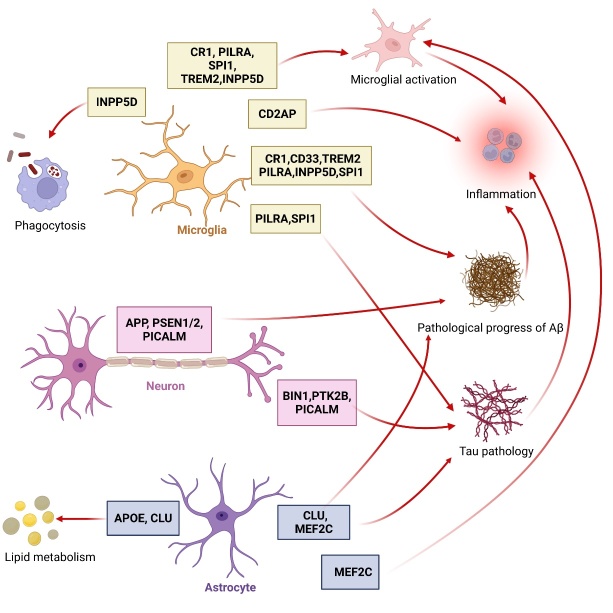
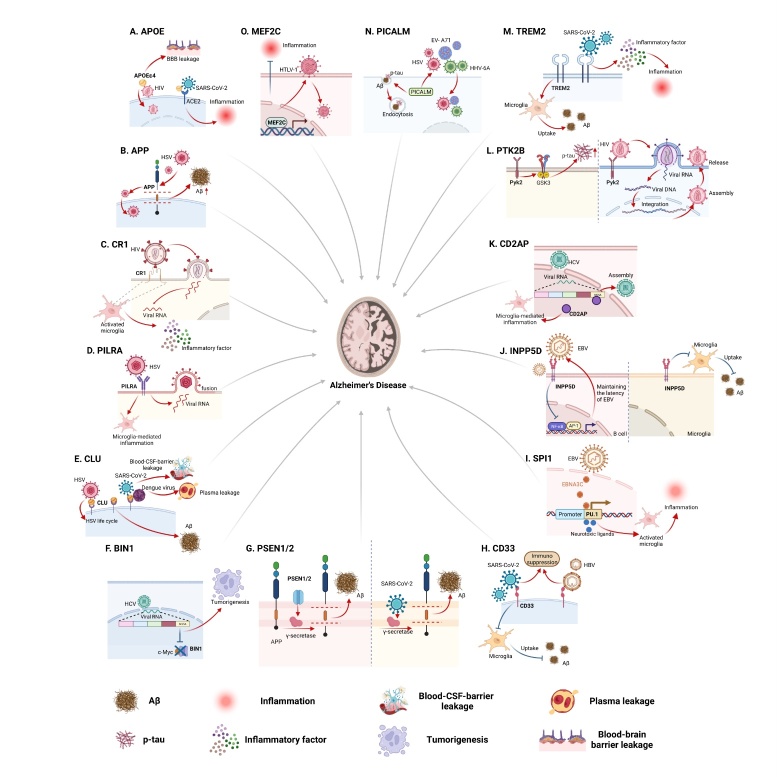
- Data/sample: synthesis of published GWAS-identified AD risk genes and studies of viral infection, immune response, and inflammation, organized in Table 1 and Figures 1–3.
- Main analysis: qualitative integration of gene functions, putative mechanisms, viral associations, and inflammatory responses; no systematic search strategy, meta-analysis, or quantitative synthesis is described.
Limitations
- The paper states that mechanisms underlying the association of AD susceptibility genes with pathogenesis remain inadequately understood; how a specific virus interacts with AD risk genes and how those interactions affect AD pathology, viral infection, and inflammation require further evaluation, and no anti-inflammatory agents have been translated into clinical applications.
- Evident from the text: as a narrative review, it lacks systematic search criteria, risk-of-bias assessment, and quantitative pooling; conclusions rely on heterogeneous cited studies, including contradictory findings such as APP’s protective role against Zika virus versus its promotion of Aβ pathology.
- Evident from the text: many gene–virus links are putative or mechanistic hypotheses, and causal direction cannot be established from the reviewed evidence.
Model-written summary. Check it against the paper before relying on it.
Integrity signals
Registry
Cites
Statistics
Figures
Verification
Claims the paper makes
0 Valid · 2 Not valid · 174 Not checked · 6 Own results and interpretations
In the paper
“In CD2AP-knockout mice, reduced BBB integrity has been reported [56].”
§ Coupling of Alzheimer’s Disease Genetic Risk Factors with Viral Susceptibility and Inflammation > 1. Genetic risk factors for AD associated with viral infection > 1.11 CD2-associated protein (CD2AP)
What the sources say
- Not checked yetcites [56] Cochran JN, Rush T, Buckingham SC, Roberson ED (2015). The Alzheimer's disease risk factor CD2AP maintains blood-brain barrier integrity. Hum Mol Genet, 24: 6667- 6674. 26358779 PMC4634373 source
plainstates a cause- Asserted: passes — The authors put it forward as true.
- Checkable: passes — It can be checked against evidence.
- Load-bearing: unclear — It is unclear whether the paper’s conclusions depend on it.
- Based: passes — The paper gives a reason why it holds.
In the paper
“By quantifying the frequency of cells expressing CD33 and HBV surface antigen (HBsAg) using peripheral blood mononuclear cells isolated from patients with chronic hepatitis B, 56.5% of CD33-positive cells were found to be bound to HBsAg and almost all HBsAg-positive cells were bound to CD33 [85].”
§ Coupling of Alzheimer’s Disease Genetic Risk Factors with Viral Susceptibility and Inflammation > 1. Genetic risk factors for AD associated with viral infection > 1.8 Cluster of differentiation 33 (CD33)
What the sources say
- Not checked yetcites [85] Tsai T-Y, Huang M-T, Sung P-S, Peng C-Y, Tao M-H, Yang H-I, et al. (2023). SIGLEC-3 (CD33) serves as an immune checkpoint receptor for HBV infection. J Clin Invest, 131: e141965. PMC8159688 34060491 source
plainstates an association- Asserted: passes — The authors put it forward as true.
- Checkable: passes — It can be checked against evidence.
- Load-bearing: passes — The paper’s conclusions depend on it.
- Based: passes — The paper gives a reason why it holds.
In the paper
“Using microarray analysis and quantitative reverse transcription polymerase chain reaction, studies with peripheral whole blood samples of HCV patients have shown a significant negative correlation between INPP5D gene expression and the degree of fibrosis [98].”
§ Coupling of Alzheimer’s Disease Genetic Risk Factors with Viral Susceptibility and Inflammation > 1. Genetic risk factors for AD associated with viral infection > 1.10 Inositol polyphosphate-5-phosphatase (INPP5D)
What the sources say
- Not checked yetcites [98] Katsounas A, Trippler M, Kottilil S, Lempicki RA, Gerken G, Schlaak JF (2011). Altered expression of SHIP, a Toll-like receptor pathway inhibitor, is associated with the severity of liver fibrosis in chronic hepatitis C virus infection. J Infect Dis, 204: 1181- 1185. 21917890 PMC3173502 source
plainstates an association- Asserted: passes — The authors put it forward as true.
- Checkable: passes — It can be checked against evidence.
- Load-bearing: passes — The paper’s conclusions depend on it.
- Based: passes — The paper gives a reason why it holds.
In the paper
“Quantitative proteomic studies have found that the C-terminal hypervariable domain of viral replicase proteins can bind with CD2AP, leading to reduced CHIKV replication [104].”
§ Coupling of Alzheimer’s Disease Genetic Risk Factors with Viral Susceptibility and Inflammation > 1. Genetic risk factors for AD associated with viral infection > 1.11 CD2-associated protein (CD2AP)
What the sources say
- Not checked yetcites [104] Mutso M, Morro AM, Smedberg C, Kasvandik S, Aquilimeba M, Teppor M, et al. (2018). Mutation of CD2AP and SH3KBP1 Binding Motif in Alphavirus nsP3 Hypervariable Domain Results in Attenuated Virus. Viruses, 10: 226. 29702546 PMC5977219 source
plainstates a cause- Asserted: passes — The authors put it forward as true.
- Checkable: passes — It can be checked against evidence.
- Load-bearing: unclear — It is unclear whether the paper’s conclusions depend on it.
- Based: passes — The paper gives a reason why it holds.
98 more claims
Create a free account to see all 182 claims and to verify the 242 references still open.
- It may state two separate claims as one. 74
- Probably not a substantial claim. 8
Self-check
Percentages, sums and reported differences re-computed from the paper’s own numbers.
Each contradiction between two passages listed here was confirmed by an independent check.
Rated minor: it would not touch a result — a value no result rests on, a p-value that stays on the same side of the significance level, or a conflict that is clerical, resolved elsewhere in the paper, or outside its own findings.
In the paper
§ Coupling of Alzheimer’s Disease Genetic Risk Factors with Viral Susceptibility and Inflammation > 1. Genetic risk factors for AD associated with viral infection > 1.8 Cluster of differentiation 33 (CD33)
“the inhibition of Aβ uptake was inhibited when CD33 was elevated”
§ Coupling of Alzheimer’s Disease Genetic Risk Factors with Viral Susceptibility and Inflammation > 1. Genetic risk factors for AD associated with viral infection > 1.2 Amyloid precursor protein (APP)
“Immunosuppressive effects of CD33 enhance SARS-CoV-2 and HBV infection and impede Aβ uptake by microglia.”
Rated minor: it would not touch a result — a value no result rests on, a p-value that stays on the same side of the significance level, or a conflict that is clerical, resolved elsewhere in the paper, or outside its own findings.
In the paper
§ Coupling of Alzheimer’s Disease Genetic Risk Factors with Viral Susceptibility and Inflammation > 1. Genetic risk factors for AD associated with viral infection > 1.9 Salmonella pathogenicity island 1 (SPI1)
“SPI1 is a 40-kb island consisting of a type III secretion system [86].”
§ Coupling of Alzheimer’s Disease Genetic Risk Factors with Viral Susceptibility and Inflammation > 1. Genetic risk factors for AD associated with viral infection > 1.9 Salmonella pathogenicity island 1 (SPI1)
“The transcription factor PU.1, encoded by SPI1, is a major regulator of microglial development, function and homeostasis [87].”
Rated minor: it would not touch a result — a value no result rests on, a p-value that stays on the same side of the significance level, or a conflict that is clerical, resolved elsewhere in the paper, or outside its own findings.
In the paper
§ Coupling of Alzheimer’s Disease Genetic Risk Factors with Viral Susceptibility and Inflammation > 1. Genetic risk factors for AD associated with viral infection > 1.13 Triggering receptor expressed on myeloid cells 2 (TREM2)
“knocking out TREM2 in PS2APP and 5xFAD AD model mice resulted in a more severe plaque load, neuroinflammation, and neurodegeneration [81, 121].”
§ Coupling of Alzheimer’s Disease Genetic Risk Factors with Viral Susceptibility and Inflammation > References
“Trem2 Deletion Reduces Late-Stage Amyloid Plaque Accumulation, Elevates the Aβ42:Aβ40 Ratio, and Exacerbates Axonal Dystrophy and Dendritic Spine Loss in the PS2APP Alzheimer's Mouse Model.”
Citations
Cites
A Unique Microglia Type Associated with Restricting Development of Alzheimer’s Disease
Keren-Shaul, H., Spinrad, A., Weiner, A., Matcovitch-Natan, O., Dvir-Szternfeld, R., Ulland, T. K., David, E., Baruch, K., Lara-Astaiso, D., Toth, B., et al. (2017) · Cell · doi:10.1016/j.cell.2017.05.018 · Cited by 5,493
Inflammation and Alzheimer’s disease
Akiyama, H. (2000) · Neurobiology of Aging · doi:10.1016/s0197-4580(00)00124-x · Cited by 4,514
Meta-Analysis of 74,046 Individuals Identifies 11 New Susceptibility Loci for Alzheimer’s Disease
(EADI), E. A. D. I., Lambert, J.-C., (GERAD), G. A. E. R. I. A. D., Alzheimer's Disease Genetic Consortium (ADGC), (CHARGE), C. F. H. A. A. R. I. G. E., Ibrahim-Verbaas, C. A., Harold, D., Naj, A. C., Sims, R., Bellenguez, C., et al. (2013) · Nature Genetics · doi:10.1038/ng.2802 · Cited by 4,336
Harold, D., Abraham, R., Hollingworth, P., Sims, R., Gerrish, A., Hamshere, M. L., Pahwa, J. S., Moskvina, V., Dowzell, K., Williams, A., et al. (2009) · Nature Genetics · doi:10.1038/ng.440 · Cited by 3,326 · cited 1×
“The PICALM was a major genetic susceptibility locus for AD, which has been ranking second to APOE in a GWAS, and an interaction between PICALM and APOE has been reported [131].”
BackgroundVariant of TREM2 Associated with the Risk of Alzheimer's Disease
Jonsson, T., Stefansson, H., Steinberg, S., Jonsdottir, I., Jonsson, P. V., Snaedal, J., Bjornsson, S., Huttenlocher, J., Levey, A. I., Lah, J. J., et al. (2013) · New England Journal of Medicine · doi:10.1056/nejmoa1211103 · Cited by 2,558
New insights into the genetic etiology of Alzheimer’s disease and related dementias
Bellenguez, C., Küçükali, F., Jansen, I. E., Kleineidam, L., Moreno-Grau, S., Amin, N., Naj, A. C., Campos-Martin, R., Grenier-Boley, B., Andrade, V., et al. (2022) · Nature Genetics · doi:10.1038/s41588-022-01024-z · Cited by 2,498
Jansen, I. E., Savage, J. E., Watanabe, K., Bryois, J., Williams, D. M., Steinberg, S., Sealock, J., Karlsson, I. K., Hägg, S., Athanasiu, L., et al. (2019) · Nature Genetics · doi:10.1038/s41588-018-0311-9 · Cited by 2,277
Role of Genes and Environments for Explaining Alzheimer Disease
Gatz, M., Reynolds, C. A., Fratiglioni, L., Johansson, B., Mortimer, J. A., Berg, S., Fiske, A., & Pedersen, N. L. (2006) · Archives of General Psychiatry · doi:10.1001/archpsyc.63.2.168 · Cited by 1,798
Angiogenic signaling pathways and anti-angiogenic therapy for cancer
Liu, Z.-L., Chen, H.-H., Zheng, L.-L., Sun, L.-P., & Shi, L. (2023) · Signal Transduction and Targeted Therapy · doi:10.1038/s41392-023-01460-1 · Cited by 1,300
Wang, X., Sun, G., Feng, T., Zhang, J., Huang, X., Wang, T., Xie, Z., Chu, X., Yang, J., Wang, H., et al. (2019) · Cell Research · doi:10.1038/s41422-019-0216-x · Cited by 1,144 · cited 1×
“Furthermore, it can effectively reduce neuroinflammation and rescue the AD-related cognitive impairment [182].”
Background
Cited by
Navigating Alzheimer’s Disease Mouse Models: Age-Related Pathology and Cognitive Deficits
Plano, L. M. D., Saitta, A., Oddo, S., & Caccamo, A. (2024) · Biomolecules · doi:10.3390/biom14111405 · Cited by 22
Exploring the Efficacy and Safety of Nutritional Supplements in Alzheimer’s Disease
Gualtieri, P., Frank, G., Cianci, R., Ciancarella, L., Romano, L., Ortoman, M., Bigioni, G., Nicoletti, F., Falco, M. I., Placa, G. L., et al. (2025) · Nutrients · doi:10.3390/nu17050922 · Cited by 20
Upadhayay, S. (2026) · International Immunopharmacology · doi:10.1016/j.intimp.2026.116285 · Cited by 8
Gupta, V., Chitranshi, N., & Gupta, V. B. (2024) · Aging and Disease · doi:10.14336/ad.2024.0986 · Cited by 8
Body Composition and Alzheimer’s Disease: A Holistic Review
Frank, G., Gualtieri, P., Cianci, R., Caldarelli, M., Palma, R., Santis, G. L. D., Porfilio, C., Nicoletti, F., Bigioni, G., & Renzo, L. D. (2024) · International Journal of Molecular Sciences · doi:10.3390/ijms25179573 · Cited by 5
Metadata
- Authors
- Cao, C., Fu, G., Xu, R., & Li, N.
- Affiliations
- Institute of Basic Theory for Chinese Medicine (CN)
- Corresponding author
- Xu, Ruodan
- Li, Ning
- Venue
- Aging and disease
- Publisher
- Aging and Disease
- Published
- 2024
- Volume
- 15
- Issue
- 5
- Pages
- 2028
- ISSN
- 2152-5250 (ISSN-L)
- PMC
- PMC11346407
- OpenAlex
- W4387845137
- Semantic Scholar
- e800770f8efa8c1cfc9375f0a365393b320c736c
- Cited by
- 8
- References
- 185
- Citations by year
- 2026: 3 · 2025: 2 · 2024: 3
- FWCI
- 0.20
- Type
- journal article
- Language
- en
- Open access
- gold
- doi.org
- Licence
- cc-by
- Locations
- Aging and Disease (publishedVersion, cc-by)
- PubMed Central (publishedVersion, cc-by)
- PubMed (publishedVersion)
- Funders
- National Natural Science Foundation of China (82104672, 2021-19, 82141220)
- China Academy of Chinese Medical Sciences (CI2021A00609, CI2021B001)
- National Key Research and Development Program of China
- Topics
- Life Sciences › Neuroscience › Cellular and Molecular Neuroscience › Alzheimer's disease research and treatments
- Life Sciences › Neuroscience › Neurology › Neuroinflammation and Neurodegeneration Mechanisms
- Health Sciences › Medicine › Psychiatry and Mental health › Dementia and Cognitive Impairment Research
- Keywords
- Alzheimer's disease, genetic risk factors, viral susceptibility, neuroinflammation, candidate genes, amyloid plaques, neurofibrillary tangles, viral infection, inflammatory signaling, therapeutic target
- MeSH terms
- Alzheimer Disease, Humans, Inflammation, Risk Factors, Virus Diseases, Genetic Predisposition to Disease, Genome-Wide Association Study
About these checks
Registry, retraction, Cites and statistics results are computed, not judged, with one exception: a printed reference that no index lists is read once by a model before it counts as a citation error. Claims are extracted by a model and kept only when their quote appears verbatim in the text; each cited source is then checked, with a model’s help, for whether it says what the claim relies on. Those verdicts can be wrong — read the claim’s quote and the cited source before relying on one.
A language model drew the claims from the paper on 2026-11-26, under version 3 of the claim definition (model deepseek-v4.1-flash, prompt extract-v3).
A second model labelled each claim on 2026-11-26 (model jev-1.13-20260917, definition revision gold-guideline-v0.2).
Statistics and arithmetic are recomputed, not judged.
Confidence bands are shown only for fields calibrated on our annotated test set. None is calibrated yet, so no band is shown.
What counts as a claim ›How we measure confidence ›How we check this ›
Are you an author, or do you see a problem with this page? Request a review
Data sources
Bibliographic data: Semantic Scholar, OpenAlex, Crossref.
Contains information from the Semantic Scholar Academic Graph Datasets, made available under the ODC Attribution License (ODC-BY 1.0).
Semantic Scholar’s data is described in: Kinney, R., et al. (2023). The Semantic Scholar Open Data Platform. arXiv:2301.10140.
