

The DOI matches its Crossref record; 88 of the 89 references it cites were found in a registry or an index, and 1 are not checked yet.
Integrative Multi-Omics Approaches in Cancer Research: From Biological Networks to Clinical Subtypes
Open accessAbstract
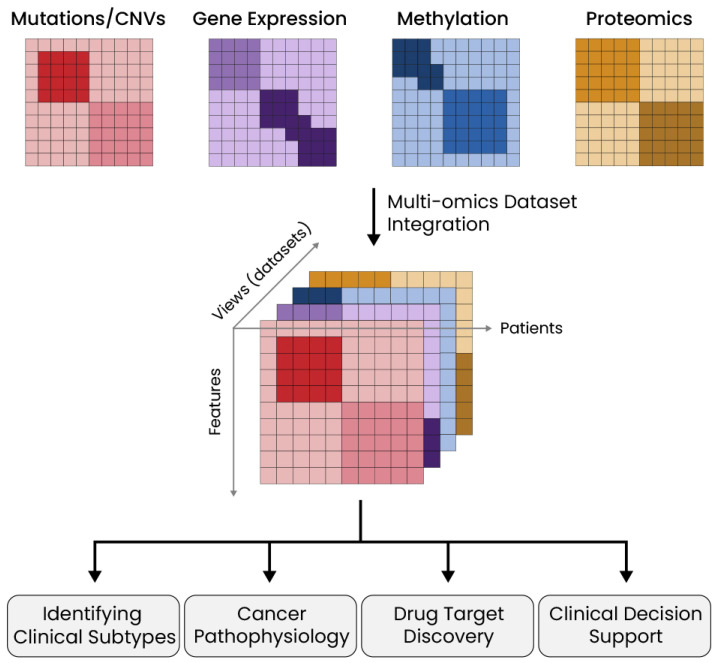
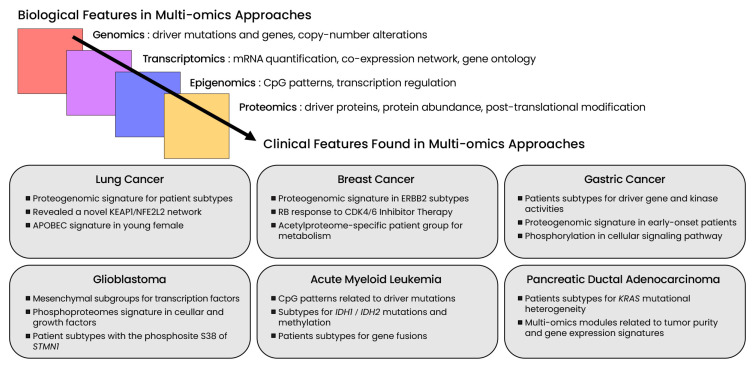
Multi-omics approaches are novel frameworks that integrate multiple omics datasets generated from the same patients to better understand the molecular and clinical features of cancers. A wide range of emerging omics and multi-view clustering algorithms now provide unprecedented opportunities to further classify cancers into subtypes, improve the survival prediction and therapeutic outcome of these subtypes, and understand key pathophysiological processes through different molecular layers. In this review, we overview the concept and rationale of multi-omics approaches in cancer research. We also introduce recent advances in the development of multi-omics algorithms and integration methods for multiple-layered datasets from cancer patients. Finally, we summarize the latest findings from large-scale multi-omics studies of various cancers and their implications for patient subtyping and drug development.
Overview
The claims and statistics of this paper haven’t been checked yet.
Run the check — free, no account needed. It reads the open-access text and checks the sources it cites.
Integrity signals
Registry
Cites
Statistics
Figures
Verification
Claims the paper makes
The claims and statistics of this paper haven’t been checked yet.
Run the check — free, no account needed. It reads the open-access text and checks the sources it cites.
Claims other papers make about this one
Each is checked against this paper’s own text: does it say what the citing paper says it does?
The source backs part of the claim, not all of it — or backs it for a different population, condition or comparison.
In the citing paper
“At the biological level, the diagnostic data it processes reflects the multi-level organization of cancer”
From A generative AI multi-agent framework with integrated XAI governance for cancer diagnostics: from multi-omics interpretation to lifestyle risk stratification (2026) · cites this paper as Heo et al., 2021
Experimental — accuracy not yet measured
Self-check
Percentages, sums and reported differences re-computed from the paper’s own numbers.
The self-check needs the paper’s full text.
Citations
Cites
PD-1 and PD-L1 Immune Checkpoint Blockade to Treat Breast Cancer
Hartkopf, A. D., Taran, F., Wallwiener, M., Walter, C. B., Krämer, B., Grischke, E., & Brucker, S. Y. (2016) · Breast Care · doi:10.1159/000453569 · Cited by 30,989
WGCNA: an R package for weighted correlation network analysis
Langfelder, P., & Horvath, S. (2008) · BMC Bioinformatics · doi:10.1186/1471-2105-9-559 · Cited by 27,252
Szklarczyk, D., Gable, A. L., Lyon, D., Junge, A., Wyder, S., Huerta-Cepas, J., Simonovic, M., Doncheva, N. T., Morris, J. H., Bork, P., et al. (2019) · Nucleic Acids Research · doi:10.1093/nar/gky1131 · Cited by 17,749
Comprehensive Integration of Single-Cell Data
Stuart, T., Butler, A., Hoffman, P., Hafemeister, C., Papalexi, E., Mauck, W. M., Hao, Y., Stoeckius, M., Smibert, P., & Satija, R. (2019) · Cell · doi:10.1016/j.cell.2019.05.031 · Cited by 15,453
Nishimura, R., Osako, T., Nishiyama, Y., Tashima, R., Nakano, M., Fujisue, M., Toyozumi, Y., & Arima, N. (2013) · Oncology · doi:10.1159/000353099 · Cited by 13,239
Comprehensive molecular portraits of human breast tumours
The Cancer Genome Atlas Network (2012) · Nature · doi:10.1038/nature11412 · Cited by 12,129
Comprehensive molecular characterization of human colon and rectal cancer
The Cancer Genome Atlas Network (2012) · Nature · doi:10.1038/nature11252 · Cited by 8,499
Integrated genomic analyses of ovarian carcinoma
Perou, C. M. (2019) · Carolina Digital Repository (University of North Carolina at Chapel Hill) · doi:10.17615/hvp3-wg08 · Cited by 7,927
Comprehensive molecular characterization of gastric adenocarcinoma
The Cancer Genome Atlas Research Network (2014) · Nature · doi:10.1038/nature13480 · Cited by 6,498
The genomic and transcriptomic architecture of 2,000 breast tumours reveals novel subgroups
METABRIC Group, Curtis, C., Shah, S. P., Chin, S.-F., Turashvili, G., Rueda, O. M., Dunning, M. J., Speed, D., Lynch, A. G., Samarajiwa, S., et al. (2012) · Nature · doi:10.1038/nature10983 · Cited by 6,097
Cited by
Sorted by citations
Xiong, N., Wu, H., & Yu, Z. (2024) · Frontiers in Oncology · doi:10.3389/fonc.2024.1405491 · Cited by 227
Multi-OMICS approaches in cancer biology: New era in cancer therapy
Chakraborty, S., Sharma, G., Karmakar, S., & Banerjee, S. (2024) · Biochimica et Biophysica Acta (BBA) - Molecular Basis of Disease · doi:10.1016/j.bbadis.2024.167120 · Cited by 198
Wei, L., Niraula, D., Gates, E. D. H., Fu, J. Y., Luo, Y., Nyflot, M. J., Bowen, S. R., Naqa, I. M. E., & Cui, S. (2023) · British Journal of Radiology · doi:10.1259/bjr.20230211 · Cited by 179
A benchmark study of deep learning-based multi-omics data fusion methods for cancer
Leng, D., Zheng, L., Wen, Y., Zhang, Y., Wu, L., Wang, J., Wang, M., Zhang, Z., He, S., & Bo, X. (2022) · Genome biology · doi:10.1186/s13059-022-02739-2 · Cited by 163
Li, X., Ma, J., Leng, L., Han, M., Li, M., He, F., & Zhu, Y. (2022) · Frontiers in Genetics · doi:10.3389/fgene.2022.806842 · Cited by 161
Metadata
- Authors
- Heo, Y. J., Hwa, C., Lee, G.-H., Park, J.-M., & An, J.-Y.
- Affiliations
- Korea University (KR)
- Venue
- Molecules and Cells
- Publisher
- Elsevier BV
- Published
- 2021-07
- Volume
- 44
- Issue
- 7
- Pages
- 433-443
- ISSN
- 0219-1032 (ISSN-L)
- 1016-8478
- PMC
- PMC8334347
- OpenAlex
- W3180571536
- Cited by
- 294
- References
- 88
- Citations by year
- 2026: 66 · 2025: 81 · 2024: 75 · 2023: 56 · 2022: 15
- FWCI
- 3.86
- Type
- journal article
- Language
- en
- Open access
- gold
- doi.org
- Licence
- Locations
- Molecules and Cells (publishedVersion, cc-by-nc-sa)
- PubMed Central (publishedVersion, cc-by-nc-sa)
- PubMed (publishedVersion)
- Funders
- National Research Foundation of Korea (2019M3E5D3073568)
- Topics
- Life Sciences › Biochemistry, Genetics and Molecular Biology › Molecular Biology › Bioinformatics and Genomic Networks
- Life Sciences › Biochemistry, Genetics and Molecular Biology › Cancer Research › Cancer Genomics and Diagnostics
- Life Sciences › Biochemistry, Genetics and Molecular Biology › Molecular Biology › Gene expression and cancer classification
- Keywords
- multi-omics integration, cancer subtyping, multi-view clustering, biological networks, survival prediction, therapeutic outcome prediction, drug development, cancer genomics
- MeSH terms
- Humans, Neoplasms, Survival Analysis, Computational Biology, Biomedical Research, Metabolomics
About these checks
Registry, retraction, Cites and statistics results are computed, not judged, with one exception: a printed reference that no index lists is read once by a model before it counts as a citation error. Claims are extracted by a model and kept only when their quote appears verbatim in the text; each cited source is then checked, with a model’s help, for whether it says what the claim relies on. Those verdicts can be wrong — read the claim’s quote and the cited source before relying on one.
Statistics and arithmetic are recomputed, not judged.
Confidence bands are shown only for fields calibrated on our annotated test set. None is calibrated yet, so no band is shown.
What counts as a claim ›How we measure confidence ›How we check this ›
Are you an author, or do you see a problem with this page? Request a review
