

Shalom, Ḥesed, and Tsedaqah as Religious Community Pathways to Human Flourishing: An Exploration of Old Testament Theological Virtue
Open accessThe DOI matches its Crossref record; 21 of the 21 references it cites were found in a registry or an index; none of the 54 sources its claims cite is checked for support yet.
Abstract
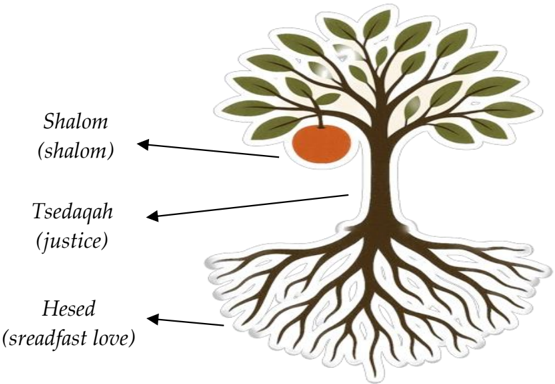
This research explores shalom, ḥesed, and tsedaqah as Old Testament theological virtues that shape the moral and spiritual foundations of human flourishing in religious communities. Through an exegetical-theological reading of Psalm 85, Isaiah 32, and Jeremiah 29, this research argues that the Hebrew Scriptures present flourishing not as individual achievement but as covenantal participation in God’s order of love, justice, and peace. Shalom represents the holistic goal of restored life; ḥesed is the relational virtue of faithful love sustaining solidarity; and tsedaqah embodies the structural virtue of justice that orders communal and ecological life. Together, they form an integrated moral ecology—ḥesed as the root of divine faithfulness, tsedaqah as the trunk of justice, and shalom as the fruit of peace. The research concludes that true human flourishing arises not from autonomy or prosperity, but from covenantal relationships grounded in God’s steadfast love, social justice, and peace that embraces all creation.
Overview
CoChat Summary
TL;DR
The paper argues that Old Testament shalom, ḥesed, and tsedaqah function as covenantal theological virtues that shape religious communities toward human flourishing, with ḥesed as root, tsedaqah as trunk, and shalom as fruit. Through exegetical-theological readings of Psalm 85, Isaiah 32, and Jeremiah 29, it concludes that flourishing is participatory and communal rather than individual prosperity.
Key findings
- Shalom is presented as holistic peace/restored life, ḥesed as faithful love sustaining solidarity, and tsedaqah as justice ordering communal and ecological life; together they form an integrated “moral ecology” of ḥesed as root, tsedaqah as trunk, and shalom as fruit.
- Exegesis of three texts: Psalm 85 portrays shalom as post-exilic restoration through ḥesed, ʾemeth, ṣedeq, and shalom; Isaiah 32 presents shalom as the result of righteousness/justice, with the sequence “Spirit of God – Transformation – Justice & Truth – Shalom”; Jeremiah 29 says shalom appears four times in verses 7 and 11 and commands seeking the welfare of the exiled city Babylon, extending flourishing even to oppressors.
- Lexical/theological survey reports that the noun Ṣedeq appears 119 times and Ṣᵊdāqâ appears 157 times in the Old Testament.
- Practical implications cite the Jeremiah Group in the United States, rooted in Jeremiah 29:7, and Wahana Visi Indonesia, which reports 1,200,000 children receiving assistance, 527 integrated programs, 8,000 individual sponsors from Indonesia and 11 other countries, and work in 500 villages across Indonesia.
Methods
- Design: an exegetical-theological reading of selected Old Testament texts—Psalm 85, Isaiah 32, and Jeremiah 29—alongside lexical and theological survey of shalom, ḥesed, and tsedaqah.
- Data/sample: biblical texts and secondary theological dictionaries/commentaries; no empirical sample is reported. Practical examples include the Jeremiah Group and Wahana Visi Indonesia.
- Main analysis: textual exegesis and synthesis of scholarly interpretations (e.g., Schmid, Zenger, Beuken, Oswalt, Thompson, Nicholson) into an integrated theological framework, followed by ethical and practical implications.
Limitations
- The paper does not state limitations.
- Evident from the text: the study is normative/exegetical and does not report empirical data or systematic measurement of human flourishing, so its claims about pathways to flourishing are theological rather than tested.
- Evident from the text: practical implications rely on illustrative cases (Jeremiah Group, Wahana Visi Indonesia) without detailed evaluation of mechanisms, generalizability, or counterexamples.
Model-written summary. Check it against the paper before relying on it.
Integrity signals
Registry
Cites
Statistics
Figures
Verification
Claims the paper makes
0 Valid · 8 Not valid · 54 Not checked · 133 Own results and interpretations
None of the sources cited for this claim have been checked yet.
In the paper
“The concept of shalom in Isaiah 32:17-18 is the result of righteousness (tsedeq).”
§ Community Pathways to Human Flourishing: An Exploration of Old Testament Theological Virtue > b. Isaiah 32
plainstates a cause- Asserted: passes — The authors put it forward as true.
- Checkable: passes — It can be checked against evidence.
- Load-bearing: passes — The paper’s conclusions depend on it.
- Based: passes — The paper gives a reason why it holds.
In the paper
“This shows that the positive effects of human flourishing are much greater when a person is involved in communal religious life (through communal worship or collective rituals) than when they simply maintain a personal religious identity.”
§ Community Pathways to Human Flourishing: An Exploration of Old Testament Theological Virtue > 1. Introduction
What the sources say
- Not checked yetcites VanderWeele 2017 matched to “Religious Communities and Human Flourishing” (2017) source
boostedstates a cause- Asserted: passes — The authors put it forward as true.
- Checkable: passes — It can be checked against evidence.
- Load-bearing: passes — The paper’s conclusions depend on it.
- Based: passes — The paper gives a reason why it holds.
A conclusion the paper draws from its own results — it cites no other source for it, so there is none to check. The quote shows it is in the paper.
In the paper
“Furthermore, shalom has an eschatological dimension that expands the horizon of human flourishing beyond the limits of history.”
§ Community Pathways to Human Flourishing: An Exploration of Old Testament Theological Virtue > 2. Shalom: A Whole and Balanced Life
plainstates a cause- Asserted: passes — The authors put it forward as true.
- Checkable: passes — It can be checked against evidence.
- Load-bearing: unclear — It is unclear whether the paper’s conclusions depend on it.
- Based: passes — The paper gives a reason why it holds.
A conclusion the paper draws from its own results — it cites no other source for it, so there is none to check. The quote shows it is in the paper.
In the paper
“the Hebrew Scriptures present flourishing not as individual achievement but as covenantal participation in God's order of love, justice, and peace.”
§ Community Pathways to Human Flourishing: An Exploration of Old Testament Theological Virtue > Abstract
plainstates a cause- Asserted: passes — The authors put it forward as true.
- Checkable: passes — It can be checked against evidence.
- Load-bearing: passes — The paper’s conclusions depend on it.
- Based: passes — The paper gives a reason why it holds.
A conclusion the paper draws from its own results — it cites no other source for it, so there is none to check. The quote shows it is in the paper.
In the paper
“Thus, relationality is not merely a complement to flourishing, but rather a key indicator of human success in living a full life.”
§ Community Pathways to Human Flourishing: An Exploration of Old Testament Theological Virtue > 1. Introduction
plainstates an association- Asserted: passes — The authors put it forward as true.
- Checkable: passes — It can be checked against evidence.
- Load-bearing: passes — The paper’s conclusions depend on it.
- Based: passes — The paper gives a reason why it holds.
27 more claims
Create a free account to see all 195 claims and to verify the 7 references still open.
- Probably not a substantial claim. 156
- It may state two separate claims as one. 63
Self-check
Percentages, sums and reported differences re-computed from the paper’s own numbers.
Each contradiction between two passages listed here was confirmed by an independent check.
Rated minor: it would not touch a result — a value no result rests on, a p-value that stays on the same side of the significance level, or a conflict that is clerical, resolved elsewhere in the paper, or outside its own findings.
In the paper
§ Community Pathways to Human Flourishing: An Exploration of Old Testament Theological Virtue > SHALOM, ḤESED, AND TSEDAQAH AS RELIGIOUS COMMUNITY c. Jeremiah 29
“According to Nicholson, shalom in Deuteronomy 29:7, 11 is:”
§ Community Pathways to Human Flourishing: An Exploration of Old Testament Theological Virtue > SHALOM, ḤESED, AND TSEDAQAH AS RELIGIOUS COMMUNITY c. Jeremiah 29
“The word shalom appears four times in Jeremiah 29, in verses 7 and 11.”
Rated minor: it would not touch a result — a value no result rests on, a p-value that stays on the same side of the significance level, or a conflict that is clerical, resolved elsewhere in the paper, or outside its own findings.
In the paper
§ Community Pathways to Human Flourishing: An Exploration of Old Testament Theological Virtue > 7. Conclusion
“(Oswalt 1998, 588).”
§ Community Pathways to Human Flourishing: An Exploration of Old Testament Theological Virtue > References
“16. Oswalt, John N. 1988. The Book of Isaiah: Chapters 1-39.”
Citations
Cites
Social Relationships and Mortality Risk: A Meta-analytic Review
Holt-Lunstad, J., Smith, T. B., & Layton, J. B. (2010) · PLoS Medicine · doi:10.1371/journal.pmed.1000316 · Cited by 7,272
Religious Communities and Human Flourishing
VanderWeele, T. J. (2017) · Current Directions in Psychological Science · doi:10.1177/0963721417721526 · Cited by 268
Social relations and self-reported health: a prospective analysis of the French Gazel cohort
Melchior, M., Berkman, L. F., Niedhammer, I., Chea, M., & Goldberg, M. (2003) · Social Science & Medicine · doi:10.1016/s0277-9536(02)00181-8 · Cited by 177
Human Flourishing, Human Dignity, and Human Rights
Kleinig, J., & Evans, N. G. (2012) · Law and Philosophy · doi:10.1007/s10982-012-9153-2 · Cited by 110
The Book of Isaiah: Chapters 1–39
Oswalt, J. N. (1986) · doi:10.5040/bci-008u · Cited by 109
Flourishing in critical dialogue
VanderWeele, T. J., Case, B. W., Chen, Y., Cowden, R. G., Johnson, B. R., Lee, M. T., Lomas, T., & Long, K. N. G. (2022) · SSM - Mental Health · doi:10.1016/j.ssmmh.2022.100172 · Cited by 96
Blessed Are the Organized: Grassroots Democracy in America
Stout, J. (2010) · doi:10.1515/9781400836079 · Cited by 86
Aristotelian Flourishing and Contemporary Philosophical Theories of Wellbeing
Symons, X., & VanderWeele, T. J. (2024) · Journal of Happiness Studies · doi:10.1007/s10902-024-00723-0 · Cited by 65
Positive Relationships as an Indicator of Flourishing During Emerging Adulthood
Padilla‐Walker, L. M., Memmott‐Elison, M. K., & Nelson, L. J. (2017) · Oxford University Press eBooks · doi:10.1093/acprof:oso/9780190260637.003.0018 · Cited by 56
The Meaning of Hesed in the Hebrew Bible
Sakenfeld, K. D. (1978) · BRILL eBooks · doi:10.1163/9789004386778 · Cited by 53
Research works printed but not linked: 5
- Neil, William. 1970. The Prophets of Israel (2): Jeremiah and Ezekiel. Philadelphia: Westminster Press.
- Nicholson, Ernest W. 1989. The Book of the Prophet Jeremiah, Volume 2: Chapters 26-52. Cambridge: Cambridge University Press.
- Stendebach, F.-J. 1998. לֹום" שָׁ (Shalom)." In Theological Dictionary of the Old Testament, vol. 9, edited by G. Johannes Botterweck, Helmer Ringgren, and Heinz-Josef Fabry. Grand Rapids: Wm. B. Eerdmans.
- VanderWeele, Tyler J. 2024. A Theology of Health: Wholeness and Human Flourishing. Notre Dame: University of Notre Dame Press.
- Wegner, Paul D. 2021. Isaiah: An Introduction and Commentary. Downers Grove, IL: InterVarsity Press.
Cited by
Still being checked.
Metadata
- Authors
- Sibagariang, J. S., & Sihombing, A. F.
- Venue
- TheoLogica: An International Journal for Philosophy of Religion and Philosophical Theology
- Publisher
- Universite Catholique de Louvain
- Published
- 2026-06-15
- Volume
- 10
- Issue
- 1
- ISSN
- 2593-0265 (ISSN-L)
- OpenAlex
- W7164821048
- Cited by
- 0
- References
- 20
- FWCI
- 0.00
- Type
- journal article
- Language
- en
- Open access
- diamond
- doi.org
- Licence
- Locations
- TheoLogica An International Journal for Philosophy of Religion and Philosophical Theology (publishedVersion, cc-by-nc-nd)
- DOAJ (DOAJ: Directory of Open Access Journals) (submittedVersion)
- Topics
- Social Sciences › Arts and Humanities › Religious studies › Biblical Studies and Interpretation
- Social Sciences › Arts and Humanities › Philosophy › Karl Barth and Christian Theology
- Social Sciences › Arts and Humanities › Religious studies › Contemporary Christian Leadership and Education
- Keywords
- shalom, theological virtues, eudaimonia, Old Testament, Psalm 85, covenant, social justice, peace, divine faithfulness, moral ecology, religious communities
About these checks
Registry, retraction, Cites and statistics results are computed, not judged, with one exception: a printed reference that no index lists is read once by a model before it counts as a citation error. Claims are extracted by a model and kept only when their quote appears verbatim in the text; each cited source is then checked, with a model’s help, for whether it says what the claim relies on. Those verdicts can be wrong — read the claim’s quote and the cited source before relying on one.
A language model drew the claims from the paper on 2026-11-21, under version 3 of the claim definition (model deepseek-v4.1-flash, prompt extract-v3).
A second model labelled each claim on 2026-11-21 (model jev-1.13-20260917, definition revision gold-guideline-v0.2).
Statistics and arithmetic are recomputed, not judged.
Confidence bands are shown only for fields calibrated on our annotated test set. None is calibrated yet, so no band is shown.
What counts as a claim ›How we measure confidence ›How we check this ›
Are you an author, or do you see a problem with this page? Request a review
How to cite
Cite CoChat for the checks on this page, and the paper for its own findings.
- This page
- CoChat. (2026). Citation check: Shalom, Ḥesed, and Tsedaqah as Religious Community Pathways to Human Flourishing: An Exploration of Old Testament Theological Virtue. https://app.cochat.ai/papers/10.14428/thl.v10i1.90453
- The paper
- Sibagariang, J. S., & Sihombing, A. F. (2026). Shalom, Ḥesed, and Tsedaqah as Religious Community Pathways to Human Flourishing: An Exploration of Old Testament Theological Virtue. TheoLogica: An International Journal for Philosophy of Religion and Philosophical Theology. https://doi.org/10.14428/thl.v10i1.90453
Data sources
Bibliographic data: Semantic Scholar, OpenAlex, Crossref.
Contains information from the Semantic Scholar Academic Graph Datasets, made available under the ODC Attribution License (ODC-BY 1.0).
Semantic Scholar’s data is described in: Kinney, R., et al. (2023). The Semantic Scholar Open Data Platform. arXiv:2301.10140.
