

The DOI matches its Crossref record.
Embed Attitude from Student on Elearning Using Instructional Design with ADDIE Model
Open accessAbstract
Attitude is very important in an education, without a good attitude certainly education will not be able to run smoothly, even education can be said to fail if the output of the education did not have a good attitude in the community in the workplace. To determine the value of the attitude in elearning is not easy. In this study will try to create a method or means that can be used to determine the value of the attitude of a student in the learning system elearning. The method to be used is instructional design using ADDIE Model, where the latter begins by determining the parameters to be assessed from that attitude, the parameters used are each - each part of Affective Learning. After determining the parameters are then carried out the design and manufacture of questioner, before this questioner deployed then ever before will be testing the validity and reliability using SPSS. If questioner has valid and reliabl, then the next can be done questioner deployment and then be evaluated. Questioner from spreading to some of the students showed that students that the attitude of the students already Very Good with a total student getting very good value are 96 people with a percentage of 48%.
Overview
The claims and statistics of this paper haven’t been checked yet.
Run the check — free, no account needed. It reads the open-access text and checks the sources it cites.
Integrity signals
Registry
Cites
Statistics
Figures
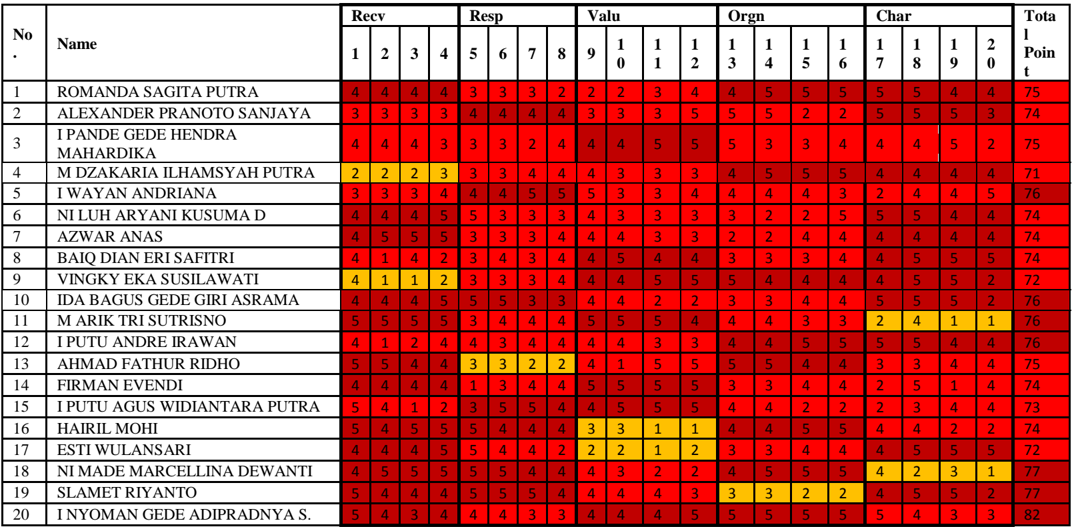
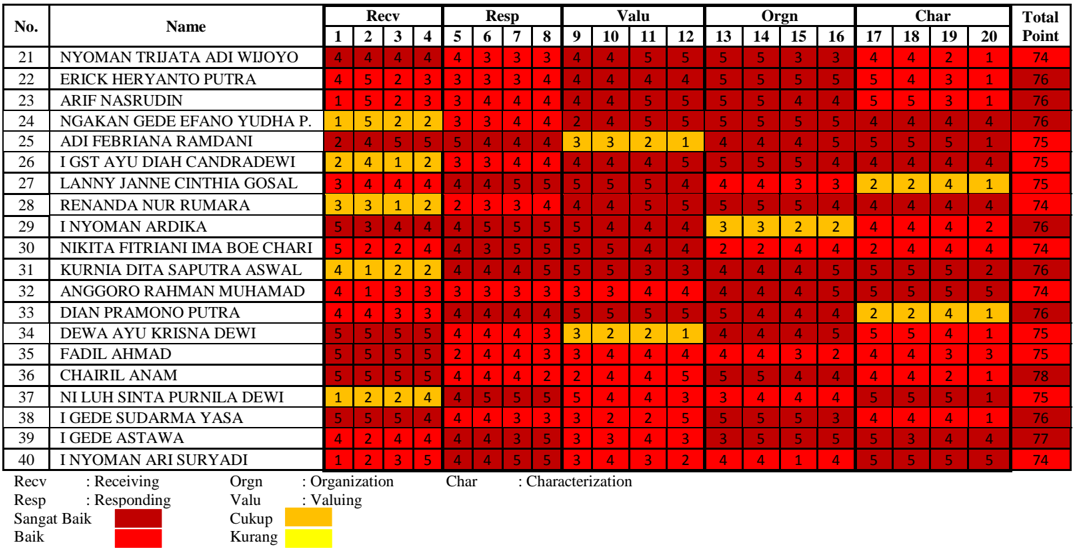
Verification
Claims the paper makes
The claims and statistics of this paper haven’t been checked yet.
Run the check — free, no account needed. It reads the open-access text and checks the sources it cites.
Claims other papers make about this one
Each is checked against this paper’s own text: does it say what the citing paper says it does?
In the citing paper
“This is important as e-learning is considered as completely successful when a positive workplace attitude is also achieved (e.g., Santiari [55]).”
From A Comparative Study of the ADDIE Instructional Design Model in Distance Education (2022) · cites this paper as Santiari [55]
In the citing paper
“Moreover, learners' characteristics, such as abilities or skills, motivation, and personality play an important role in e-learning and they are directly related to the transfer of knowledge in the work environment (e.g., Santiari [55]).”
From A Comparative Study of the ADDIE Instructional Design Model in Distance Education (2022) · cites this paper as Santiari [55]
Self-check
Percentages, sums and reported differences re-computed from the paper’s own numbers.
The self-check needs the paper’s full text.
Citations
Cites
No references could be resolved yet.
Research works printed but not linked: 16
- R. W. Picard, S. Papert, W. Bender, B. Blumberg, C. Breazeal, D. Cavallo, T. Machover, M. Resnick, D. Roy, and C. Strohecker, -Affective Learning -A Manifesto,‖ BT Technol. J., vol. 22, no. 4, pp. 253-269, 2004.
- K. N. Allen and D. Ph, -Affective Learning: A Taxonomy for Teaching Social Work Values,‖ J. Soc. Work Values Ethics, vol. 7, no. 2, 2010.
- B. M. Ngussa, -Application of ADDIE Model of Instruction in Teaching-Learning Transaction among Teachers of Mara Conference Adventist Secondary Schools , Tanzania,‖ J. Educ. Pract., vol. 5, no. 25, pp. 1-11, 2014.
- B. S. Wang and H. Hsu, -Using the ADDIE Model to Design Second Life Activities for Online Learners,‖ vol. 53, no. 6, 2009.
- H. Cetin and E. Ertekin, -The Relationship Between Eighth Grade Primary School Student's Proportional Reasoning Skills,‖ Int. J. Instr., vol. 4, no. 1, 2011.
- H. Yueh, W. Lin, and W. L. Corporation, -Effect of Student Engagement on Multimedia -Assisted Instruction,‖ Int. J. Knowl. Manag. Elearning, vol. 4, no. 3, pp. 346-358.
- R. N. Melo and L. B. Baruque, -Learning Theory and Instructional Design Using Learning Object,‖ Int. J. Scholarsh. Teach. Learn., vol. 5, no. 1, 2011.
- K. T. Dewi, I. W. Suastra, N. M. Pujani, P. Pascasarjana, and U. P. Ganesha, -Pengaruh Model Pembelajaran Analyse ,Design ,Develop , Implement , Evaluate (ADDIE) Terhadap Keterampilan,‖ E-Journal Progr. Pascasarj. Univ. Pendidik. Ganesha, vol. 3, no. 1, 2013.
- R. Schroeder, -Valuing Information Literacy: Affective Learning and the ACRL Standards,‖ vol. 10, no. 2, pp. 127-146, 2010.
- P. Schaber, A. L. Whiteside, and D. C. Brooks, -Designing Learning Environments to Foster Affective Learning : Comparison of Classroom to Blended Learning Designing Learning Environments to Foster Affective Learning :,‖ Int. J. Scholarsh. Teach. Learn., vol. 4, no. 2, 2010.
- Ö. Korkmaz, -A validity and reliability study of the Attitude Scale of Computer Programming Learning (ASCOPL) Halis Altun,‖ Int. J. Educ., vol. 4, no. 1, pp. 30-43, 2014.
- A. Test, -Validity and Reliability Study of the Internet Addiction Test,‖ Int. J. Educ., vol. 3, no. 4, pp. 207-222, 2013.
- S. Fan, -Developing a Valid and Reliable Instrument to Evaluate Users ' Perception of Web-Based Learning in an Australian University Context,‖ J. Online Learn. Teach., vol. 7, no. 3, pp. 366-379, 2011.
- I. Kalender, -Reliability-Related Issues in the Context of Student Evaluations of Teaching in Higher Education,‖ Int. J. High. Educ., vol. 4, no. 3, 2015.
- M. J. Warrens, -On Cronbach ' s Alpha as the Mean of All Possible - Split Alphas,‖ Adv. Stat., vol. 2014, pp. 5-10, 2014.
- M. Tavakol and R. Dennick, -Making sense of Cronbach ' s alpha,‖ Int. J. Med. Educ., pp. 53-55, 2011.
Cited by
Sorted by citations
A Comparative Study of the ADDIE Instructional Design Model in Distance Education
Spatioti, A. G., Kazanidis, I., & Pange, J. (2022) · Information · doi:10.3390/info13090402 · Cited by 689
Metadata
- Authors
- Putu, N.
- Corresponding author
- Putu, Ni
- Venue
- International Journal of Advanced Computer Science and Applications
- Published
- 2015
- Volume
- 6
- Issue
- 11
- ISSN
- 2156-5570 (ISSN-L)
- 2158-107X
- OpenAlex
- W2279200121
- Cited by
- 10
- References
- 0
- Citations by year
- 2025: 1 · 2024: 4 · 2023: 2 · 2022: 2 · 2021: 1
- FWCI
- 0.00
- Type
- journal article
- Language
- en
- Open access
- hybrid
- doi.org
- Licence
- cc-by
- Locations
- International Journal of Advanced Computer Science and Applications (publishedVersion, cc-by)
- Topics
- Physical Sciences › Computer Science › Information Systems › Educational Technology and E-Learning
- Social Sciences › Education › Innovative Education Methods and Tools
- Social Sciences › Education › Educational Methods and Outcomes
- Keywords
- student attitudes, online learning, instructional design, ADDIE model, affective learning, questionnaire reliability and validity
About these checks
Registry, retraction, Cites and statistics results are computed, not judged, with one exception: a printed reference that no index lists is read once by a model before it counts as a citation error. Claims are extracted by a model and kept only when their quote appears verbatim in the text; each cited source is then checked, with a model’s help, for whether it says what the claim relies on. Those verdicts can be wrong — read the claim’s quote and the cited source before relying on one.
Statistics and arithmetic are recomputed, not judged.
Confidence bands are shown only for fields calibrated on our annotated test set. None is calibrated yet, so no band is shown.
What counts as a claim ›How we measure confidence ›How we check this ›
Are you an author, or do you see a problem with this page? Request a review
