

The DOI matches its Crossref record; 35 of the 35 references it cites were found in a registry or an index.
CQRS and Blockchain with Zero-Knowledge Proofs for Secure Multi-Agent Decision-Making
Open accessAbstract
Autonomous decision-making in decentralized multi-agent systems (MAS) poses significant challenges related to security, scalability, and privacy. This paper introduces an innovative architecture that integrates Decentralized Identifiers (DIDs), Zero-Knowledge Proofs (ZKPs), Hyperledger Fabric blockchain, OAuth 2.0 authorization, and the Command Query Responsibility Segregation (CQRS) pattern to establish a secure, scalable, and privacy-focused framework for MAS. The use of DIDs and ZKPs ensures secure, self-sovereign identities and enables privacy-preserving interactions among autonomous agents. Hyperledger Fabric provides an immutable ledger, ensuring data integrity and facilitating transparent transaction processing through smart contracts. The CQRS pattern, combined with event sourcing, optimizes the system’s ability to handle high volumes of read and write operations, enhancing performance and scalability. Practical applications are showcased in Smart Grids, Healthcare Data Management, Secure Internet of Things (IoT) Networks, and Supply Chain Management, highlighting the architecture’s ability to address industry-specific challenges. This integration offers a robust solution for ensuring trust, verifiability, and scalability in distributed systems while preserving the confidentiality of agents.
Overview
The claims and statistics of this paper haven’t been checked yet.
Free: it reads the open-access text and checks the first 5 claims that cite a source we can check. Create a free account to check every claim.
Integrity signals
Registry
Cites
Statistics
Figures


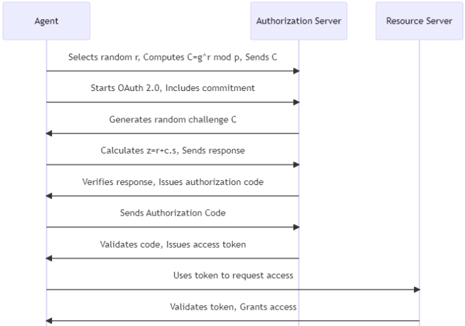
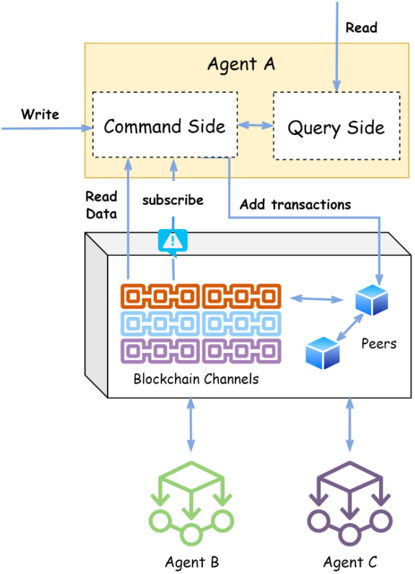
Verification
Claims the paper makes
The claims and statistics of this paper haven’t been checked yet.
Free: it reads the open-access text and checks the first 5 claims that cite a source we can check. Create a free account to check every claim.
Claims other papers make about this one
Each is checked against this paper’s own text: does it say what the citing paper says it does?
The source backs part of the claim, not all of it — or backs it for a different population, condition or comparison.
In the citing paper
“By using techniques like federated learning and zero-knowledge proofs, agents can work together without sharing raw patient data (48).”
From Ethical issues in multi-agent AI systems for healthcare: a narrative review (2026) · cites this paper as [48]
Experimental — accuracy not yet measured
Self-check
Percentages, sums and reported differences re-computed from the paper’s own numbers.
The self-check needs the paper’s full text.
Citations
Cites
The publisher hasn’t deposited this paper’s reference list.
Research works printed but not linked: 8
- [7]7. Xiong, S., Chen, P., Ge, S., & Ni, Q. SFOM-DT: A Secure and Fair One- to-Many Data Trading Scheme Based on Blockchain. IEEE Xplore, 2024. IEEE Xplore.
- [11]11. Lad, K., Dewan, M., & Lin, F. (2020). Trust Management for Multi-Agent Systems Using Smart Contracts. 2020 IEEE Intl Conf on Dependable, Autonomic and Secure Computing, 414-419. https://doi.org/10.1109/DASC-PICom-CBDCom- CyberSciTech49142.2020.00080. · doi:10.1109/dasc-picom-cbdcom-
- [28]28. Fanitabasi, F. (2018). A Review of Adversarial Behaviour in Distributed Multi-Agent Optimisation. 2018 IEEE/ACM International Conference on Utility and Cloud Computing Companion (UCC Companion), 53-58. https://doi.org/10.1109/UCC-Co mpanion.2018.00034. · doi:10.1109/ucc-co
- [33]33. Sahingoz, O., & Sonmez, A. (2006). Fault Tolerance Mechanism of Agent-Based Distributed Event System. , 192-199. https://doi.org/10.1007/11758532_ 27. · doi:10.1007/11758532_
- [34]34. Cristea, V., Pop, F., Dobre, C., & Costan, A. (2011). Distributed Architectures for Event-Based Systems. , 11-45. https://doi.org/10.1007/978-3-642-19724-6_ 2. · doi:10.1007/978-3-642-19724-6_
- [35]35. Long, Z. (2017). Improvement and Implementation of a High Performance CQRS Architecture. 2017 International Conference on Robots & Intelligent System (ICRIS), 170-173. https://doi.org/10.1109/ICRIS.2017.49. · DOI
- [36]36. Navabi, S., & Nayyar, A. (2020). A Dynamic Mechanism for Security Management in Multi-Agent Networked Systems. IEEE INFOCOM 2020 -IEEE Conference on Computer Communications, 1628-1637. https://doi.org/10.1109/INFOCOM 41043.2020.9155295. · doi:10.1109/infocom
- [39]39. Yang, Y., Jin, K., Liang, W., Liu, Y., Li, Y., & Hosam, O. (2023). A Review of Blockchain-based Privacy Computing Research. 2023 IEEE 10th International Conference on Cyber Security and Cloud Computing (CSCloud)/2023 IEEE 9th International Conference on Edge Computing and Scalable Cloud (EdgeCom), 241-246. https://doi.org/10.1109/CSCloud-EdgeCo m58631.2023.00049. · doi:10.1109/cscloud-edgeco
Cited by
Ethical issues in multi-agent AI systems for healthcare: a narrative review
Xie, Z., Wang, H., Dai, L., Wang, Z., Song, H., & Qian, J. (2026) · Frontiers in Public Health · doi:10.3389/fpubh.2026.1792627 · Cited by 11
“Inter-agent communication requires frequent sharing of sensitive patient data across distributed components, increasing attack surfaces and audit complexity (24, 45, 46, 48).”
InfluentialReal-Time Payment Processing Architectures: Event-Driven Systems and Latency Optimization at Scale
Zhao, X., Yang, Y., Yang, J., & Chen, J. (2025) · Journal of Banking and Financial Dynamics · doi:10.55220/2576-6821.v9.797 · Cited by 16
Metadata
- Authors
- CHERIF, A. N., YOUSSFI, M., EN-NAIMANI, Z., TADLAOUI, A., SOULAMI, M., & BOUATTANE, O.
- Affiliations
- University of Hassan II Casablanca (MA)
- Venue
- International Journal of Advanced Computer Science and Applications
- Published
- 2024
- Volume
- 15
- Issue
- 11
- ISSN
- 2156-5570 (ISSN-L)
- 2158-107X
- OpenAlex
- W4405087846
- Cited by
- 1
- References
- 0
- Citations by year
- 2026: 1
- FWCI
- 0.38
- Type
- journal article
- Language
- en
- Open access
- diamond
- doi.org
- Licence
- cc-by
- Locations
- International Journal of Advanced Computer Science and Applications (publishedVersion, cc-by)
- International Journal of Advanced Computer Science and Applications (submittedVersion, cc-by)
- Topics
- Physical Sciences › Computer Science › Information Systems › Blockchain Technology Applications and Security
- Physical Sciences › Computer Science › Information Systems › Blockchain Technology in Education and Learning
- Physical Sciences › Computer Science › Computer Networks and Communications › Access Control and Trust
- Keywords
- blockchain, zero-knowledge proofs, multi-agent systems, decentralized identifiers, self-sovereign identity, Hyperledger Fabric, smart contracts, event sourcing, smart grid, health data management, supply chain management
About these checks
Registry, retraction, Cites and statistics results are computed, not judged, with one exception: a printed reference that no index lists is read once by a model before it counts as a citation error. Claims are extracted by a model and kept only when their quote appears verbatim in the text; each cited source is then checked, with a model’s help, for whether it says what the claim relies on. Those verdicts can be wrong — read the claim’s quote and the cited source before relying on one.
Statistics and arithmetic are recomputed, not judged.
Confidence bands are shown only for fields calibrated on our annotated test set. None is calibrated yet, so no band is shown.
What counts as a claim ›How we measure confidence ›How we check this ›
Are you an author, or do you see a problem with this page? Request a review
How to cite
Cite CoChat for the checks on this page, and the paper for its own findings.
- This page
- CoChat. (2026). Citation check: CQRS and Blockchain with Zero-Knowledge Proofs for Secure Multi-Agent Decision-Making. https://app.cochat.ai/papers/10.14569/ijacsa.2024.0151188
- The paper
- CHERIF, A. N., YOUSSFI, M., EN-NAIMANI, Z., TADLAOUI, A., SOULAMI, M., & BOUATTANE, O. (2024). CQRS and Blockchain with Zero-Knowledge Proofs for Secure Multi-Agent Decision-Making. International Journal of Advanced Computer Science and Applications. https://doi.org/10.14569/ijacsa.2024.0151188
Data sources
Bibliographic data: Semantic Scholar, OpenAlex, Crossref.
Contains information from the Semantic Scholar Academic Graph Datasets, made available under the ODC Attribution License (ODC-BY 1.0).
Semantic Scholar’s data is described in: Kinney, R., et al. (2023). The Semantic Scholar Open Data Platform. arXiv:2301.10140.
