

5. Stone Hymn – The Buddhist Colophon of 579 Engraved on Mount Tie, Shandong
Open accessThe DOI matches its Crossref record; 1 of the 2 references it cites were found in a registry or an index; none of the 2 sources its claims cite is checked for support yet.
Abstract
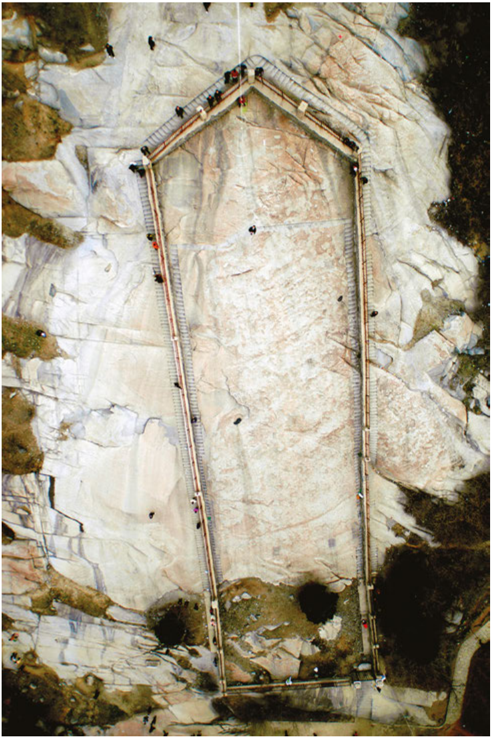
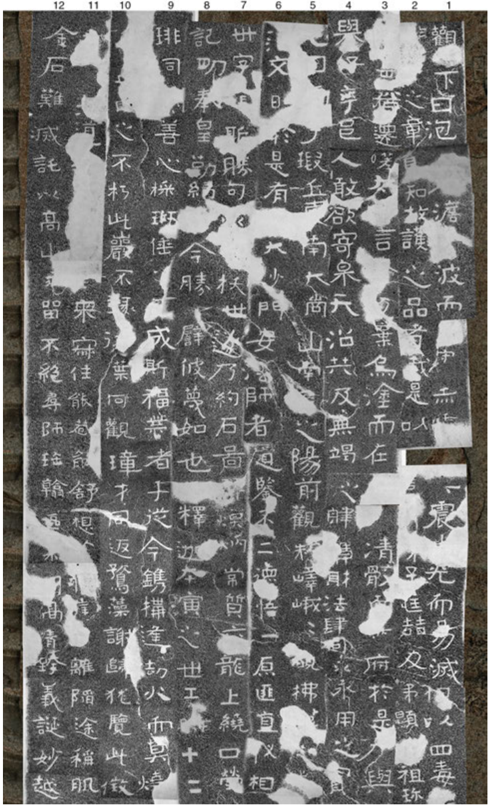
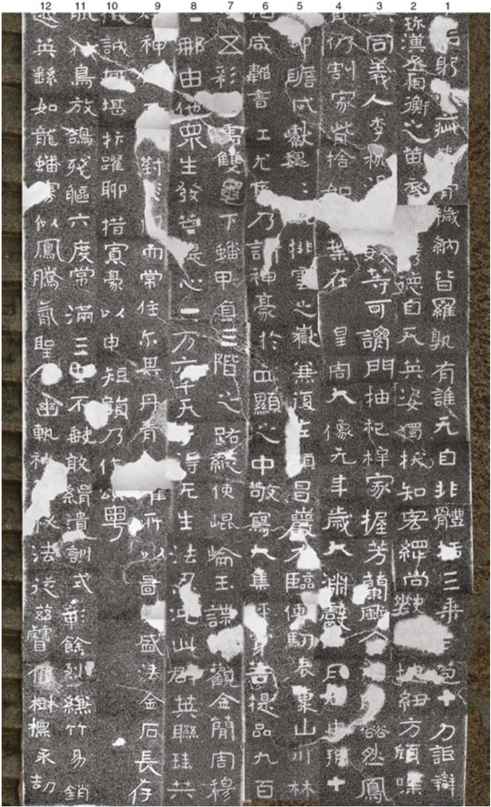
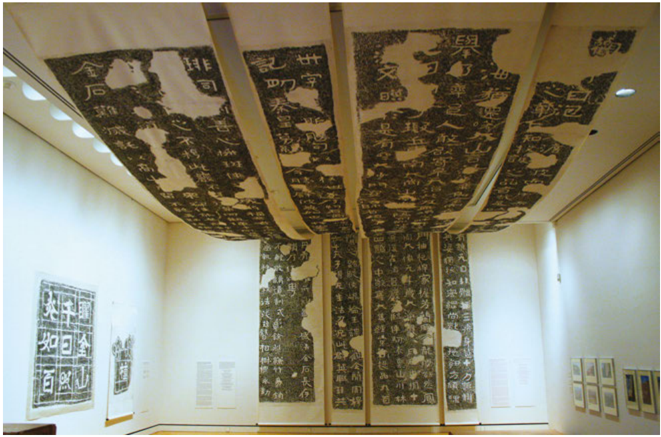
Ledderose 5 Stone Hymn -The Buddhist Colophon of 579 Engraved on Mount Tie, ShandongTwo characters, reading Shisong 石頌, Stone Hymn, are engraved on a rocky cliff at Mount Tie, in the northern outskirts of the city of Zoucheng 鄒城 in Shandong Province. 1 These two characters, written in a stately archaistic seal script, form the title above the text of the Stone Hymn.Its field of script on the slanting granite 2 surface under the open sky is 17 meters long and 4 meters wide (Figure 5.1).The characters are arranged in twelve columns with 52 characters each.There are, however, some exceptions in this grid: columns five and eight have 53, and column two has 54 characters, while column ten has only 43 characters, because the hymn proper begins with a new column.3 As the rock has been exposed to the elements for more than fourteen hundred years, many characters are now effaced and hard to make out.Figures 5.2-3 show a rubbing taken in 2008.4 It is so large, that it had to be hung beneath the ceiling, when it was exhibited in the Museum für Ostasiatische Kunst in Cologne in 2009 (Figure 5.4).In spite of its enormous size, the text of the Stone Hymn is dwarfed by the sutra engraved to its right (east).This, a passage from the Great Collection Sutra (Dajijing 大集經), has an overall height of more than 51 meters.The Stone Hymn is one of its three colophons.
Overview
CoChat Summary
TL;DR
This chapter analyzes the Stone Hymn (Shisong 石頌), a 579 Buddhist colophon engraved on Mount Tie, Shandong, accompanying a passage from the Great Collection Sutra. It argues that the text and its praise of Dharma Master An’s calligraphy show Buddhism’s successful integration into Chinese cultural and epigraphic traditions.
Key findings
- The Stone Hymn’s field of script is 17 meters long and 4 meters wide, arranged in twelve columns of 52 characters each, with exceptions: columns five and eight have 53, column two has 54, and column ten has 43 characters.
- The dedication date is given as “the seventeenth day, a bingzi day, of the eighth month, which began on a gengshen day, Jupiter in Pisces, first year of the daxiang era of the August Zhou dynasty,” corresponding to September 23, 579.
- The donors include Kuang Zhe and his four younger brothers, descendants of Han Chief Minister Kuang Heng, along with a lay society; the officiant and calligrapher is the Great Renunciant, Dharma Master An, generally identified today as Seng’an Daoyi.
- The hymn proper claims Dharma Master An’s calligraphy surpasses even Wang Xizhi and others, which the author reads as evidence that a Buddhist monk—possibly of foreign background—was recognized in a quintessentially Chinese art, proving Buddhism’s transcultural rooting by the late sixth century.
Methods
- The study is an epigraphic and textual analysis of the Stone Hymn, its adjacent Great Collection Sutra engraving, and earlier transcriptions by Huang Yi, Ruan Yuan, and later Chinese epigraphers.
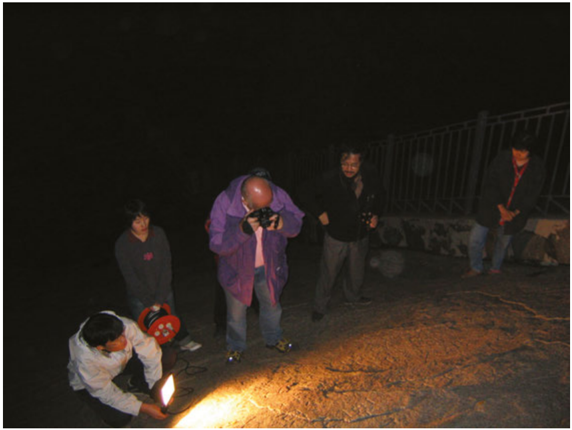
- The authors conducted field investigations on Mount Tie, including night photography with strong slanting strobe lighting, and built on the Heidelberger Akademie der Wissenschaften project with the Shandong Stone Carving Art Museum.
- The chapter presents a new reading and translation of the text, with Professor Luo Zhao contributing knowledge of Buddhist texts; detailed footnotes for character readings are deferred to Buddhist Stone Sutras in China, Shandong Province, vol. 2.
Limitations
- The paper states that many characters are effaced and hard to make out after more than fourteen hundred years, and that the number of characters in columns remains disputed among scholars.
- It notes that suggestions about the anonymous author and anonymous calligrapher of the Stone Hymn have not reached a convincing conclusion.
- Evident from the text: this chapter synthesizes and translates the inscription but does not repeat the fuller routes of analysis in the main publication, and some readings rely on informed suggestions for worn or unreadable characters.
Model-written summary. Check it against the paper before relying on it.
Integrity signals
Registry
Cites
Statistics
Figures
Verification
Claims the paper makes
0 Valid · 1 Not valid · 2 Not checked · 31 Own results and interpretations
A result the paper reports from its own data — it cites no other source for it, so there is none to check. The quote shows it is in the paper.
In the paper
“Two characters, reading Shisong 石頌, Stone Hymn, are engraved on a rocky cliff at Mount Tie, in the northern outskirts of the city of Zoucheng 鄒城 in Shandong Province.”
plain- Asserted: passes — The authors put it forward as true.
- Checkable: passes — It can be checked against evidence.
- Load-bearing: passes — The paper’s conclusions depend on it.
- Based: passes — The paper gives a reason why it holds.
A conclusion the paper draws from its own results — it cites no other source for it, so there is none to check. The quote shows it is in the paper.
In the paper
“In the second half of the 6 th century, Buddhists in northern China now rejoiced in celebrating a new unification of their land, this time under the Buddha.”
plain- Asserted: passes — The authors put it forward as true.
- Checkable: passes — It can be checked against evidence.
- Load-bearing: passes — The paper’s conclusions depend on it.
- Based: passes — The paper gives a reason why it holds.
- Rests on an assumption not shown here.
A conclusion the paper draws from its own results — it cites no other source for it, so there is none to check. The quote shows it is in the paper.
In the paper
“By invoking Mount Yi and Mount Tai, the author of the Stone Hymn affirms that these two venerable peaksincluding their ancient imperial aurahad now been fully integrated into the Buddhist realm.”
plainstates a cause- Asserted: passes — The authors put it forward as true.
- Checkable: passes — It can be checked against evidence.
- Load-bearing: passes — The paper’s conclusions depend on it.
- Based: passes — The paper gives a reason why it holds.
- Rests on an assumption not shown here.
- Probably not a substantial claim. 28
- It may state two separate claims as one. 19
- The quote only partly states this claim. 7
Self-check
Percentages, sums and reported differences re-computed from the paper’s own numbers.
Each contradiction between two passages listed here was confirmed by an independent check.
Rated minor: it would not touch a result — a value no result rests on, a p-value that stays on the same side of the significance level, or a conflict that is clerical, resolved elsewhere in the paper, or outside its own findings.
In the paper
§ Abstract
“Figures 5.2-3 show a rubbing taken in 2008.”
§ Abstract
“Figures 5.2-3: Stone Hymn.Upper part.Rubbing in four stripes of paper.Made in 2009 by the Shandong Stone Carving Art Museum in Jinan.”
Citations
Cites
The landscape of words: stone inscriptions from early and medieval China
(2009) · Choice Reviews Online · doi:10.5860/choice.46-5774 · Cited by 37
Research works printed but not linked: 7
- Aikawa Masayuki 相川政行. 2004. "Shujōshi Tetsusan「Daishūkyō」daikaku to 「Sekishō」 no kenkyū 鄒城市鐵山「大集経」題刻と「石頌」の研究 [Research on the main engraving of the Great Collection Sutra and the Stone Hymn on Mount Tie at Zoucheng]." Heisei 16 nen Risshō daigaku bungakubu kenkyū kiyō 平成 16 年立正大学文学部研究紀要 (The Academic Journal of the Faculty of Letters, Rissho University) 20:1-17.
- Bi Yuan 畢沅, and Ruan Yuan 阮元, eds. 1977-2006. Shanzuo jinshi zhi 山左金石志 [Epigraphic Records of Shandong]. In Shike shiliao xinbian 石刻史料新編, series 1, vol. 19:14325-14802.
- Ledderose, Lothar, series editor, 2014 ff. Buddhist Stone Sutras in China, Zhongguo fojiao shijing 中國佛教石經. Wiesbaden: Harrassowitz; Hangzhou: China Academy of Art Press.
- Li Zuoxian 李佐賢, and Chen Zhu 陳洙, postface 1911. Shiquan shuwu jinshi tiba 石泉書屋金石 題跋 [Colophons to Epigraphica from the Stone Well Studio]. In Shike shiliao xinbian, series 2, vol. 19:14189-14196.
- Museum für Ostasiatische Kunst Köln and Heidelberger Akademie der Wissenschaften, eds. 2009. The Centenary of the Museum of East Asian Art Cologne. The Heart of Enlightenment: Buddhist Art in China 550-600. Köln: Museum für Ostasiatische Kunst Köln. Shike shiliao xinbian 石刻史料新編 [New Edition of Historical Materials Carved on Stone]. 1977-2006. Edited by Xinwenfeng chubangongsi bianjibu 新文豐出版公司編輯部, 4 series, 100 vols. Taibei: Xinwenfeng chubanshe 新文豐出版社.
- Sun Baotian 孫葆田. 1977-2006. Shandong jinshi zhi 山東金石志 [Epigraphic Records of Shandong]. In Shike shiliao xinbian石刻史料新編, series 2, vol. 12:9147-9392.
- Wu Shifen 吳式芬. Undated; ed. 1937. Jinshi huimu fenbian 金石彙目分編 [Categorized Edition of an Assembled Catalog of Epigraphica]. In Shike shiliao xinbian, series 1, vol. 27-28: 20651-21591.
Cited by
(2019) · De Gruyter eBooks · doi:10.1515/9783110413083-toc
Metadata
- Authors
- Ledderose, L.
- Affiliations
- Heidelberg Academy of Sciences and Humanities (DE)
- Corresponding author
- Ledderose, Lothar
- Venue
- Buddhism and the Dynamics of Transculturality
- Publisher
- De Gruyter
- Published
- 2019-10-08
- Pages
- 101-118
- OpenAlex
- W4238380563
- Semantic Scholar
- ec9b4de4042d28913305f392ee5f936ffabbead6
- Cited by
- 1
- References
- 2
- Citations by year
- 2019: 1
- FWCI
- 4.79
- Type
- book chapter
- Language
- en
- Open access
- hybrid
- doi.org
- Licence
- Locations
- De Gruyter eBooks (publishedVersion, cc-by-nc-nd)
- Topics
- Social Sciences › Arts and Humanities › Religious studies › Indian and Buddhist Studies
- Social Sciences › Arts and Humanities › History › Chinese history and philosophy
- Social Sciences › Arts and Humanities › Language and Linguistics › Classical Studies and Philology
- Keywords
- seal script, rock-cut inscriptions, Zoucheng
About these checks
Registry, retraction, Cites and statistics results are computed, not judged, with one exception: a printed reference that no index lists is read once by a model before it counts as a citation error. Claims are extracted by a model and kept only when their quote appears verbatim in the text; each cited source is then checked, with a model’s help, for whether it says what the claim relies on. Those verdicts can be wrong — read the claim’s quote and the cited source before relying on one.
A language model drew the claims from the paper on 2026-10-04, under version 3 of the claim definition (model deepseek-v4.1-flash, prompt extract-v3).
A second model labelled each claim on 2026-10-04 (model jev-1.13-20260917, definition revision gold-guideline-v0.2).
Statistics and arithmetic are recomputed, not judged.
Confidence bands are shown only for fields calibrated on our annotated test set. None is calibrated yet, so no band is shown.
What counts as a claim ›How we measure confidence ›How we check this ›
Are you an author, or do you see a problem with this page? Request a review
Data sources
Bibliographic data: Semantic Scholar, OpenAlex, Crossref.
Contains information from the Semantic Scholar Academic Graph Datasets, made available under the ODC Attribution License (ODC-BY 1.0).
Semantic Scholar’s data is described in: Kinney, R., et al. (2023). The Semantic Scholar Open Data Platform. arXiv:2301.10140.
