

7. In the Footprints of the Buddha: Ceylon and the Quest for the Origin of Buddhism in Early Modern Japan – A Minor Episode in the History of the Japanese Imagination of India
Open accessThe DOI matches its Crossref record; 10 of the 11 references it cites were found in a registry or an index; none of the 4 sources its claims cite is checked for support yet.
Abstract
7. In the Footprints of the Buddha: Ceylon and the Quest for the Origin of Buddhism in Early Modern Japan – A Minor Episode in the History of the Japanese Imagination of India was published in Buddhism and the Dynamics of Transculturality on page 151.
Overview
CoChat Summary
TL;DR
This chapter traces how early modern Japanese scholars came to associate Ceylon (Śrī Laṅkā) with the origins of Buddhism, a misunderstanding produced by the collision of received Buddhist geography with new, largely erroneous European information. It argues that this "geographical short-circuit" shaped Japanese imaginings of India and Buddhism well into the Meiji period.
Key findings
- Arai Hakuseki's *Sairan igen* (1713), drawing on Faxian and conversations with the Jesuit Giovanni Battista Sidotti, reported Buddha's footprints, a reclining Buddha statue, and a tooth relic in Ceylon, adding that "this [Ceylon] is the place of Buddha's nirvana."
- Nishikawa Joken's *Zōho Ka-i tsūshōkō* (1708) mentioned Ceylon three times (as Keiran, Sairon/Seira, Seiron) but made no connection to Buddhism's origin.
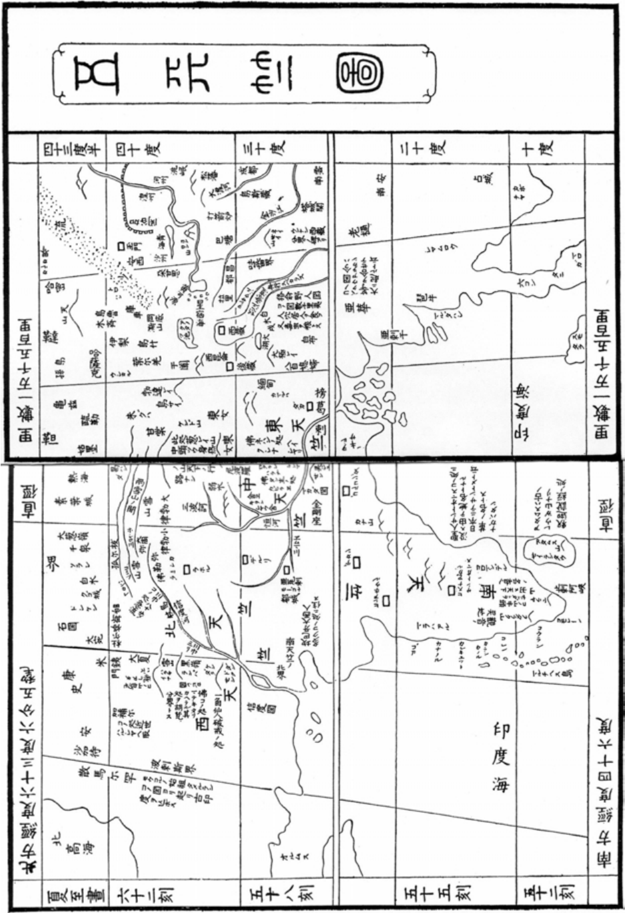
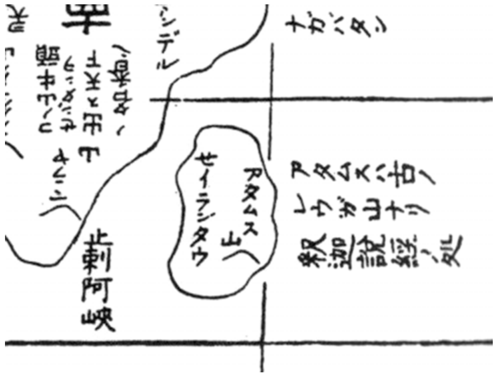
- Hirata Atsutane's *Indo zōshi* (1820–1826) equated Adam's Peak with Mount Laṅkā (Ryōgasen), the site where Śākyamuni preached the *Laṅkāvatārasūtra*; Shiba Kōkan (1808) instead identified Adam's Peak with the Vulture Peak (Ryōjusen).
- Fukuzawa Yukichi's *Sekai kunizukushi* (1869) called Ceylon "the birthplace of Śākyamuni," yet the same book located Allahabad as a sacred place of Śākyamuni and elsewhere placed Kapilavastu and Kusinagara in north-eastern India.
- The paper notes that Europeans generally recognized India as Buddhism's origin only by the late 1840s, and that Buddhist sacred sites were rediscovered by Markham Kittoe and Alexander Cunningham in the 1840s.
Methods
- Historical/textual analysis of early modern Japanese and European sources on India, Ceylon, and Buddhism, including Arai Hakuseki, Nishikawa Joken, Hirata Atsutane, Shiba Kōkan, Asahina Kōsei, and Fukuzawa Yukichi.
- Comparison of these Japanese texts with European accounts (Marco Polo, Robert Knox, Simon de la Loubère, Diogo do Couto, Constantino de Sá de Miranda, Ozeray) and with Buddhist sources (Faxian, Xuanzang, *Mahāvaṃsa*, *Laṅkāvatārasūtra*).
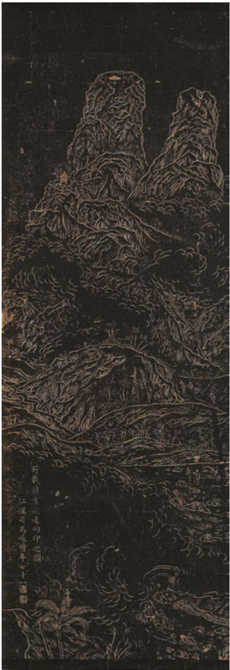
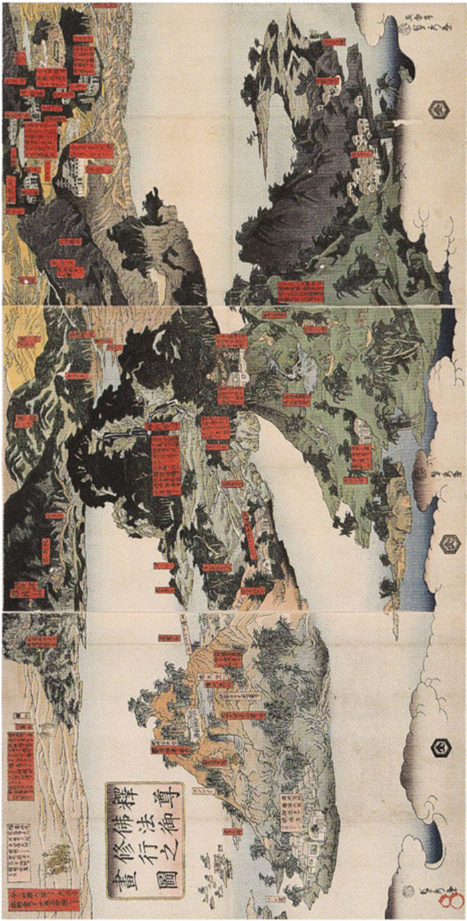
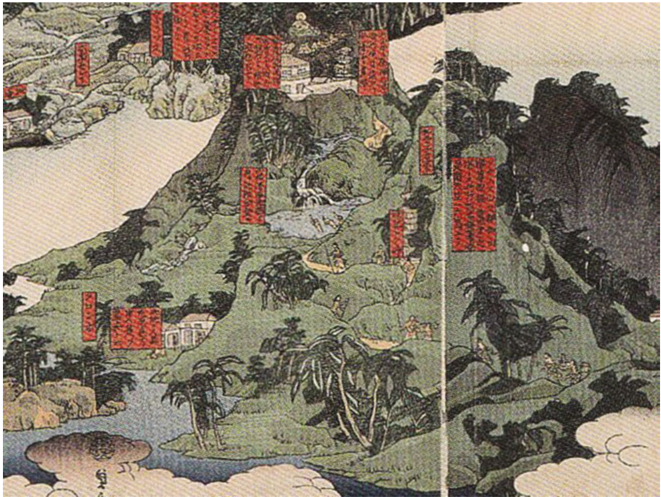
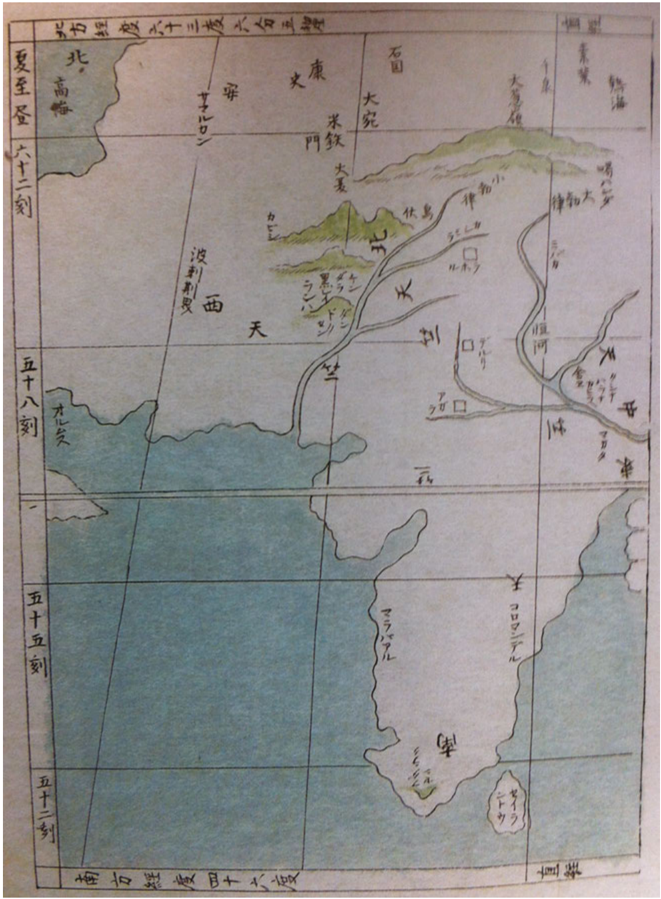
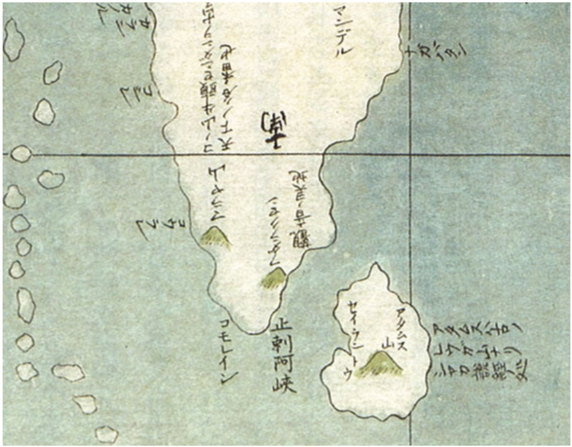
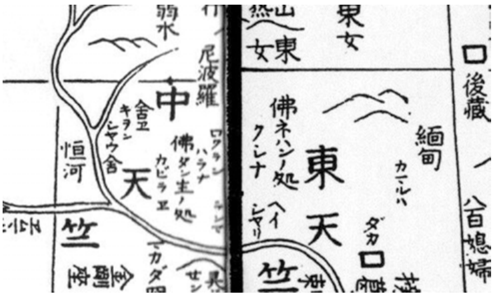
- Analysis of accompanying maps and paintings (e.g., Hirata Atsutane's map of India, Gountei Sadahide's 1860 painting, Asahina Kōsei's 1814 maps) as evidence of geographical understanding.
Limitations
- The paper does not present a formal limitations section; it is a historical essay rather than an empirical study.
- The author acknowledges uncertainty about sources in places, e.g., "It is not clear where Fukuzawa acquired this information," and speculates about a possible feedback loop of misinformation from Japan to Europe ("One cannot but wonder about the possibility...").
- The text is a chapter in an edited volume and is largely descriptive, with no systematic sampling or quantitative claims.
Model-written summary. Check it against the paper before relying on it.
Integrity signals
Registry
Cites
Statistics
Figures
Verification
Claims the paper makes
0 Valid · 25 Not valid · 6 Not checked · 50 Own results and interpretations
A result the paper states — it cites no source for it, so there is none to check. The quote shows it is in the paper.
In the paper
“It is interesting to note here that Hakuseki and other early modern authors did not quote from the account of Śrī Laṅkā made by the Chinese monk Xuanzang (ca.602-664) in his Da Tang xiyu ji (646)”
plain- Asserted: passes — The authors put it forward as true.
- Checkable: passes — It can be checked against evidence.
- Load-bearing: unclear — It is unclear whether the paper’s conclusions depend on it.
- Based: passes — The paper gives a reason why it holds.
None of the sources cited for this claim have been checked yet.
In the paper
“The misperception of Śrī Laṅkā as being directly connected with the life of the Buddha continues in Japan well into the Meiji period (1868-1912), the time of the early phases of Japan's modernization.”
plainSingle case- Asserted: passes — The authors put it forward as true.
- Checkable: passes — It can be checked against evidence.
- Load-bearing: passes — The paper’s conclusions depend on it.
- Based: passes — The paper gives a reason why it holds.
A result the paper states — it cites no source for it, so there is none to check. The quote shows it is in the paper.
In the paper
“At first, the Europeans did not envision Buddhism as a separate religious tradition, but they merged it within their broader category of Paganism/ Heathenism.”
plain- Asserted: passes — The authors put it forward as true.
- Checkable: passes — It can be checked against evidence.
- Load-bearing: passes — The paper’s conclusions depend on it.
- Based: passes — The paper gives a reason why it holds.
The paper states this without a source or data behind it here, so there is nothing to check it against. The quote shows it is in the paper.
In the paper
“As late as at the beginning of the nineteenth century Jiun Sonja Onkō (1718-1804) was writing that he would like to visit the sacred places on the Buddha in India”
plain- Asserted: passes — The authors put it forward as true.
- Checkable: passes — It can be checked against evidence.
- Load-bearing: passes — The paper’s conclusions depend on it.
- Based: unclear — It is unclear why the paper says it holds.
A result the paper states — it cites no source for it, so there is none to check. The quote shows it is in the paper.
In the paper
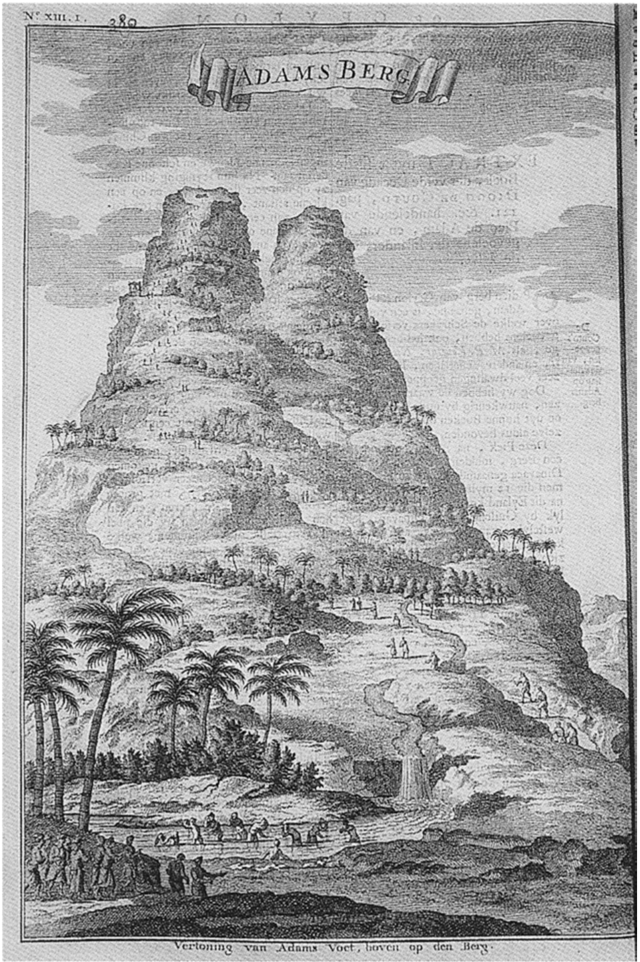
“Shiba Kōkan's painting was, in turn, based on Dutch precedents, such as the painting presented in Figure 7.4.”
plainstates a cause- Asserted: passes — The authors put it forward as true.
- Checkable: passes — It can be checked against evidence.
- Load-bearing: unclear — It is unclear whether the paper’s conclusions depend on it.
- Based: passes — The paper gives a reason why it holds.
29 more claims
Create a free account to see all 81 claims and every source verdict.
- Probably not a substantial claim. 28
- It may state two separate claims as one. 28
Citations
Cites
The British Discovery of Buddhism
Almond, P. C. (1988) · Cambridge University Press eBooks · doi:10.1017/cbo9780511598210 · Cited by 367
The great Tang dynasty record of the western regions
Zang, X., 辯機, & Li, J.-H. (1996) · Numata Center for Buddhist Translation and Research eBooks · Cited by 146
The Japanese Discovery of Europe, 1720-1830: Revised Edition
Keene, D. (1969) · Stanford University Press eBooks · doi:10.1515/9780804774161 · Cited by 116
The Lankavatara Sutra: A Mahayana Text
Hamilton, C. H., & Suzuki, D. T. (1933) · Journal of the American Oriental Society · doi:10.2307/593205 · Cited by 56
The Buddha and the Sahibs: the men who discovered India's lost religion
Allen, C. (2002) · Cited by 41
Fa-Hien, C. M. (2016) · Cited by 38
The Sri Lanka reader : history, culture, politics
Holt, J., Kirk, R., & Starn, O. (2011) · doi:10.1215/9780822394051 · Cited by 35
The Sri Lanka Reader: History, Culture, Politics
Ahsan, S. B. (2013) · Asian Affairs · doi:10.1080/03068374.2013.795305 · Cited by 13
Storia di Barlaam e Ioasaf. La vita bizantina del Buddha
Ronchey, S., & Cesaretti, P. (2012) · Iris (Roma Tre University) · Cited by 4
Rambelli, F. (2014) · ISEAS Publishing eBooks · doi:10.1355/9789814519335-013 · Cited by 4
Self-citation
Research works printed but not linked: 9
- Xuanzang, Da Tang xiyu ji, in T vol. 51, n. 2087, pp. 932b-934c; see The Great Tang Dynasty Record of the Western Regions, translated by Li Rongxi (1996, 323-333). Xuanzang does not mention any statue of a reclining Buddha. 9 See http://archive.wul.waseda.ac.jp/kosho/i13/i13_00581/i13_00581_0004/i13_00581_ 0004_p0009.jpg, last accessed 30 January 2018.
- Arai Hakuseki 新井白石. (1906) 1977. Sairan igen 采覧異言 (Collected Views on Foreign Discourses). In Arai Hakuseki zenshū 新井白石全集 (Complete Works of Arai Hakuseki). Vol. 4. Tokyo: Kokusho kankōkai 国書刊行会.
- Arai Hakuseki. 1975. Seiyō kibun 西洋記聞 (Records of Matters Heard about the Western Countries). In Nihon shisō taikei 日本思想大系. Vol. 35. Tokyo: Iwanami shoten 岩波 書店.
- Faxian. Foguoji, also known as Kaoseng Faxian zhuan. In T. vol. 51 no. 2085, pp. 857-866.
- Fukuzawa Yukichi 福沢諭吉. 1959. Sekai kunizukushi 世界国尽 (Compendium of All Countries of the World). In Fukuzawa Yukichi zenshū 福沢諭吉全集 (Complete Works of Fukuzawa Yukichi). Vol. 2. Tokyo: Iwanami shoten 岩波書店.
- Geiger, Wilhelm, trans. 1912. The Mahāvaṃsa or the Great Chronicle of Ceylon. London: The Pali Text Society.
- Kondō Osamu 近藤治, ed. 2006. Tōyōjin no Indokan 東洋人のインド観 (East Asian People's Images of India). Tokyo: Kyūko shoin 汲古書院. Laṅkāvatārasūtra. In T vol. 14, no. 671.
- Lee, Rev. Samuel, trans. 1829. The Travels of Ibn Batuta. Translated from the Abridged Arabic Manuscript Copies, preserved in the Public Library of Cambridge. London: Oriental Translation Committee.
- Xuanzang. Da Tang xiyu ji. In T vol. 51, no. 2087, pp. 932b-934c.
Metadata
- Authors
- Rambelli, F.
- Corresponding author
- Rambelli, Fabio
- ORCID
- Rambelli, Fabio
- Venue
- Buddhism and the Dynamics of Transculturality
- Publisher
- De Gruyter
- Published
- 2019-10-08
- Pages
- 151-168
- OpenAlex
- W3217675936
- Cited by
- 0
- References
- 11
- FWCI
- 0.00
- Type
- book chapter
- Language
- en
- Open access
- hybrid
- doi.org
- Licence
- Locations
- De Gruyter eBooks (publishedVersion, cc-by-nc-nd)
- Topics
- Social Sciences › Arts and Humanities › Religious studies › Indian and Buddhist Studies
- Social Sciences › Cultural Studies › Japanese History and Culture
- Social Sciences › Arts and Humanities › History › Travel Writing and Literature
- Keywords
- Japanese Buddhism, origins of Buddhism, Ceylon, Sri Lanka, early modern Japan, Buddhist pilgrimage, transculturality
About these checks
Registry, retraction, Cites and statistics results are computed, not judged, with one exception: a printed reference that no index lists is read once by a model before it counts as a citation error. Claims are extracted by a model and kept only when their quote appears verbatim in the text; each cited source is then checked, with a model’s help, for whether it says what the claim relies on. Those verdicts can be wrong — read the claim’s quote and the cited source before relying on one.
A language model drew the claims from the paper on 2026-10-04, under version 3 of the claim definition (model deepseek-v4.1-flash, prompt extract-v3).
A second model labelled each claim on 2026-10-04 (model jev-1.13-20260917, definition revision gold-guideline-v0.2).
Statistics and arithmetic are recomputed, not judged.
Confidence bands are shown only for fields calibrated on our annotated test set. None is calibrated yet, so no band is shown.
What counts as a claim ›How we measure confidence ›How we check this ›
Are you an author, or do you see a problem with this page? Request a review
How to cite
Cite CoChat for the checks on this page, and the paper for its own findings.
- This page
- CoChat. (2026). Citation check: 7. In the Footprints of the Buddha: Ceylon and the Quest for the Origin of Buddhism in Early Modern Japan – A Minor Episode in the History of the Japanese Imagination of India. https://app.cochat.ai/papers/10.1515/9783110413083-007
- The paper
- Rambelli, F. (2019). 7. In the Footprints of the Buddha: Ceylon and the Quest for the Origin of Buddhism in Early Modern Japan – A Minor Episode in the History of the Japanese Imagination of India. Buddhism and the Dynamics of Transculturality. https://doi.org/10.1515/9783110413083-007
Data sources
Bibliographic data: Semantic Scholar, OpenAlex, Crossref.
Contains information from the Semantic Scholar Academic Graph Datasets, made available under the ODC Attribution License (ODC-BY 1.0).
Semantic Scholar’s data is described in: Kinney, R., et al. (2023). The Semantic Scholar Open Data Platform. arXiv:2301.10140.
