

Self-Determination and Physical Exercise Adherence in the Contexts of Fitness Academies and Personal Training
Open accessThe DOI matches its Crossref record; 33 of the 34 references it cites were found in a registry or an index.
Abstract
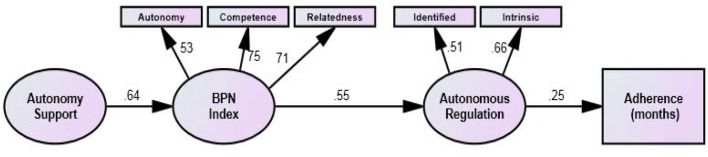
This research aimed to analyze the validity of the relations hypothesized by the theory of self-determination in predicting adherence to physical exercise in fitness academy users and subjects following personal training. A total of 588 persons from Pelotas / RS / Brazil (405 gym users and 183 subjects following personal training) completed the Portuguese version of the three questionnaires, i.e. the Perceived Autonomy Support Climate Exercise Questionnaire, Basic Psychological Needs in the Exercise Scale and Behavioral Regulation in the Exercise Questionnaire −2. The results support the factorial structure of the questionnaires used in this sample. There was a significant multivariate effect of context on self-determination for physical exercise training [Wilks’ λ = 0.934, F (10, 576.000) = 4.03, p < 0.001, η 2 = 0.01]. The hypothesized structural equation model, which considered the self-determination theory, showed a good fit to the data (S-B χ 2 = 234.703; p= .001; df = 52; χ 2 /df = 4.514; SRMS = .049; NNFI = .906; CFI = .926; RMSEA = .077; RMSEA 90% CI = .067 − .088). However, in the comparative analysis, the perception of autonomy support, relatedness and competence were significantly higher in the context of personal training, while the amotivation and external regulation were significantly higher in the context of fitness academies.
Overview
The claims and statistics of this paper haven’t been checked yet.
Free: it reads the open-access text and checks the first 5 claims that cite a source we can check. Create a free account to check every claim.
Integrity signals
Registry
Cites
Statistics
Figures
Verification
Claims the paper makes
The claims and statistics of this paper haven’t been checked yet.
Free: it reads the open-access text and checks the first 5 claims that cite a source we can check. Create a free account to check every claim.
Claims other papers make about this one
Each is checked against this paper’s own text: does it say what the citing paper says it does?
The check wasn’t confident either way, so it gives no verdict — never disputed.
In the citing paper
“which may be in part related to the preference of some exercisers to train alone”
From Can Interpersonal behavior influence the persistence and adherence to physical exercise practice in adults? A systematic review (2018) · cites this paper as Klain et al., 2015
Experimental — accuracy not yet measuredIn the citing paper
“Thus, individuals who acquire new skills or improve existing ones tend to have greater predisposition to maintain exercise frequency”
From Can Interpersonal behavior influence the persistence and adherence to physical exercise practice in adults? A systematic review (2018) · cites this paper as Klain et al., 2015
Self-check
Percentages, sums and reported differences re-computed from the paper’s own numbers.
The self-check needs the paper’s full text.
Citations
Cites
Hu, L., & Bentler, P. M. (1999) · Structural Equation Modeling A Multidisciplinary Journal · doi:10.1080/10705519909540118 · Cited by 108,788 · cited 2×
“For these indexes, cutoff values suggested by Hu and Bentler (1999) were adopted: SRMR ≤ .080, CFI and NNFI ≥ .950 and RMSEA ≤ .060.”
The "what" and "why" of goal pursuits: Human needs and the self-determination of behavior
Deci, E. L., & Ryan, R. M. (2000) · Psychological Inquiry · doi:10.1207/s15327965pli1104_01 · Cited by 34,210 · cited 1×
“These findings are in accordance with the assumptions of the SDT, suggesting that more self-determined people are more likely to compromise with certain behaviors than those with low self-determination (Deci and Ryan, 2000).”
Intrinsic Motivation and Self-Determination in Human Behavior
Deci, E. L., & Ryan, R. M. (1985) · doi:10.1007/978-1-4899-2271-7 · Cited by 26,772 · cited 4×
“According to the Self-Determination Theory (SDT; Deci and Ryan, 1985), the person's motivation is not directly related to the factors of social involvement, since the influence of these factors (e.g., environment during activities, behavior of the instructors) is mediated by the satisfaction of…”
InfluentialIntrinsic and Extrinsic Motivations: Classic Definitions and New Directions
Ryan, R. M., & Deci, E. L. (2000) · Contemporary Educational Psychology · doi:10.1006/ceps.1999.1020 · Cited by 18,666
Intrinsic Motivation and Self-Determination in Human Behavior
Miller, K. A., Deci, E. L., & Ryan, R. M. (1988) · Contemporary Sociology · doi:10.2307/2070638 · Cited by 15,312
(1998) · DigitalCommons - Kennesaw State University (Kennesaw State University) · Cited by 13,997
Multivariate Data Analysis, 6th ed
Tatham, R. L., Anderson, R. E., Babin, B. J., Black, W. C., & Hair, J. F. (2006) · Cited by 9,807
(2008) · Environmental Chemometrics · doi:10.1201/9781420067972-10 · Cited by 8,170
Self-determination theory: A macrotheory of human motivation, development, and health
Deci, E. L., & Ryan, R. M. (2008) · Canadian Psychology / Psychologie canadienne · doi:10.1037/a0012801 · Cited by 6,664 · cited 3×
“According to Deci and Ryan (2008), the Journal of Human Kinetics - volume 46/2015 http://www.johk.pl central differentiation of the SDT is between autonomous regulation (that incorporates the intrinsic, integrated and identified motivation) and controlled regulation (which incorporates introjected…”
Influential-Handbook of Self-Determination Research by Edward L. Deci and Richard M. Ryan (Editors)
Paulson, D. S. (2002) · The Journal of mind and behavior · Cited by 5,171
Research works printed but not linked: 3
- Nunnally JC Psychometric Theory New York McGraw-Hill Inc 1978
- Vlachopoulos S Psychometric Evaluation of the Basic Psychological Needs in Exercise Scale in Community Exercise Programs: A Cross-Validation Approach Hellenic Journal of Psychology 2007 4 52 74
- Vlachopoulos S Karavani E Psychological Needs and Subjective Vitality in Exercise: A Cross-Gender Situational Test of Needs Universality Hypothesis Hellenic Journal of Psychology 2009 6 207 22
Cited by
Rodrigues, F., Bento, T., Cid, L., Pereira Neiva, H., Teixeira, D., Moutão, J., Almeida Marinho, D., & Monteiro, D. (2018) · Frontiers in Psychology · doi:10.3389/fpsyg.2018.02141 · Cited by 135
“Thus, individuals who acquire new skills or improve existing ones tend to have greater predisposition to maintain exercise frequency (Klain et al., 2015).”
BackgroundSelf-citationCid, L., Monteiro, D., Teixeira, D., Teques, P., Alves, S., Moutão, J. M. R. P., Silva, M. N., & Palmeira, A. L. (2018) · Frontiers in Psychology · doi:10.3389/fpsyg.2018.01940 · Cited by 156
Self-citationSilva, P., Vilar, L., Davids, K., Araújo, D., & Garganta, J. (2016) · SpringerPlus · doi:10.1186/s40064-016-1813-5 · Cited by 126
Ardeńska, A., Tomik, R., Berber, S., Düz, B., Çıvak, B., Çalışkan, U., & Ogrodnik, J. (2016) · Journal of Human Kinetics · doi:10.1515/hukin-2016-0046 · Cited by 44
“Klain et al. (2015) studied the influence of autonomy support induced by the physical educator on the motivational regulation in subjects attending fitness academies as well as following personal training and its impact on adherence to exercise.”
Rodrigues, F. F., Pelletier, L. G., Neiva, H. P., Teixeira, D., Cid, L., & Monteiro, D. (2019) · Current Psychology · doi:10.1007/s12144-019-00374-y · Cited by 41
“For instance, the majority of scales have only focused on autonomy support (e.g., Edmunds et al. 2008; Klain et al. 2015) and/or competence support (e.g., Puente and Anshel 2010) in the exercise context.”
BackgroundSelf-citationBentzen, M., Brurok, B., Roeleveld, K., Hoff, M., Jahnsen, R. B., Wouda, M. F., & Baumgart, J. K. (2021) · Disability and health journal · doi:10.1016/j.dhjo.2021.101126 · Cited by 31
“pandemic, previous studies show that it is especially the satisfaction of the need for competence that is positively associated with both PA adherence and frequency (39, 40).”
BackgroundMotivation in sport and exercise: a comparison between the BRSQ and BREQ
Rodrigues, F. F., Macedo, R., Teixeira, D., Cid, L., & Monteiro, D. (2020) · Quality & Quantity · doi:10.1007/s11135-020-00988-6 · Cited by 36
Self-citationMarin, D. P., Polito, L. F. T., Foschini, D., Urtado, C. B., & Otton, R. (2018) · Psychology · doi:10.4236/psych.2018.914166 · Cited by 37
“Previous studies have supported the construct validity of the Portuguese versions of PASECQ, BPNES, and BREQ-3 in Brazil, allowing its use in the subsequent statistical analysis (Cid, Moutao, Leitao, & Alves, 2012; Klain et al., 2015).”
ResultCoach Competences to Induce Positive Affective Reactions in Sport and Exercise—A Qualitative Study
Strauch, U. G., Wäsche, H., & Jekauc, D. (2019) · Sports · doi:10.3390/sports7010016 · Cited by 30
“[39] showed in an empirical study that basic psychological needs were significantly higher in cases of closer and more personal contact between coach and participant than in the case of impersonal relationships between the coach and the participant.”
BackgroundGjestvang, C., Tangen, E. M., Arntzen, M. B., & Haakstad, L. A. H. (2023) · Journal of Sports Science and Medicine · doi:10.52082/jssm.2023.235 · Cited by 23
Mack, D. E., Gunnell, K. E., Wilson, P. M., & Wierts, C. M. (2016) · Applied Research in Quality of Life · doi:10.1007/s11482-016-9454-y · Cited by 15
“The proposition that interpersonal supports are linked with psychological need fulfillment has received support when investigated in the context of exercise (Duda et al. 2014; Edmunds et al. 2006; Klain et al. 2015; Puente and Anshel 2010).”
BackgroundExploring exercise adherence and quality of life among veteran, novice, and dropout trainees
Gabay, M., Levi, O., Petracovschi, S., Negrea, C., Matichescu, M., & Oravitan, M. (2023) · Frontiers in Sports and Active Living · doi:10.3389/fspor.2023.1293535 · Cited by 6
“According to Klain et al. (40), subjects who had personal trainers had more self-determined forms of regulation and were more adherent to physical exercise.”
BackgroundCid, L., Monteiro, D., Bento, T., Jacinto, M., Vitorino, A., Teixeira, D. S., Duarte‐Mendes, P., Bastos, V., & Couto, N. (2025) · Healthcare · doi:10.3390/healthcare13151879 · Cited by 10
“A composite score for autonomous motivation, validated by Cid et al. [54], was used [56].”
Self-citationRodrigues, F. F., Cid, L., Teixeira, D., & Monteiro, D. (2021) · Perceptual and Motor Skills · doi:10.1177/00315125211016803 · Cited by 6
Self-citationPuigarnau, S. (2017) · Psychology and Behavioral Science International Journal · doi:10.19080/pbsij.2017.07.555714 · Cited by 4
“In this context, studies suggest that effective intervention strategies [14,15], an instructional style based on positive encouragement [11,16], and good communication on the part of instructors [17,18] are aspects that can boost people’s confidence and participation in physical exercise programs.”
BackgroundA Prediction Model of Exercise Level in Patients with Ankylosing Spondylitis
Kim, M. J., & Lee, E. N. (2022) · Journal of Korean Academy of Nursing · doi:10.4040/jkan.21238 · Cited by 2
del Castillo, U. F., Martínez, L. M. O., Camacho-Hernández, F., & del Castillo, U. F. (2025) · Revista digital Actividad Física y Deporte · doi:10.31910/rdafd.v11.n1.2025.2745 · Cited by 2
Exploring the motivation mechanisms of sports trackers among non-professional swimmers
Kuru, H. (2024) · German Journal of Exercise and Sport Research · doi:10.1007/s12662-024-00972-4 · Cited by 3
Interpersonal motivating style, basic psychological needs and reasons for fitness practice
Murcia, J. A. M., & Borges-Silva, F. (2021) · The Journal of Sports Medicine and Physical Fitness · doi:10.23736/s0022-4707.20.11461-0 · Cited by 1
Beyond Being Physically Active: Culturing the Ageing Body
Budiman, Y., & Nilsson, K. (2018) · Lund University Publications Student Papers (Lund University)
McDermott, J. (2020) · Carolina Digital Repository (University of North Carolina at Chapel Hill) · doi:10.17615/nr4k-vr86
Nhusawi, K., Mattayakorn, K., Ruangthai, R., & Prachakul, W. (2022) · Kasetsart Journal of Social Sciences · doi:10.34044/j.kjss.2022.43.4.11
Wang, N., Lee, J.-H., & Cho, H. (2024) · Korean Journal of Leisure, Recreation & Park · doi:10.26446/kjlrp.2024.6.48.4.79
신체활동유지이론과 사회인지이론을 활용한 피트니스 센터 이용자의 운동 참가 행동예측
김, 수., 홍, 금., & 리우, 씨. (2026) · 한국체육학회지 · doi:10.23949/kjpe.2026.3.65.2.28
Task receptivity in school strength training: A function of individual interest profiles?
Belhouchat, M., Dieu, O., & Roure, C. (2026) · European Physical Education Review · doi:10.1177/1356336x261471022
Metadata
- Authors
- Klain, I. P., de Matos, D. G., Leitão, J. C., Cid, L., & Moutão, J.
- Affiliations
- University of Trás-os-Montes and Alto Douro (PT)
- - University of Trás-os-Montes and Alto Douro (UTAD), Research Centre in Sport, Health and Human Development (CIDESD), Vila Real, Portugal.
- - Sport Sciences School of Rio Maior (ESDRM-IPS), Research Centre in Sport, Health and Human Development (CIDESD), Vila Real, Portugal.
- Corresponding author
- Klain, Ingi Petitemberte
- Venue
- Journal of Human Kinetics
- Publisher
- Walter de Gruyter GmbH
- Published
- 2015-06-01
- Volume
- 46
- Issue
- 1
- Pages
- 241-249
- ISSN
- 1640-5544 (ISSN-L)
- 1899-7562
- PMC
- PMC4519215
- OpenAlex
- W1577297319
- Cited by
- 25
- References
- 34
- Citations by year
- 2026: 2 · 2025: 2 · 2024: 2 · 2023: 2 · 2022: 2 · 2021: 3 · 2020: 2 · 2019: 2 · 2018: 4 · 2017: 1 · 2016: 3
- FWCI
- 4.37
- Type
- journal article
- Language
- en
- Open access
- diamond
- doi.org
- Locations
- Journal of Human Kinetics (publishedVersion, cc-by)
- Europe PMC (PubMed Central) (publishedVersion, cc-by)
- PubMed Central (publishedVersion, cc-by)
- PubMed (publishedVersion)
- Portuguese National Funding Agency for Science, Research and Technology (RCAAP Project by FCT) (submittedVersion, cc-by-nc-nd)
- Topics
- Social Sciences › Psychology › Social Psychology › Motivation and Self-Concept in Sports
- Health Sciences › Medicine › Public Health, Environmental and Occupational Health › Physical Activity and Health
- Social Sciences › Psychology › Applied Psychology › Behavioral Health and Interventions
- Keywords
- self-determination theory, exercise adherence, fitness academies, personal training, autonomy support, basic psychological needs, behavioral regulation, relatedness, competence, amotivation, external regulation, gym members
About these checks
Registry, retraction, Cites and statistics results are computed, not judged, with one exception: a printed reference that no index lists is read once by a model before it counts as a citation error. Claims are extracted by a model and kept only when their quote appears verbatim in the text; each cited source is then checked, with a model’s help, for whether it says what the claim relies on. Those verdicts can be wrong — read the claim’s quote and the cited source before relying on one.
Statistics and arithmetic are recomputed, not judged.
Confidence bands are shown only for fields calibrated on our annotated test set. None is calibrated yet, so no band is shown.
What counts as a claim ›How we measure confidence ›How we check this ›
Are you an author, or do you see a problem with this page? Request a review
Data sources
Bibliographic data: Semantic Scholar, OpenAlex, Crossref.
Contains information from the Semantic Scholar Academic Graph Datasets, made available under the ODC Attribution License (ODC-BY 1.0).
Semantic Scholar’s data is described in: Kinney, R., et al. (2023). The Semantic Scholar Open Data Platform. arXiv:2301.10140.
