

The DOI matches its Crossref record; 18 of the 18 references it cites were found in a registry or an index.
Validation and Reliability of a Novel Test of Upper Body Isometric Strength
Open accessAbstract
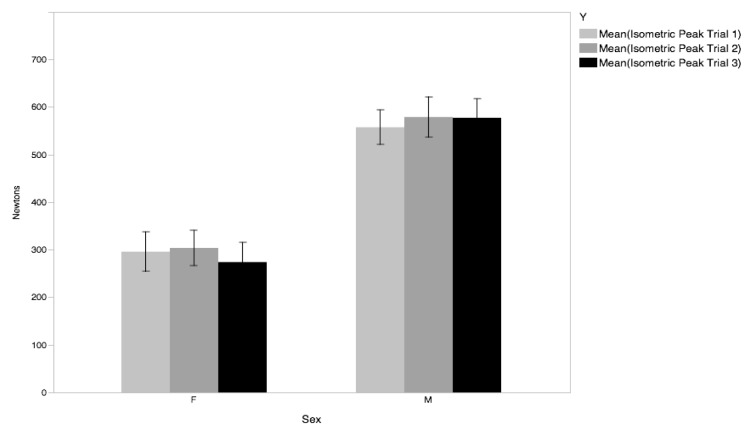
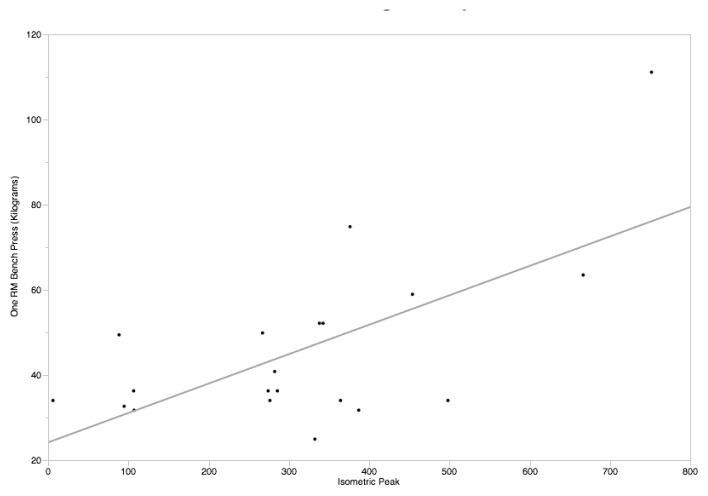
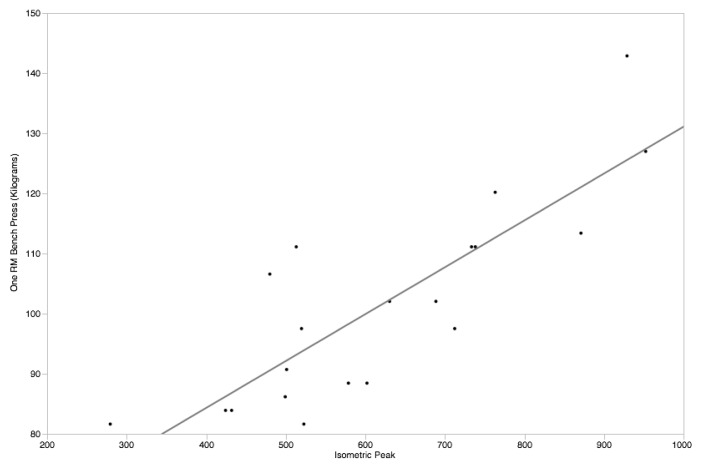
The purpose of the present investigation was to examine the association of a novel test of upper body isometric strength against a 1RM bench press measurement. Forty college age adults (n = 20 female, n = 20 male; age 22.8 ± 2.8 years; body height 171.6 ± 10.8 cm; body mass 73.5 ± 16.3 kg; body fat 23.1 ± 5.4%) volunteered for the present investigation. The participants reported to the lab on three occasions. The first visit included anthropometric measurements and familiarization with both the upper body isometric test and bench press exercise. The final visits were conducted in a randomized order, with one being a 1RM assessment on the bench press and the other consisting of three trials of the upper body isometric assessment. For the isometric test, participants were positioned in a “push-up” style position while tethered (stainless steel chain) to a load cell (high frequency) anchored to the ground. The peak isometric force was consistent across all three trials (ICC = 0.98) suggesting good reliability. Multiple regression analysis was completed with the predictors: peak isometric force, gender, against the outcome variable 1RM bench press. The analysis resulted in a significant model (r2 = 0.861, p≤0.001) with all predictor variables attaining significance in the model (p<0.05). Isometric peak strength had the greatest effect on the model (Beta = 5.19, p≤0.001). Results from this study suggest that the described isometric upper body strength assessment is likely a valid and reliable tool to determine strength. Further research is warranted to gather a larger pool of data in regard to this assessment.
Overview
The claims and statistics of this paper haven’t been checked yet.
Run the check — free, no account needed. It reads the open-access text and checks the sources it cites.
Integrity signals
Registry
Cites
Statistics
Figures
Verification
Claims the paper makes
The claims and statistics of this paper haven’t been checked yet.
Run the check — free, no account needed. It reads the open-access text and checks the sources it cites.
Claims other papers make about this one
Each is checked against this paper’s own text: does it say what the citing paper says it does?
The source backs part of the claim, not all of it — or backs it for a different population, condition or comparison.
In the citing paper
“The upper body isometric test (UBIST) used in this study has previously been reported to be both reliable (ICC =0.9) and valid when examined against a 1 RM bench press (r = .92) [15].”
From Evaluation of the effects of two doses of alpha glycerylphosphorylcholine on physical and psychomotor performance (2017) · cites this paper as [15]
Experimental — accuracy not yet measured
Self-check
Percentages, sums and reported differences re-computed from the paper’s own numbers.
The self-check needs the paper’s full text.
Citations
Cites
Relationship Between Strength Characteristics and Unweighted and Weighted Vertical Jump Height
Kraska, J. M., Ramsey, M. W., Haff, G. G., Fethke, N., Sands, W. A., Stone, M. E., & Stone, M. H. (2009) · International Journal of Sports Physiology and Performance · doi:10.1123/ijspp.4.4.461 · Cited by 272
Haff, G. G., Carlock, J., Hartman, M. J., Kilgore, J. L., Kawamori, N., Jackson, J. R., Morris, R. T., Sands, W. A., & Stone, M. H. (2005) · The Journal of Strength and Conditioning Research · doi:10.1519/r-15134.1 · Cited by 252
Variability and Predictability of Finals Times of Elite Rowers
Smith, T. B., & Hopkins, W. G. (2011) · Medicine & Science in Sports & Exercise · doi:10.1249/mss.0b013e31821d3f8e · Cited by 187
Relationships of isometric mid-thigh pull variables to weightlifting performance.
Beckham, G. K., Mizuguchi, S., Carter, C., Sato, K., Ramsey, M. R., Lamont, H., Hornsby, W. G., Haff, G., & Stone, M. (2013) · PubMed · Cited by 164
Effects of Single vs. Multiple Sets of Weight Training: Impact of Volume, Intensity, and Variation
Kramer, J. B., Stone, M. H., OʼBryant, H. S., Conley, M. S., Johnson, R. L., Nieman, D. C., Honeycutt, D. R., & Hoke, T. P. (1997) · The Journal of Strength and Conditioning Research · doi:10.1519/1533-4287(1997)011 · Cited by 127
The importance of isometric maximum strength in college wrestlers.
(2006) · Europe PMC (PubMed Central) · Cited by 102
Application of Strength Diagnosis
Newton, R. U., & Dugan, E. L. (2002) · Strength and conditioning journal · doi:10.1519/00126548-200210000-00014 · Cited by 99
Arslan, C. (2005) · The Journal of Strength and Conditioning Research · doi:10.1519/14533.1 · Cited by 46
Thompson, B. J., Ryan, E. D., Sobolewski, E. J., Smith, D. B., Conchola, E. C., Akehi, K., & Buckminster, T. (2012) · The Journal of Strength and Conditioning Research · doi:10.1519/jsc.0b013e31825bb56c · Cited by 41
DAWSON, B., VLADICH, T., & BLANKSBY, B. A. (2002) · Journal of Strength and Conditioning Research · doi:10.1519/00124278-200211000-00001 · Cited by 41
Reliability and Validity of Two Isometric Squat Tests
Blazevich, A. J., GILL, N., & Newton, R. U. (2002) · The Journal of Strength and Conditioning Research · doi:10.1519/00124278-200205000-00020 · Cited by 24
ARSLAN, C. (2005) · The Journal of Strength and Conditioning Research · doi:10.1519/00124278-200508000-00029 · Cited by 23
Predictors of Personal Best Performance in the Hammer Throw for U.S. Collegiate Throwers
Judge, W. L., Bellar, D. M., McAtee, G., & Judge, M. (2010) · International Journal of Performance Analysis in Sport · doi:10.1080/24748668.2010.11868501 · Cited by 15
Self-citationMetabolic Cost:Vertical Work Ratio During Knee Extension and Knee Flexion Weight-training Exercise
Hunter, G. R., Kekes-Szabo, T., & Schnitzler, A. (1992) · The Journal of Strength and Conditioning Research · doi:10.1519/1533-4287(1992)006 · Cited by 14
Judge, W. L., Bellar, D. M., Turk, M., et al. (2011) · International Journal of Performance Analysis in Sport · doi:10.1080/24748668.2011.11868542 · Cited by 9
Self-citationJudge, W. L., & Bellar, D. M. (2012) · International Journal of Performance Analysis in Sport · doi:10.1080/24748668.2012.11868581 · Cited by 9
Self-citationHaff, G. G. (2012) · Strength and conditioning journal · doi:10.1519/ssc.0b013e31824f2a88 · Cited by 6
Low-Carbohydrate Diets and High-Intensity Anaerobic Exercise
Haff, G. G., & Whitley, A. (2002) · Strength and conditioning journal · doi:10.1519/1533-4295(2002)024 · Cited by 5
Research works printed but not linked: 2
- Bellar D Judge LW Patrick TJ Craig BW Efficacy of the use of fractional plates during maximum strength testing for the bench press and strict curl Applied Research in Coaching and Athletics Annual 2013 28 143 157
- Petersen D Wagner K Greener T Testing Strength & Conditioning Journal 2011 33 2 36 38
Cited by
Sorted by citations
The effect of 6 days of alpha glycerylphosphorylcholine on isometric strength
Bellar, D., LeBlanc, N. R., & Campbell, B. (2015) · Journal of the International Society of Sports Nutrition · doi:10.1186/s12970-015-0103-x · Cited by 43
Self-citationMarcus, L., Soileau, J., Judge, L. W., & Bellar, D. (2017) · Journal of the International Society of Sports Nutrition · doi:10.1186/s12970-017-0196-5 · Cited by 36
Self-citationMoreira, O. C., Oliveira, C. E. P. D., Maroto-Izquierdo, S., Cuevas, M. J., & De Paz, J. A. (2019) · Bioscience Journal · doi:10.14393/bj-v35n6a2019-42775 · Cited by 11
Metadata
- Authors
- Bellar, D., Marcus, L., & Judge, L. W.
- Affiliations
- University of Louisiana at Lafayette (US)
- Ball State University (US)
- Corresponding author
- Bellar, David
- Venue
- Journal of Human Kinetics
- Publisher
- Walter de Gruyter GmbH
- Published
- 2015-09-01
- Volume
- 47
- Issue
- 1
- Pages
- 189-195
- ISSN
- 1640-5544 (ISSN-L)
- 1899-7562
- PMC
- PMC4633254
- OpenAlex
- W2292761450
- Cited by
- 26
- References
- 18
- Citations by year
- 2026: 5 · 2025: 3 · 2023: 2 · 2020: 3 · 2019: 2 · 2018: 4 · 2017: 5 · 2016: 1 · 2015: 1
- FWCI
- 3.78
- Type
- journal article
- Language
- en
- Open access
- diamond
- doi.org
- Locations
- Journal of Human Kinetics (publishedVersion, cc-by)
- Europe PMC (PubMed Central) (publishedVersion, cc-by)
- PubMed Central (publishedVersion, cc-by)
- PubMed (publishedVersion)
- DOAJ (DOAJ: Directory of Open Access Journals) (submittedVersion)
- Topics
- Health Sciences › Medicine › Orthopedics and Sports Medicine › Sports Performance and Training
- Health Sciences › Health Professions › Physical Therapy, Sports Therapy and Rehabilitation › Physical Education and Training Studies
- Health Sciences › Medicine › Physiology (medical) › Cardiovascular and exercise physiology
- Keywords
- test-retest reliability, test validity, load cell, strength analysis
About these checks
Registry, retraction, Cites and statistics results are computed, not judged, with one exception: a printed reference that no index lists is read once by a model before it counts as a citation error. Claims are extracted by a model and kept only when their quote appears verbatim in the text; each cited source is then checked, with a model’s help, for whether it says what the claim relies on. Those verdicts can be wrong — read the claim’s quote and the cited source before relying on one.
Statistics and arithmetic are recomputed, not judged.
Confidence bands are shown only for fields calibrated on our annotated test set. None is calibrated yet, so no band is shown.
What counts as a claim ›How we measure confidence ›How we check this ›
Are you an author, or do you see a problem with this page? Request a review
