

Enhancing metasurface fabricability through minimum feature size enforcement
Open accessThe DOI matches its Crossref record; 41 of the 41 references it cites were found in a registry or an index; 1 of the 3 sources its claims cite were checked for support.
Abstract
The metasurfaces have shown great potential for miniaturizing conventional optics while offering extended flexibility. Recently, there has been considerable interest in using algorithms to generate meta-atom shapes for these metasurfaces, as they offer vast design freedom and not biased by the human intuition. However, these complex designs significantly increase the difficulty of fabrication. To address this, we introduce a design process that rigorously enforces the fabricability of both the material-filled (fill) and empty (void) regions in a metasurface design. This process takes into account specific constraints regarding the minimum feature size for each region. Additionally, it corrects any violations of these constraints across the entire device, ensuring only minimal impact on performance. Our method provides a practical way to create metasurface designs that are easy to fabricate, even with complex shapes, hence improving the overall production yield of these advanced meta-optical components.
Overview
CoChat Summary
## TL;DR
The paper presents a device-level algorithm that enforces minimum feature size on both fill and void regions in metasurface layouts, aiming to make complex free-form designs fabrication-friendly. In a 40 μm-diameter silicon metalens example designed for 1064 nm, MFS correction improved fabrication quality and experimental performance relative to the non-corrected layout.
## Key findings
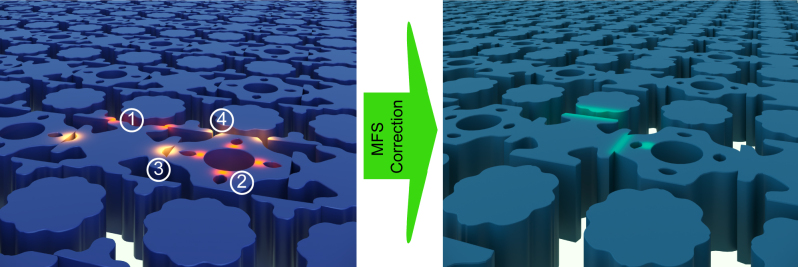
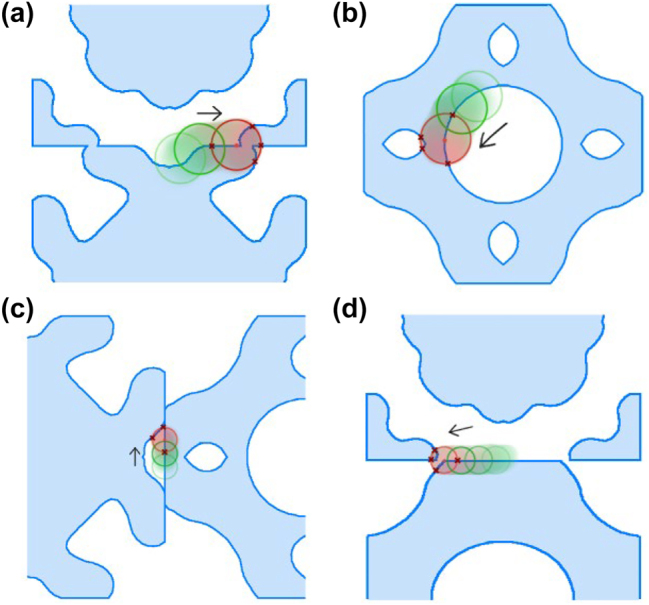
- The algorithm checks and corrects metasurface layouts at the entire device level using a “rolling circle” method, separately enforcing MFSf for fill regions and MFSv for void regions.
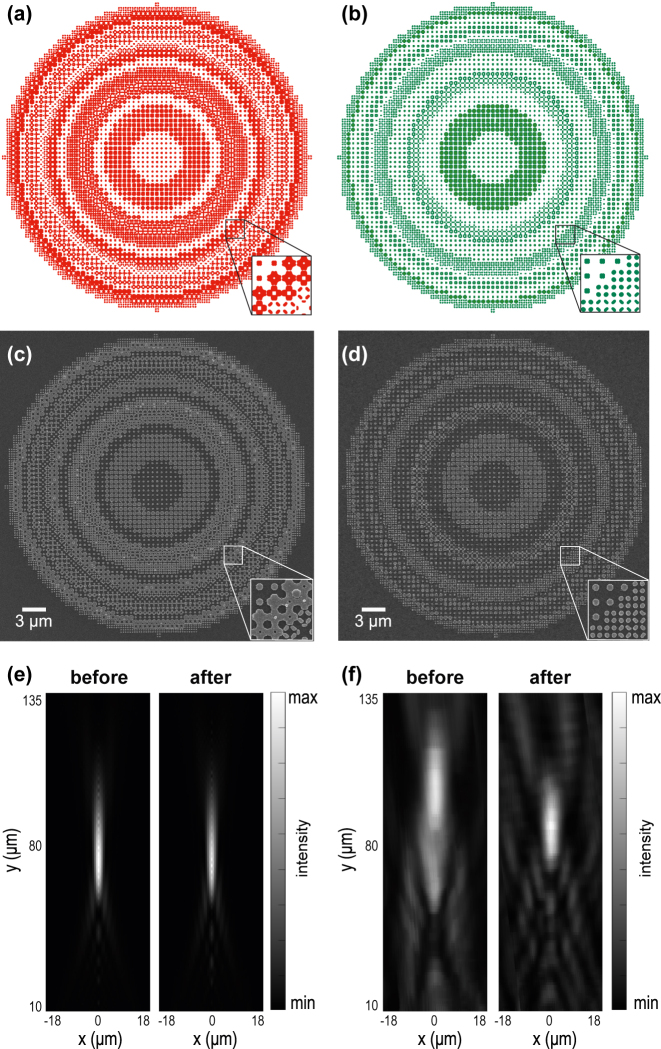
- In the demonstrated metalens, the layout had a 40 μm diameter, a 600 nm lattice constant, and an MFS requirement of 100 nm for both fills and voids.
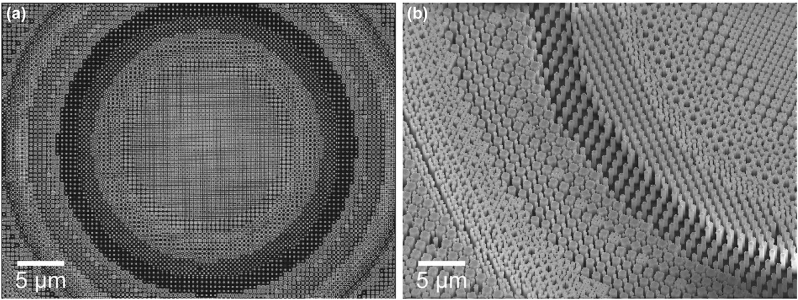
- SEM images showed that the non-fabricable regions stuck together when fabricated without correction, while with MFS correction the meta-atoms were successfully resolved and fabrication quality “increased dramatically.”
- The corrected metalens had only slight performance decrease in numerical simulations, whereas the uncorrected fabricated metalens showed a significantly shifted focal distance and a broadened focal spot and depth of focus.
## Methods
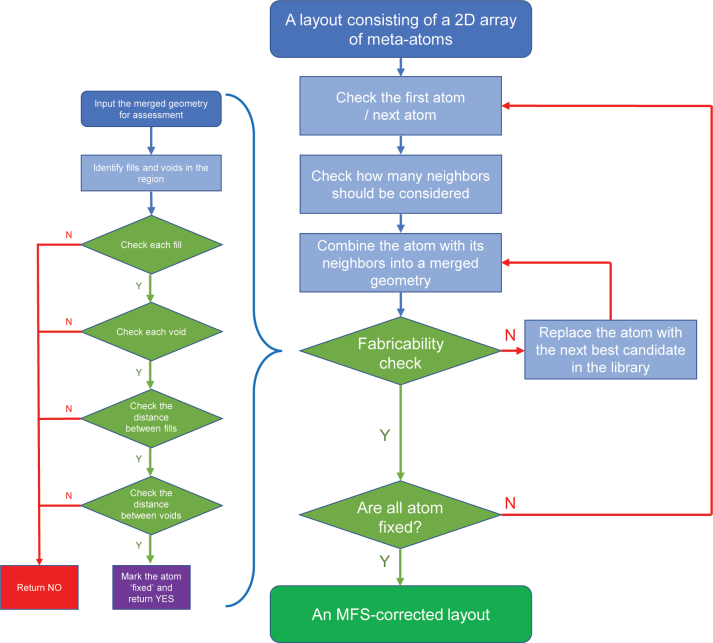
- The paper proposes a four-step algorithm: it checks fill polygons, checks void polygons, checks distances between fill polygons, and checks distances between void polygons and their enclosing fill boundaries.
- The method uses a rolling circle of radius equal to the relevant MFS; fabricability is inferred from the number of circle–polygon intersections.
- Demonstrations include a silicon-on-glass metalens and another fabricated metasurface with free-form shapes including high-aspect-ratio features up to 26:1; fabrication was evaluated with SEM imaging and optical characterization.
## Limitations
- The paper states that the algorithm is an additional design-step and is meant to work before proximity effect correction (PEC); it does not claim PEC alone can solve non-fabricability.
- Evident from the text: the paper demonstrates the approach on specific metalens examples, so broader performance across other metasurface types or fabrication platforms is not directly shown.
- Evident from the text: the correction aims for minimal impact on performance, but the paper still notes a slight decrease in numerical performance after correction.
Model-written summary. Check it against the paper before relying on it.
Integrity signals
Registry
Cites
Statistics
Figures

Verification
Claims the paper makes
1 Valid · 0 Not valid · 1 Not checked · 20 Own results and interpretations
A result the paper reports from its own data — it cites no other source for it, so there is none to check. The quote shows it is in the paper.
In the paper
“In contrast, the experimental results show significant differences between two metasurfaces.”
§ Enhancing metasurface fabricability through minimum feature size enforcement > Results and discussion
plainstates an association- Asserted: passes — The authors put it forward as true.
- Checkable: passes — It can be checked against evidence.
- Load-bearing: passes — The paper’s conclusions depend on it.
- Based: passes — The paper gives a reason why it holds.
A result the paper reports from its own data — it cites no other source for it, so there is none to check. The quote shows it is in the paper.
In the paper
“It demonstrates that complex free-form shapes, including those with high-aspect-ratio features (up to 26:1), are all well-resolved.”
§ Enhancing metasurface fabricability through minimum feature size enforcement > Results and discussion
boostedstates a causeSingle case- Asserted: passes — The authors put it forward as true.
- Checkable: passes — It can be checked against evidence.
- Load-bearing: passes — The paper’s conclusions depend on it.
- Based: passes — The paper gives a reason why it holds.
A result the paper reports from its own data — it cites no other source for it, so there is none to check. The quote shows it is in the paper.
In the paper
“Our numerical simulations (Figure 5(e)) confirm that the performance of the corrected metalens only slightly decreased.”
- Also stated in: § Results and discussion · plain
“We highlight that the MFS correction had a minimal impact on the metalens’s performance degradation.”
§ Enhancing metasurface fabricability through minimum feature size enforcement > Results and discussion
plain- Asserted: passes — The authors put it forward as true.
- Checkable: passes — It can be checked against evidence.
- Load-bearing: passes — The paper’s conclusions depend on it.
- Based: passes — The paper gives a reason why it holds.
- Also stated in: § Results and discussion · plain
A result the paper reports from its own data — it cites no other source for it, so there is none to check. The quote shows it is in the paper.
In the paper
“The proximity effect correction was additionally used for both layouts’ fabrication to confirm that the non-fabricable layout cannot be corrected simply by existing means.”
§ Enhancing metasurface fabricability through minimum feature size enforcement > Results and discussion
plainSingle case- Asserted: passes — The authors put it forward as true.
- Checkable: passes — It can be checked against evidence.
- Load-bearing: passes — The paper’s conclusions depend on it.
- Based: passes — The paper gives a reason why it holds.
A result the paper reports from its own data — it cites no other source for it, so there is none to check. The quote shows it is in the paper.
In the paper
“We showed that the ideal metalenses with and without MFS correction display comparable performance”
§ Enhancing metasurface fabricability through minimum feature size enforcement > Discussion
plain- Asserted: passes — The authors put it forward as true.
- Checkable: passes — It can be checked against evidence.
- Load-bearing: passes — The paper’s conclusions depend on it.
- Based: passes — The paper gives a reason why it holds.
7 more claims
Create a free account to see all 22 claims and every source verdict.
- Probably not a substantial claim. 5
- It may state two separate claims as one. 9
Citations
Cites
Inverse design in nanophotonics
Molesky, S., Lin, Z., Piggott, A. Y., Jin, W., Vucković, J., & Rodriguez, A. W. (2018) · Nature Photonics · doi:10.1038/s41566-018-0246-9 · Cited by 1,818
Metasurface Holograms for Visible Light
Ni, X., Kildishev, A. V., & Shalaev, V. M. (2013) · Nature Communications · doi:10.1038/ncomms3807 · Cited by 1,513
Self-citationSpatiotemporal light control with active metasurfaces
Shaltout, A. M., Shalaev, V. M., & Brongersma, M. L. (2019) · Science · doi:10.1126/science.aat3100 · Cited by 1,020
Flat optics with dispersion-engineered metasurfaces
Chen, W. T., Zhu, A. Y., & Capasso, F. (2020) · Nature Reviews Materials · doi:10.1038/s41578-020-0203-3 · Cited by 802
Review of numerical optimization techniques for meta-device design [Invited]
Campbell, S. D., Sell, D., Jenkins, R. P., Whiting, E. B., Fan, J. A., & Werner, D. H. (2019) · Optical Materials Express · doi:10.1364/ome.9.001842 · Cited by 322
So, S., & Rho, J. (2019) · Nanophotonics · doi:10.1515/nanoph-2019-0117 · Cited by 285
Kim, J., Seong, J., Kim, W., Lee, G.-Y., Kim, S., Kim, H., Moon, S.-W., Oh, D. K., Yang, Y., Park, J., et al. (2023) · Nature Materials · doi:10.1038/s41563-023-01485-5 · Cited by 285
Nonreciprocal metasurface with space–time phase modulation
Guo, X., Ding, Y., Duan, Y., & Ni, X. (2019) · Light: Science & Applications · doi:10.1038/s41377-019-0225-z · Cited by 272
Self-citationIntegrated metasurfaces for re-envisioning a near-future disruptive optical platform
Yang, Y., Seong, J., Choi, M., Park, J., Kim, G., Kim, H., Jeong, J., Jung, C., Kim, J., Jeon, G., et al. (2023) · Light: Science & Applications · doi:10.1038/s41377-023-01169-4 · Cited by 244
Qiu, C.-W., Zhang, T., Hu, G., & Kivshar, Y. (2021) · Nano Letters · doi:10.1021/acs.nanolett.1c00828 · Cited by 243
Machine-learning-assisted metasurface design for high-efficiency thermal emitter optimization
Kudyshev, Z. A., Kildishev, A. V., Shalaev, V. M., & Boltasseva, A. (2020) · Applied Physics Reviews · doi:10.1063/1.5134792 · Cited by 233
Artificial Intelligence in Meta-optics
Chen, M. K., Liu, X., Sun, Y., & Tsai, D. P. (2022) · Chemical Reviews · doi:10.1021/acs.chemrev.2c00012 · Cited by 224
Terekhov, P. D., Babicheva, V. E., Baryshnikova, K. V., Shalin, A. S., Karabchevsky, A., & Evlyukhin, A. B. (2019) · Physical Review B · doi:10.1103/physrevb.99.045424 · Cited by 220
Self-citationRevisiting the Design Strategies for Metasurfaces: Fundamental Physics, Optimization, and Beyond
So, S., Mun, J., Park, J., & Rho, J. (2023) · Advanced Materials · doi:10.1002/adma.202206399 · Cited by 187
All-Glass 100 mm Diameter Visible Metalens for Imaging the Cosmos
Park, J., Lim, S. W. D., Amirzhan, A., Kang, H., Karrfalt, K., Kim, D., Leger, J. D., Urbas, A. M., Ossiander, M., Li, Z., et al. (2024) · ACS Nano · doi:10.1021/acsnano.3c09462 · Cited by 187
Ultraspectral Imaging Based on Metasurfaces with Freeform Shaped Meta‐Atoms
Yang, J., Cui, K., Cai, X., Xiong, J., Zhu, H., Rao, S., Xu, S., Huang, Y., Liu, F., Feng, X., et al. (2022) · Laser & Photonics Reviews · doi:10.1002/lpor.202100663 · Cited by 164
Observation of full-parameter Jones matrix in bilayer metasurface
Bao, Y., Nan, F., Yan, J., Yang, X., Qiu, C., & Li, B. (2022) · Nature Communications · doi:10.1038/s41467-022-35313-2 · Cited by 156
One-step printable platform for high-efficiency metasurfaces down to the deep-ultraviolet region
Kim, J., Kim, W., Oh, D. K., Kang, H., Kim, H., Badloe, T., Kim, S., Park, C., Choi, H., Lee, H., et al. (2023) · Light Science & Applications · doi:10.1038/s41377-023-01086-6 · Cited by 142
Ignatyeva, D. O., Karki, D., Voronov, A. A., Kozhaev, M. A., Krichevsky, D. M., Chernov, A. I., Levy, M., & Belotelov, V. I. (2020) · Nature Communications · doi:10.1038/s41467-020-19310-x · Cited by 133
High-Efficiency, 80 mm Aperture Metalens Telescope
Zhang, L., Chang, S., Chen, X., Ding, Y., Rahman, M. T., Duan, Y., Stephen, M. A., & Ni, X. (2022) · Nano Letters · doi:10.1021/acs.nanolett.2c03561 · Cited by 130
Self-citationLarge‐area metasurface on CMOS‐compatible fabrication platform: driving flat optics from lab to fab
Li, N., Xu, Z., Dong, Y., Hu, T., Zhong, Q., Fu, Y. H., Zhu, S., & Singh, N. (2018) · Nanophotonics · doi:10.1515/nanoph-2020-0063 · Cited by 128
Kim, J., Oh, D. K., Kim, H., Yoon, G., Jung, C., Kim, J., Badloe, T., Kang, H., Kim, S., Yang, Y., et al. (2022) · Laser & Photonics Review · doi:10.1002/lpor.202200098 · Cited by 123
Huang, L., Xu, K., Yuan, D., Hu, J., Wang, X., & Xu, S. (2022) · Nature Communications · doi:10.1038/s41467-022-33644-8 · Cited by 99
Kim, J., Im, J., So, S., Choi, Y., Kang, H., Lim, B., Lee, M., Kim, Y., & Rho, J. (2024) · Advanced Materials · doi:10.1002/adma.202311785 · Cited by 99
Special scattering regimes for conical all-dielectric nanoparticles
Kuznetsov, A. V., Valero, A. C., Shamkhi, H. K., Terekhov, P. D., Ni, X., Bobrovs, V., Рыбин, М. В., & Shalin, A. S. (2022) · Scientific Reports · doi:10.1038/s41598-022-25542-2 · Cited by 81
Self-citationDeep neural network enabled active metasurface embedded design
An, S., Zheng, B., Julian, M., Williams, C., Tang, H., Gu, T., Zhang, H., Kim, H. J., & Hu, J. (2022) · Nanophotonics · doi:10.1515/nanoph-2022-0152 · Cited by 69
8″ wafer-scale, centimeter-sized, high-efficiency metalenses in the ultraviolet
Kim, J., Kim, Y., Kim, W., Oh, D. K., Kang, D., Seong, J., Shin, J. W., Go, D., Park, C., Song, H., et al. (2024) · Materials Today · doi:10.1016/j.mattod.2024.01.010 · Cited by 64
Controlling the degrees of freedom in metasurface designs for multi-functional optical devices
Xiong, B., Deng, L., Peng, R., & Liu, Y. (2019) · Nanoscale Advances · doi:10.1039/c9na00343f · Cited by 52
Theory and Fundamental Limit of Quasiachromatic Metalens by Phase Delay Extension
Chen, Q., Gao, Y., Pian, S., & Ma, Y. (2023) · Physical Review Letters · doi:10.1103/physrevlett.131.193801 · Cited by 47 · cited 1×
“Successfully manufacturing high aspect ratio freeform metalenses is promising for overcoming chromatic aberrations [38] and generally expanding the functionality of meta-devices [39].”
BackgroundBeyond dipolar Huygens’ metasurfaces for full‐phase coverage and unity transmittance
Rahimzadegan, A., Arslan, D., Dams, D., Groner, A., Garcia‐Santiago, X., Alaee, R., Fernandez‐Corbaton, I., Pertsch, T., Staude, I., & Rockstuhl, C. (2018) · Nanophotonics · doi:10.1515/nanoph-2019-0239 · Cited by 43
Resonant Light Trapping via Lattice-Induced Multipole Coupling in Symmetrical Metasurfaces
Prokhorov, A. V., Terekhov, P. D., Gubin, M. Y., Shesterikov, A. V., Ni, X., Tuz, V. R., & Evlyukhin, A. B. (2022) · ACS Photonics · doi:10.1021/acsphotonics.2c01066 · Cited by 41
Self-citationLarge‐Area, High‐Numerical‐Aperture, Freeform Metasurfaces
Zhou, Y., Mao, C., Gershnabel, E., Chen, M., & Fan, J. A. (2024) · Laser & Photonics Reviews · doi:10.1002/lpor.202300988 · Cited by 38 · cited 1×
“Successfully manufacturing high aspect ratio freeform metalenses is promising for overcoming chromatic aberrations [38] and generally expanding the functionality of meta-devices [39].”
BackgroundA Generative Meta‐Atom Model for Metasurface‐Based Absorber Designs
Ding, W., Chen, J., & Wu, R. (2022) · Advanced Optical Materials · doi:10.1002/adom.202201959 · Cited by 37
Arbitrary Achromatic Polarization Control with Reconfigurable Metasurface Systems
Wang, E. W., Yu, S., Phan, T., Dhuey, S. D., & Fan, J. A. (2023) · Laser & Photonics Review · doi:10.1002/lpor.202200926 · Cited by 33
Sapphire nanophotonics: Fabrication challenges and optical properties
Chen, Y., Chien, K.-C., Chen, I., et al. (2022) · Micro and Nano Engineering · doi:10.1016/j.mne.2022.100115 · Cited by 26
Jenkins, R. P., Campbell, S. D., & Werner, D. H. (2022) · ACS Photonics · doi:10.1021/acsphotonics.2c01166 · Cited by 15
Inverse Design of Optical Switch Based on Bilevel Optimization Inspired by Meta-Learning
Lou, B., Rodríguez, J. A., Wang, B. C., Cappelli, M., & Fan, S. (2023) · ACS Photonics · doi:10.1021/acsphotonics.3c00113 · Cited by 14
Fabrication-Friendly Random Meta-Atom Generation for Phase-Shifting Metasurfaces
Huang, H., Zhang, X., Gan, F., & Ni, X. (2022) · IEEE photonics journal · doi:10.1109/jphot.2022.3144434 · Cited by 7
Self-citationYang, J., Cui, K., Cai, X., et al. (2022) · Laser & Photonics Review · doi:10.1002/lpor.202270035 · Cited by 4
Large-area, high-numerical-aperture, freeform MetasurfacesPreprint
Zhou, Y. J., Mao, C., Gershnabel, E., et al. (2023) · Research Square · doi:10.21203/rs.3.rs-3065220/v1 · Cited by 3
Fabrication of high aspect ratio structures for meta-surface optics
Burckel, D. B., Musick, K. M., Young, T. R., Gastian, L., & Mudrick, J. (2023) · Metamaterials, Metadevices, and Metasystems 2023 · doi:10.1117/12.2678379 · Cited by 1 · cited 1×
“The fabrication high aspect-ratiostructuresatthenanoscaleremainschallenging [37] but highly desirable for the wavefront manipulation since aheight increase provides more freedom for phase manipulation.”
Background
Cited by
Advancements in metasurfaces for polarization control: A comprehensive survey
Khan, H. Z., Zafar, J., Jabbar, A., Kazim, J. U. R., Rehman, M. U., Imran, M. A., & Abbasi, Q. H. (2025) · Next research. · doi:10.1016/j.nexres.2025.100407 · Cited by 16
“The study in [161] explores the impact of minimum feature sizes on the fabricability of metasurfaces.”
Kang, M., Choi, S., Fu, K., Liu, X., Wei, Z., Jin, L., Wang, H., Martin, O. J. F., Yang, J. K. W., So, S., et al. (2026) · Opto-Electronic Advances · doi:10.29026/oea.2026.250263 · Cited by 13
Chen, S., Lin, J., Sun, J., & Li, X. (2025) · Photonics · doi:10.3390/photonics12090910 · Cited by 3
Achromatic metalens for visible and infrared band: a unified four-paradigm framework
Dong, G., & Yan, J. (2026) · npj Nanophotonics · doi:10.1038/s44310-026-00127-3 · Cited by 4
“…gap, inverse design should incorporate (1) minimum feature size / minimum gap constraints in both “ solid ” and “ void ” regions during optimization 78 , (2) fabrication-aware regularization (e.g., curvature-and gap-penalty terms in level-set representations) to avoid unrealistically sharp corners…”
Yang, Z., Kong, L., & Wang, Q. (2026) · Photonics and Nanostructures - Fundamentals and Applications · doi:10.1016/j.photonics.2026.101631
Metadata
- Authors
- Terekhov, P., Chang, S., Rahman, M. T., Shafi, S., Ahn, H., Zhao, L., & Ni, X.
- Affiliations
- Pennsylvania State University (US)
- Corresponding author
- Ni, Xingjie
- Venue
- Nanophotonics
- Publisher
- Wiley
- Published
- 2024-05-21
- Volume
- 13
- Issue
- 17
- Pages
- 3147-3154
- ISSN
- 2192-8606 (ISSN-L)
- 2192-8614
- PMC
- PMC11267437
- OpenAlex
- W4398140114
- Cited by
- 7
- References
- 40
- Citations by year
- 2026: 5 · 2025: 2
- FWCI
- 0.55
- Type
- journal article
- Language
- en
- Open access
- gold
- doi.org
- Licence
- cc-by
- creativecommons.org/licenses/by/4.0/ (am)
- creativecommons.org/licenses/by/4.0/ (vor)
- doi.wiley.com/10.1002/tdm_license_1.1 (tdm)
- Locations
- Nanophotonics (publishedVersion, cc-by)
- PubMed Central (publishedVersion, cc-by)
- PubMed (publishedVersion)
- DOAJ (DOAJ: Directory of Open Access Journals) (submittedVersion)
- Funders
- Division of Chemistry (CHE‐2305139)
- Division of Electrical, Communications and Cyber Systems (ECCS‐1609693, ECCS‐2047446)
- National Eye Institute (1R21EY031853‐01)
- Topics
- Physical Sciences › Materials Science › Electronic, Optical and Magnetic Materials › Metamaterials and Metasurfaces Applications
- Physical Sciences › Engineering › Electrical and Electronic Engineering › Advanced Antenna and Metasurface Technologies
- Physical Sciences › Materials Science › Surfaces, Coatings and Films › Optical Coatings and Gratings
- Keywords
- metasurfaces, metasurface fabrication, void regions, meta-optics, fabrication yield
About these checks
Registry, retraction, Cites and statistics results are computed, not judged, with one exception: a printed reference that no index lists is read once by a model before it counts as a citation error. Claims are extracted by a model and kept only when their quote appears verbatim in the text; each cited source is then checked, with a model’s help, for whether it says what the claim relies on. Those verdicts can be wrong — read the claim’s quote and the cited source before relying on one.
A language model drew the claims from the paper on 2026-10-10, under version 3 of the claim definition (model deepseek-v4.1-flash, prompt extract-v3).
A second model labelled each claim on 2026-10-10 (model jev-1.13-20260917, definition revision gold-guideline-v0.2).
Statistics and arithmetic are recomputed, not judged.
Confidence bands are shown only for fields calibrated on our annotated test set. None is calibrated yet, so no band is shown.
What counts as a claim ›How we measure confidence ›How we check this ›
Are you an author, or do you see a problem with this page? Request a review
Data sources
Bibliographic data: Semantic Scholar, OpenAlex, Crossref.
Contains information from the Semantic Scholar Academic Graph Datasets, made available under the ODC Attribution License (ODC-BY 1.0).
Semantic Scholar’s data is described in: Kinney, R., et al. (2023). The Semantic Scholar Open Data Platform. arXiv:2301.10140.
