

The DOI matches its Crossref record; the references it cites are not checked yet.
Critical Information Literacy as a Path to Resist “Fake News”: Understanding Disinformation as the Root Problem
Open accessAbstract
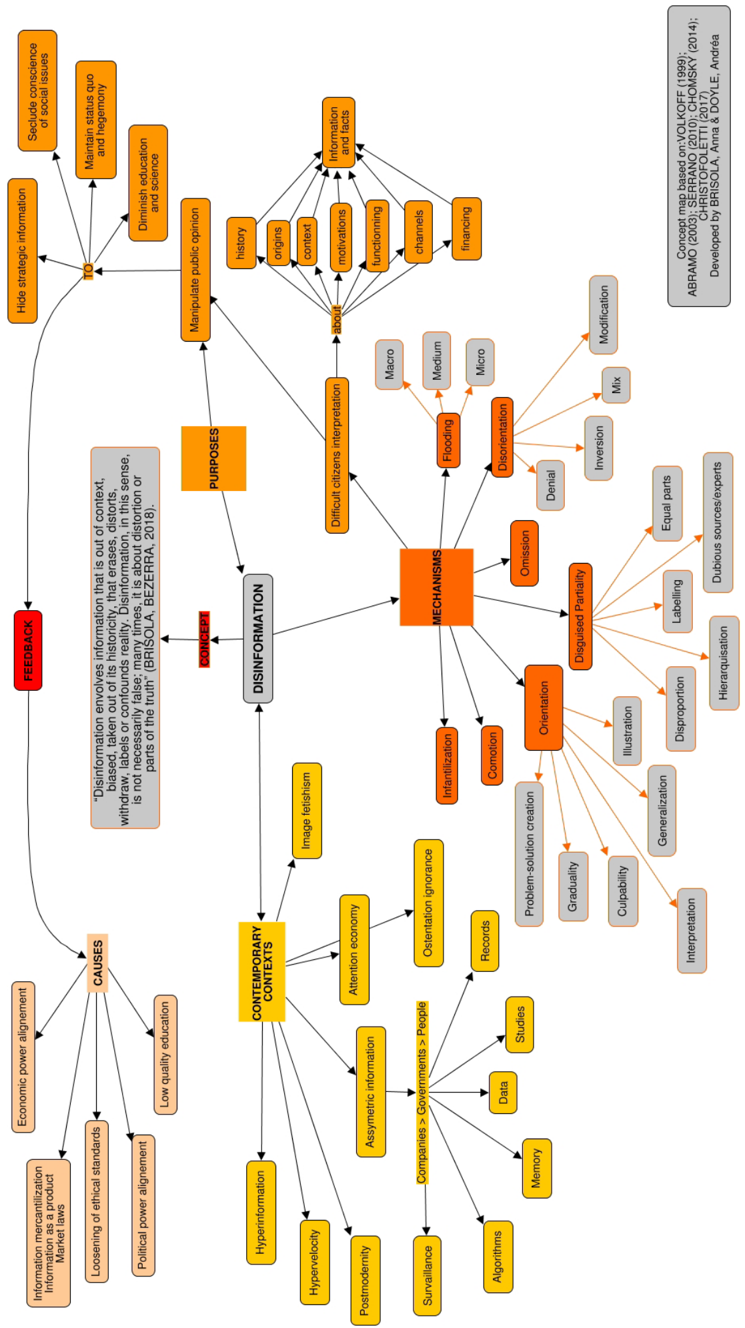
This paper proposes to discuss the problem of Fake News, its root problem disinformation and the path to resist it, critical information literacy. It initially distinguishes the concepts of fake news and disinformation through the views of authors as Allcott & Gentzkow (2017), Chomsky (2014), Serrano (2010) and Volkoff (1999). Our perspective considers that none of these phenomena are new or recent, and we do not consider the “combat” of fake news to be a simple task, considering that it involves issues related to the limits of freedom of speech and media censorship. Fake News are understood as intentionally and verifiably false articles created to manipulate people and disinformation as a bigger ensemble of techniques to manipulate public opinion for political gain with perverted (but not only false) information. One way to deal with these matters goes through a more complex process: the development of critical information literacy in the society as a whole. This concept is studied from the work of Downey (2016), Elmborg (2012), Freire (1967;1970) and others. Freire’s critical pedagogy helps the self-construction of subjects aware of their position and their social role, and it is a basic key for the formation of autonomous, critical and responsible individuals. Based on that, critical information literacy is a state of vigilance towards information that enables people to understand that information is socially constructed and to use it to produce new information in a creative and contextualized way. It concludes that critical information literacy is a consistent tool of resistance to Fake News as it allows people not only survive the informational flood but mainly to build a more ethical society in the use of information.
Overview
The claims and statistics of this paper haven’t been checked yet.
Run the check — free, no account needed. It reads the open-access text and checks the sources it cites.
Integrity signals
Registry
Cites
Statistics
Figures
Verification
Claims the paper makes
The claims and statistics of this paper haven’t been checked yet.
Run the check — free, no account needed. It reads the open-access text and checks the sources it cites.
Claims other papers make about this one
Each is checked against this paper’s own text: does it say what the citing paper says it does?
In the citing paper
“CIL has been proposed as an effective means of teaching how to evaluate online sources, especially the proliferation of fake news and mis- and disinformation (Brisola and Doyle, 2019; Cooke, 2018; O'Hara, 2024; Rajić, 2022; Wendt et al., 2024).”
From Two decades of critical information literacy: a review and analysis of the literature (2025) · cites this paper as Brisola and Doyle, 2019
Self-check
Percentages, sums and reported differences re-computed from the paper’s own numbers.
The self-check needs the paper’s full text.
Citations
The citation lists haven’t been fetched yet
References 4 · Cited by 53
Research works printed but not linked: 19
- Matshall, 2017, Disinformation Cosmopolitan Democracy Cosmopolitan Civil Societies No, Society Communication Journal, 1
- Wallis, 2016, Mapping and Privilege in Scholarly Conversations In Nicole eds Critical Pedagogy Handbook vols Chicago of College Cap, Power Library Association Research Libraries, 1
- Tewell, 2016, Authority and Source Evaluation in the Critical Library Classroom In eds Critical Library Pedagogy Handbook vols Chicago Association of College Cap, Research Libraries, 49
- Nicholson, 2018, The Politics of Theory and the Practice of Critical Librarianship Editors Juice California, Library
- Beilin, 2016, How Unplanned Events Can Sharpen the Critical Focus in Information Literacy Instruction In Nicole eds Critical Library Pedagogy Handbook vols Chicago Association of College Cap, Research Libraries, 1
- ACRL, 2000, Association of Research Libraries Literacy Competency Standards for Chicago Available at http www ala org acrl sites ala org acrl files content standards standards pdfAccess, American Information Higher Education
- Nyhan, 2010, When corrections fail The persistence of political misperceptions, Political Behavior, 303, 10.1007/s11109-010-9112-2 · DOI · Paper page
- Tewell, 2018, The Practice and Promise of Critical Information Literacy : Academic Librarians Involvement in Critical Instruction In No em https crl acrl org index php crl article view Access, Library College Research Libraries, 1
- Galoozis, 2016, Cultivating a Mind of One s Own Drawing on Critical Information Literacy and In Nicole Pagowsky eds Critical Library Pedagogy Handbook vols Chicago Association of College & Cap, Liberal Education Research Libraries, 17, 1
- Tewell, 2018, decade of critical information literacy Communications in Information Literacy vol Available at http www comminfolit org index php journal cil page article op view path i Access, 9, 2015
- Accardi, 2010, eds Critical Instruction Theories Juice, Library Methods Library
- Williams, 2016, What Is Possible : Setting the Stage for Co - Exploration in Archives and Special Collections In eds Critical Library Pedagogy Handbook vols Chicago Association of College Cap, Research Libraries, 12, 1
- Seale, 2016, Carrots in the Brownies : Incorporating Critical Librarianship in Unlikely Places In eds Critical Library Pedagogy Handbook vols Chicago Association of College Cap, Research Libraries, 26, 1
- Downey, 2016, Critical Literacy foundations inspiration ideas CA Juice, Information Library
- Pagowsky, 2016, Introdução In Nicole eds Critical Pedagogy Handbook vols Chicago of College xvii xxi, Library Association Research Libraries, 1
- Witek, 2016, Resistance is fertile or everything know about teaching learned in yoga class In eds Critical Library Pedagogy Handbook vols Chicago Association of College Cap, Research Libraries, 23, 1
- Watson, 2016, Developing a critical pedagogy disposition In eds Critical Library Pedagogy Handbook vols Chicago Association of College Cap, Research Libraries, 22, 1
- Lee, 2018, Fake news phishing fraud a call for research on digital media literacy education beyond the classroom em https www tandfonline com doi full, Communication Education, 67, 10.1080/03634523.2018.1503313>.Access26/03/2019 · DOI
- Gardner, 2016, At Odds with Assessment Being a Critical Educator within the Academy In Nicole eds Critical Library Pedagogy Handbook vols Chicago Association of College Cap, Research Libraries, 1
Metadata
- Authors
- Brisola, A. C., & Doyle, A.
- Affiliations
- Universidade Federal do Rio de Janeiro (BR)
- Corresponding author
- Brisola, Anna Cristina
- Venue
- Open Information Science
- Publisher
- Walter de Gruyter GmbH
- Published
- 2019-01-01
- Volume
- 3
- Issue
- 1
- Pages
- 274-286
- ISSN
- 2451-1781 (ISSN-L)
- OpenAlex
- W3002420400
- Cited by
- 53
- References
- 4
- Citations by year
- 2026: 6 · 2025: 12 · 2024: 16 · 2023: 2 · 2022: 13 · 2021: 4
- FWCI
- 8.56
- Type
- journal article
- Language
- en
- Open access
- diamond
- doi.org
- Locations
- Open Information Science (publishedVersion, cc-by)
- DOAJ (DOAJ: Directory of Open Access Journals) (submittedVersion, cc-by-sa)
- Topics
- Social Sciences › Sociology and Political Science › Misinformation and Its Impacts
- Social Sciences › Education › Literacy, Media, and Education
- Social Sciences › Library and Information Sciences › Library Science and Information Literacy
- Keywords
- critical information literacy, fake news, disinformation, critical pedagogy, Paulo Freire, freedom of expression, media censorship, public opinion manipulation, information ethics
About these checks
Registry, retraction, Cites and statistics results are computed, not judged, with one exception: a printed reference that no index lists is read once by a model before it counts as a citation error. Claims are extracted by a model and kept only when their quote appears verbatim in the text; each cited source is then checked, with a model’s help, for whether it says what the claim relies on. Those verdicts can be wrong — read the claim’s quote and the cited source before relying on one.
Statistics and arithmetic are recomputed, not judged.
Confidence bands are shown only for fields calibrated on our annotated test set. None is calibrated yet, so no band is shown.
What counts as a claim ›How we measure confidence ›How we check this ›
Are you an author, or do you see a problem with this page? Request a review
How to cite
Cite CoChat for the checks on this page, and the paper for its own findings.
- This page
- CoChat. (2026). Citation check: Critical Information Literacy as a Path to Resist “Fake News”: Understanding Disinformation as the Root Problem. https://app.cochat.ai/papers/10.1515/opis-2019-0019
- The paper
- Brisola, A. C., & Doyle, A. (2019). Critical Information Literacy as a Path to Resist “Fake News”: Understanding Disinformation as the Root Problem. Open Information Science. https://doi.org/10.1515/opis-2019-0019
Data sources
Bibliographic data: Semantic Scholar, OpenAlex, Crossref.
Contains information from the Semantic Scholar Academic Graph Datasets, made available under the ODC Attribution License (ODC-BY 1.0).
Semantic Scholar’s data is described in: Kinney, R., et al. (2023). The Semantic Scholar Open Data Platform. arXiv:2301.10140.
