

Prolonged exposure for pain and comorbid PTSD: a single-case experimental study of a treatment supplement to multiprofessional pain rehabilitation
Open accessThe DOI matches its Crossref record; 47 of the 49 references it cites were found in a registry or an index.
Abstract
Objectives: It is unclear how to address PTSD in the context of chronic pain management. Here we examine the potential benefits of an addition of prolonged exposure (PE) therapy for PTSD for adults attending multidisciplinary CBT for chronic pain. Methods: Four adults seeking treatment for chronic pain from a specialized pain rehabilitation service were offered PE for PTSD using a replicated, randomized, single-case experimental phase design, prior to commencing a 5-week multidisciplinary CBT program for chronic pain. Pre-, post-, follow-up, and daily measures allowed examination of PTSD and pain outcomes, potential mediators, and the trajectory of these outcomes and potential mediators during the subsequent pain-focused CBT program. Results: Visual inspection of the daily data demonstrated changes in all outcome variables and potential mediators during the PE phase. Changes came at different times and at different rates for the four participants, highlighting the individual nature of putative change mechanisms. Consistent with expectation, PE produced reliable change in the severity of PTSD symptoms and trauma-related beliefs for all four participants, either by the end of the PE phase or the PE follow-up, with these gains maintained by the end of the 5-week pain-focused CBT program. However, few reductions in pain intensity or pain interference were seen either during the PE phase or after. Conclusions: Although “disorder specific” approaches have dominated the conceptualising, study, and treatment of conditions like PTSD and chronic pain, such approaches may not be optimal. It may be better instead to approach cases in an individual and process-focused fashion. Ethical committee number: 2013/381.
Overview
The claims and statistics of this paper haven’t been checked yet.
Free: it reads the open-access text and checks the first 5 claims that cite a source we can check. Create a free account to check every claim.
Integrity signals
Registry
Cites
Statistics
Figures
Verification
Claims the paper makes
The claims and statistics of this paper haven’t been checked yet.
Free: it reads the open-access text and checks the first 5 claims that cite a source we can check. Create a free account to check every claim.
Claims other papers make about this one
Each is checked against this paper’s own text: does it say what the citing paper says it does?
The source backs part of the claim, not all of it — or backs it for a different population, condition or comparison.
In the citing paper
“There is a growing body of research showing the benefits of simultaneously treating post-traumatic stress and chronic pain in particular.30-35”
From An updated audit of the patient selection process for pain management programmes in a speciality care service before and during the COVID-19 pandemic (2023) · cites this paper as [35]
Experimental — accuracy not yet measured
Self-check
Percentages, sums and reported differences re-computed from the paper’s own numbers.
The self-check needs the paper’s full text.
Citations
Cites
Diagnostic and Statistical Manual of Mental Disorders
American Psychiatric Association (2013) · doi:10.1176/appi.books.9780890425596 · Cited by 116,369
The Hospital Anxiety and Depression Scale
Zigmond, A. S., & Snaith, R. P. (1983) · Acta Psychiatrica Scandinavica · doi:10.1111/j.1600-0447.1983.tb09716.x · Cited by 47,139 · cited 4×
“The next two items come from the HADS and measure levels of anxiety and depression: “I look forward with enjoyment to things” (depression scale); “Worrying thoughts go through my mind” (anxiety scale).”
BackgroundMethodInfluentialJacobson, N. S., & Truax, P. (1991) · Journal of Consulting and Clinical Psychology · doi:10.1037/0022-006x.59.1.12 · Cited by 7,770 · cited 4×
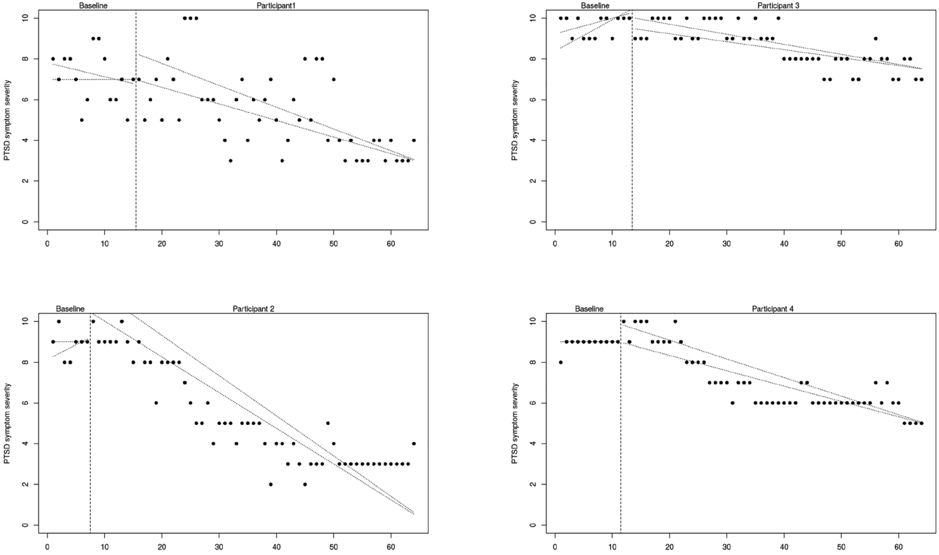
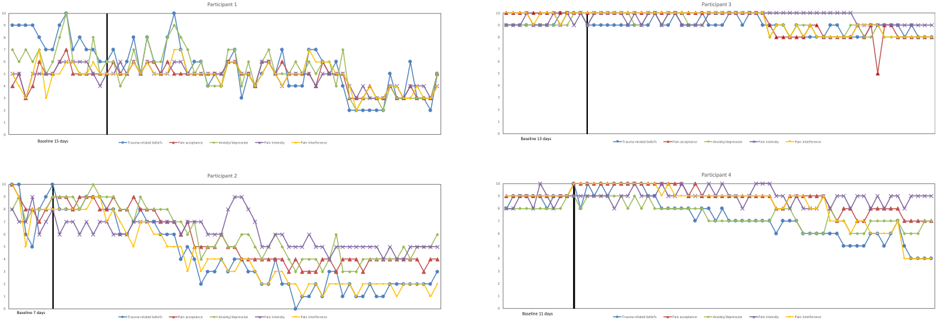
“Basedon Jacobsonand Truax criteria [42], participants 1, 2, and 3 demonstrated reliable changes, relative to baseline, on the measure of PTSDat the end of the PE phase, and these gains (relative to Figure 2: Daily measures of trauma-related beliefs, pain-related acceptance, anxiety/depression, pain intensity, and pain…”
BackgroundMethodInfluentialFoa, E. B., Cashman, L., Jaycox, L., & Perry, K. (1997) · Psychological Assessment · doi:10.1037/1040-3590.9.4.445 · Cited by 2,709
Mediators and Moderators of Treatment Effects in Randomized Clinical Trials
Kraemer, H. C., Wilson, G. T., Fairburn, C. G., & Agras, W. S. (2002) · Archives of General Psychiatry · doi:10.1001/archpsyc.59.10.877 · Cited by 2,562 · cited 1×
“Daily measures:Mediators are treatment processes through which a treatment might reach its effects [37].”
BackgroundMediators and Mechanisms of Change in Psychotherapy Research
Kazdin, A. E. (2007) · Annual Review of Clinical Psychology · doi:10.1146/annurev.clinpsy.3.022806.091432 · Cited by 2,504 · cited 1×
“There is widespread agreement that such designs measure too few mediators and outcome variables, and lack the number of measurement points necessary to estimate whether change in the mediator(s) precedes changes in the outcome variables, an important assumption of mediation [15].”
BackgroundThe West Haven-Yale Multidimensional Pain Inventory (WHYMPI)
Kerns, R. D., Turk, D. C., & Rudy, T. E. (1985) · Pain · doi:10.1016/0304-3959(85)90004-1 · Cited by 2,128 · cited 2×
“These itemswere chosenbasedonprevious studies that have shown them to explain the most unique variance in their respective (factor) subscales [18, 25, 30, 33, 34].”
BackgroundValidity of four pain intensity rating scales
Ferreira-Valente, M. A., Pais-Ribeiro, J. L., & Jensen, M. P. (2011) · Pain · doi:10.1016/j.pain.2011.07.005 · Cited by 1,872 · cited 1×
“The NRS is widely used in pain research and has been found to be a valid measure of pain intensity and sensitive to changes in pain in different contexts [27, 28].”
MethodThe Posttraumatic Cognitions Inventory (PTCI): development and validation
Foa, E. B., Ehlers, A., Clark, D. M., Tolin, D. F., & Orsillo, S. M. (1999) · Psychological Assessment · doi:10.1037/1040-3590.11.3.303 · Cited by 1,727 · cited 4×
“These itemswere chosenbasedonprevious studies that have shown them to explain the most unique variance in their respective (factor) subscales [18, 25, 30, 33, 34].”
BackgroundMethodInfluentialProlonged Exposure Therapy for PTSD: Therapist Guide: Emotional processing of traumatic experiences
Foa, E. B., Hembree, E., & Rothbaum, B. (2007) · doi:10.1093/med:psych/9780195308501.001.0001 · Cited by 1,050
Research works printed but not linked: 1
- Jensen MP, Karoly P. Self-report scales and procedures for assessing pain in adults. In: Turk DC, Melzack R, editors. Handbook of pain assessment. New York London: The Guildford Press; 1992.
Cited by
New generation psychological treatments in chronic pain
McCracken, L. M., Yu, L., & Vowles, K. E. (2022) · BMJ · doi:10.1136/bmj-2021-057212 · Cited by 123
Self-citationMcCracken, L. M. (2023) · European Journal of Pain · doi:10.1002/ejp.2091 · Cited by 105
“In fact, when we have occasions in individual data to see treatment responses in outcomes, processes of change and relations of processes with outcomes, for people with chronic pain, we see differing rates of change, different processes and different relations of process change with outcome in different people (Åkerbl…”
Self-citationAlpert, E., Tabke, C. S., Cole, T. A., Lee, D. J., & Sloan, D. M. (2023) · Clinical Psychology Review · doi:10.1016/j.cpr.2023.102300 · Cited by 47
Hellman, N. M., Haft, S. M., Woodbury, A., Sherrill, A. M., & Rauch, S. A. M. (2025) · European Journal of Psychotraumatology · doi:10.1080/20008066.2025.2479923 · Cited by 12
“One example (Åkerblom et al., 2022) is patients completing two treatment courses (PE first, followed by CBT-CP) with providers using two distinct theoretical models (EPT and gate control theory) to address PTSD-Pain.”
Andersen, T. E., & Ravn, S. L. (2025) · Current Opinion in Psychology · doi:10.1016/j.copsyc.2025.101990 · Cited by 13
Metadata
- Authors
- Åkerblom, S., Perrin, S., Fischer, M. R., & McCracken, L. M.
- Affiliations
- Lund University (SE)
- Uppsala University (SE)
- Corresponding author
- Åkerblom, Sophia
- Venue
- Scandinavian Journal of Pain
- Publisher
- Walter de Gruyter GmbH
- Published
- 2022-01-05
- Volume
- 22
- Issue
- 2
- Pages
- 305-316
- ISSN
- 1877-8860 (ISSN-L)
- 1877-8879
- OpenAlex
- W3215554332
- Cited by
- 9
- References
- 49
- Citations by year
- 2026: 1 · 2025: 2 · 2023: 3 · 2022: 3
- FWCI
- 1.82
- Type
- journal article
- Language
- en
- Open access
- hybrid
- doi.org
- Locations
- Scandinavian Journal of Pain (publishedVersion, cc-by)
- PubMed (publishedVersion)
- KTH Publication Database DiVA (KTH Royal Institute of Technology) (submittedVersion, other-oa)
- Lund University Publications (Lund University) (submittedVersion)
- Topics
- Social Sciences › Psychology › Clinical Psychology › Posttraumatic Stress Disorder Research
- Health Sciences › Health Professions › Physical Therapy, Sports Therapy and Rehabilitation › Musculoskeletal pain and rehabilitation
- Social Sciences › Psychology › Experimental and Cognitive Psychology › Sleep and related disorders
- Keywords
- prolonged exposure therapy, post-traumatic stress disorder, chronic pain, pain rehabilitation, pain intensity, pain interference, single-case experimental design
- MeSH terms
- Adult, Humans, Implosive Therapy, Stress Disorders, Post-Traumatic, Treatment Outcome, Chronic Pain, Pain Management
About these checks
Registry, retraction, Cites and statistics results are computed, not judged, with one exception: a printed reference that no index lists is read once by a model before it counts as a citation error. Claims are extracted by a model and kept only when their quote appears verbatim in the text; each cited source is then checked, with a model’s help, for whether it says what the claim relies on. Those verdicts can be wrong — read the claim’s quote and the cited source before relying on one.
Statistics and arithmetic are recomputed, not judged.
Confidence bands are shown only for fields calibrated on our annotated test set. None is calibrated yet, so no band is shown.
What counts as a claim ›How we measure confidence ›How we check this ›
Are you an author, or do you see a problem with this page? Request a review
Data sources
Bibliographic data: Semantic Scholar, OpenAlex, Crossref.
Contains information from the Semantic Scholar Academic Graph Datasets, made available under the ODC Attribution License (ODC-BY 1.0).
Semantic Scholar’s data is described in: Kinney, R., et al. (2023). The Semantic Scholar Open Data Platform. arXiv:2301.10140.
