

Rotation of Cells in an Alternating Electric Field: the Occurrence of a Resonance Frequency
Open accessThe DOI matches its Crossref record.
Abstract
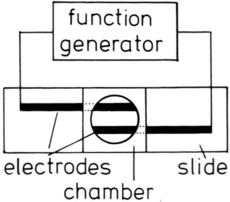
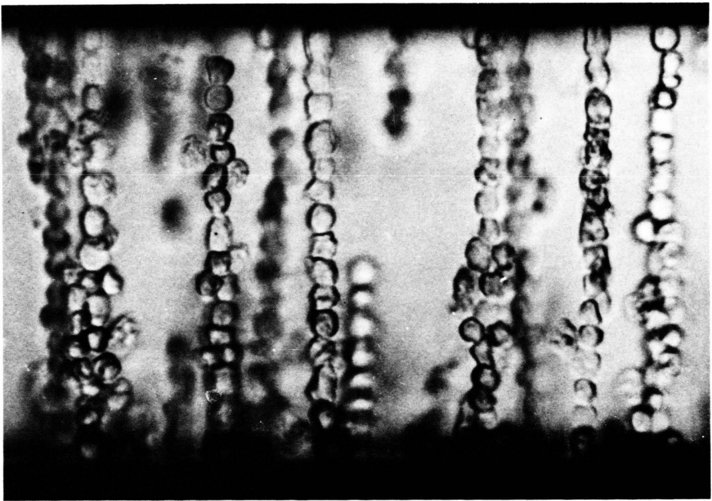
Cells suspended in a low-conducting medium were exposed to an alternating electric field whose frequency was altered between 1 kHz and 2 MHz. A resonance frequency was observed at which all suspended cells rotated about an axis normal to the field lines (when the electric field strength was larger than a threshold value of about 400 V/cm). This resonance frequency varied from species to species of cells (mesophyll protoplasts of Avena sativa = 20-40 kHz, human erythrocytes and ghost cells = 80-100 kHz, yeast cells = 140-180 kHz, Friend cells = 30-40 kHz, at room temperature). The resonance frequency of cell rotation was observed only under specific experimental conditions which excluded interference by reversible electrical breakdown of cell membranes and by gravitational forces. Glutardialdehyde fixed and heated cells exhibited no rotation in the frequency and field range investigated. The phenomenon of rotation is discussed in terms of dipole orientation within the membrane.
Overview
The claims and statistics of this paper haven’t been checked yet.
Free: it reads the open-access text and checks the first 5 claims that cite a source we can check. Create a free account to check every claim.
Integrity signals
Registry
Cites
Statistics
Figures
Verification
Claims the paper makes
The claims and statistics of this paper haven’t been checked yet.
Free: it reads the open-access text and checks the first 5 claims that cite a source we can check. Create a free account to check every claim.
Claims other papers make about this one
Each is checked against this paper’s own text: does it say what the citing paper says it does?
The source backs part of the claim, not all of it — or backs it for a different population, condition or comparison.
In the citing paper
“However, a number of nonthermal effects of minor biological consequence have been reported even at low field intensities.These include microscopic particle alignment (i.e., the pearl chain effect; Ref. 6) and cell rotation (7,8).”
From Disruption of cancer cell replication by alternating electric fields (2004) · cites this paper as [7]
Experimental — accuracy not yet measuredThe cited source says what the claim attributes to it.
In the citing paper
“This effect resembles the whole-cell rotation previously described during exposure to intermediate-frequency alternating electric fields (7,8).”
From Disruption of cancer cell replication by alternating electric fields (2004) · cites this paper as [7]
Self-check
Percentages, sums and reported differences re-computed from the paper’s own numbers.
The self-check needs the paper’s full text.
Citations
Cites
The publisher hasn’t deposited this paper’s reference list.
Research works printed but not linked: 11
- H. A. Pohl and J. S. Crane, Biophys. J. 11,711 (1971).
- H. A. Pohl, Dielectrophoresis, Cambridge University Press, Cambridge (1978).
- U. Zimmermann, F. Riemann, and G. Pilwat, Bio- chim. Biophys. Acta 436,460 (1976).
- M. C. Patuleia and C. Friend, Cancer Research 27, 726(1967).
- U. Zimmermann, G. Pilwat, and F. Riemann, Bio- chim. Biophys. Acta 375,209 (1975).
- R. Hampp and H. Ziegler, Planta 147,485 (1980).
- M. Mischel and I. Lamprecht, Z. Naturforsch., in press.
- U. Zimmermann and R. Benz, Membrane Biol. 53, 33 (1980).
- U. Zimmermann, G. Pilwat, and F. Riemann, Bio phys. J. 14,881 (1974).
- H. Fröhlich, Nature 228,1093 (1970).
- R. Benz and P. Läuger, Biochim. Biophys. Acta, 468, 245 (1977).
Cited by
Electric field-mediated fusion and related electrical phenomena
Zimmermann, U. (1982) · Biochimica et Biophysica Acta (BBA) - Reviews on Biomembranes · doi:10.1016/0304-4157(82)90007-7 · Cited by 1,012
Self-citationDisruption of cancer cell replication by alternating electric fields
Kirson, E. D., Gurvich, Z., Schneiderman, R., Dekel, E., Itzhaki, A., Wasserman, Y., Schatzberger, R., & Palti, Y. (2004) · Cancer research · doi:10.1158/0008-5472.can-04-0083 · Cited by 827
Electric field-induced cell-to-cell fusion
Zimmermann, U., & Vienken, J. (1982) · The Journal of Membrane Biology · doi:10.1007/bf01868659 · Cited by 577
Self-citationArnold, W. M., & Zimmermann, U. (1988) · Journal of Electrostatics · doi:10.1016/0304-3886(88)90027-7 · Cited by 259
Self-citationTumor treating fields: A new frontier in cancer therapy
Davies, A. M., Weinberg, U., & Palti, Y. (2013) · Annals of the New York Academy of Sciences · doi:10.1111/nyas.12112 · Cited by 193
Metadata
- Authors
- Zimmermann, U., Vienken, J., & Pilwat, G.
- Affiliations
- Forschungszentrum Jülich (DE)
- Venue
- Zeitschrift für Naturforschung C
- Publisher
- Walter de Gruyter GmbH
- Published
- 1981-02-01
- Volume
- 36
- Issue
- 1-2
- Pages
- 173-177
- ISSN
- 0341-0471 (ISSN-L)
- 1865-7125
- 0939-5075
- OpenAlex
- W207353126
- Cited by
- 73
- References
- 0
- Citations by year
- 2025: 1 · 2023: 1 · 2022: 1 · 2021: 2 · 2020: 1 · 2018: 1 · 2017: 1 · 2016: 2 · 2014: 3 · 2013: 5
- FWCI
- 9.25
- Type
- journal article
- Language
- en
- Open access
- hybrid
- doi.org
- Licence
- Locations
- Zeitschrift für Naturforschung C (publishedVersion, cc-by-nc-nd)
- PubMed (publishedVersion)
- Funders
- University of Washington
- Deutsche Forschungsgemeinschaft
- Eberhard Karls Universität Tübingen
- Bangor University
- Bundesministerium für Forschung und Technologie
- Topics
- Life Sciences › Biochemistry, Genetics and Molecular Biology › Biophysics › Electromagnetic Fields and Biological Effects
- Physical Sciences › Engineering › Biomedical Engineering › Microfluidic and Bio-sensing Technologies
- Life Sciences › Biochemistry, Genetics and Molecular Biology › Biotechnology › Microbial Inactivation Methods
- Keywords
- cell rotation, AC electric field, resonant frequency, dielectrophoresis, mesophyll protoplasts, Avena sativa, human erythrocytes, erythrocyte ghosts, yeast cells, Friend leukemia cells, glutaraldehyde fixation
- MeSH terms
- Animals, Electric Stimulation, Erythrocyte Membrane, Erythrocytes, Friend murine leukemia virus, Humans, Leukemia, Experimental, Methods, Protoplasts, Saccharomyces cerevisiae, Plant Physiological Phenomena, Mice
About these checks
Registry, retraction, Cites and statistics results are computed, not judged, with one exception: a printed reference that no index lists is read once by a model before it counts as a citation error. Claims are extracted by a model and kept only when their quote appears verbatim in the text; each cited source is then checked, with a model’s help, for whether it says what the claim relies on. Those verdicts can be wrong — read the claim’s quote and the cited source before relying on one.
Statistics and arithmetic are recomputed, not judged.
Confidence bands are shown only for fields calibrated on our annotated test set. None is calibrated yet, so no band is shown.
What counts as a claim ›How we measure confidence ›How we check this ›
Are you an author, or do you see a problem with this page? Request a review
How to cite
Cite CoChat for the checks on this page, and the paper for its own findings.
- This page
- CoChat. (2026). Citation check: Rotation of Cells in an Alternating Electric Field: the Occurrence of a Resonance Frequency. https://app.cochat.ai/papers/10.1515/znc-1981-1-229
- The paper
- Zimmermann, U., Vienken, J., & Pilwat, G. (1981). Rotation of Cells in an Alternating Electric Field: the Occurrence of a Resonance Frequency. Zeitschrift für Naturforschung C. https://doi.org/10.1515/znc-1981-1-229
Data sources
Bibliographic data: Semantic Scholar, OpenAlex, Crossref.
Contains information from the Semantic Scholar Academic Graph Datasets, made available under the ODC Attribution License (ODC-BY 1.0).
Semantic Scholar’s data is described in: Kinney, R., et al. (2023). The Semantic Scholar Open Data Platform. arXiv:2301.10140.
