

Craig Rhos-y-felin: a Welsh bluestone megalith quarry for Stonehenge
Open accessThe DOI matches its Crossref record; 40 of the 40 references it cites were found in a registry or an index; none of the 63 sources its claims cite is checked for support yet.
Abstract
The long-distance transport of the bluestones from south Wales to Stonehenge is one of the most remarkable achievements of Neolithic societies in north-west Europe. Where precisely these stones were quarried, when they were extracted and how they were transported has long been a subject of speculation, experiment and controversy. The discovery of a megalithic bluestone quarry at Craig Rhos-y-felin in 2011 marked a turning point in this research. Subsequent excavations have provided details of the quarrying process along with direct dating evidence for the extraction of bluestone monoliths at this location, demonstrating both Neolithic and Early Bronze Age activity.
Overview
CoChat Summary
TL;DR
Excavations at Craig Rhos-y-felin identify a Welsh bluestone megalith quarry matching Stonehenge’s “rhyolite with fabric” debitage, with Neolithic and Early Bronze Age quarrying features. The paper argues for direct extraction and overland transport, while dating most quarry features only broadly and leaving the Stonehenge monolith’s exact position unidentified.
Key findings
- More than 1200 “rhyolite with fabric” chippings from Stonehenge and its environs match outcrops at Craig Rhos-y-felin, Pont Saeson, in the Ordovician Fishguard Volcanic Group; of 43 identified Welsh bluestones at Stonehenge, 30 are dolerite, while this rhyolite type is provenanced to Craig Rhos-y-felin.
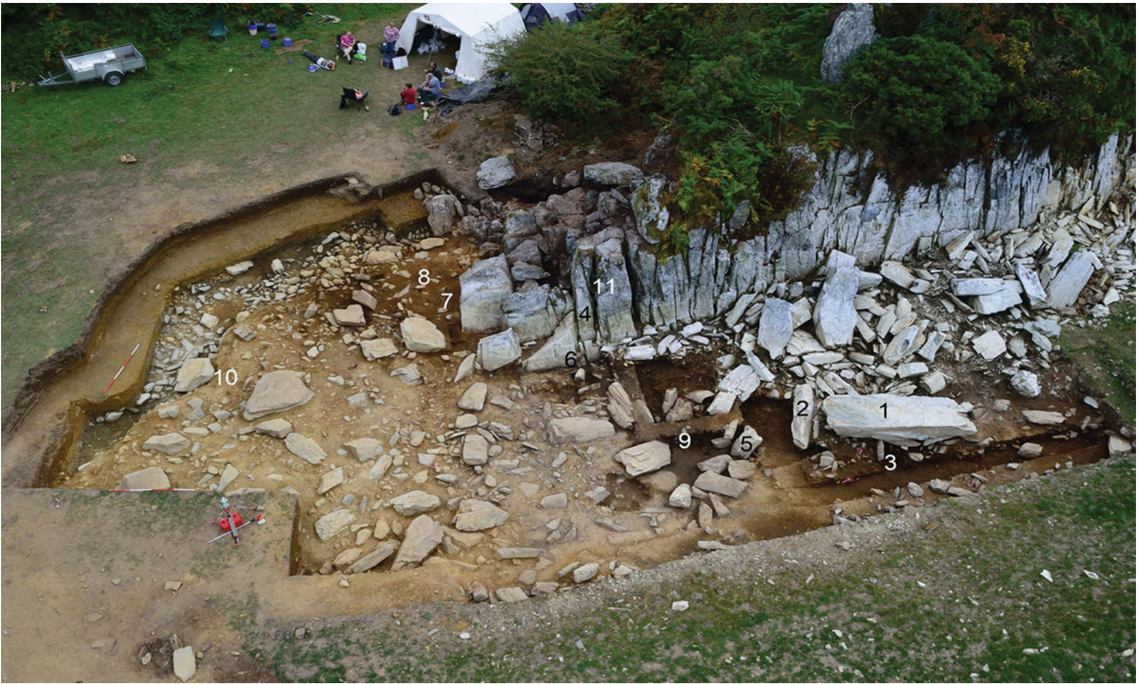
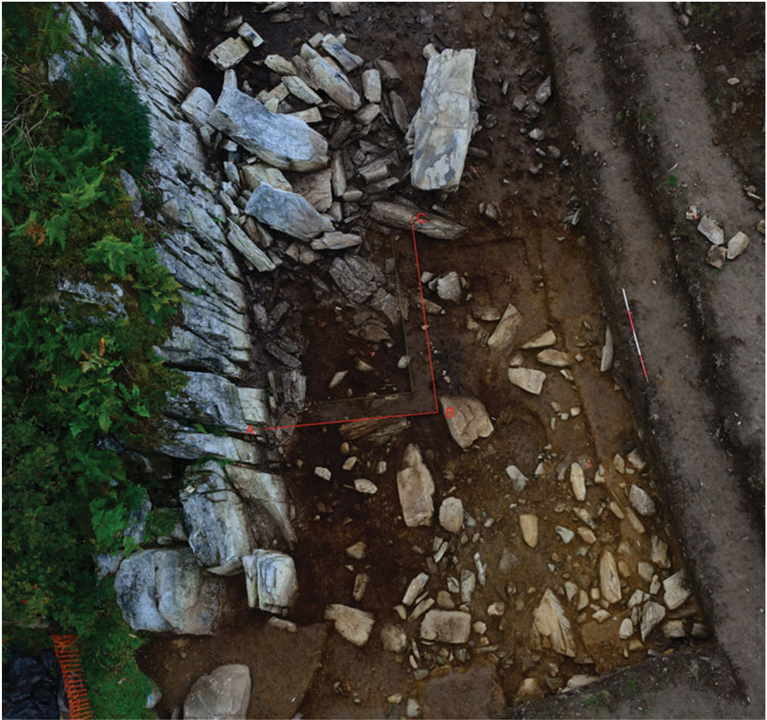
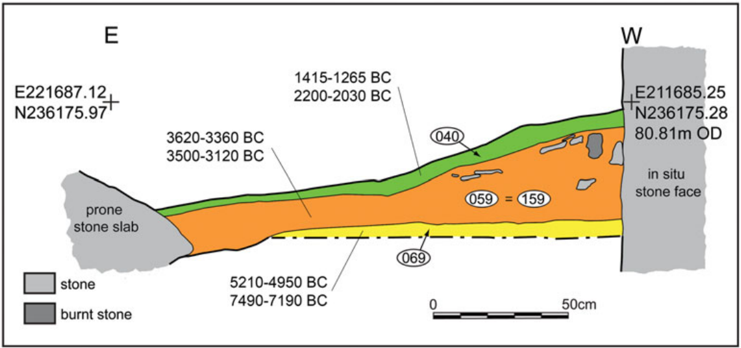
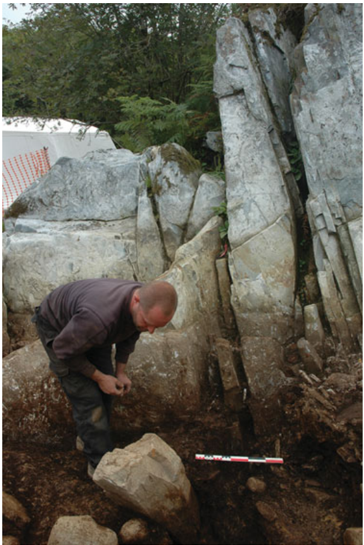
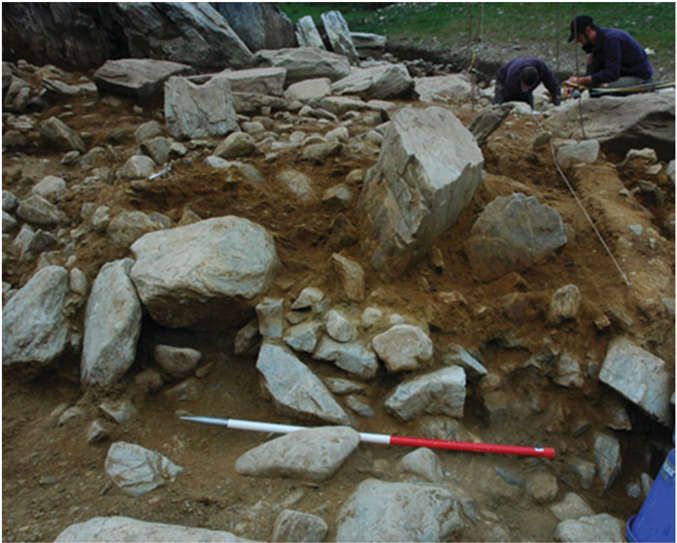
- Six megalith-quarrying features were discovered, three dating to the Bronze Age. A recess at the outcrop indicates removal of a pillar 2.5m long, 0.4m wide and c. 0.4m thick; the most probable dates for its removal are 3500–3120 cal BC (SUERC-46205; 4590±30 BP) and 3620–3360 cal BC (OxA-30502; 4667±30 BP), from hazelnut shells 1.5m away.
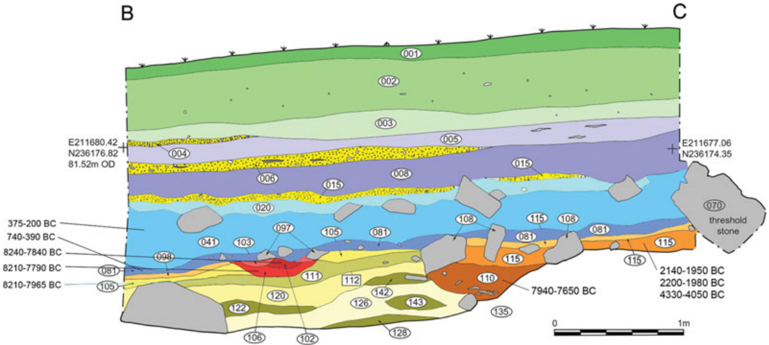
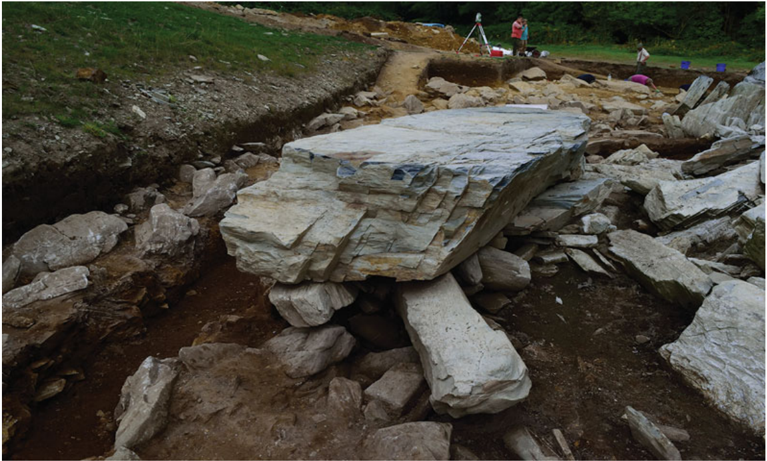
- A 4m-long prone monolith sits on an artificial platform formed from at least 8 tons of 0.3–0.4m-diameter sediment and stone dumps, reaching 0.5m depth; platform dates include 2140–1950 cal BC (OxA-31779; 3665±28 BP), 2200–1980 cal BC (OxA-31780; 3700±30 BP) and 4330–4050 cal BC (OxA-31812; 5367±33 BP). This later quarrying phase is more than a thousand years after the Middle Neolithic activity and many centuries after the bluestone erections at Stonehenge.
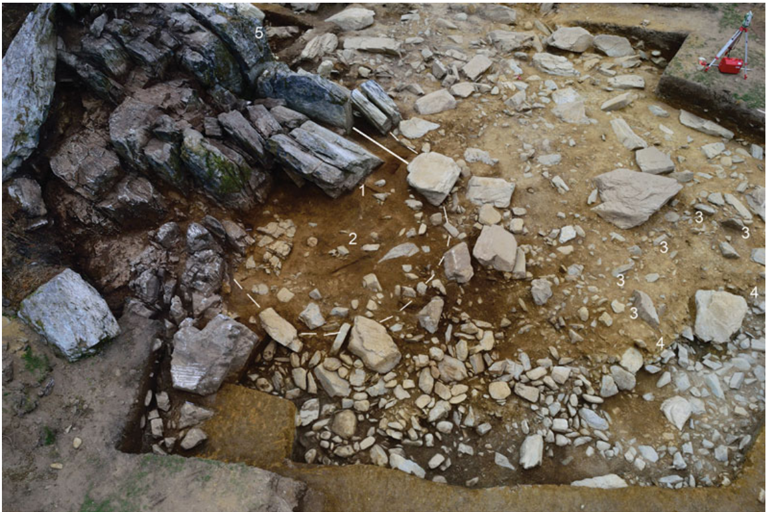
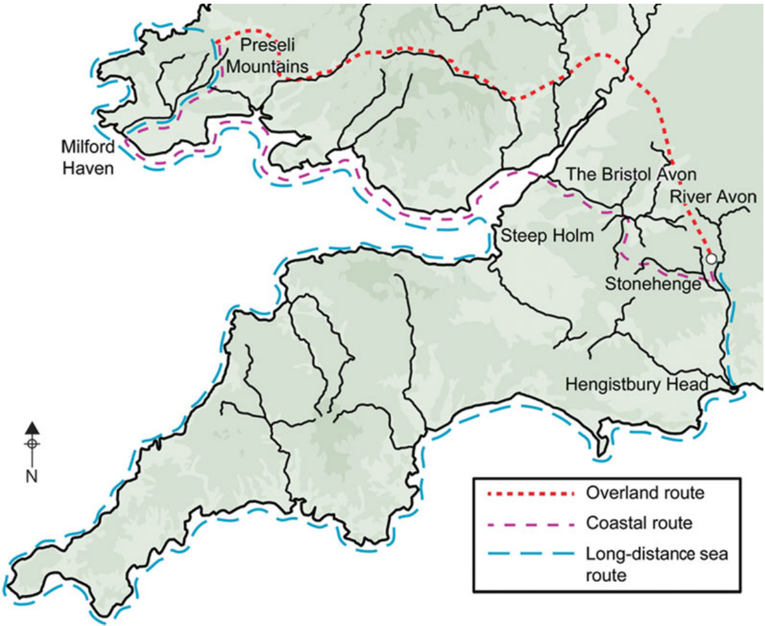
- Four Early Mesolithic hearths in a large humanly dug pit date between 8550–8330 cal BC (SUERC-50761; 9229±21 BP) and 8220–7790 cal BC (SUERC-51165; 8851±44 BP), with no evidence of Mesolithic quarrying or working of rhyolite. For transport, the paper favours an overland route and notes bluestones were on average 2 tons or less, so a 4m-long 2-ton monolith could have been carried by up to 60 people, each bearing 30–50kg.
Methods
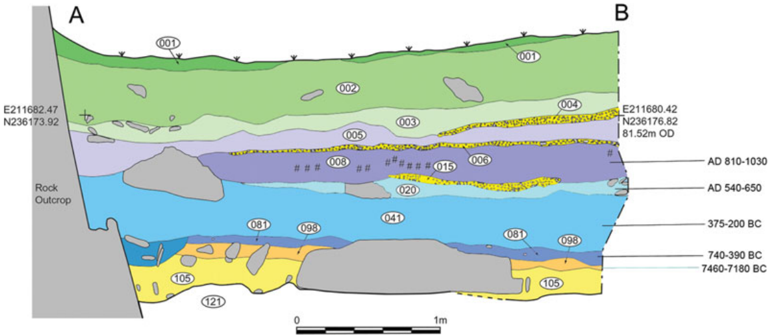
- Five field seasons of excavation in 2011–2015 north and west of the outcrop, revealing a 2m-deep stratigraphic sequence on the west side from the Early Mesolithic through Neolithic, Bronze Age and Iron Age to the ninth–eleventh centuries AD; colluvium buried and protected prehistoric quarrying remains.
- Geological and petrographic characterisation of more than 1200 “rhyolite with fabric” chippings from the Stonehenge Riverside Project, the SPACES project and 1980 Stonehenge excavations, compared by thin section and macroscopic fabric to the Craig Rhos-y-felin outcrop.
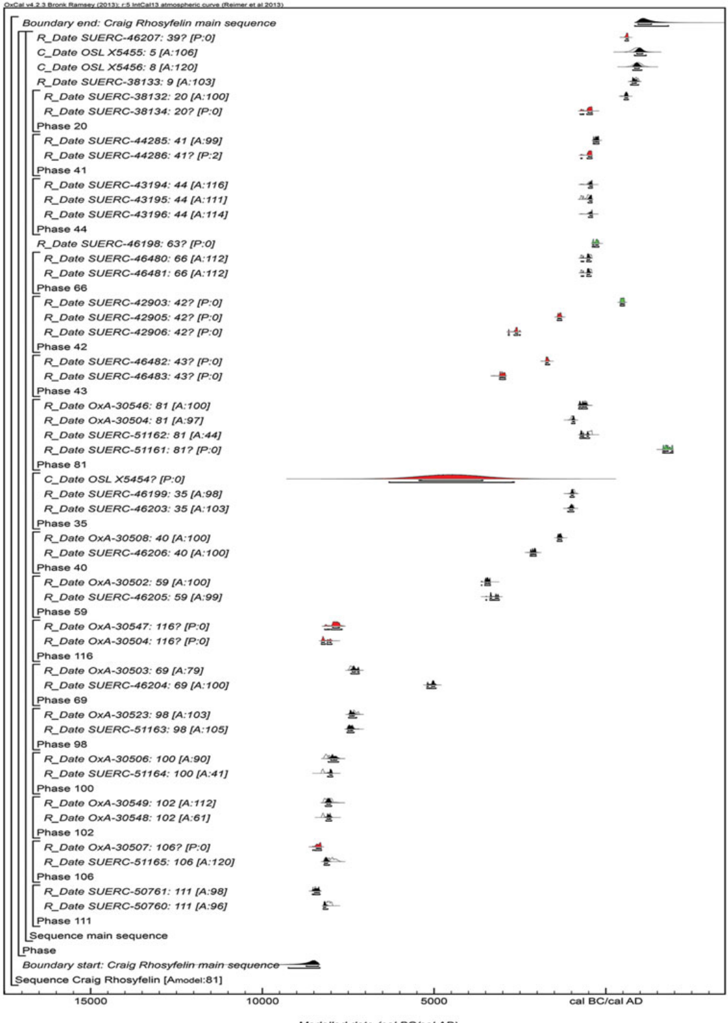
- Radiocarbon and OSL dating, with calibrated dates reported at 95.4% probability and a chronological model of the stratigraphic sequence; Table 1 lists radiocarbon and OSL dates in stratigraphic order.
Limitations
- The paper states that most quarry features at Craig Rhos-y-felin cannot yet be dated more closely than to the fourth to second millennia BC; the actual position of a “rhyolite with fabric” monolith at Stonehenge has not been positively determined; the four currently exposed rhyolitic orthostats are not of this type; and Stonehenge’s protected status makes sampling difficult. It also states that sources of the remaining rock types have yet to be located, that there is no evidence along any hypothesised transport route, and that the Group 3 spotted dolerite source remains unexcavated.
- Evident from the text: dating of quarrying events relies on associated charcoal or nutshell fragments, and some dates are described as residual or later contaminants or as inconsistent with stratigraphy; there is relatively little debris in the quarry and no evidence of fire-setting, so extraction methods are inferred rather than directly demonstrated.
Model-written summary. Check it against the paper before relying on it.
Integrity signals
Registry
Cites
Statistics
Figures
Verification
Claims the paper makes
0 Valid · 0 Not valid · 40 Not checked · 72 Own results and interpretations
A result the paper reports from its own data — it cites no other source for it, so there is none to check. The quote shows it is in the paper.
In the paper
“Most of the site was then covered by a layer of yellow colluvium (035), dated by oak charcoal to 1030-910 cal BC (combine SUERC-46199; 2799±30 BP and SUERC-46203; 2841±28 BP).”
§ Craig Rhos-y-felin: a Welsh bluestone megalith quarry for Stonehenge > Bronze Age deposits
plain- Asserted: passes — The authors put it forward as true.
- Checkable: passes — It can be checked against evidence.
- Load-bearing: unclear — It is unclear whether the paper’s conclusions depend on it.
- Based: passes — The paper gives a reason why it holds.
A result the paper reports from its own data — it cites no other source for it, so there is none to check. The quote shows it is in the paper.
In the paper
“The Neolithic layer 059 = 159 was covered by a deposit (040) radiocarbon dated by carbonised Pomoideae roundwood to 2200-2030 cal BC (SUERC-46206; 3717±27 BP) and by hazelnut shell to 1420-1260 cal BC (OxA-30508; 3076±26 BP).”
§ Craig Rhos-y-felin: a Welsh bluestone megalith quarry for Stonehenge > Bronze Age deposits
plain- Asserted: passes — The authors put it forward as true.
- Checkable: passes — It can be checked against evidence.
- Load-bearing: unclear — It is unclear whether the paper’s conclusions depend on it.
- Based: passes — The paper gives a reason why it holds.
A result the paper reports from its own data — it cites no other source for it, so there is none to check. The quote shows it is in the paper.
In the paper
“Two radiocarbon dates on carbonised hazelnut shells from this layer provide dates of 3500-3120 cal BC (SUERC-46205; 4590±30 BP) and 3620-3360 cal BC (OxA-30502; 4667±30 BP), both at 95.4% probability.”
§ Craig Rhos-y-felin: a Welsh bluestone megalith quarry for Stonehenge > Neolithic activity
plain- Asserted: passes — The authors put it forward as true.
- Checkable: passes — It can be checked against evidence.
- Load-bearing: unclear — It is unclear whether the paper’s conclusions depend on it.
- Based: passes — The paper gives a reason why it holds.
A result the paper reports from its own data — it cites no other source for it, so there is none to check. The quote shows it is in the paper.
In the paper
“Four Early Mesolithic hearths were set sequentially within the top of a large, humanly dug pit.”
§ Craig Rhos-y-felin: a Welsh bluestone megalith quarry for Stonehenge > Mesolithic activity
plain- Asserted: passes — The authors put it forward as true.
- Checkable: passes — It can be checked against evidence.
- Load-bearing: unclear — It is unclear whether the paper’s conclusions depend on it.
- Based: passes — The paper gives a reason why it holds.
A result the paper states — it cites no source for it, so there is none to check. The quote shows it is in the paper.
In the paper
“The discovery of a megalithic bluestone quarry at Craig Rhos-y-felin in 2011 marked a turning point in this research.”
§ Craig Rhos-y-felin: a Welsh bluestone megalith quarry for Stonehenge > Abstract
plainstates a cause- Asserted: passes — The authors put it forward as true.
- Checkable: passes — It can be checked against evidence.
- Load-bearing: passes — The paper’s conclusions depend on it.
- Based: passes — The paper gives a reason why it holds.
59 more claims
Create a free account to see all 112 claims and to verify the 34 references still open.
- It may state two separate claims as one. 37
- Probably not a substantial claim. 14
Self-check
Percentages, sums and reported differences re-computed from the paper’s own numbers.
Each contradiction between two passages listed here was confirmed by an independent check.
Rated minor: it would not touch a result — a value no result rests on, a p-value that stays on the same side of the significance level, or a conflict that is clerical, resolved elsewhere in the paper, or outside its own findings.
In the paper
§ Craig Rhos-y-felin: a Welsh bluestone megalith quarry for Stonehenge > Bronze Age quarry features: the prone monolith and platform
“Three determinations on Corylus charcoal from this platform fill date to 2140-1950 cal BC (OxA-31779; 3665±28 BP), 2200-1980 cal BC (OxA-31780; 3700±30 BP) and 4330-4050 cal BC (OxA-31812; 5367±33 BP), all at 95.4% probability.”
§ Craig Rhos-y-felin: a Welsh bluestone megalith quarry for Stonehenge > Mesolithic activity
“115 Platform under monolith 4330-4050 BC 5367±33 OxA-31812 Nutshell Corylus avellana”
Rated minor: it would not touch a result — a value no result rests on, a p-value that stays on the same side of the significance level, or a conflict that is clerical, resolved elsewhere in the paper, or outside its own findings.
In the paper
§ Craig Rhos-y-felin: a Welsh bluestone megalith quarry for Stonehenge > Mesolithic activity
“081 Lower topsoil 1050-910 BC 2825±25 OxA-30504 Roundwood Corylus avellana”
§ Craig Rhos-y-felin: a Welsh bluestone megalith quarry for Stonehenge > Mesolithic activity
“116 Orthostat pit fill 8280-7970 BC 8966±38 OxA-30504 Roundwood Corylus avellana”
Citations
Cites
The Dawn of European Civilization
Gordon Childe, V. (2013) · Routledge eBooks · doi:10.4324/9781315005249 · Cited by 508
Pattern and timing of retreat of the last British-Irish Ice Sheet
Clark, C. D., Hughes, A. L. C., Greenwood, S. L., Jordan, C., & Sejrup, H. P. (2012) · Quaternary Science Reviews · doi:10.1016/j.quascirev.2010.07.019 · Cited by 496
Quaternary Glaciations - Extent and Chronology - A Closer Look
(2011) · Developments in Quaternary Sciences · doi:10.1016/c2009-0-20217-0 · Cited by 270
Stonehenge for the ancestors: the stones pass on the message
Pearson, M. P., & Ramilisonina (1998) · Antiquity · doi:10.1017/s0003598x00086592 · Cited by 200
Self-citationAncient Warfare: Archaeological Perspectives
Carman, J., & Harding, A. (2002) · Cited by 171
Cult in Context: Reconsidering Ritual in Archaeology
Malone, C. (2007) · Cited by 112
Pleistocene Glaciation Limits in Great Britain
Gibbard, P. L., & Clark, C. D. (2011) · Developments in quaternary science · doi:10.1016/b978-0-444-53447-7.00007-6 · Cited by 86
The Source of the Stones of Stonehenge
Thomas, H. H. (1923) · The Antiquaries Journal · doi:10.1017/s0003581500005096 · Cited by 70
(1998) · Choice Reviews Online · doi:10.5860/choice.36-0420 · Cited by 62
The Geological Sources and Transport of the Bluestones of Stonehenge, Wiltshire, UK
Thorpe, R. S., Williams-Thorpe, O., Jenkins, D. G., Watson, J. S., Ixer, R. A., & Thomas, R. G. (1991) · Proceedings of the Prehistoric Society · doi:10.1017/s0079497x00004527 · Cited by 56
Self-citation
Research works printed but not linked: 9
- WEBLEY, D. 1976. How the west was won: prehistoric land-use in the southern marches, in G.C. Boon & J.M. Lewis (ed.) Welsh antiquity: 19-35. Cardiff: National Museum of Wales.
- Craig Rhos-y-felin, Pont Saeson is the dominant source of the Stonehenge rhyolitic 'debitage'. Archaeology in Wales 50: 21-32.
- DIXON, P. 1988. The Neolithic settlements on Crickley Hill, in C. Burgess, P. Topping, C. Mordent & M. Maddison (ed.) Enclosures and defences in the Neolithic of Western Europe (British Archaeological Reports international series 403): 75-88. Oxford: Archaeopress.
- Pitts, 2001, Hengeworld
- IXER, R.A. & P. TURNER. 2006. A detailed re-examination of the petrography of the Altar Stone and other non-sarsen sandstones from Stonehenge as a guide to their provenance. Wiltshire Archaeological and Natural History Magazine 99: 1-9.
- ATKINSON, R.J.C. 1956. Stonehenge. London: Hamish Hamilton.
- IXER, R.A. & R.E. BEVINS. 2010. The petrography, affinity and provenance of lithics from the Cursus Field, Stonehenge. Wiltshire Archaeological and Natural History Magazine 103: 1-15.
- WHITTLE, A.W.R. 1994. Excavations at Millbarrow chambered tomb, Winterbourne Monkton, north Wiltshire. Wiltshire Archaeological and Natural History Magazine 87: 1-53.
- CUNNINGTON, B.H. 1924. The 'blue stone' from Boles Barrow. Wiltshire Archaeological and Natural History Magazine 42: 431-37.
Cited by
Madgwick, R., Lamb, A. L., Sloane, H. J., Nederbragt, A. J., Albarella, U., Pearson, M. P., & Evans, J. A. (2019) · Science Advances · doi:10.1126/sciadv.aau6078 · Cited by 122
Strontium isotope analysis on cremated human remains from Stonehenge support links with west Wales
Snoeck, C., Pouncett, J., Claeys, P., Goderis, S., Mattielli, N., Pearson, M. P., Willis, C., Zazzo, A., Lee‐Thorp, J. A., & Schulting, R. (2018) · Scientific Reports · doi:10.1038/s41598-018-28969-8 · Cited by 114
Megalith quarries for Stonehenge's bluestones
Pearson, M. P., Pollard, J., Richards, C., Welham, K., Casswell, C., French, C. A. I., Schlee, D., Shaw, D., Simmons, E., Stanford, A., et al. (2019) · Antiquity · doi:10.15184/aqy.2018.111 · Cited by 50
Self-citationThe original Stonehenge? A dismantled stone circle in the Preseli Hills of west Wales
Pearson, M. P., Pollard, J., Richards, C., Welham, K., Kinnaird, T. C., Shaw, D., Simmons, E., Stanford, A., Bevins, R. E., Ixer, R. A., et al. (2021) · Antiquity · doi:10.15184/aqy.2020.239 · Cited by 47
Self-citationMaking Megaliths: Shifting and Unstable Stones in the Neolithic of the Avebury Landscape
Gillings, M., & Pollard, J. (2016) · Cambridge Archaeological Journal · doi:10.1017/s0959774316000330 · Cited by 36
Self-citationThe Prehistory of Britain and Ireland
Bradley, R. A. (2019) · Cambridge University Press eBooks · doi:10.1017/9781108419925 · Cited by 29
Houses of the Holy: Architecture and Meaning in the Structure of Stonehenge, Wiltshire, UK
Darvill, T. (2016) · Time and Mind · doi:10.1080/1751696x.2016.1171496 · Cited by 27
Neolithic and Bronze Age Pembrokeshire
Darvill, T., & Wainwright, G. (2016) · Bournemouth University Research Online (Bournemouth University) · Cited by 28
Bevins, R. E., Pirrie, D., Ixer, R. A., O'Brien, H. E., Pearson, M. P., Power, M. R., & Shail, R. (2020) · Journal of Archaeological Science · doi:10.1016/j.jas.2020.105188 · Cited by 27
Self-citationBarclay, G. J., & Brophy, K. (2020) · Archaeological Journal · doi:10.1080/00665983.2020.1769399 · Cited by 26
A Scottish provenance for the Altar Stone of Stonehenge
Clarke, A. J. I., Kirkland, C. L., Bevins, R. E., Pearce, N. J. G., Glorie, S., & Ixer, R. A. (2024) · Nature · doi:10.1038/s41586-024-07652-1 · Cited by 24
Self-citationJiménez, G. A., Rodríguez, J. A. L., & Pérez‐Valera, F. (2017) · Geoarchaeology · doi:10.1002/gea.21643 · Cited by 24
Bevins, R. E., Pearce, N. J. G., Pearson, M. P., & Ixer, R. A. (2022) · Journal of Archaeological Science Reports · doi:10.1016/j.jasrep.2022.103556 · Cited by 20
Self-citationHarding, A. (2021) · De Gruyter eBooks · doi:10.1515/9783110705805 · Cited by 20
Pearce, N. J. G., Bevins, R. E., & Ixer, R. A. (2022) · Journal of Archaeological Science Reports · doi:10.1016/j.jasrep.2022.103525 · Cited by 18
Self-citationBevins, R. E., Pearce, N. J. G., & Ixer, R. A. (2021) · Journal of Archaeological Science Reports · doi:10.1016/j.jasrep.2021.103083 · Cited by 17
Self-citationIxer, R. A., & Bevins, R. E. (2017) · Geology Today · doi:10.1111/gto.12198 · Cited by 15
Self-citationCatela, J. A. L., Romero, T. D., Molina, C. M., & Puro, L. M. C. (2023) · Archaeological and Anthropological Sciences · doi:10.1007/s12520-023-01799-0 · Cited by 14
Harris, B. (2018) · Oxford Journal of Archaeology · doi:10.1111/ojoa.12142 · Cited by 13
Müller, W., Lugli, F., McCormack, J., Evans, D., Anczkiewicz, R., Bondioli, L., & Nava, A. (2024) · Elsevier eBooks · doi:10.1016/b978-0-323-99762-1.00105-4 · Cited by 13
Bevins, R. E., Pearce, N. J. G., Pirrie, D., Ixer, R. A., Hillier, S., Turner, P., & Power, M. R. (2023) · Journal of Archaeological Science Reports · doi:10.1016/j.jasrep.2023.103973 · Cited by 13
Self-citationLocal and exotic sources of sarsen debitage at Stonehenge revealed by geochemical provenancing
Ciborowski, T. J. R., Nash, D. J., Darvill, T., Chan, B., Pearson, M. P., Pullen, R., Richards, C., & Anderson-Whymark, H. (2024) · Journal of Archaeological Science Reports · doi:10.1016/j.jasrep.2024.104406 · Cited by 11
Self-citationCatela, J. A. L. (2017) · theses.fr (ABES) · doi:10.70675/c39b2cdbz43f3z4a78z9fe2z1edde5755a54 · Cited by 12
Mays, S., Roberts, D., Marshall, P., Pike, A. W. G., van Heekeren, V., Bronk Ramsey, C., Dunbar, E., Reimer, P., Linscott, B., Radini, A., et al. (2018) · Journal of Archaeological Science: Reports · doi:10.1016/j.jasrep.2018.06.008 · Cited by 10
Pearson, M. P., Bevins, R. E., Pearce, N. J. G., Ixer, R. A., Pollard, J., Richards, C., & Welham, K. (2022) · Journal of Archaeological Science Reports · doi:10.1016/j.jasrep.2022.103697 · Cited by 10
Self-citationWang, N., Dong, C., Hong-gen, X., & Zhuang, Y. (2020) · Geoarchaeology · doi:10.1002/gea.21793 · Cited by 10
Bevins, R. E., Atkinson, N., Ixer, R. A., & Evans, J. A. (2016) · Journal of the Geological Society · doi:10.1144/jgs2016-042 · Cited by 10
Self-citationStonehenge and its Altar Stone: the significance of distant stone sources
Pearson, M. P., Bevins, R. E., Bradley, R. A., Ixer, R. A., Pearce, N., & Richards, C. (2025) · Archaeology International · doi:10.14324/ai.27.1.13 · Cited by 10
Self-citationArchaeology and legend: investigating Stonehenge
Pearson, M. P. (2021) · Archaeology International · doi:10.14324/111.444.ai.2021.09 · Cited by 9
Zena, A. G. (2021) · Journal of Anthropological Archaeology · doi:10.1016/j.jaa.2021.101372 · Cited by 8
A Late Bronze Age ring-forst at Bayvil Farm, Pembrokeshire
Pearson, M. P., Casswell, C., & Welham, K. (2018) · Bournemouth University Research Online (Bournemouth University) · Cited by 7
Self-citationThe Neolithic of Europe: Papers in Honour of Alasdair Whittle
BICKLE, P., CUMMINGS, V., HOFMANN, D., & POLLARD, J. (2017) · Oxbow Books · doi:10.2307/j.ctvh1dgtm · Cited by 7
The Origins of Stonehenge: On the Track of the bluestones
Pearson, M. P., Pollard, J., Richards, C., & Welham, K. (2017) · Archaeology International · doi:10.5334/ai-353 · Cited by 6
Self-citationBarrientos, G., & Sanjuán, L. G. (2020) · Journal of Archaeological Method and Theory · doi:10.1007/s10816-020-09489-0 · Cited by 6
Bevins, R. E., Ixer, R. A., Pearce, N. J. G., Scourse, J. D., & Daw, T. M. (2023) · Geoarchaeology · doi:10.1002/gea.21971 · Cited by 5
Self-citationRetracing the footsteps of H.H. Thomas: a review of his Stonehenge bluestone provenancing study
Bevins, R. E., & Ixer, R. A. (2018) · Antiquity · doi:10.15184/aqy.2018.10 · Cited by 5
Self-citationFrom Highlands to Henge: Refining the Provenance and Transport Pathways of Stonehenge's Altar Stone
Clarke, A. J. I., Veness, R., Kirkland, C. L., Clark, C. D., Gandy, N., Emery, A., Bradley, S., Ely, J. C., & Ádám, I. (2026) · Journal of Quaternary Science · doi:10.1002/jqs.70080 · Cited by 4
A bluestone boulder at Stonehenge: implications for the glacial transport theory
John, B. (2024) · E&G Quaternary Science Journal · doi:10.5194/egqsj-73-117-2024 · Cited by 4
Excavations at the Castell Mawr Iron Age hillfort, Pembrokeshire
Pearson, M. P., Casswell, C., & Welham, K. (2019) · Bournemouth University Research Online (Bournemouth University) · doi:10.5284/1081838 · Cited by 4
Self-citationHarris, B. (2016) · Public Archaeology · doi:10.1080/14655187.2016.1261250 · Cited by 4
World Prehistory and Archaeology: Pathways Through Time
Chazan, M. (2021) · Routledge eBooks · doi:10.4324/9780367815271 · Cited by 5
Detrital zircon–apatite fingerprinting challenges glacial transport of Stonehenge’s megaliths
Clarke, A. J. I., & Kirkland, C. L. (2026) · Communications Earth & Environment · doi:10.1038/s43247-025-03105-3 · Cited by 3
McCurdy, L., & Hiquet, J. (2025) · Ancient Mesoamerica · doi:10.1017/s0956536121000596 · Cited by 3
Puro, L. M. C., Romero, T. D., Rodríguez, J. A. L., Díaz-Guardamino, M., Martínez‐Sevilla, F., Medialdea, A., del Val, M., Alcaina-Mateos, J., Vidal, J. R., Guinea, F. M., et al. (2025) · Journal of Archaeological Science · doi:10.1016/j.jas.2025.106263 · Cited by 2
What if none of the Building Stones at Stonehenge Came from Wiltshire?
Whitaker, K. (2019) · Oxford Journal of Archaeology · doi:10.1111/ojoa.12161 · Cited by 2
Wibowo, U. P., Handini, R., Simanjuntak, T., Sofian, H. O., & Maulana, S. (2018) · AMERTA · doi:10.24832/amt.v36i2.101-114 · Cited by 2
Witcher, R. (2019) · Antiquity · doi:10.15184/aqy.2019.10 · Cited by 2
The enigmatic ‘Newall boulder’ excavated at Stonehenge in 1924: New data and correcting the record
Bevins, R. E., Pearce, N. J. G., Ixer, R. A., Scourse, J. D., Daw, T. M., Pearson, M. P., Pitts, M., Field, D. B., Pirrie, D., Saunders, I., et al. (2025) · Journal of Archaeological Science Reports · doi:10.1016/j.jasrep.2025.105303 · Cited by 1
Self-citationBradley, R. A. (2019) · Cambridge University Press eBooks · doi:10.1017/9781108419925.001 · Cited by 1
Garrido, T. C. V. (2023) · Pesquisa e Ensino em Ciências Exatas e da Natureza · doi:10.56814/pecen.v7i1.1915 · Cited by 2
The Stonehenge bluestones did not come from Waun Mawn in West Wales
John, B. (2024) · The Holocene · doi:10.1177/09596836241236318 · Cited by 1
Singtuen, V., Jansamut, S., Pongsaisri, N., & Phajuy, B. (2024) · Heritage Science · doi:10.1186/s40494-024-01259-5 · Cited by 1
McVeigh, T. (2016) · Arrow@dit (Dublin Institute of Technology) · doi:10.13025/17732 · Cited by 1
Origins of sedentism: possible roles of ideology and shamanism in the transition
Wickham, R. D. (2019) · ANU Open Research (Australian National University) · doi:10.25911/5d134a48535bc · Cited by 1
Menu, B. (2022) · theses.fr (ABES) · doi:10.70675/4195b74ez0aacz40f8zadcez1b72a16f6b6d · Cited by 1
Stonehenge, druidit ja kulttuurinen muisti
Bergholm, A. (2018) · Uskonnontutkija - Religionsforskaren · doi:10.24291/uskonnontutkija.v7i1.71205
Whitaker, K. (2019) · European Journal of Archaeology · doi:10.1017/eaa.2019.30
Bradley, R. A. (2019) · Cambridge University Press eBooks · doi:10.1017/9781108419925.006
Bithell, S. (2020) · Durham e-Theses (Durham University)
Bradley, R. A. (2019) · Cambridge University Press eBooks · doi:10.1017/9781108419925.003
Bradley, R. A. (2019) · Cambridge University Press eBooks · doi:10.1017/9781108419925.004
Bradley, R. A. (2019) · Cambridge University Press eBooks · doi:10.1017/9781108419925.002
Bradley, R. A. (2019) · Cambridge University Press eBooks · doi:10.1017/9781108419925.005
Harding, A. (2021) · De Gruyter eBooks · doi:10.1515/9783110705805-007
Bradley, R. A. (2019) · Cambridge University Press eBooks · doi:10.1017/9781108419925.007
Bradley, R. A. (2019) · Cambridge University Press eBooks · doi:10.1017/9781108419925.008
Pearson, M. P. (2016) · Encyclopedia of earth sciences series/Encyclopedia of earth sciences · doi:10.1007/978-1-4020-4409-0_108
Summary—Whither Archaeological Chemistry?
Pollard, A. M., Heron, C., & Armitage, R. A. (2016) · Royal Society of Chemistry eBooks · doi:10.1039/bk9781782624264-00532
Pearson, M. P. (2023) · Encyclopedia of earth sciences series/Encyclopedia of earth sciences · doi:10.1007/978-3-030-44600-0_108-1
Prehistoric Landscape Change Around the Sources of Stonehenge’s Bluestones in Preseli, Wales
Spencer, D. E., Molloy, K., Pearson, M. P., Fyfe, R., & Potito, A. P. (2025) · Environmental Archaeology · doi:10.1080/14614103.2025.2574741
Singtuen, V., Jansamut, S., Pongsaisri, N., & Phajuy, B. (2024) · Figshare · doi:10.6084/m9.figshare.26713933
Long-distance landscapes: from quarries to monument at Stonehenge.
Pearson, M. P., Bevins, R., Ixer, R. A., Pollard, J., Richards, C., & Welham, K. (2020) · Bournemouth University Research Online (Bournemouth University)
Self-citationRemembered and imagined belongings: Stonehenge in the age of first metals
Pollard, C. J., Garwood, P., Pearson, M. P., Richards, C., Thomas, J., & Welham, K. (2017) · Bournemouth University Research Online (Bournemouth University)
Self-citation
Metadata
- Authors
- Parker Pearson, M., Bevins, R., Ixer, R., Pollard, J., Richards, C., Welham, K., Chan, B., Edinborough, K., Hamilton, D., Macphail, R., Schlee, D., Schwenninger, J.-L., Simmons, E., & Smith, M.
- Affiliations
- National Museum Wales (GB)
- University College London (GB)
- University of Southampton (GB)
- University of Manchester (GB)
- Bournemouth University (GB)
- Leiden University (NL)
- Scottish Universities Environmental Research Centre (GB)
- University of Oxford (GB)
- University of Sheffield (GB)
- ORCID
- Venue
- Antiquity
- Publisher
- Antiquity Publications
- Published
- 2015-12
- Volume
- 89
- Issue
- 348
- Pages
- 1331-1352
- ISSN
- 0003-598X (ISSN-L)
- 1745-1744
- OpenAlex
- W2195708234
- Cited by
- 73
- References
- 39
- Citations by year
- 2026: 2 · 2025: 5 · 2024: 7 · 2023: 5 · 2022: 4 · 2021: 7 · 2020: 6 · 2019: 16 · 2018: 7 · 2017: 6 · 2016: 8
- FWCI
- 30.34
- Type
- journal article
- Language
- en
- Open access
- hybrid
- doi.org
- Locations
- Antiquity (publishedVersion, cc-by)
- Bournemouth University Research Online (Bournemouth University) (acceptedVersion)
- Enlighten: Publications (University of Glasgow) (acceptedVersion)
- ePrints Soton (University of Southampton) (acceptedVersion)
- UCL Discovery (University College London) (submittedVersion)
- Funders
- Arts and Humanities Research Council (AH/H000879/1)
- Natural Environment Research Council (NRCF010002)
- Topics
- Social Sciences › Arts and Humanities › Archeology (arts and humanities) › Archaeological and Geological Studies
- Social Sciences › Arts and Humanities › Archeology (arts and humanities) › Historical and Architectural Studies
- Social Sciences › Arts and Humanities › Archeology (arts and humanities) › Ancient and Medieval Archaeology Studies
- Keywords
- Stonehenge, Neolithic, Early Bronze Age, South Wales, direct dating
About these checks
Registry, retraction, Cites and statistics results are computed, not judged, with one exception: a printed reference that no index lists is read once by a model before it counts as a citation error. Claims are extracted by a model and kept only when their quote appears verbatim in the text; each cited source is then checked, with a model’s help, for whether it says what the claim relies on. Those verdicts can be wrong — read the claim’s quote and the cited source before relying on one.
A language model drew the claims from the paper on 2026-11-18, under version 3 of the claim definition (model deepseek-v4.1-flash, prompt extract-v3).
A second model labelled each claim on 2026-11-18 (model jev-1.13-20260917, definition revision gold-guideline-v0.2).
Statistics and arithmetic are recomputed, not judged.
Confidence bands are shown only for fields calibrated on our annotated test set. None is calibrated yet, so no band is shown.
What counts as a claim ›How we measure confidence ›How we check this ›
Are you an author, or do you see a problem with this page? Request a review
Data sources
Bibliographic data: Semantic Scholar, OpenAlex, Crossref.
Contains information from the Semantic Scholar Academic Graph Datasets, made available under the ODC Attribution License (ODC-BY 1.0).
Semantic Scholar’s data is described in: Kinney, R., et al. (2023). The Semantic Scholar Open Data Platform. arXiv:2301.10140.
