

Seals and signs: tracing the origins of writing in ancient South-west Asia
Open accessThe DOI matches its Crossref record; 53 of the 55 references it cites were found in a registry or an index, and 2 are not checked yet; none of the 38 sources its claims cite is checked for support yet.
Abstract
Administrative innovations in South-west Asia during the fourth millennium BC, including the cylinder seals that were rolled on the earliest clay tablets, laid the foundations for proto-cuneiform script, one of the first writing systems. Seals were rich in iconography, but little research has focused on the potential influence of specific motifs on the development of the sign-based proto-cuneiform script. Here, the authors identify symbolic precursors to fundamental proto-cuneiform signs among late pre-literate seal motifs that describe the transportation of vessels and textiles, highlighting the synergy of early systems of clay-based communication.
Checked 2026-11-24 · 2 references not checked yet
Overview
CoChat Summary
TL;DR
The paper argues that specific late pre-literate seal motifs—especially fringed cloth and netted/suspended vessels—were symbolic precursors to proto-cuneiform signs, showing synergy between sealing and early writing in fourth-millennium BC South-west Asia. It identifies contextual parallels between seal imagery and proto-cuneiform signs on transitional records such as bullae and numerical tablets.
Key findings
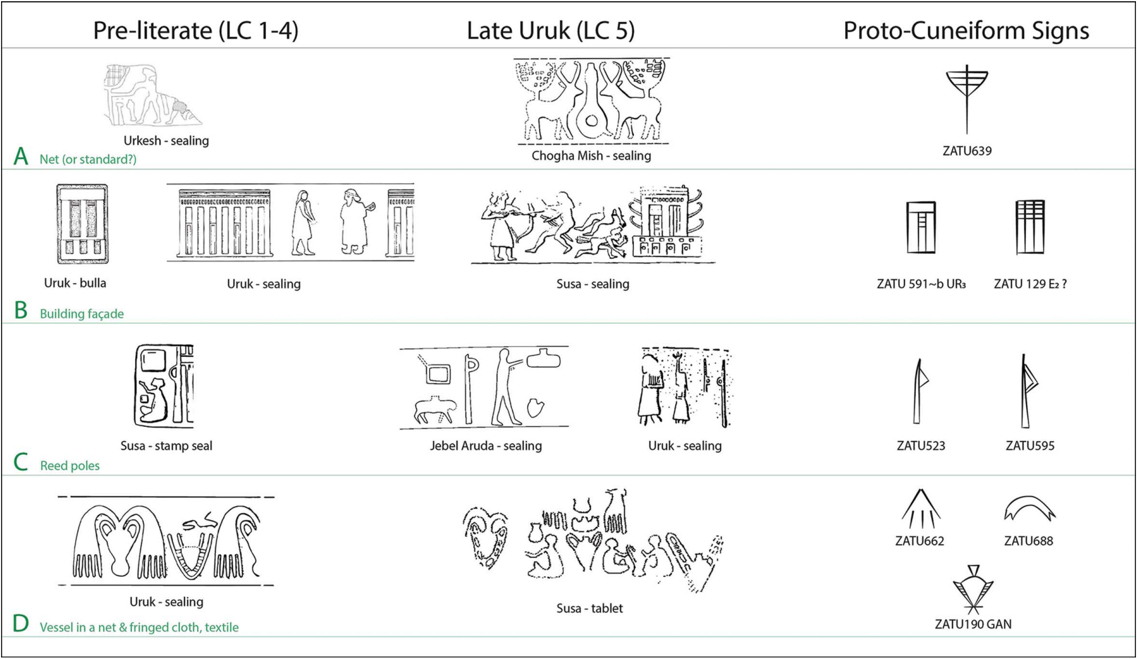
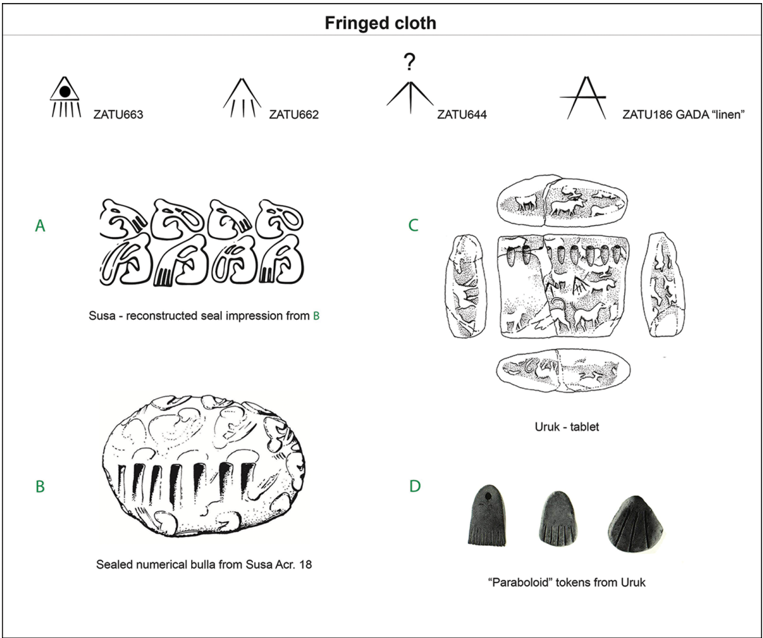
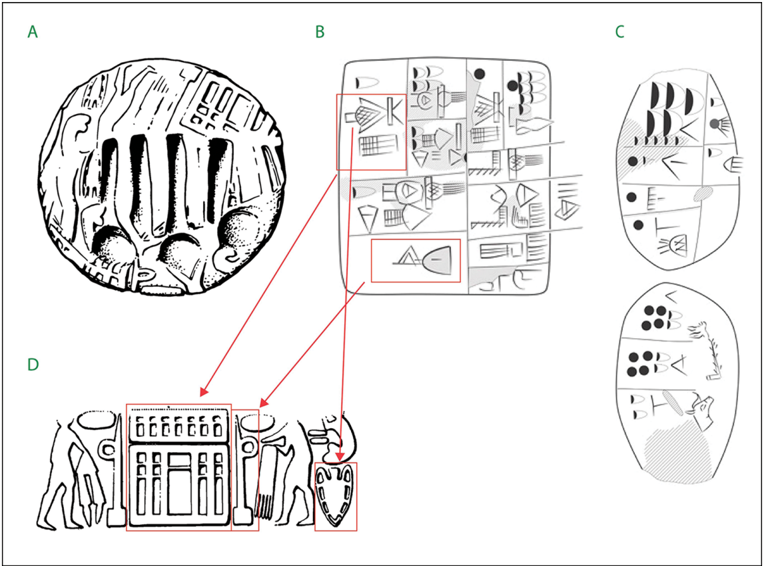
- Proto-cuneiform is first attested at Uruk c. 3350–3000 BC; the authors identify convincing parallels between pre-literate seal elements and proto-cuneiform signs, including fringed cloth (ZATU662) and netted/suspended vessel signs (ZATU190 and ZATU191–194), plus façade and flag/pole motifs.
- These motifs appear on clay sealings, bullae and numerical tablets and pre-date proto-cuneiform, arguing for continuity from pre-literate symbol systems to writing; they often depict production, transport and presentation of textiles/vessels to buildings or persons.
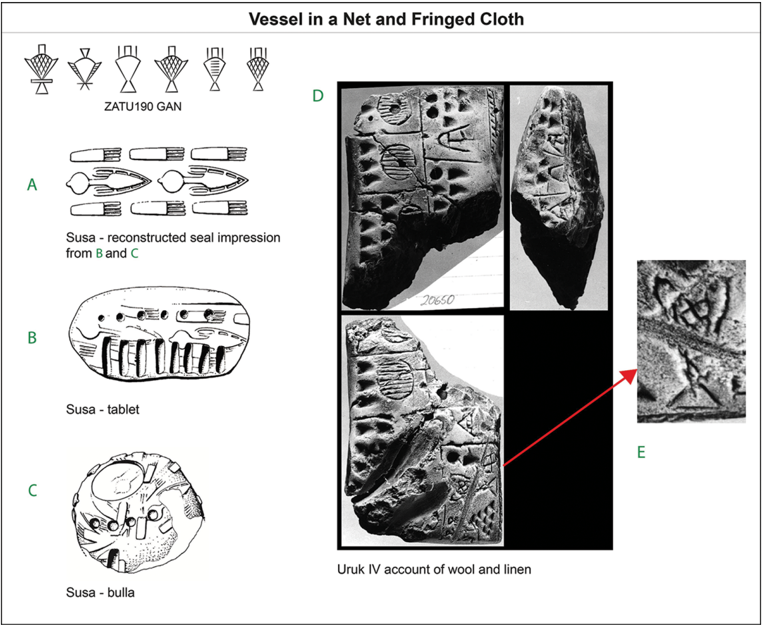
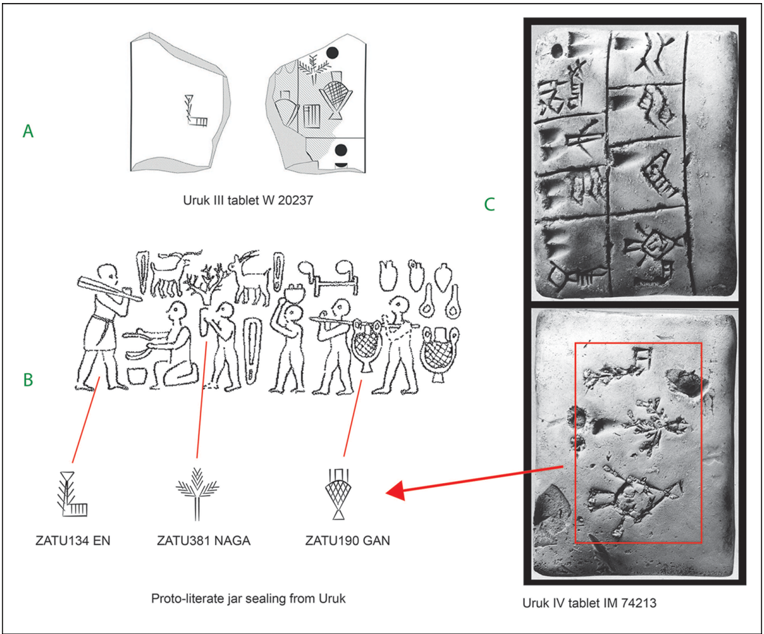
- In an Uruk IV tablet accounting 21 products or “vessel deliveries,” seven deliveries are possibly associated with different officials; a summary line mimics a rolled-out cylinder seal with the sequence “suspended vessel”–“alkaline plant”(?)–EN.
- Many of the approximately 800 proto-cuneiform signs remain poorly understood, with the iconic referent of more than half either contested or unidentified; the authors suggest seals and texts operated synergistically to document delivery of similar products to temple households while remaining distinct information systems.
Methods
- Design: comparative iconographic and contextual analysis of late pre-literate seal motifs and proto-cuneiform signs, explicitly avoiding simple shape comparison as lacking a sound methodological basis.
- Data: survey of a corpus of seals from LC-1 to LC-4 contexts (c. 4400–3400 BC) across South-west Asia, alongside proto-cuneiform tablets, bullae, numerical tablets and seal impressions; full list in OSM Appendix 1.
- Analysis: correlations supported by contextual clues, including co-occurrence of motifs/signs, administrative contexts and transitional document types, using conventional sign labels and ZATU numbers.
Limitations
- Stated in the paper: interpreting seal images and signs and their connection is challenging; relationships remain difficult to define; “symbol-hopping” remains difficult to confirm; the range of products indicated by the seal images and signs is unclear; further clarification is still needed.
- Stated in the paper: many proto-cuneiform signs are poorly understood, with more than half of iconic referents contested or unidentified, and poor understanding of the script hampers correlating tablet seal motifs with tablet contents.
- Evident from the text: dating is problematic, and many seals are difficult to date securely as pre- or proto-literate (Table 1 caption); the paper also states it is not clear whether the motifs represent commodity processing enacted locally or long-distance/inter-city exchanges.
Model-written summary. Check it against the paper before relying on it.
Integrity signals
Registry
Cites
Statistics
Figures
Verification
Claims the paper makes
0 Valid · 0 Not valid · 30 Not checked · 63 Own results and interpretations
A result the paper reports from its own data — it cites no other source for it, so there is none to check. The quote shows it is in the paper.
In the paper
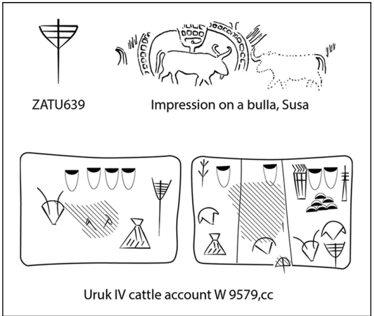
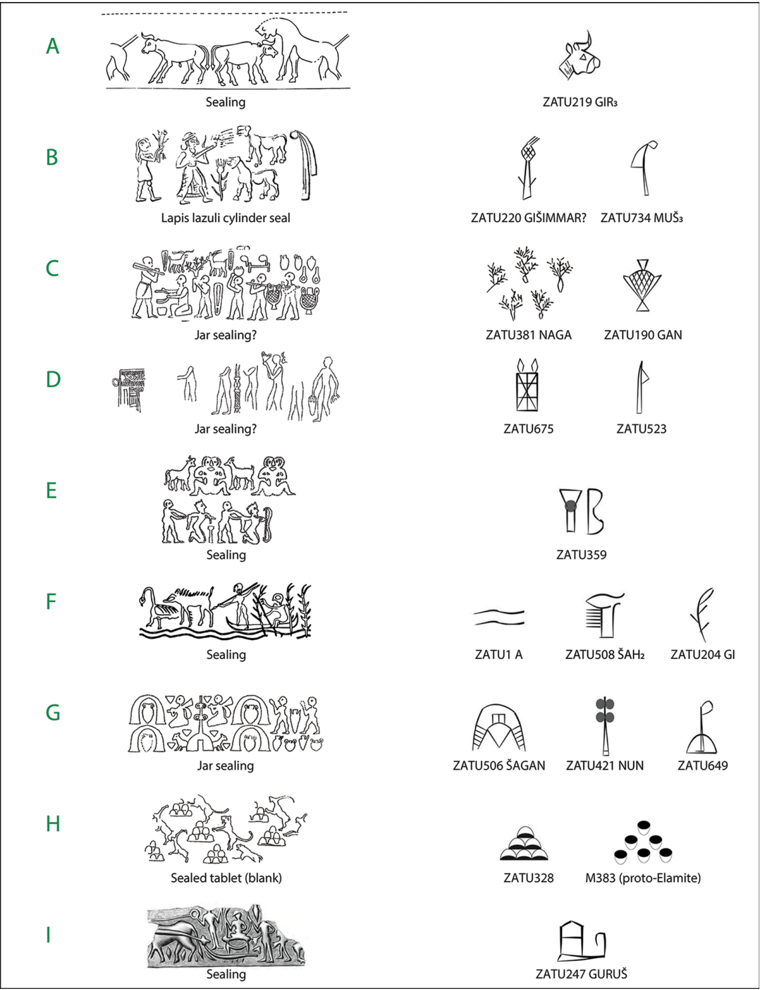
“For example, a 'pole and net' sign (ZATU639) that appears alongside cattle signs in tablets is similar to an object sometimes shown with cattle in pre-and proto-literate seals (Figure 4).”
§ Seals and signs: tracing the origins of writing in ancient South-west Asia > Late pre-literate seal motifs and proto-cuneiform correlates
plainstates an association- Asserted: passes — The authors put it forward as true.
- Checkable: passes — It can be checked against evidence.
- Load-bearing: unclear — It is unclear whether the paper’s conclusions depend on it.
- Based: passes — The paper gives a reason why it holds.
A result the paper reports from its own data — it cites no other source for it, so there is none to check. The quote shows it is in the paper.
In the paper
“Plant shapes reveal connections between script and seals beginning with the proto-literate material (Figure 9B & C)”
§ Seals and signs: tracing the origins of writing in ancient South-west Asia > Symbol-sharing in the proto-literate period
plainstates an association- Asserted: passes — The authors put it forward as true.
- Checkable: passes — It can be checked against evidence.
- Load-bearing: unclear — It is unclear whether the paper’s conclusions depend on it.
- Based: passes — The paper gives a reason why it holds.
A result the paper states — it cites no source for it, so there is none to check. The quote shows it is in the paper.
In the paper
“and the water in a boar-hunting scene parallels the protocuneiform sign ZATU1 (Figure 9F).”
§ Seals and signs: tracing the origins of writing in ancient South-west Asia > Symbol-sharing in the proto-literate period
plainstates an associationSingle case- Asserted: passes — The authors put it forward as true.
- Checkable: passes — It can be checked against evidence.
- Load-bearing: unclear — It is unclear whether the paper’s conclusions depend on it.
- Based: passes — The paper gives a reason why it holds.
A result the paper reports from its own data — it cites no other source for it, so there is none to check. The quote shows it is in the paper.
In the paper
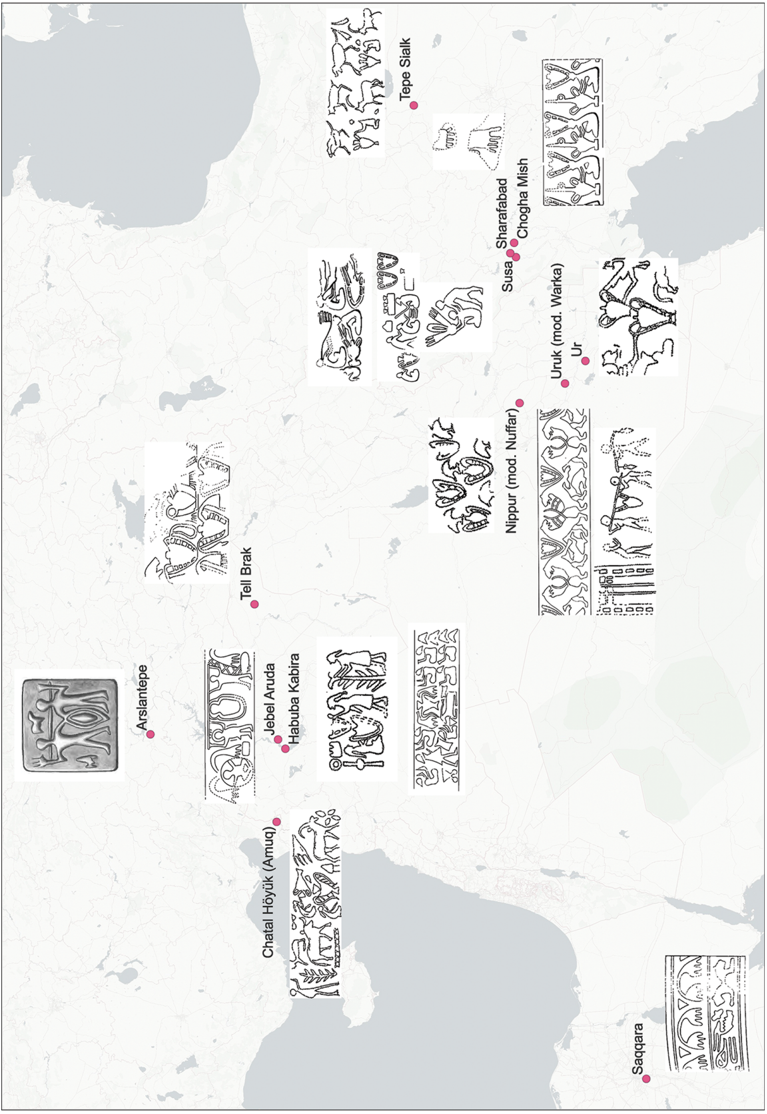
“In seals, the fringed cloth and netted-vessel often appear individually or together in scenes of production, transport and presentation to a building/person, or in heraldic configurations (Figure 7, full list in OSM Appendix 1).”
§ Seals and signs: tracing the origins of writing in ancient South-west Asia > Late pre-literate seal motifs and proto-cuneiform correlates
plainstates an association- Asserted: passes — The authors put it forward as true.
- Checkable: passes — It can be checked against evidence.
- Load-bearing: unclear — It is unclear whether the paper’s conclusions depend on it.
- Based: passes — The paper gives a reason why it holds.
A result the paper states — it cites no source for it, so there is none to check. The quote shows it is in the paper.
In the paper
“Dairy products represented by vessels are often recorded alongside textiles on proto-cuneiform tablets.”
§ Seals and signs: tracing the origins of writing in ancient South-west Asia > Late pre-literate seal motifs and proto-cuneiform correlates
plainstates an association- Asserted: passes — The authors put it forward as true.
- Checkable: passes — It can be checked against evidence.
- Load-bearing: unclear — It is unclear whether the paper’s conclusions depend on it.
- Based: passes — The paper gives a reason why it holds.
57 more claims
Create a free account to see all 93 claims and to verify the 11 references still open.
- It may state two separate claims as one. 26
- Probably not a substantial claim. 11
Citations
Cites
Nissen, H. J., Damerow, P., & Englund, R. K. (1994) · Max Planck Digital Library · Cited by 367
Ancient Mesopotamia at the Dawn of Civilization: The Evolution of an Urban Landscape
Algaze, G. (2008) · University of Chicago Press eBooks · doi:10.7208/chicago/9780226013787.001.0001 · Cited by 280
Textile Extensification, Alienation, and Social Stratification in Ancient Mesopotamia
McCorriston, J. (1997) · Current Anthropology · doi:10.1086/204643 · Cited by 222
Origins and ancient history of wine
McGovern, P. E., Fleming, S. J., & Katz, S. H. (1995) · Gordon and Breach eBooks · Cited by 195
Prehistories of Commodity Branding
Wengrow, D. (2008) · Current Anthropology · doi:10.1086/523676 · Cited by 178
Mesopotamian civilization: the material foundations
(1997) · Choice Reviews Online · doi:10.5860/choice.34-5231 · Cited by 150
Algaze, G., Brenties, B., Knapp, A. B., Kohl, P. L., Kotter, W. R., Lamberg‐Karlovsky, C. C., Schwartz, G. M., Weiss, H., Wenke, R. J., Wright, R. P., et al. (1989) · Current Anthropology · doi:10.1086/203786 · Cited by 142
First Impressions: Cylinder Seals in the Ancient Near East
Bleibtreu, E., & Collon, D. (1996) · Journal of the American Oriental Society · doi:10.2307/605709 · Cited by 112
Investigating artistic environments in the ancient Near East
Gunter, A. C., & Institution), A. M. S. G. (. (1990) · doi:10.5479/sil.501160.39088016139750 · Cited by 100
Artefacts of Complexity: Tracking the Uruk in the Near East
Postgate, J. N. (2002) · Cited by 95
The invention of cuneiform: writing in Sumer
(2004) · Choice Reviews Online · doi:10.5860/choice.41-6691 · Cited by 92
Critical Approaches to Ancient Near Eastern Art
Brown, B. A. (2013) · De Gruyter eBooks · doi:10.1515/9781614510352 · Cited by 91
Trade and power in the fifth and fourth millennia BC: New evidence from northern Mesopotamia
Oates, J. (1993) · World Archaeology · doi:10.1080/00438243.1993.9980216 · Cited by 80
Before Writing. Volume I: From Counting to Cuneiform
Zimansky, P. E., & Schmandt‐Besserat, D. (1993) · Journal of Field Archaeology · doi:10.2307/530080 · Cited by 70
Image, thought, and the making of social worlds
Wengrow, D., Küchler, S., Lagrou, E., Pettitt, P., van Eck, C., Knappett, C., Quilter, J., Severi, C., Martínez-Ruiz, B., Selz, G. J., et al. (2022) · doi:10.11588/propylaeum.842 · Cited by 69
Bréniquet, C. (2008) · HAL · Cited by 57
Sign and Image: Representations of Plants on the Warka Vase of Early Mesopotamia
Miller, N. F., Jones, P. H., & Pittman, H. (2015) · ScholarlyCommons (University of Pennsylvania) · Cited by 52
Ameri, M., Costello, S. K., Jamison, G., & Scott, S. (2018) · Cambridge University Press eBooks · doi:10.1017/9781108160186 · Cited by 48
Archaic City Seals and the Question of Early Babylonian Unity
Steinkeller, P. (2002) · Penn State University Press eBooks · doi:10.1515/9781575065335-020 · Cited by 46
Englund, R. K. (1993) · Science · doi:10.1126/science.260.5114.1670 · Cited by 46
Zeichenliste der archaischen Texte aus Uruk
Powell, M. A., Green, M. W., Nissen, H. J., Damerow, P., & Englund, R. K. (1990) · Journal of the American Oriental Society · doi:10.2307/604549 · Cited by 45
The Role of Women in Work and Society in the Ancient Near East
Lion, B., Michel, C., & Walter de Gruyter Inc. (2016) · HAL · Cited by 43
Mesopotamia’s invisible exports in the third millennium B.C
Crawford, H. E. W. (1973) · World Archaeology · doi:10.1080/00438243.1973.9979570 · Cited by 39
The Role of Women in Work and Society in the Ancient Near East
Vigo, M. (2016) · De Gruyter eBooks · doi:10.1515/9781614519089 · Cited by 35
Textile Terminologies from the Orient to the Mediterranean and Europe, 1000 BC to 1000 AD
Gaspa, S., Michel, C., & Nosch, M. L. B. (2017) · Lincoln (University of Nebraska) · doi:10.13014/k2s46pv · Cited by 29
Materiality of Writing in Early Mesopotamia
Balke, T. E., & Tsouparopoulou, C. (2016) · De Gruyter eBooks · doi:10.1515/9783110459630 · Cited by 27
Circle, C., Suite, Louisville, Colorado, & -, P. (2012) · University Press of Colorado eBooks · doi:10.5876/9781607321996 · Cited by 25
Uruk: Early Administration Practices and the Development of Proto-Cuneiform Writing
Nissen, H.-J. (2016) · Archéo-Nil. Revue de la société pour l'étude des cultures prépharaoniques de la vallée du Nil · doi:10.3406/arnil.2016.1102 · Cited by 24
Changing views on ancient Near Eastern mathematics
Høyrup, J., & Damerow, P. (2001) · Max Planck Institute for Plasma Physics · Cited by 23
The Art of Elam ca. 4200–525 bc
Álvarez-Mon, J. (2020) · doi:10.4324/9781003018254 · Cited by 22
Pittman, H. (2018) · Cambridge University Press eBooks · doi:10.1017/9781108160186.004 · Cited by 20
CHRONOLOGICAL PARAMETERS OF THE EARLIEST WRITING SYSTEM IN IRAN
Dahl, J. L., Petrie, C. A., & Potts, D. T. (2013) · Ancient Iran and Its Neighbours · doi:10.2307/j.ctvh1dn46.22 · Cited by 19
Matthews, R., & Richardson, A. (2018) · World Archaeology · doi:10.1080/00438243.2019.1592018 · Cited by 18
COLLINS, P. D. (2001) · Cited by 17
Art’s Role in the Origins of Writing: The Seal-Carver, the Scribe, and the Earliest Lexical Texts
Ross, J. (2013) · De Gruyter eBooks · doi:10.1515/9781614510352.295 · Cited by 15
IMAGERY IN ADMINISTRATIVE CONTEXT: SUSIANA AND THE WEST IN THE FOURTH MILLENNIUM BC
Pittman, H. (2013) · Ancient Iran and Its Neighbours · doi:10.2307/j.ctvh1dn46.20 · Cited by 14
Kämmerer, T. R., & Rogge, S. (2013) · Cited by 14
Minc, L. D., & Emberling, G. (2016) · Journal of Archaeological Science Reports · doi:10.1016/j.jasrep.2016.03.032 · Cited by 13
It's a long way to a historiography of the early dynastic period(s)
Dittmann, R., Selz, G. J., & Rehm, E. (2015) · Cited by 11
An Annotated Sumerian Dictionary
Cohen, M. E. (2023) · Penn State University Press eBooks · doi:10.5325/jj.15944986 · Cited by 9
Slave Labor: Uruk Cylinder-Seal Imagery and Early Writing
Scott, S. J. (2018) · Cambridge University Press eBooks · doi:10.1017/9781108160186.005 · Cited by 9
Die Warka-Vase – eine neue Interpretation
Hockmann, D. (2009) · Altorientalische Forschungen · doi:10.1524/aofo.2008.0024 · Cited by 7
Siegelabrollungen aus den archaischen Bauschichten in Uruk-Warka
Porada, E., & Brandes, M. A. (1983) · Journal of the American Oriental Society · doi:10.2307/601505 · Cited by 7
Que savons-nous exactement du kaunakès mésopotamien ?
Bréniquet, C. (2016) · Revue d assyriologie et d archéologie orientale · doi:10.3917/assy.110.0001 · Cited by 6
Sheep Husbandry and Production of Wool, Garments and Cloths in Archaic Sumer
Englund, R. K., & Szarzyñska, K. (2004) · Journal of the American Oriental Society · doi:10.2307/4132201 · Cited by 6
TEXTS, ART AND ARCHAEOLOGY: AN ARCHAIC PLAQUE FROM MARI AND THE SUMERIAN BIRTH-GODDESS NINHURSAG
Steinkeller, P. (2019) · De l'Argile au Numerique · doi:10.2307/j.ctv1q26s9t.50 · Cited by 5
The Standards of Mesopotamia in the Third and Fourth Millennia BCE
van Dijk-Coombes, R. M. (2022) · Mohr Siebeck eBooks · doi:10.1628/978-3-16-162011-9 · Cited by 3
Zählmarken, Zeichenträger und Siegelpraxis
Sauer, K., & Sürenhagen, D. (2016) · De Gruyter eBooks · doi:10.1515/9783110459630-002 · Cited by 2
Considerations on some digressions in the early dynastic lexical lists
Greco, A. (2014) · CINECA IRIS Institutial research information system (University of Pisa) · Cited by 2
(1981) · Visible Language
(2003) · CNRS Éditions eBooks
(1987) · OpenGrey (Institut de l'Information Scientifique et Technique)
(1999) · Philipp von Zabern eBooks
An Annotated Sumerian Dictionary
Cohen, M. E. (2023) · doi:10.1515/9781646022212
Research works printed but not linked: 21
- COOPER, J.S. 2008. Incongruent corpora: writing and art in ancient Iraq, in P. Taylor (ed.) Iconography without texts (Warburg Institute Colloquia 13): 69-94. London: Warburg Institute.
- 10.5325/j.ctv1bxh4wn.22 · doi:10.5325/j.ctv1bxh4wn.22
- -1993. On the early toponymy of Sumer: a contribution to the study of early Mesopotamian writing, in A.F. Rainey & R. Kutscher (ed.) Kinattâtu sa darâti (Raphael Kutcher Memorial Volume): 119-35. Tel Aviv: Institute of Archaeology.
- Pittman, 2023, Seen not heard: composition, iconicity, and the classifier systems of logosyllabic scripts, 237
- Englund, 2006, A collection of papers on ancient civilizations of western Asia, Asia Minor and North Africa, 1
- ROTHMAN, M. 2001. Uruk Mesopotamia and its neighbours. Santa Fe (NM): School of American Research.
- CHARVÁT, P. 1998. On people, signs and states. Spotlights on Sumerian society, c. 3500-2500 B.C. Prague: Oriental Institute, Academy of Sciences of the Czech Republic.
- PITTMAN, H. 1994. Towards an understanding of the role of glyptic imagery in the administrative systems of proto-literate greater Mesopotamia, in P. Ferioli (ed.) Archives before writing: 177-203. Torino: Ministero Beni Culturali. -2013. Imagery in administrative context: Susiana and the west in the fourth millennium BC, in C.A. Petrie (ed.) Ancient Iran and its neighbours: 293-336. Oxford: Oxbow.
- ZIMANSKY, P. 1993. Book review of 'Before writing' by Denise Schmandt-Besserat. Journal of Field Archaeology 20: 513-17. https://doi.org/10.1179/jfa.1993.20.4.513 · DOI
- Szarzyńska, 1997, Sumerica. Prace sumeroznawcze
- MATTHEWS, R. 1993. Cities, seals and writing: archaic seal impressions from Jemdet Nasr and Ur. Berlin: Mann.
- Englund, 1998, Mesopotamien: Späturuk-Zeit und Frühdynastische Zeit, 15
- Deimel, 1922, Die Inschriften von Fara. 1, Liste der archaischen Keilschriftzeichen
- NISSEN, H.J. 2011. Schule vor der Schrift, in G.J. Selz & K. Wagensonner (ed.) The empirical dimension of Ancient Near Eastern studies: 589-602. Berlin: LIT.
- Breniquet, 2008, Essai sur le tissage en Mésopotamie: des premières communautés sédentaires au milieu du IIIe millénaire avant J.-C
- Dittmann, 1986, Ğamdat Naṣr: period or regional style?, 332
- WAEDZOLT, H. 1985. Ölpflanzen und pflanzenöle im 3. Jahrtausend. Bulletin on Sumerian Agriculture 2: 77-96.
- -1994. Writing and literacy in early states: a Mesopotamianist perspective, in D. Keller-Cohen (ed.) Literacy: interdisciplinary conversations. New York: Hampton.
- POURNELLE, J. & G. ALGAZE. 2014. Travels in Edin: deltaic resilience and early urbanism in greater Mesopotamia, in A. McMahon & H. Crawford (ed.) Preludes to urbanism: the Late Chalcolithic of Mesopotamia. Cambridge: McDonald Institute for Archaeological Research.
- LE BRUN, A. & F. VALLAT. 1978. L'origine de l'écriture à Suse. Cahiers de la Délégation Archéologique Française en Iran 8: 11-59.
- SCHMANDT-BESSERAT, D. 1992. Before writing. Austin: University of Texas Press.
Cited by
Insights into human adaptation from ancient DNA
MemarMoshrefi, D., Johnson, O. L., & Huber, C. D. (2026) · Nature Genetics · doi:10.1038/s41588-026-02562-6 · Cited by 5
Cooperation: An enduring theory of relationship marketing
Henderson, C. M., Steinhoff, L., & Palmatier, R. W. (2026) · Journal of the Academy of Marketing Science · doi:10.1007/s11747-026-01158-0 · Cited by 3
Script over Sealings: Proto-Elamite Bureaucratic Innovation at Tepe Sofalin, Iran
Zoshk, R. Y., & Hessari, M. (2026) · Near Eastern Archaeology · doi:10.1086/739810 · Cited by 1
A Critical Examination of the Current Paradigms on the Origin of Writing in Mesopotamia
Maiocchi, M. (2025) · Enki & Ptah. Journal of Technology and Trade in Ancient Egypt and Western Asia · doi:10.54103/eap/27180
Generative AI as the second wave of cognitive externalization
Сидорчук, Р. (2026) · MIR (Modernization Innovation Research) · doi:10.18184/2079-4665.2026.17.3.396-416
Metadata
- Authors
- Kelley, K., Cartolano, M., & Ferrara, S.
- Affiliations
- University of Bologna (IT)
- Corresponding author
- Ferrara, Silvia
- Venue
- Antiquity
- Publisher
- Antiquity Publications
- Published
- 2024-11-05
- Volume
- 99
- Issue
- 403
- Pages
- 64-82
- ISSN
- 0003-598X (ISSN-L)
- 1745-1744
- OpenAlex
- W4404083974
- Cited by
- 15
- References
- 50
- Citations by year
- 2026: 11 · 2025: 4
- FWCI
- 13.06
- Type
- journal article
- Language
- en
- Open access
- hybrid
- doi.org
- Licence
- Locations
- Antiquity (publishedVersion, cc-by-nc-nd)
- Archivio istituzionale della ricerca (Alma Mater Studiorum Università di Bologna) (submittedVersion, cc-by-nc-nd)
- Funders
- H2020 European Research Council (771127)
- Topics
- Social Sciences › Arts and Humanities › Archeology (arts and humanities) › Ancient Near East History
- Social Sciences › Arts and Humanities › Religious studies › Biblical Studies and Interpretation
- Social Sciences › Archeology › Archaeology and ancient environmental studies
- Keywords
- cylinder seal, proto-cuneiform, origins of writing, seal iconography, sign formation, management innovation, 4th millennium BC, West Asia, clay tablets, Uruk period
About these checks
Registry, retraction, Cites and statistics results are computed, not judged, with one exception: a printed reference that no index lists is read once by a model before it counts as a citation error. Claims are extracted by a model and kept only when their quote appears verbatim in the text; each cited source is then checked, with a model’s help, for whether it says what the claim relies on. Those verdicts can be wrong — read the claim’s quote and the cited source before relying on one.
A language model drew the claims from the paper on 2026-11-24, under version 3 of the claim definition (model deepseek-v4.1-flash, prompt extract-v3).
A second model labelled each claim on 2026-11-24 (model jev-1.13-20260917, definition revision gold-guideline-v0.2).
Statistics and arithmetic are recomputed, not judged.
Confidence bands are shown only for fields calibrated on our annotated test set. None is calibrated yet, so no band is shown.
What counts as a claim ›How we measure confidence ›How we check this ›
Are you an author, or do you see a problem with this page? Request a review
Data sources
Bibliographic data: Semantic Scholar, OpenAlex, Crossref.
Contains information from the Semantic Scholar Academic Graph Datasets, made available under the ODC Attribution License (ODC-BY 1.0).
Semantic Scholar’s data is described in: Kinney, R., et al. (2023). The Semantic Scholar Open Data Platform. arXiv:2301.10140.
