

The first pottery in the Arabian Gulf: origins, production and distribution
Open accessThe DOI matches its Crossref record; 31 of the 31 references it cites were found in a registry or an index; none of the 63 sources its claims cite is checked for support yet.
Abstract
The earliest pottery vessels in the Arabian Gulf, appearing in the mid-sixth millennium BC, belong to two distinct traditions: Ubaid Ware was imported from Mesopotamia, but the origins of the Coarse Red Ware have remained obscure. Geochemical examination of pottery from Bahra 1, in modern-day Kuwait, and geological samples from the surrounding area reveal a regional origin for the clay. Further exploration of the Bahra 1 assemblage indicates that Coarse Red Ware was probably made at the site by low-skilled potters. This research provides insights into the organisation of pottery production and distribution in the Arabian Neolithic.
Overview
CoChat Summary
TL;DR
Geochemical and archaeological analyses at Bahra 1 (Kuwait) show that Coarse Red Ware, the earliest locally made pottery tradition in the Arabian Gulf, was produced at the site from local al-Subiyah clays by low-skilled, part-time potters in a household industry. Ubaid Ware was imported from Mesopotamia, and CRW distribution across the Gulf fits a down-the-line model with the Upper Gulf as the main production centre.
Key findings
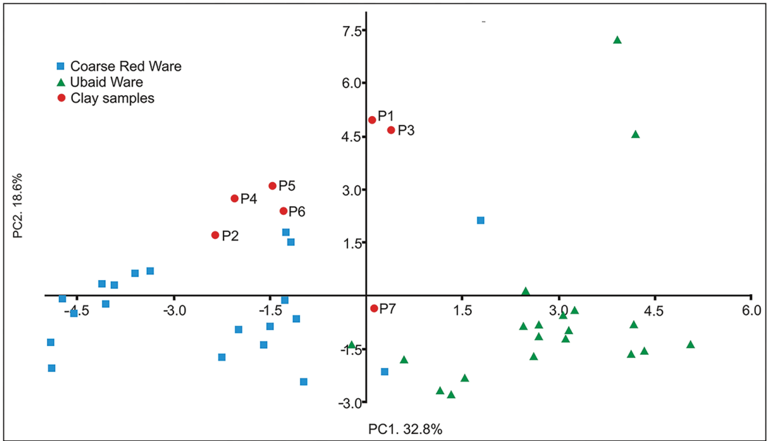
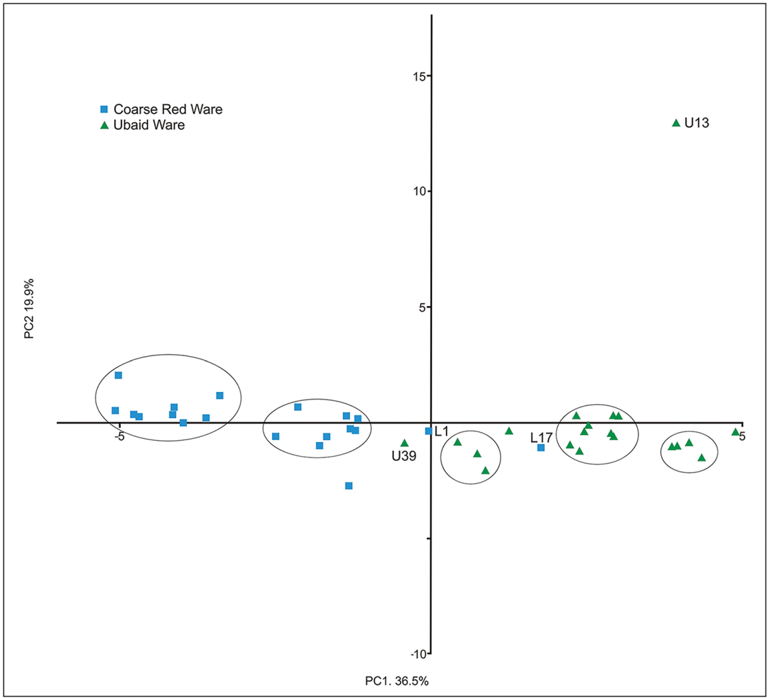
- CRW from Bahra 1 has a local origin: its geochemical composition corresponds to three clay samples from the al-Subiyah region (P4, P5, P6), and the unfired clay vessel (P2) shares a similar composition; PCA separates Ubaid Ware and CRW into two geochemically distinct groups.
- CRW accounts for 47 per cent of the total ceramic assemblage at Bahra 1 (n = 10 742), the largest known collection of this pottery group; the site yielded more than 22 000 Ubaid Ware and CRW potsherds in 2009–2023, with 42 macroscopically distinct CRW fabrics.
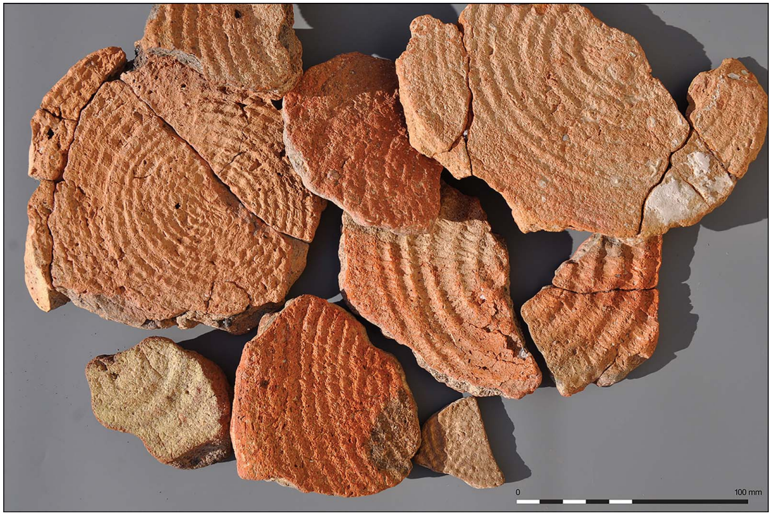
- Production is interpreted as household industry by low-skilled, part-time potters: CRW was hand-built by coiling or slab-building, often poorly mixed and irregularly fired, with some higher-quality vessels suggesting experimentation; Ubaid Ware and CRW were largely complementary in function.
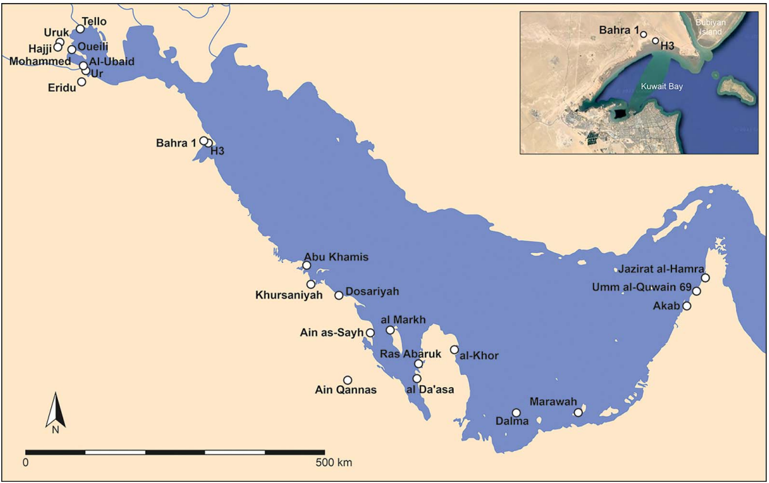
- CRW distribution follows a down-the-line model, decreasing from north to south: Bahra 1 has 47 per cent, H3 has 26 per cent (20–38 per cent depending on period), Dosariyah has 17.8 per cent, while Lower Gulf finds are very small (e.g. one potsherd at DA11 on Dalma Island; three or four fragments at Jazirat al-Hamra JH4).
Methods
- Excavation and assemblage study at Bahra 1, al-Subiyah, Kuwait, by the Kuwaiti-Polish Archaeological Mission since 2009; more than 22 000 Ubaid Ware and CRW potsherds from 2009–2023 were analysed typologically, technologically and by fabric, alongside evidence for local production (pottery wasters, fire-related installations, an unfired clay vessel).
- Archaeometric provenance analysis: 40 ceramic samples from Bahra 1 with even representation of Ubaid Ware and CRW, one clay sample from the unfired vessel (P2), and six geological samples from al-Subiyah (P1, P3–P7); elemental composition measured by ICP-MS and analysed using principal components analysis (PCA).
- Distribution synthesis comparing CRW frequencies and quantities across Gulf sites and regions.
Limitations
- Stated in the paper: the exact number of fire-related installations at Bahra 1 cannot yet be given because the study is still in progress; with available data it is not possible to determine whether the geochemical subgroups represent different production centres; and whether CRW was also produced at other Neolithic Gulf sites besides Bahra 1 remains an open question.
- Stated in the paper: at most other Gulf sites, CRW quantities are described only in general terms, which hampers interpretations of distribution; the cultural affiliations of CRW and its producers remain debated.
- Evident from the text: provenance conclusions rest on 40 ceramic samples, one unfired-vessel clay sample and six geological reference samples; some CRW and Ubaid outliers and within-group variation are attributed to possible post-depositional alteration, contamination or paste modification, so source assignments are not unambiguous.
Model-written summary. Check it against the paper before relying on it.
Integrity signals
Registry
Cites
Statistics
Figures
Verification
Claims the paper makes
0 Valid · 0 Not valid · 40 Not checked · 82 Own results and interpretations
A result the paper reports from its own data — it cites no other source for it, so there is none to check. The quote shows it is in the paper.
In the paper
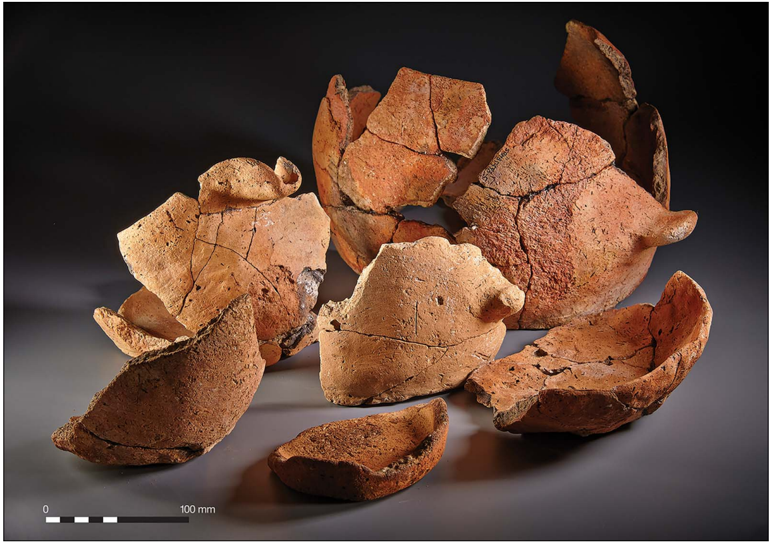
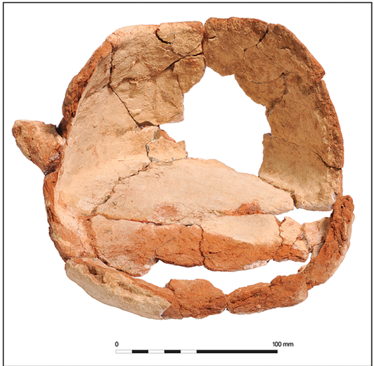
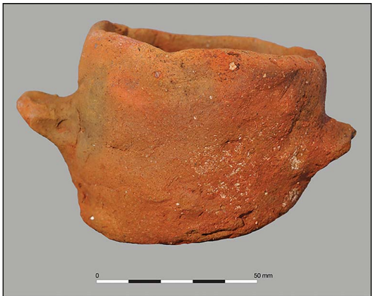
“Another piece of evidence confirming the local production of CRW at Bahra 1 was the discovery of an almost complete unfired clay vessel-a pot with lugs (Figure 6).The pot was discovered in 2019 alongside a fired jar in Sector SBH 35, where CRW vessels may have been fired, as suggested by the fire installations and pottery wasters found in this area.”
§ The first pottery in the Arabian Gulf: origins, production and distribution > Archaeological indications of local production
plainSingle case- Asserted: passes — The authors put it forward as true.
- Checkable: passes — It can be checked against evidence.
- Load-bearing: passes — The paper’s conclusions depend on it.
- Based: passes — The paper gives a reason why it holds.
A result the paper reports from its own data — it cites no other source for it, so there is none to check. The quote shows it is in the paper.
In the paper
“Three geological samples (P1, P3, P7) do not match the geochemical composition of the CRW; this includes a sample from the Jal az-Zor escarpment (P3), which has also previously been shown to differ geochemically from the CRW at H3 (Carter & Crawford 2010: 36).”
§ The first pottery in the Arabian Gulf: origins, production and distribution > Results
plainn = 3- Asserted: passes — The authors put it forward as true.
- Checkable: passes — It can be checked against evidence.
- Load-bearing: unclear — It is unclear whether the paper’s conclusions depend on it.
- Based: passes — The paper gives a reason why it holds.
A result the paper reports from its own data — it cites no other source for it, so there is none to check. The quote shows it is in the paper.
In the paper
“Two outliers in the Ubaid Ware samples (UF13 and UF39) can be distinguished based on their elemental composition.”
§ The first pottery in the Arabian Gulf: origins, production and distribution > Results
plainstates an associationn = 2- Asserted: passes — The authors put it forward as true.
- Checkable: passes — It can be checked against evidence.
- Load-bearing: unclear — It is unclear whether the paper’s conclusions depend on it.
- Based: passes — The paper gives a reason why it holds.
A result the paper reports from its own data — it cites no other source for it, so there is none to check. The quote shows it is in the paper.
In the paper
“The unfired clay vessel (P2) also shares a similar geochemical composition to the CRW from Bahra 1.”
§ The first pottery in the Arabian Gulf: origins, production and distribution > Results
plainstates an associationSingle case- Asserted: passes — The authors put it forward as true.
- Checkable: passes — It can be checked against evidence.
- Load-bearing: unclear — It is unclear whether the paper’s conclusions depend on it.
- Based: passes — The paper gives a reason why it holds.
None of the sources cited for this claim have been checked yet.
In the paper
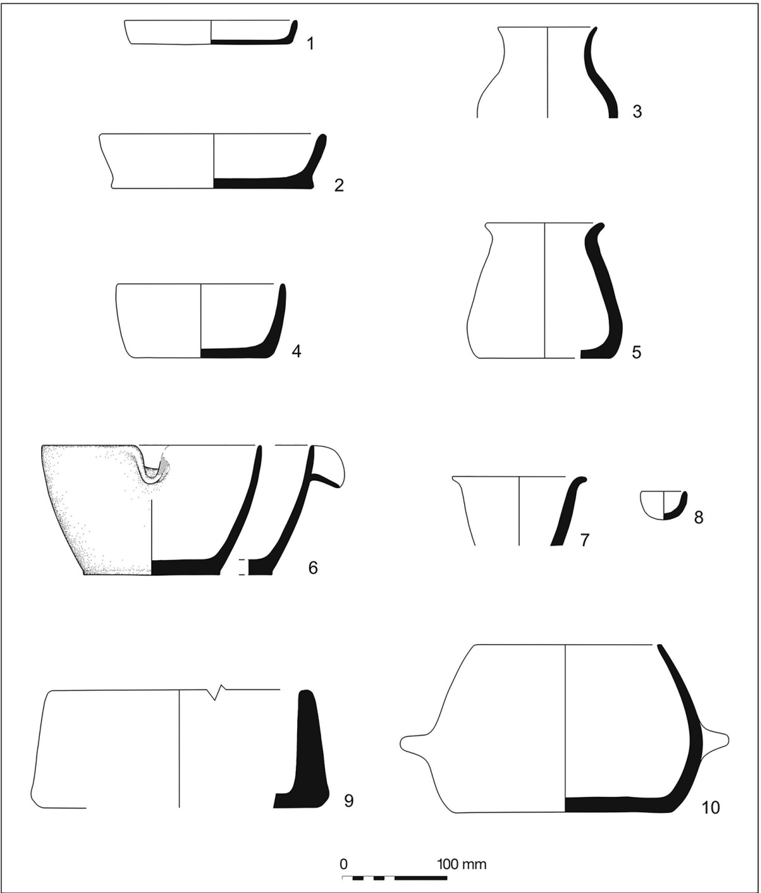
“Additionally, the CRW repertoire at the site is more diverse than at any other location in the Gulf region (for forms of CRW vessels found at other Gulf sites, see Masry 1997;Carter & Crawford 2010;Kainert & Drechsler 2014;Kainert 2018).”
§ The first pottery in the Arabian Gulf: origins, production and distribution > Archaeological indications of local production
What the sources say
- Not checked yetcites Masry 1997
- Not checked yetcites Carter & Crawford 2010
- Not matchedcites Kainert & Drechsler 2014
An author–year citation the paper’s reference list doesn’t settle. We don’t search these by name.
plain- Asserted: passes — The authors put it forward as true.
- Checkable: passes — It can be checked against evidence.
- Load-bearing: passes — The paper’s conclusions depend on it.
- Based: passes — The paper gives a reason why it holds.
69 more claims
Create a free account to see all 122 claims and to verify the 26 references still open.
- It may state two separate claims as one. 44
- Probably not a substantial claim. 8
- The quote only partly states this claim. 1
Citations
Cites
Pottery Analysis: A Sourcebook.
Tobert, N., & Rice, P. (1990) · Man · doi:10.2307/2804120 · Cited by 1,821
The archaeology of social boundaries
Stark, M. T. (1998) · Cited by 571
Costin, C. L., & Hagstrum, M. B. (1995) · American Antiquity · doi:10.2307/282046 · Cited by 336
The Global Origins and Development of Seafaring
Callaghan, R. T. (2011) · The Journal of Island and Coastal Archaeology · doi:10.1080/15564894.2011.582072 · Cited by 273
Compositional Analysis and “Sources” of Pottery: An Ethnoarcheological Approach
Arnold, D. E., Neff, H., & Bishop, R. L. (1991) · American Anthropologist · doi:10.1525/aa.1991.93.1.02a00040 · Cited by 226
Magee, P. (2014) · Cambridge University Press eBooks · doi:10.1017/cbo9781139016667 · Cited by 175
The Use of Ethnoarchaeology for the Archaeological Study of Ceramic Production
Costin, C. L. (2000) · Journal of Archaeological Method and Theory · doi:10.1023/a:1026523023550 · Cited by 116
Bahrain through the ages : the archaeology
Khalifa, H. A., & Rice, M. (1986) · KPI eBooks · Cited by 96
Oates, J., Davidson, T. E., Kamilli, D., & McKerrell, H. (1977) · Antiquity · doi:10.1017/s0003598x00071738 · Cited by 53
The Role of Exchange in Productive Specialization
BATES, D. G., & LEES, S. H. (1977) · American Anthropologist · doi:10.1525/aa.1977.79.4.02a00040 · Cited by 47
Research works printed but not linked: 18
- VOGT, B. 1994. In search for coastal sites in prehistoric Makkan: mid-Holocene 'shell-eaters' in the coastal desert of Ras al-Khaimah, U.A.E, in J.M. Kenoyer (ed.) From Sumer to Melluha: contributions to the archaeology of West and South Asia in memory of George F. Dales (Wisconsin Archaeological Reports 3): 113-28. Madison: University of Wisconsin.
- COSTIN, C.L. 1991. Craft specialization: issues in defining, documenting, and explaining the organization of production, in M.B. Schiffer (ed.) Archaeological method and theory, vol. 3: 1-56. Tucson: University of Arizona Press.
- -2018. Bahra 1: eight years of excavations of an Ubaid culture-related settlement in the al-Sabiyyah desert (Kuwait). Proceedings of the Seminar for Arabian Studies 48: 23-30.
- Munsell Color. 1994. Munsell soil color charts. Grand Rapids (MI): Munsell Color.
- KAINERT, C. 2018. Pottery, in P. Drechsler (ed.) Dosariyah: reinvestigating a Neolithic coastal community in eastern Arabia (British Foundation for the Study of Arabia Monographs 19): 183-98. Oxford: Archaeopress.
- KAINERT, C. & P. DRECHSLER. 2014. An interplay of imports and local traditions? The pottery assemblage from Dosariyah, Saudi Arabia. Proceedings of the Seminar for Arabian Studies 44: 213-26.
- BLACKMAN, M.J. 1992. The effect of human size sorting on the mineralogy and chemistry of ceramic clays, in H. Neff (ed.) Chemical characterization of ceramics pastes in archaeology (Monographs in World Archaeology 7): 113-24. Madison (WI): Prehistory.
- POTTS, D.T. 1990. The Arabian Gulf in antiquity 1: from prehistory to the fall of the Achaemenid Empire. Oxford: Clarendon.
- MAGEE, P. & S. KARACIC. 2018. Geochemical analysis of putative local and Ubaid ceramics from Dosariyah, in P. Drechsler (ed.) Dosariyah: reinvestigating a Neolithic coastal community in eastern Arabia (British Foundation for the Study of Arabia Monographs) 19: 199-208. Oxford: Archaeopress.
- BURKHOLDER, G. 1972. Ubaid sites and pottery in Saudi Arabia. Archaeology 25: 264-69.
- PRESTON, E.L. 2020. The Ubaid in the Gulf: compositional analysis of ceramic material (sixth-fifth millennium BC), in C. Coppini & F. Simi (ed.) Interactions and new directions in Near Eastern archaeology, vol. 3: 385-404. Trieste: Edizioni Università di Trieste.
- REICHE, A. 2013. Bahra 1. Small finds from the 2012 season, in P. Bielinśki (ed.) As-Sabbiya. autumn 2012; report on the eight seasons of joint Kuwaiti-Polish archaeological investigations in Kuwait: Bahra 1, Ubaid culture related settlement (4th season): 98-123. Warsaw: National Council for Culture Arts and Letters and Polish Centre of Mediterranean Archaeology, University of Warsaw.
- DUISTERMAAT, K. 2007. Not fit for firing: unfired vessel fragments from Late Bronze Age Tell Sabi Abyad, Syria, and their value for the study of pottery technology. Leiden Journal of Pottery Studies 23: 21-40.
- JORNET, A., M.J. BLACKMAN & J. OLIN. 1985. 13th to 18th century ceramics from the Paterna-Manises area (Spain), in D. Kingery (ed.) Ceramics and civilization: 235-55. Columbus (OH): American Ceramic Society.
- BIELINSKI, P. 2017. The architecture of Bahra 1, an Ubaid culture-related settlement in Kuwait. Ash-sharq 1: 104-11.
- Craft production, in H. Maschner & C. Chippindale (ed.) Handbook of archaeological method: 1084-1107.
- DRECHSLER, P. (ed.) 2018. Dosariyah: reinvestigating a Neolithic coastal community in eastern Arabia (British Foundation for the Study of Arabia Monographs 19). Oxford: Archaeopress.
- MYERS, J.E. & M.J. BLACKMAN. 1986. Conical plates of the Hispano-Moresque tradition from Islamic Qsar es-Seghir: petrographic and chemical analysis, in La Ceramica Medievale nelMediterraneo Occidentale: 55-68. Florence: All'insegna del Giglio.
Cited by
COŞKUN, K., & Muşkara, Ü. (2025) · X-Ray Spectrometry · doi:10.1002/xrs.70031 · Cited by 2
Settlement Dynamics and Coastal Change in the Arabian Gulf Neolithic: Wādī aḍ‐Ḍubayʿān (Qatar)
Cuttler, R., Al-Naimi, F. A., Crassard, R., Spencer, P., & Roberts, H. M. (2026) · Arabian archaeology and epigraphy · doi:10.1111/aae.70033
Hovsepyan, R., Mueller‐Bieniek, A., Smogorzewska, A., & Bieliński, P. (2026) · Arabian archaeology and epigraphy · doi:10.1111/aae.70029
Self-citation
Metadata
- Authors
- Smogorzewska, A.
- Affiliations
- University of Warsaw (PL)
- Corresponding author
- Smogorzewska, Anna
- ORCID
- Smogorzewska, Anna
- Venue
- Antiquity
- Publisher
- Antiquity Publications
- Published
- 2025-02-10
- Volume
- 99
- Issue
- 404
- Pages
- 303-318
- ISSN
- 0003-598X (ISSN-L)
- 1745-1744
- OpenAlex
- W4407308751
- Cited by
- 3
- References
- 31
- Citations by year
- 2026: 2 · 2025: 1
- FWCI
- 2.95
- Type
- journal article
- Language
- en
- Open access
- hybrid
- doi.org
- Locations
- Antiquity (publishedVersion, cc-by)
- Funders
- Uniwersytet Warszawski
- Topics
- Social Sciences › Archeology › Archaeology and ancient environmental studies
- Social Sciences › Arts and Humanities › Archeology (arts and humanities) › Cultural Heritage Materials Analysis
- Social Sciences › Arts and Humanities › Archeology (arts and humanities) › Archaeological and Geological Studies
- Keywords
- pottery production, pottery distribution, clay provenance, geochemical analysis, Mesopotamian influence, prehistoric trade
About these checks
Registry, retraction, Cites and statistics results are computed, not judged, with one exception: a printed reference that no index lists is read once by a model before it counts as a citation error. Claims are extracted by a model and kept only when their quote appears verbatim in the text; each cited source is then checked, with a model’s help, for whether it says what the claim relies on. Those verdicts can be wrong — read the claim’s quote and the cited source before relying on one.
A language model drew the claims from the paper on 2026-11-24, under version 3 of the claim definition (model deepseek-v4.1-flash, prompt extract-v3).
A second model labelled each claim on 2026-11-24 (model jev-1.13-20260917, definition revision gold-guideline-v0.2).
Statistics and arithmetic are recomputed, not judged.
Confidence bands are shown only for fields calibrated on our annotated test set. None is calibrated yet, so no band is shown.
What counts as a claim ›How we measure confidence ›How we check this ›
Are you an author, or do you see a problem with this page? Request a review
How to cite
Cite CoChat for the checks on this page, and the paper for its own findings.
- This page
- CoChat. (2026). Citation check: The first pottery in the Arabian Gulf: origins, production and distribution. https://app.cochat.ai/papers/10.15184/aqy.2025.13
- The paper
- Smogorzewska, A. (2025). The first pottery in the Arabian Gulf: origins, production and distribution. Antiquity. https://doi.org/10.15184/aqy.2025.13
Data sources
Bibliographic data: Semantic Scholar, OpenAlex, Crossref.
Contains information from the Semantic Scholar Academic Graph Datasets, made available under the ODC Attribution License (ODC-BY 1.0).
Semantic Scholar’s data is described in: Kinney, R., et al. (2023). The Semantic Scholar Open Data Platform. arXiv:2301.10140.
