

The DOI matches its Crossref record; 29 of the 29 references it cites were found in a registry or an index.
The phase of ongoing oscillations mediates the causal relation between brain excitation and visual perception.
Open accessAbstract
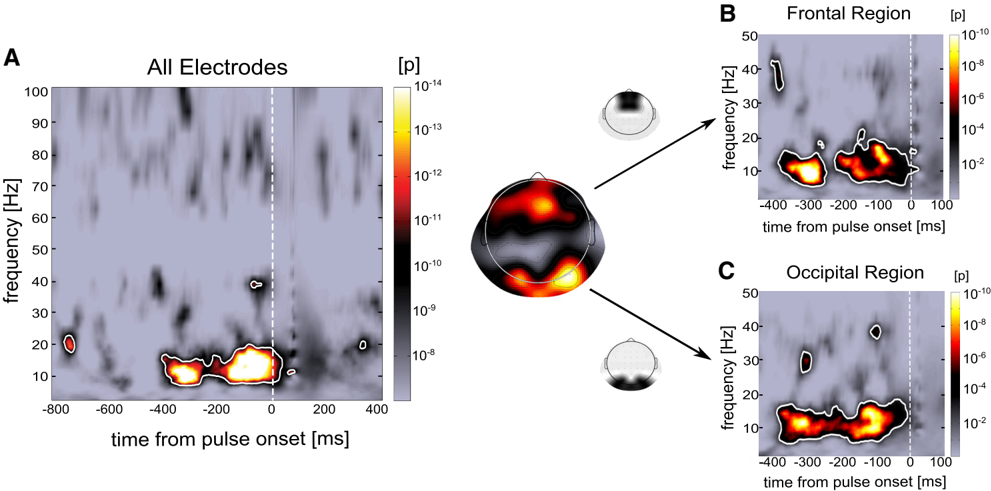
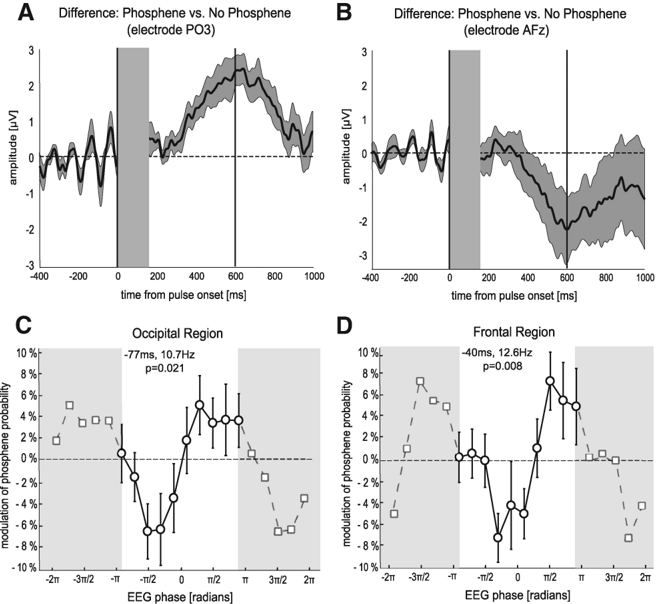
Why does neuronal activity in sensory brain areas sometimes give rise to perception, and sometimes not? Although neuronal noise is often invoked as the key factor, a portion of this variability could also be due to the history and current state of the brain affecting cortical excitability. Here we directly test this idea by examining whether the phase of prestimulus oscillatory activity is causally linked with modulations of cortical excitability and with visual perception. Transcranial magnetic stimulation (TMS) was applied over human visual cortex to induce illusory perceptions (phosphenes) while electroencephalograms (EEGs) were simultaneously recorded. Subjects reported the presence or absence of an induced phosphene following a single pulse of TMS at perceptual threshold. The phase of ongoing alpha (∼10 Hz) oscillations within 400 ms before the pulse significantly covaried with the perceptual outcome. This effect was observed in occipital regions around the site of TMS, as well as in a distant frontocentral region. In both regions, we found a systematic relationship between prepulse EEG phase and perceptual performance: phosphene probability changed by ∼15% between opposite phases. In summary, we provide direct evidence for a chain of causal relations between the phase of ongoing oscillations, neuronal excitability, and visual perception: ongoing oscillations create periodic "windows of excitability," with sensory perception being more likely to occur at specific phases.
Overview
The claims and statistics of this paper haven’t been checked yet.
Run the check — free, no account needed. It reads the open-access text and checks the sources it cites.
Integrity signals
Registry
Cites
Statistics
Figures
Verification
Claims the paper makes
The claims and statistics of this paper haven’t been checked yet.
Run the check — free, no account needed. It reads the open-access text and checks the sources it cites.
Claims other papers make about this one
Each is checked against this paper’s own text: does it say what the citing paper says it does?
In the citing paper
“Moreover, it has been shown in humans that there is a causal relationship between cortical excitation and phosphenes perception so that the phase of pre-stimulus oscillatory activity seems linked to visual perception (Dugue et al., 2011)”
From Toward a personalized closed-loop stimulation of the visual cortex: Advances and challenges (2022) · cites this paper as Dugue et al., 2011
In the citing paper
“This has been reported in experiments in rats (Allison-Walker et al., 2020) and using non-invasive transcranial magnetic stimulation (TMS) in sighted humans (Dugue et al., 2011), but the feasibility of LFP phase-locked stimulation with intracortical electrodes in humans still remains unexplored.”
From Toward a personalized closed-loop stimulation of the visual cortex: Advances and challenges (2022) · cites this paper as Dugue et al., 2011
In the citing paper
“it seems that the frequency of ongoing oscillations is around 10 Hz (Dugue et al., 2011)”
From Toward a personalized closed-loop stimulation of the visual cortex: Advances and challenges (2022) · cites this paper as Dugue et al., 2011
Self-check
Percentages, sums and reported differences re-computed from the paper’s own numbers.
The self-check needs the paper’s full text.
Citations
Cites
Neuronal Oscillations in Cortical Networks
Buzsáki, G., & Draguhn, A. (2004) · Science · doi:10.1126/science.1099745 · Cited by 6,576
Rossi, S., Hallett, M., Rossini, P. M., & Pascual-Leone, A. (2009) · Clinical Neurophysiology · doi:10.1016/j.clinph.2009.08.016 · Cited by 5,367
Wassermann, E. M. (1998) · Electroencephalography and Clinical Neurophysiology/Evoked Potentials Section · doi:10.1016/s0168-5597(97)00096-8 · Cited by 2,337
Lakatos, P., Shah, A. S., Knuth, K. H., Ulbert, I., Karmos, G., & Schroeder, C. E. (2005) · Journal of Neurophysiology · doi:10.1152/jn.00263.2005 · Cited by 1,281
The Phase of Ongoing EEG Oscillations Predicts Visual Perception
Busch, N. A., Dubois, J., & VanRullen, R. (2009) · Journal of Neuroscience · doi:10.1523/jneurosci.0113-09.2009 · Cited by 1,208
Fries, P., Nikolić, D., & Singer, W. (2007) · Trends in Neurosciences · doi:10.1016/j.tins.2007.05.005 · Cited by 1,044
Entrainment of Neocortical Neurons and Gamma Oscillations by the Hippocampal Theta Rhythm
Sirota, A., Montgomery, S., Fujisawa, S., Isomura, Y., Zugaro, M., & Buzsáki, G. (2008) · Neuron · doi:10.1016/j.neuron.2008.09.014 · Cited by 1,015
To See or Not to See: Prestimulus α Phase Predicts Visual Awareness
Mathewson, K. E., Gratton, G., Fabiani, M., Beck, D. M., & Ro, T. (2009) · Journal of Neuroscience · doi:10.1523/jneurosci.3963-08.2009 · Cited by 1,011
Prestimulus Oscillatory Activity in the Alpha Band Predicts Visual Discrimination Ability
van Dijk, H., Schoffelen, J., Oostenveld, R., & Jensen, O. B. (2008) · Journal of Neuroscience · doi:10.1523/jneurosci.1853-07.2008 · Cited by 831
Romei, V., Brodbeck, V., Michel, C. M., Amedi, A., Pascual‐Leone, Á., & Thut, G. (2007) · Cerebral Cortex · doi:10.1093/cercor/bhm229 · Cited by 717
Cited by
Sorted by citations
Lisman, J. E., & Jensen, O. (2013) · Neuron · doi:10.1016/j.neuron.2013.03.007 · Cited by 1,609
“2) probably accounts for why perception is dependent on alpha phase (Busch et al., 2009; Dugue et al., 2011; Mathewson et al., 2009).”
EEG and MEG: Relevance to Neuroscience
Lopes da Silva, F. (2013) · Neuron · doi:10.1016/j.neuron.2013.10.017 · Cited by 900
“Thus, a oscillations modulate ‘‘windows of excitability,’’ as Dugué et al. (2011) expressed.”
VanRullen, R. (2016) · Trends in Cognitive Sciences · doi:10.1016/j.tics.2016.07.006 · Cited by 631
“Figure I depicts a joint analysis of 10 distinct datasets testing the rhythmicity of very different visual perception tasks (involving threshold detection [10], threshold detection with attentional manipulation [12], transcranial magnetic stimulation (TMS) phosphene detection [13], visual search [23], saccadic executi…”
BackgroundDistilling the neural correlates of consciousness
Aru, J., Bachmann, T., Singer, W., & Melloni, L. (2012) · Neuroscience & Biobehavioral Reviews · doi:10.1016/j.neubiorev.2011.12.003 · Cited by 589
Noninvasive brain stimulation: from physiology to network dynamics and back
Dayan, E., Censor, N., Buch, E. R., Sandrini, M., & Cohen, L. G. (2013) · Nature Neuroscience · doi:10.1038/nn.3422 · Cited by 626
Metadata
- Authors
- Dugué, L., Marque, P., & VanRullen, R.
- Affiliations
- Centre National de la Recherche Scientifique (FR)
- ORCID
- Dugué, Laura
- Venue
- The Journal of Neuroscience
- Publisher
- Society for Neuroscience
- Published
- 2011-08-17
- Volume
- 31
- Issue
- 33
- Pages
- 11889-11893
- ISSN
- 0270-6474 (ISSN-L)
- 1529-2401
- PMC
- PMC6623205
- OpenAlex
- W2003309602
- Cited by
- 364
- References
- 29
- Citations by year
- 2026: 20 · 2025: 25 · 2024: 19 · 2023: 17 · 2022: 26 · 2021: 21 · 2020: 19 · 2019: 27 · 2018: 36 · 2017: 40 · 2016: 28 · 2015: 21 · 2014: 23 · 2013: 21 · 2012: 18
- FWCI
- 10.40
- Type
- journal article
- Language
- en
- Open access
- hybrid
- doi.org
- Licence
- Locations
- Journal of Neuroscience (publishedVersion, cc-by-nc-sa)
- Europe PMC (PubMed Central) (publishedVersion)
- PubMed Central (publishedVersion)
- PubMed (publishedVersion)
- HAL (submittedVersion)
- Topics
- Life Sciences › Neuroscience › Cognitive Neuroscience › Neural dynamics and brain function
- Life Sciences › Neuroscience › Neurology › Transcranial Magnetic Stimulation Studies
- Life Sciences › Neuroscience › Cognitive Neuroscience › Visual perception and processing mechanisms
- Keywords
- EEG phase, alpha oscillations, cortical excitability, visual perception, phosphenes, transcranial magnetic stimulation, illusory perception, neural noise, perceptual thresholds, visual cortex
- MeSH terms
- Adult, Alpha Rhythm, Electroencephalography, Female, Humans, Male, Phosphenes, Photic Stimulation, Visual Cortex, Visual Perception, Transcranial Magnetic Stimulation, Young Adult
About these checks
Registry, retraction, Cites and statistics results are computed, not judged, with one exception: a printed reference that no index lists is read once by a model before it counts as a citation error. Claims are extracted by a model and kept only when their quote appears verbatim in the text; each cited source is then checked, with a model’s help, for whether it says what the claim relies on. Those verdicts can be wrong — read the claim’s quote and the cited source before relying on one.
Statistics and arithmetic are recomputed, not judged.
Confidence bands are shown only for fields calibrated on our annotated test set. None is calibrated yet, so no band is shown.
What counts as a claim ›How we measure confidence ›How we check this ›
Are you an author, or do you see a problem with this page? Request a review
