

The DOI matches its Crossref record; 45 of the 45 references it cites were found in a registry or an index.
Increased Probability of GABA Release during Withdrawal from Morphine
Open accessAbstract
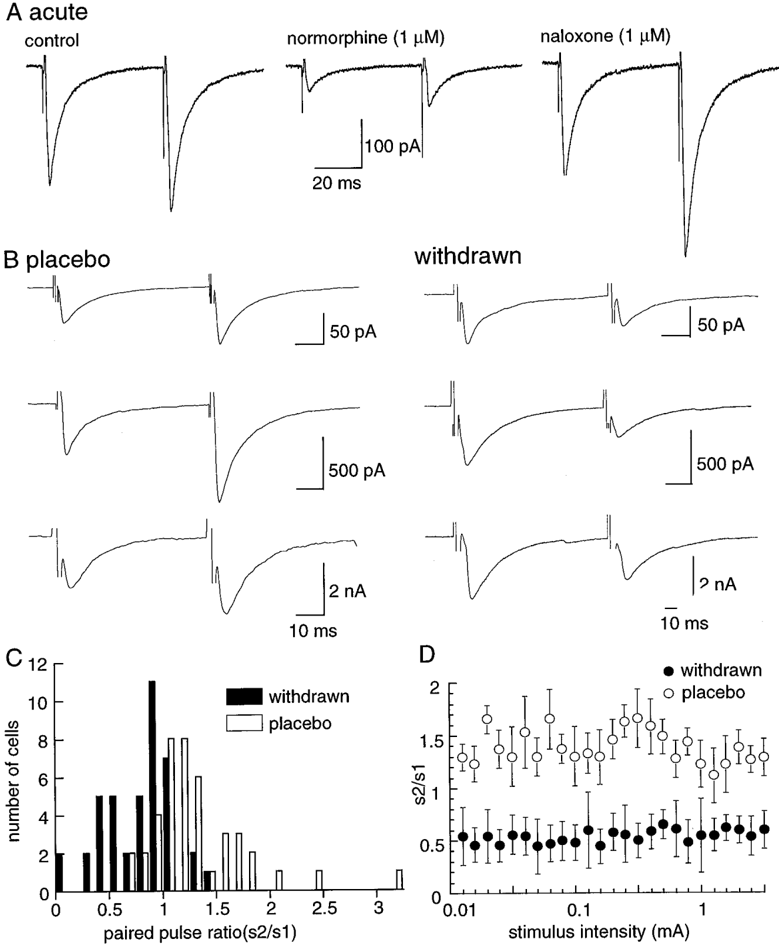
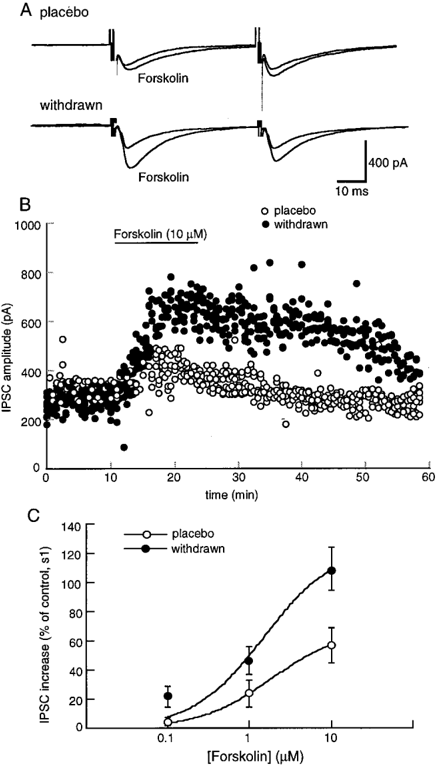
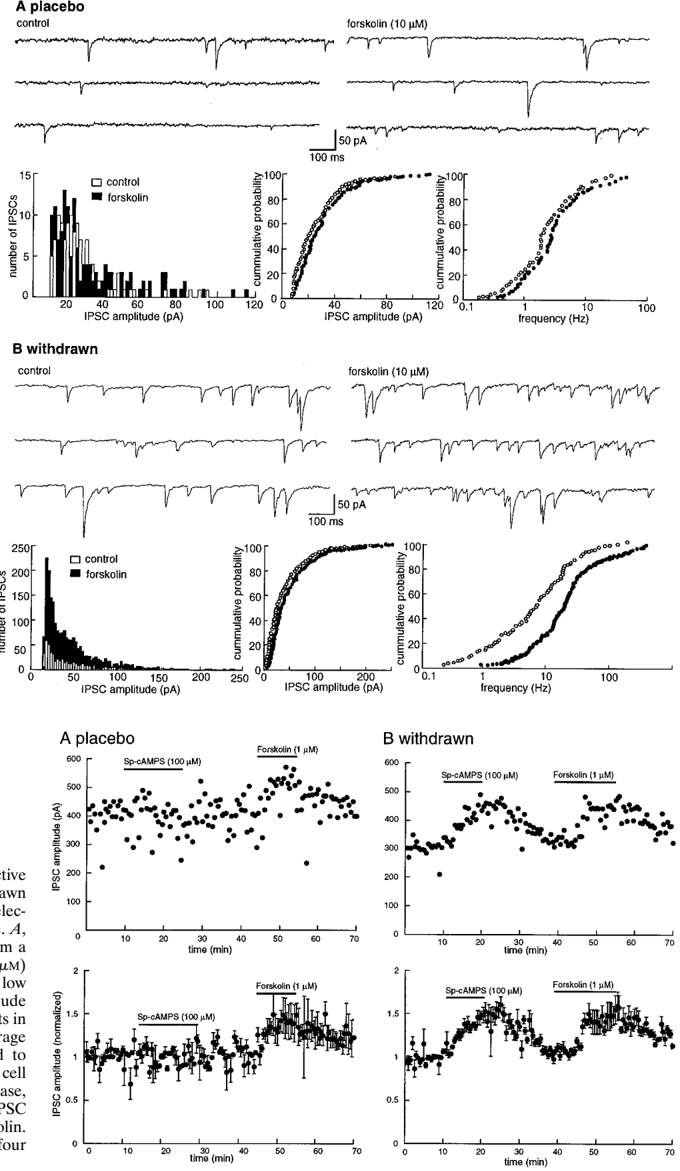
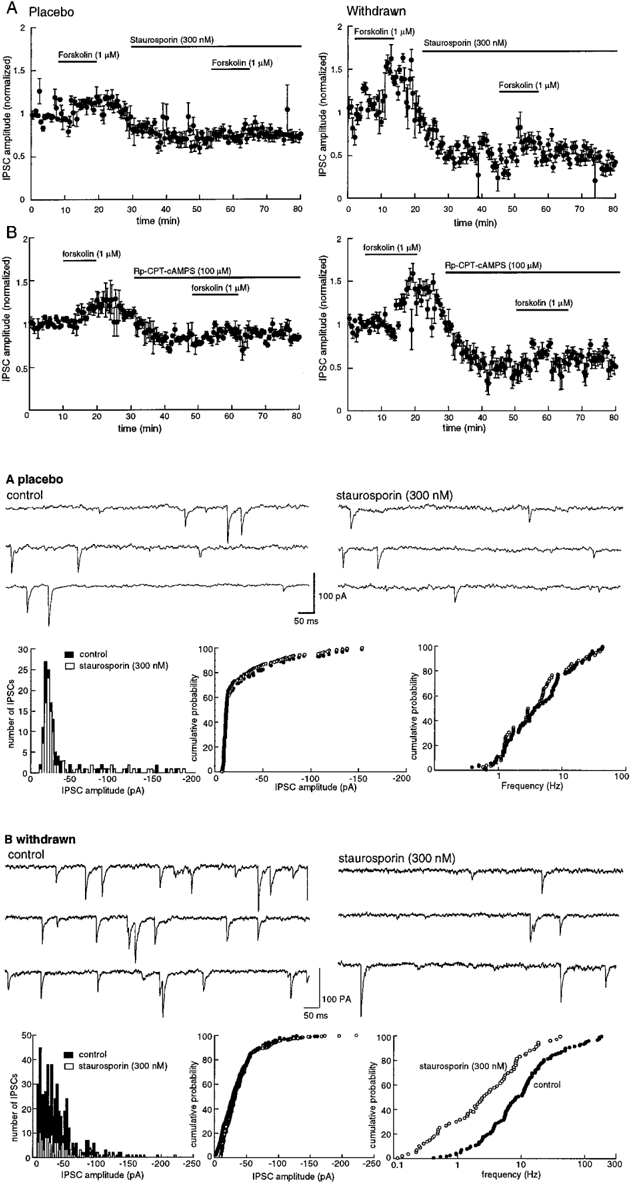
Opioid receptors located on interneurons in the ventral tegmental area (VTA) inhibit GABA A -mediated synaptic transmission to dopamine projection neurons. The resulting disinhibition of dopamine cells in the VTA is thought to play a pivotal role in drug abuse; however, little is known about how this GABA A synapse is affected after chronic morphine treatment. The regulation of GABA release during acute withdrawal from morphine was studied in slices from animals treated for 6–7 d with morphine. Slices containing the VTA were prepared and maintained in morphine-free solutions, and GABA A IPSCs were recorded from dopamine cells. The amplitude of evoked IPSCs and the frequency of spontaneous miniature IPSCs measured in slices from morphine-treated guinea pigs were greater than placebo-treated controls. In addition, activation of adenylyl cyclase, with forskolin, and cAMP-dependent protein kinase, with Sp-cAMPS, caused a larger increase in IPSCs in slices from morphine-treated animals. Conversely, the kinase inhibitors staurosporine and Rp-CPT-cAMPS decreased GABA IPSCs to a greater extent after drug treatment. The results indicate that the probability of GABA release was increased during withdrawal from chronic morphine treatment and that this effect resulted from an upregulation of the cAMP-dependent cascade. Increased transmitter release from opioid-sensitive synapses during acute withdrawal may be one adaptive mechanism that results from prolonged morphine treatment.
Overview
The claims and statistics of this paper haven’t been checked yet.
Run the check — free, no account needed. It reads the open-access text and checks the sources it cites.
Integrity signals
Registry
Cites
Statistics
Figures
Verification
Claims the paper makes
The claims and statistics of this paper haven’t been checked yet.
Run the check — free, no account needed. It reads the open-access text and checks the sources it cites.
Claims other papers make about this one
Each is checked against this paper’s own text: does it say what the citing paper says it does?
In the citing paper
“A prominent observation is a chronic opioid-induced cAMP-dependent increase in the probability of GABA release in the VTA, which would inhibit dopamine neurons (Bonci and Williams, 1997).”
From Drug Addiction: Hyperkatifeia/Negative Reinforcement as a Framework for Medications Development (2021) · cites this paper as Bonci and Williams, 1997
Self-check
Percentages, sums and reported differences re-computed from the paper’s own numbers.
The self-check needs the paper’s full text.
Citations
Cites
Wise, R. A., & Rompre, P.-P. (1989) · Annual Review of Psychology · doi:10.1146/annurev.ps.40.020189.001203 · Cited by 1,968
Opioids excite dopamine neurons by hyperpolarization of local interneurons
Johnson, S., & North, R. (1992) · The Journal of Neuroscience · doi:10.1523/jneurosci.12-02-00483.1992 · Cited by 1,637
Aghajanian, G. K. (1978) · Nature · doi:10.1038/276186a0 · Cited by 800
Local and diffuse synaptic actions of GABA in the hippocampus
Isaacson, J. S., Solis, J. M., & Nicoll, R. A. (1993) · Neuron · doi:10.1016/0896-6273(93)90308-e · Cited by 688
Two types of neurone in the rat ventral tegmental area and their synaptic inputs.
Johnson, S. W., & NORTH, R. A. (1992) · The Journal of Physiology · doi:10.1113/jphysiol.1992.sp019136 · Cited by 672
Dual regulation of adenylate cyclase accounts for narcotic dependence and tolerance.
Sharma, S. K., Klee, W. A., & Nirenberg, M. W. (1975) · Proceedings of the National Academy of Sciences · doi:10.1073/pnas.72.8.3092 · Cited by 671
Molecular Mechanisms of Drug Reinforcement and Addiction
Self, D. W., & Nestler, E. J. (1995) · Annual Review of Neuroscience · doi:10.1146/annurev.ne.18.030195.002335 · Cited by 571
Drug addiction: A model for the molecular basis of neural plasticity
Nestler, E. J., Hope, B. T., & Widnell, K. L. (1993) · Neuron · doi:10.1016/0896-6273(93)90213-b · Cited by 535
Terwilliger, R. Z., Beitner‐Johnson, D., Sevarino, K. A., Crain, S. M., & Nestler, E. J. (1991) · Brain Research · doi:10.1016/0006-8993(91)91111-d · Cited by 534
Intracranial self-administration of morphine into the ventral tegmental area in rats
Bozarth, M. A., & Wise, R. A. (1981) · Life Sciences · doi:10.1016/0024-3205(81)90148-x · Cited by 507
Cited by
Sorted by citations
Molecular basis of long-term plasticity underlying addiction
Nestler, E. J. (2001) · Nature reviews. Neuroscience · doi:10.1038/35053570 · Cited by 1,893
Is there a common molecular pathway for addiction?
Nestler, E. J. (2005) · Nature Neuroscience · doi:10.1038/nn1578 · Cited by 1,388
Cellular and Synaptic Adaptations Mediating Opioid Dependence
Williams, J. T., Christie, M. J., & Manzoni, O. J. (2001) · Physiological Reviews · doi:10.1152/physrev.2001.81.1.299 · Cited by 853
Self-citationWaldhoer, M., Bartlett, S. E., & Whistler, J. L. (2004) · Annual Review of Biochemistry · doi:10.1146/annurev.biochem.73.011303.073940 · Cited by 740
Activation of VTA GABA Neurons Disrupts Reward Consumption
van Zessen, R., Phillips, J. L., Budygin, E. A., & Stuber, G. D. (2012) · Neuron · doi:10.1016/j.neuron.2012.02.016 · Cited by 646
Metadata
- Authors
- Bonci, A., & Williams, J. T.
- Affiliations
- Oregon Health & Science University (US)
- Venue
- The Journal of Neuroscience
- Publisher
- Society for Neuroscience
- Published
- 1997-01-15
- Volume
- 17
- Issue
- 2
- Pages
- 796-803
- ISSN
- 0270-6474 (ISSN-L)
- 1529-2401
- PMC
- PMC6573250
- OpenAlex
- W2169322025
- Cited by
- 286
- References
- 45
- Citations by year
- 2026: 4 · 2025: 8 · 2024: 3 · 2023: 12 · 2022: 7 · 2021: 11 · 2020: 6 · 2019: 10 · 2018: 10 · 2017: 9 · 2016: 10 · 2015: 8 · 2014: 15 · 2013: 5 · 2012: 12
- FWCI
- 2.36
- Type
- journal article
- Language
- en
- Open access
- hybrid
- doi.org
- Licence
- Locations
- Journal of Neuroscience (publishedVersion, cc-by-nc-sa)
- Europe PMC (PubMed Central) (publishedVersion)
- PubMed Central (publishedVersion)
- PubMed (publishedVersion)
- Funders
- National Institutes of Health
- National Institute on Drug Abuse (R01DA008163, DA-08163)
- Topics
- Life Sciences › Neuroscience › Cellular and Molecular Neuroscience › Neuroscience and Neuropharmacology Research
- Life Sciences › Neuroscience › Cellular and Molecular Neuroscience › Neurotransmitter Receptor Influence on Behavior
- Life Sciences › Neuroscience › Cellular and Molecular Neuroscience › Neuropeptides and Animal Physiology
- Keywords
- morphine withdrawal, GABA release, ventral tegmental area, dopaminergic neurons, miniature IPSCs, opioid receptors, cAMP signaling, adenylate cyclase, protein kinase A, chronic morphine administration, synaptic plasticity, drug addiction
- MeSH terms
- Adenylyl Cyclase Inhibitors, Action Potentials, Cyclic AMP, Adenylyl Cyclases, Animals, Dopamine, Enzyme Activation, Enzyme Inhibitors, Colforsin, gamma-Aminobutyric Acid, Guinea Pigs, Interneurons, Morphine, Nerve Tissue Proteins, Organophosphorus Compounds, Picrotoxin, Receptors, GABA-A, Salicylamides, Serotonin, Strychnine, Substance Withdrawal Syndrome, Tegmentum Mesencephali, Thionucleotides, Phorbol 12,13-Dibutyrate, Signal Transduction, 2-Amino-5-phosphonovalerate, Cyclic AMP-Dependent Protein Kinases, Patch-Clamp Techniques, Dopamine Antagonists, Excitatory Amino Acid Antagonists, 6-Cyano-7-nitroquinoxaline-2,3-dione, GABA Antagonists, Staurosporine
About these checks
Registry, retraction, Cites and statistics results are computed, not judged, with one exception: a printed reference that no index lists is read once by a model before it counts as a citation error. Claims are extracted by a model and kept only when their quote appears verbatim in the text; each cited source is then checked, with a model’s help, for whether it says what the claim relies on. Those verdicts can be wrong — read the claim’s quote and the cited source before relying on one.
Statistics and arithmetic are recomputed, not judged.
Confidence bands are shown only for fields calibrated on our annotated test set. None is calibrated yet, so no band is shown.
What counts as a claim ›How we measure confidence ›How we check this ›
Are you an author, or do you see a problem with this page? Request a review
