

The DOI matches its Crossref record; 16 of the 18 references it cites were found in a registry or an index.
La pervivencia de estereotipos de género en la enseñanza de la historia. Un estudio a través de libros de texto y las percepciones del alumnado de educación secundaria en España
Open accessAbstract
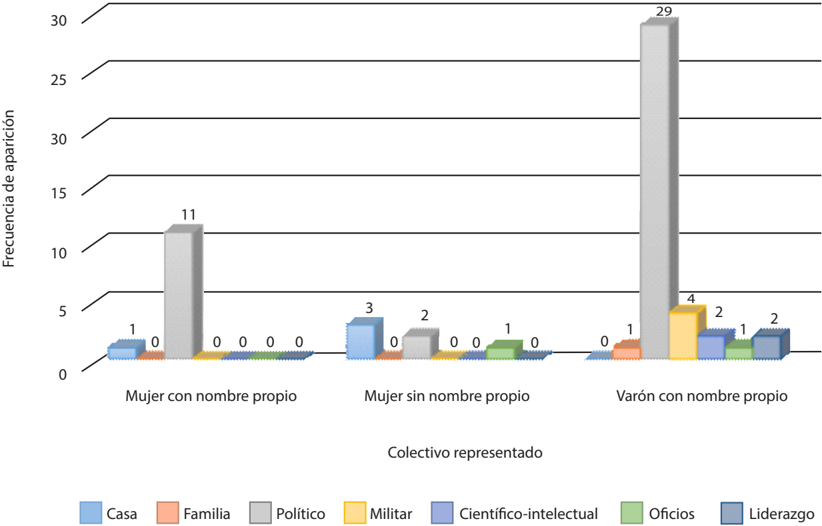
The aim of this paper is to study the persistence of gender stereotypes in History Education. This study is conducted through an iconographic analysis of textbooks and the perception of students in Secondary Education in Spain. The educational reforms carried out in Spain over the last twenty five years have improved some aspects of gender equality, especially the introduction of some cross-cutting themes related to this subject. However, investigations related to sexism in school materials have revealed the persistence of some gender clichés. To do this research, we have analysed 128 pictures on three History textbooks for fourth grade students of Compulsory Secondary Education in Spain. In the analysis, various categories were combined and they allowed a multifactorial study. Furthermore, these data have been contrasted with the answers given to a questionnaire on gender stereotypes by 152 students of two grades. The results show that, despite the improvement of textbooks, an imbalance still survives in the representation of male and female genders and in the images associated with them. In the answers to the questionnaire, disparate findings are also perceived. Although some sexist prejudices seem to be overcome, especially those related to the role of men and women at home, images and negative stereotypes about gender relations and women’s role still persist.
Overview
The claims and statistics of this paper haven’t been checked yet.
Run the check — free, no account needed. It reads the open-access text and checks the sources it cites.
Integrity signals
Registry
Cites
Statistics
Figures
Verification
Claims the paper makes
The claims and statistics of this paper haven’t been checked yet.
Run the check — free, no account needed. It reads the open-access text and checks the sources it cites.
Claims other papers make about this one
Each is checked against this paper’s own text: does it say what the citing paper says it does?
The source backs part of the claim, not all of it — or backs it for a different population, condition or comparison.
In the citing paper
“As previously mentioned, elementary education students tend to develop their own gender schemes, choosing the role models that they need (Gómez-Carrasco & Gallego-Herrera, 2016).”
From The influence of school textbooks on the configuration of gender identity: A study on the unequal representation of women and men in the school discourse during the Spanish democracy (2022) · cites this paper as Gómez-Carrasco & Gallego-Herrera, 2016
Experimental — accuracy not yet measured
Self-check
Percentages, sums and reported differences re-computed from the paper’s own numbers.
The self-check needs the paper’s full text.
Citations
Cites
(2014) · LA Referencia (Red Federada de Repositorios Institucionales de Publicaciones Científicas) · doi:10.4438/1988-592x-re-2012-363-188 · Cited by 93
Conquistar la igualdad: la coeducación hoy
Martòri, M. S. (1994) · Revista Iberoamericana de Educación · doi:10.35362/rie601207 · Cited by 74
La Ley Orgánica 3/2007, de 22 de marzo, para la igualdad efectiva de mujeres y hombres
y Lalaguna, P. D. (2009) · Dialnet (Universidad de la Rioja) · Cited by 57
Barton, K. C. (2005) · Theory & Research in Social Education · doi:10.1080/00933104.2005.10473270 · Cited by 52
Developing a Concept of Historical Evidence: Students' Ideas About Testing Singular Factual Claims
Ashby, R. (2004) · History Education Research Journal · doi:10.18546/herj.04.2.06 · Cited by 31
Carrasco, C. J. G. (2014) · Ensayos: Revista de la Facultad de Educación de Albacete · doi:10.18239/ensayos.v29i1.498 · Cited by 22
‘Till New Facts are Discovered’
Barca, I. (2010) · Taylor & Francis eBooks · doi:10.4324/9780203340929_chapter_5 · Cited by 21
Criterios para la elección del libro de texto de historia
Cuevas, J. P. (2011) · LA Referencia (Red Federada de Repositorios Institucionales de Publicaciones Científicas) · Cited by 19
Scientific Androcentrism: the obstacle to gender equality in the current school
Sánchez‐Bello, A. (2002) · Educar · doi:10.5565/rev/educar.331 · Cited by 19
Competencias y enseñanza de las ciencias sociales
Facal, R. L. (2013) · Iber: Didáctica de las ciencias sociales, geografía e historia · Cited by 13
Research works printed but not linked: 12
- Ballarín, P. (2008). Retos de la escuela democrática. En R. Cobo (Ed.), Educar en la ciudadanía. Perspectivas feministas (pp. 151-186). Madrid: Catarata.
- Barton, K. C. (2012). Applied research: Educational research as a way of seeing [Investigación aplicada: La investigación histórica como una forma de observación]. En A. McCully, C. Mills y van Boxtel (Eds.), The professional teaching of history: UK and Dutch perspectives [La enseñanza profesional de la historia: Perspectivas británicas y holandesas] (pp. 1-15). Coleraine, Northern Ireland: History Teacher Education Network.
- Cerezo, C. y Rivas, Á. (2002). El sexismo iconográfico en los libros de texto. Murcia: C.O.E.N.S. Ciencias Sociales, Geografía e Historia 4.º ESO. (2008). Madrid: Oxford. Revista Electrónica Educare (Educare Electronic Journal) EISSN: 1409-4258 Vol. 20(3) SETIEMBRE-DICIEMBRE, 2016: 1-28 15
- años Ciencias Sociales, Geografía e Historia 4.º ESO. (2010). Madrid: Santillana Ciencias Sociales, Geografía e Historia 4.º ESO. (2014). Madrid: Vicens Vives Consejo de Gobierno. (24 de septiembre, 2007). Decreto 291/2007, de 14 de septiembre, por el que se establece el currículo de la Educación Secundaria Obligatoria en la Comunidad Autónoma de la Región de Murcia. BORM, núm. 221, pp. 27179-27303.
- Gómez, C. J. (2014). Pensamiento histórico y contenidos disciplinares en los libros de texto. Un análisis exploratorio de la Edad Moderna en 2º de la E.S.O. Ensayos. Revista de la Facultad de Educación de Albacete, 29(1), 131-158. Recuperado de https://www.revista.uclm.es/ index.php/ensayos/article/view/498/454
- Gómez, C. J. y Tenza, S. (2015). Un género invisible. Análisis de la presencia de las mujeres en los libros de texto de Historia de 4.º de la E.S.O. En A. M. Hernández, C. R. García y J. L. De La Montaña (Eds.), Una enseñanza de las ciencias sociales para el futuro: Recursos para trabajar la invisibilidad de personas, lugares y temáticas (pp. 781-791). Cáceres: Universidad de Extremadura. Recuperado de https://dialnet.unirioja.es/servlet/libro?codigo=570009
- Jefatura de Estado. (29 de diciembre, 2004). Ley Orgánica 1/2004, de 28 de diciembre, de medidas de protección integral contra la violencia de género. BOE, núm, 313, pp. 42166- 42197. Recuperado de https://www.boe.es/boe/dias/2004/12/29/pdfs/A42166-42197.pdf
- Jefatura de Estado. (4 de mayo, 2006). Ley Orgánica 2/2006, de 3 de mayo, de Educación (LOE). BOE, núm. 106, pp. 17158-17207. Recuperado de https://www.boe.es/boe/dias/2006/05/04/ pdfs/A17158-17207.pdf
- Jefatura de Estado. (10 de diciembre, 2013). Ley Orgánica 8/2013, de 9 de diciembre, para la mejora de la calidad educativa. BOE, núm. 295, pp. 97858 a 97921. Recuperado de http:// www.boe.es/diario_boe/txt.php?id=BOE-A-2013-12886
- Subirats, M. (2007). De la escuela mixta a la coeducación. La educación de las niñas, el aprendizaje de la subordinación. En A. Vega (Coord.), Mujer y educación. Una perspectiva de género (pp. 137-148). Málaga: Ediciones Aljibe.
- Subirats, M. (2010) ¿Coeducación o escuela segregada? Un viejo y persistente debate. RASE, 3(1), 143-158. Recuperado de https://dialnet.unirioja.es/servlet/articulo?codigo=3110518
- Gómez-Carrasco, C. J. y Gallego-Herrera, S. (Setiembre-diciembre, 2016). La pervivencia de estereotipos de género en la enseñanza de la historia. Un estudio a través de libros de texto y las percepciones del alumnado de educación secundaria en España. Revista Electrónica Educare, 20(3), 1-28. doi: http://dx.doi.org/10.15359/ree.20-3.1
Cited by
De la Torre-Sierra, A. M., & Guichot-Reina, V. (2022) · Teaching and Teacher Education · doi:10.1016/j.tate.2022.103810 · Cited by 31
Currículum Oculto de Género desde la Mirada Docente: Los Libros de Texto
Andújar, E. M. J., García, E. M., & Ibáñez, M. L. A. (2023) · Revista Internacional de Educación para la Justicia Social · doi:10.15366/riejs2023.12.2.002 · Cited by 15
Educación sexista en los libros de texto de Historia
López, M. D., & Gutiérrez, M. P. (2020) · Social and Education History · doi:10.17583/hse.2020.4294 · Cited by 11
de Diego‐Cordero, R., Concejero, L. T., Vargas‐Martínez, A. M., & Muñoz, M. Á. G. (2022) · Nurse Education Today · doi:10.1016/j.nedt.2022.105383 · Cited by 11
Molina, J. O., & Alvén, F. (2021) · Panta Rei · doi:10.6018/pantarei.485481 · Cited by 10
Metadata
- Authors
- Gómez-Carrasco, C. J., & Gallego-Herrera, S.
- Affiliations
- Universidad de Murcia (ES)
- Venue
- Revista Electrónica Educare
- Publisher
- Universidad Nacional de Costa Rica
- Published
- 2016-08-09
- Volume
- 20
- Issue
- 3
- Pages
- 1
- ISSN
- 1409-4258 (ISSN-L)
- OpenAlex
- W2527448260
- Cited by
- 28
- References
- 18
- Citations by year
- 2026: 2 · 2025: 7 · 2024: 4 · 2023: 1 · 2022: 4 · 2021: 7 · 2020: 2 · 2019: 1
- FWCI
- 0.76
- Type
- journal article
- Language
- en
- Open access
- diamond
- doi.org
- Licence
- Locations
- Revista Electrónica Educare (publishedVersion, cc-by-nc-nd)
- Americanae (AECID Library) (publishedVersion)
- Dialnet (Universidad de la Rioja) (submittedVersion)
- DOAJ (DOAJ: Directory of Open Access Journals) (submittedVersion, cc-by-sa)
- LA Referencia (Red Federada de Repositorios Institucionales de Publicaciones Científicas) (submittedVersion, cc-by-nc-nd)
- Redalyc (Universidad Autónoma del Estado de México) (submittedVersion)
- Topics
- Social Sciences › Gender Studies › Gender, Sexuality, and Education
- Social Sciences › Gender Studies › Gender Studies in Language
- Social Sciences › Gender Studies › Media, Gender, and Advertising
- Keywords
- gender stereotypes, history education, history textbooks, gender representation in images, high school students, student perceptions, gender equality, women's roles, gender relations, Spain
About these checks
Registry, retraction, Cites and statistics results are computed, not judged, with one exception: a printed reference that no index lists is read once by a model before it counts as a citation error. Claims are extracted by a model and kept only when their quote appears verbatim in the text; each cited source is then checked, with a model’s help, for whether it says what the claim relies on. Those verdicts can be wrong — read the claim’s quote and the cited source before relying on one.
Statistics and arithmetic are recomputed, not judged.
Confidence bands are shown only for fields calibrated on our annotated test set. None is calibrated yet, so no band is shown.
What counts as a claim ›How we measure confidence ›How we check this ›
Are you an author, or do you see a problem with this page? Request a review
