

Application of a pseudo-kinetic generalized severity model to the concentrated sulfuric acid hydrolysis of pinewood and aspenwood
Open accessThe DOI matches its Crossref record; 33 of the 34 references it cites were found in a registry or an index.
Abstract
The yield of monosaccharides after two-stage concentrated sulfuric acid hydrolysis of softwood (Scots pine) and hardwood (trembling aspen) was modeled using a generalized severity parameter with a time-independent rate constant. The severity parameter, which combines the major operating variables acid concentration, temperature, and reaction time in the decrystallization stage into a single reaction ordinate, was successfully used to describe monosaccharide yields after a standardized hydrolysis stage. Conversion of cellulose to glucose demanded a higher severity to reach maximum glucose yields than the conversion of hemicelluloses to their respective monosaccharides, and the conversion of pine demanded a higher severity to obtain maximum monosaccharide yields as compared to aspen. The results indicate that the generalized severity parameter can be a useful tool for the prediction of sugar yields in a two-stage concentrated sulfuric acid hydrolysis process.
Overview
The claims and statistics of this paper haven’t been checked yet.
Free: it reads the open-access text and checks the first 5 claims that cite a source we can check. Create a free account to check every claim.
Integrity signals
Registry
Cites
Statistics
Figures
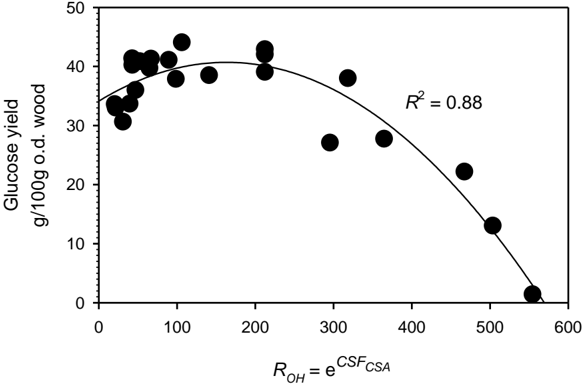
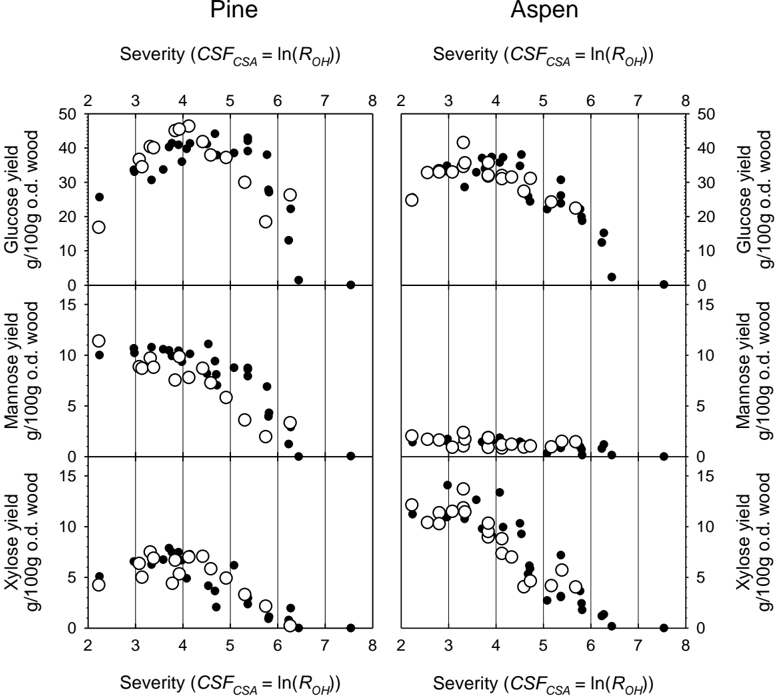
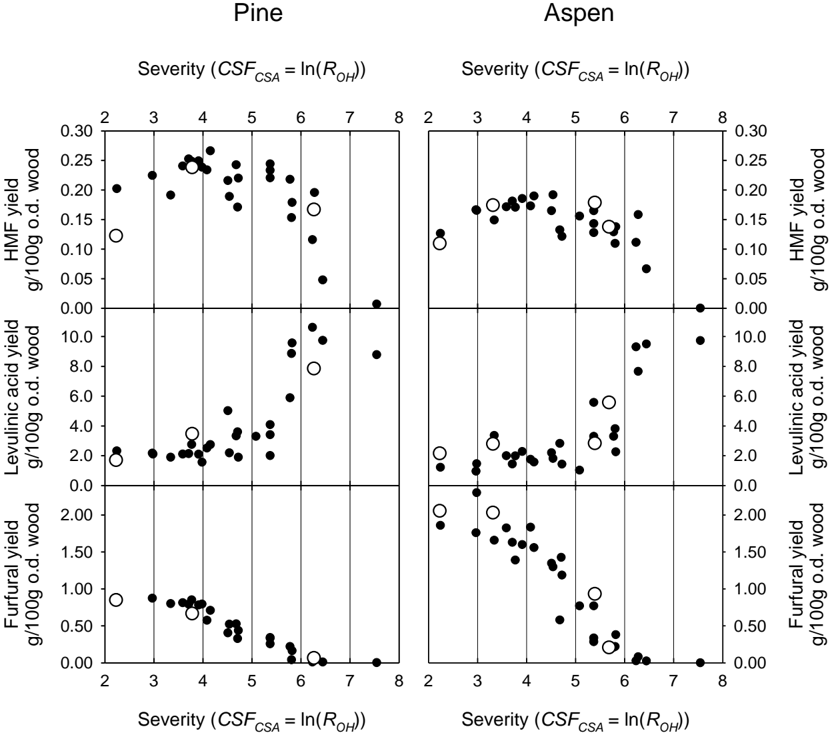
Verification
Claims the paper makes
The claims and statistics of this paper haven’t been checked yet.
Free: it reads the open-access text and checks the first 5 claims that cite a source we can check. Create a free account to check every claim.
Claims other papers make about this one
Each is checked against this paper’s own text: does it say what the citing paper says it does?
The check wasn’t confident either way, so it gives no verdict — never disputed.
In the citing paper
“Montané etal. [76] demonstrated that the reference conditions do not affect significantly the model and can be chosen at the middle of the data sets and T ref is usually set at 100°C and u1D714 at 14.75 [74, 77].”
From Hydrothermal Carbonization of Organic Waste and Biomass: A Review on Process, Reactor, and Plant Modeling (2021) · cites this paper as [77]
Experimental — accuracy not yet measured
Self-check
Percentages, sums and reported differences re-computed from the paper’s own numbers.
The self-check needs the paper’s full text.
Citations
Cites
Hydrolysis of lignocellulosic materials for ethanol production: a review
Sun, Y., & Cheng, J. (2002) · Bioresource Technology · doi:10.1016/s0960-8524(01)00212-7 · Cited by 6,070 · cited 1×
“2729 biomass-to-ethanol conversion efficiency (Larsson et al. 1998; Sanchez et al. 2004; Taherzadeh et al. 1997).”
Biomass Recalcitrance: Engineering Plants and Enzymes for Biofuels Production
Himmel, M. E., Ding, S.-Y., Johnson, D. K., Adney, W. S., Nimlos, M. R., Brady, J. W., & Foust, T. D. (2007) · Science · doi:10.1126/science.1137016 · Cited by 4,533 · cited 2×
“…by Janga et al. (2012) The upper and lower limits of the conditions used in the CCF study (Table 2) were chosen based on information in the literature (Bayat-makooi et al. 1985; Camacho et al. 1996; Goldstein 1980; Harris 1949; Hon and Shirashi 1991; Sherrard and Kressman 1945; Xiang et al. 2003).”
BackgroundMethodFractionation of lignocellulosics by steam-aqueous pretreatments
Overend, R. P., & Chornet, E. (1987) · Philosophical Transactions of the Royal Society of London. Series A, Mathematical and Physical Sciences · doi:10.1098/rsta.1987.0029 · Cited by 1,288 · cited 1×
“The presence of larger amounts of condensed lignin in softwoods, which hinders the swelling of cell wall during hydrolysis (Phaiboonsilpa et al. 2009), could also be a possible reason for this difference.”
BackgroundThe generation of fermentation inhibitors during dilute acid hydrolysis of softwood
Larsson, S., Palmqvist, E., Hahn-Hägerdal, B., Tengborg, C., Stenberg, K., Zacchi, G., & Nilvebrant, N.-O. (1999) · Enzyme and Microbial Technology · doi:10.1016/s0141-0229(98)00101-x · Cited by 1,088 · cited 1×
“…is a low-temperature high acid concentration process, which is carried out either in three stages (prehydrolysis, main hydrolysis/decrystallization, and posthydrolysis) (Sakai 1965) or in two stages (decrystallization and posthydrolysis) (Bayat-makooi et al. 1985; Liao et al. 2006).”
Background(1992) · Choice Reviews Online · doi:10.5860/choice.30-0303 · Cited by 855
Pretreatment of Lignocellulosic Materials for Efficient Bioethanol Production
Galbe, M., & Zacchi, G. (2007) · Advances in Biochemical Engineering/Biotechnology · doi:10.1007/10_2007_070 · Cited by 816 · cited 1×
“…has been applied for other reaction systems such as autohydrolysis, dilute acid hydrolysis, and delignification kinetics (Abatzoglou et al. 1992; Garrote et al. 2002; Martínez et al. 1997; Montané et al. 1993, 1994, 1998), it has not, to the authors’ knowledge, been applied to the concentrated…”
MethodPretreatment-Catalyst effects and the combined severity parameter
Chum, H. L., Johnson, D. K., Black, S. K., & Overend, R. P. (1990) · Applied Biochemistry and Biotechnology · doi:10.1007/bf02920229 · Cited by 401 · cited 1×
“…processes are currently being investigated, the main being biomass gasification for syngas-based processes, and biomass saccharification for either fermentative or catalytic conversion of monosugars to fuels and chemicals (Galbe and Zacchi 2007; Knauf and Moniruzzaman 2004; Sun and Cheng 2002).”
BackgroundCharacterization and Fermentation of Dilute-Acid Hydrolyzates from Wood
Taherzadeh, M. J., Eklund, R., Gustafsson, L., Niklasson, C., & Lidén, G. (1997) · Industrial & Engineering Chemistry Research · doi:10.1021/ie9700831 · Cited by 314 · cited 1×
“…stage concentrated acid disrupts the inter- and intra-molecular hydrogen bonding responsible for cellulose crystallinity and renders it amorphous and easily hydrolysable under fairly mild conditions with formation of low levels of degradation products (Wright and Power 1985; Xiang et al. 2003).”
BackgroundAbatzoglou, N., Chornet, E., Belkacemi, K., & Overend, R. P. (1992) · Chemical Engineering Science · doi:10.1016/0009-2509(92)80235-5 · Cited by 274 · cited 2×
“…by Janga et al. (2012) The upper and lower limits of the conditions used in the CCF study (Table 2) were chosen based on information in the literature (Bayat-makooi et al. 1985; Camacho et al. 1996; Goldstein 1980; Harris 1949; Hon and Shirashi 1991; Sherrard and Kressman 1945; Xiang et al. 2003).”
BackgroundMethodLiu, L., Sun, J., Cai, C., Wang, S., Pei, H., & Zhang, J. (2009) · Bioresource Technology · doi:10.1016/j.biortech.2009.06.048 · Cited by 236 · cited 1×
“…other reaction systems such as autohydrolysis, dilute acid hydrolysis, and delignification kinetics (Abatzoglou et al. 1992; Garrote et al. 2002; Martínez et al. 1997; Montané et al. 1993, 1994, 1998), it has not, to the authors’ knowledge, been applied to the concentrated acid hydrolysis…”
BackgroundLignocellulosic biomass processing: a perspective.
Knauf, M., & Moniruzzaman, M. (2004) · International sugar journal · Cited by 233
Hydrolysis of Lignocellulosic Materials for Ethanol Production: A Review
Sun, Y., & Cheng, J. (2003) · ChemInform · doi:10.1002/chin.200301272 · Cited by 219
Heterogeneous Aspects of Acid Hydrolysis of α-Cellulose
Xiang, Q., Lee, Y. Y., Pettersson, P. O., & Torget, R. W. (2003) · Applied Biochemistry and Biotechnology · doi:10.1385/abab:107:1-3:505 · Cited by 215 · cited 2×
“…stage concentrated acid disrupts the inter- and intra-molecular hydrogen bonding responsible for cellulose crystallinity and renders it amorphous and easily hydrolysable under fairly mild conditions with formation of low levels of degradation products (Wright and Power 1985; Xiang et al. 2003).”
BackgroundMethodSheehan, J., & Himmel, M. (1999) · Biotechnology Progress · doi:10.1021/bp990110d · Cited by 202 · cited 1×
“Proper control and management of reaction conditions is important to achieve an effective decrystallization and eventually higher sugar yields (Hon and Shirashi 1991; Sherrard and Harris 1932).”
BackgroundDilute-acid hydrolysis for fermentation of the Bolivian straw material Paja Brava
Sanchez, G., Pilcher, L., Roslander, C., Modig, T., Galbe, M., & Lidén, G. (2004) · Bioresource Technology · doi:10.1016/j.biortech.2003.11.003 · Cited by 119
Garrote, G., Domínguez, H., & Parajó, J. C. (2002) · Process Biochemistry · doi:10.1016/s0032-9592(01)00315-6 · Cited by 119 · cited 1×
“…by Janga et al. (2012) The upper and lower limits of the conditions used in the CCF study (Table 2) were chosen based on information in the literature (Bayat-makooi et al. 1985; Camacho et al. 1996; Goldstein 1980; Harris 1949; Hon and Shirashi 1991; Sherrard and Kressman 1945; Xiang et al. 2003).”
MethodAcid hydrolysis of fibers from dairy manure
Liao, W., Liu, Y., Liu, C., Wen, Z., & Chen, S. (2005) · Bioresource Technology · doi:10.1016/j.biortech.2005.07.028 · Cited by 77 · cited 1×
“…for mannose and xylose from pine, and CSFCSA below 3 for mannose and xylose from aspen), which agrees with the literature, where hemicellulose sugar yields also have shown maxima at lower severities than glucose yields from cellulose (Liu et al. 2009, Montané et al. 1993; Overend and Chornet 1987).”
BackgroundImproved Cellulose Formation by anAcetobacter xylinum Mutant Limited in (Keto)Gluconate Synthesis
Wulf, P. D., Joris, K., & Vandamme, E. J. M. C. (1996) · Journal of Chemical Technology & Biotechnology · doi:10.1002/(sici)1097-4660(199612)67:4<319::aid-jctb582>3.0.co;2-g · Cited by 76
Review of Processes in the United States Prior to World War II
Sherrard, E. C., & Kressman, F. W. (1945) · Industrial & Engineering Chemistry · doi:10.1021/ie50421a003 · Cited by 72 · cited 1×
“…processes are currently being investigated, the main being biomass gasification for syngas-based processes, and biomass saccharification for either fermentative or catalytic conversion of monosugars to fuels and chemicals (Galbe and Zacchi 2007; Knauf and Moniruzzaman 2004; Sun and Cheng 2002).”
BackgroundInvestigation of chemical changes in the structure of thermally modified wood
Niemz, P., Hofmann, T., & Rétfalvi, T. (2014) · Maderas. Ciencia y Tecnología · doi:10.4067/s0718-221x2010000200002 · Cited by 57 · cited 2×
“…for mannose and xylose from pine, and CSFCSA below 3 for mannose and xylose from aspen), which agrees with the literature, where hemicellulose sugar yields also have shown maxima at lower severities than glucose yields from cellulose (Liu et al. 2009, Montané et al. 1993; Overend and Chornet 1987).”
BackgroundKinetic models for non‐homogeneous complex systems with a time‐dependent rate constant
Montané, D., Overend, R. P., & Chornet, E. (1998) · The Canadian Journal of Chemical Engineering · doi:10.1002/cjce.5450760108 · Cited by 57 · cited 1×
“This may be attributed to the dominance of a stable glucomannan backbone in softwood hemicelluloses as compared to the glucuronoxylan or xylan backbone in hardwood hemicelluloses (Niemzl et al. 2010).”
BackgroundMontan�, D., Salvad�, J., Farriol, X., Jollez, P., & Chornet, E. (1994) · Wood Science and Technology · doi:10.1007/bf00225458 · Cited by 47 · cited 2×
“Such discrepancies in have been observed for pentosans from different hardwoods that are structurally considered to resemble each other (Abatzoglou et al. 1992; Montané et al. 1998).”
BackgroundThe fractionation of almond shells by thermo-mechanical aqueous-phase (TM-AV) pretreatment
Montané, D., Salvadó, J., Farriol, X., & Chornet, E. (1993) · Biomass and Bioenergy · doi:10.1016/0961-9534(93)90064-b · Cited by 33 · cited 3×
“For hemicellulose solubilization, a simple exponential function has been used (Montané et al. 1994); however this function is not particularly suitable for analyzing final yields in a system where the product undergoes significant degradation leading to yield loss, as is the case for acid…”
BackgroundMethodGoldstein, I. S. (1980) · Cited by 31
Factors Influencing Properties of Isolated Wood Lignin
Sherrard, E. C., & Harris, E. E. (1932) · Industrial & Engineering Chemistry · doi:10.1021/ie50265a031 · Cited by 26 · cited 2×
“…by Janga et al. (2012) The upper and lower limits of the conditions used in the CCF study (Table 2) were chosen based on information in the literature (Bayat-makooi et al. 1985; Camacho et al. 1996; Goldstein 1980; Harris 1949; Hon and Shirashi 1991; Sherrard and Kressman 1945; Xiang et al. 2003).”
BackgroundMethodHarris, E. E. (1949) · Advances in carbohydrate chemistry · doi:10.1016/s0096-5332(08)60048-x · Cited by 23
Review of Pilot Plant Programs for Bioethanol Conversion
Schell, D. J., & Duff, B. W. (2018) · Routledge eBooks · doi:10.1201/9780203752456-17 · Cited by 16
Soda-anthraquinone pulping of a softwood mixture: Applying a pseudo-kinetic severity parameter
Martínez, J. M., Reguant, J., Salvadó, J., & Farriol, X. (1997) · Bioresource Technology · doi:10.1016/s0960-8524(97)00010-2 · Cited by 15 · cited 1×
“During hydrolysis in acidic medium, pentoses degrade to furfural, while hexoses degrade to 5-hydroxymethyl furfural (HMF), which degrades further to formic acid and levulinic acid (McKibbins et al. 1962).”
BackgroundCHEMICAL CONVERSION OF LIGNOCELLULOSICS AS TREATED BY TWO-STEP SEMI-FLOW HOT-COMPRESSED WATER
Phaiboonsilpa, N. (2010) · Cited by 12
97/00965 Review of pilot plant programs for bioethanol conversion
(1997) · Fuel and Energy Abstracts · doi:10.1016/s0140-6701(97)82749-x · Cited by 9
Sakai, Y. (1965) · Bulletin of the Chemical Society of Japan · doi:10.1246/bcsj.38.863 · Cited by 7 · cited 1×
“2729 biomass-to-ethanol conversion efficiency (Larsson et al. 1998; Sanchez et al. 2004; Taherzadeh et al. 1997).”
Concentrated halogen acid hydrolysis processes for alcohol fuel production
Wright, J. D., Power, A., & Bergeron, P. W. (1985) · OSTI OAI (U.S. Department of Energy Office of Scientific and Technical Information) · Cited by 6
Concentrated Sulfuric Acid Hydrolysis of Hardwood Aspen and Softwood Pine for Bioethanol Production
Janga, K. K. (2011) · Cited by 3
Self-citation
Research works printed but not linked: 2
- Janga, K. K., Hägg, M. B., and Moe, S. T. (2012). "Influence of acid concentration, temperature, and time on decrystallization in two-stage concentrated sulfuric acid hydrolysis of pinewood and aspenwood: A statistical approach," BioResources 7(1), 391-411.
- McKibbins, S. W., Harris, J. F., Saeman, J. F., and Neill, W. K. (1962). "Kinetics of the acid-catalyzed conversion of glucose to 5-hydroxymethyl-2-furaldehyde and levulinic acid," Forest Prod. J. 12(1), 17-23.
Cited by
Ischia, G., & Fiori, L. (2021) · Waste and Biomass Valorization · doi:10.1007/s12649-020-01255-3 · Cited by 234
Hydrothermal Carbonization: Modeling, Final Properties Design and Applications: A Review
Román, S., Libra, J., Berge, N., Sabio, E., Ro, K., Li, L., Ledesma, B., Álvarez, A., & Bae, S. (2018) · Energies · doi:10.3390/en11010216 · Cited by 209
“[19] applied a more complex severity model for the prediction of the monosaccharide yield via hydrolysis of different wood by concentrated sulfuric acid.”
BackgroundZhang, T., Kumar, R., Tsai, Y.-D., Elander, R. T., & Wyman, C. E. (2014) · Green Chemistry · doi:10.1039/c4gc01283f · Cited by 47
In Deep Analysis on the Behavior of Grape Marc Constituents during Hydrothermal Carbonization
Basso, D., Weiss-Hortala, E., Patuzzi, F., Baratieri, M., & Fiori, L. (2018) · Energies · doi:10.3390/en11061379 · Cited by 45
Remarkable effect of extremely dilute H2SO4 on the cellulose conversion to ethylene glycol
Xu, G., Wang, A., Pang, J., Zheng, M., Yin, J., & Zhang, T. (2015) · Applied Catalysis A General · doi:10.1016/j.apcata.2015.05.038 · Cited by 30
Metadata
- Authors
- Janga, K. K., Øyaas, K., Hertzberg, T., & Moe, S. T.
- Affiliations
- Norwegian University of Science and Technology (NO)
- Corresponding author
- Moe, Størker T.
- ORCID
- Moe, Størker T.
- Venue
- BioResources
- Publisher
- BioResources
- Published
- 2012-05-08
- Volume
- 7
- Issue
- 3
- Pages
- 2728-2741
- ISSN
- 1930-2126 (ISSN-L)
- OpenAlex
- W1486470788
- Cited by
- 12
- References
- 34
- Citations by year
- 2022: 1 · 2020: 2 · 2018: 3 · 2015: 3 · 2014: 2 · 2013: 1
- FWCI
- 1.09
- Type
- journal article
- Language
- en
- Open access
- gold
- dx.doi.org
- Licence
- cc-by
- Locations
- BioResources (publishedVersion, cc-by)
- DOAJ (DOAJ: Directory of Open Access Journals) (submittedVersion, cc-by-sa)
- Funders
- Nordic Energy Research
- Topics
- Physical Sciences › Engineering › Biomedical Engineering › Biofuel production and bioconversion
- Physical Sciences › Chemical Engineering › Catalysis › Catalysis for Biomass Conversion
- Physical Sciences › Energy › Fuel Technology › Thermochemical Biomass Conversion Processes
- Keywords
- monosaccharide yield, two-stage hydrolysis, hemicellulose conversion, Pinus sylvestris, Populus tremuloides, softwood and hardwood, crystallinity reduction
About these checks
Registry, retraction, Cites and statistics results are computed, not judged, with one exception: a printed reference that no index lists is read once by a model before it counts as a citation error. Claims are extracted by a model and kept only when their quote appears verbatim in the text; each cited source is then checked, with a model’s help, for whether it says what the claim relies on. Those verdicts can be wrong — read the claim’s quote and the cited source before relying on one.
Statistics and arithmetic are recomputed, not judged.
Confidence bands are shown only for fields calibrated on our annotated test set. None is calibrated yet, so no band is shown.
What counts as a claim ›How we measure confidence ›How we check this ›
Are you an author, or do you see a problem with this page? Request a review
Data sources
Bibliographic data: Semantic Scholar, OpenAlex, Crossref.
Contains information from the Semantic Scholar Academic Graph Datasets, made available under the ODC Attribution License (ODC-BY 1.0).
Semantic Scholar’s data is described in: Kinney, R., et al. (2023). The Semantic Scholar Open Data Platform. arXiv:2301.10140.
