

Locating the Flood/post-Flood boundary using the relative dating of the weathering of ore deposits
Open accessThe DOI matches its Crossref record; 58 of the 58 references it cites were found in a registry or an index; none of the 61 sources its claims cite is checked for support yet.
Abstract
Erosion at the end of and after the Flood exposed the tops of primary ore deposits to subsequent weathering and the formation of supergene minerals. The 40Ar/39Ar and (U-Th)/He radioisotope methods applied to these supergene minerals provide the dates for when these minerals formed. But given the documented problems with the radioisotope methods, they can only provide at best relative dates. When the Flood waters retreated, the ground surface was dry, but extra time was needed to allow the water table to drop, soil to form and plants to grow before Noah stepped off the Ark, which marked the end of the Flood event. The weathering front then progressed downwards during the early post-Flood decades for supergene minerals to start forming. Residual post-Flood catastrophism may have involved mountains still rising and ore deposits still forming, such as the porphyry copper deposits associated with granite intrusions as the Andes continued to rise. Erosion exposed those later-formed ore deposits to subsequent weathering to produce supergene minerals well into the early post-Flood era. Thus, the relative ages of the supergene iron oxides, and potassium-bearing sulfates and manganese oxides produced span the whole Cenozoic. It is proposed that relative dates for the first formation of supergene minerals can possibly be used as a criterion for determining the placement of the Flood/post-Flood boundary at the K-Pg boundary with a relative age of 66 Ma. The few slightly earlier relative ages likely resulted from weathering that commenced before the Flood event ended, though deep weathering would have required decades. The spread of relative ages through the Cenozoic thus represents the progressive formation of supergene minerals as primary ore deposits emplaced during, and maybe after, the Flood were subsequently exposed to weathering by residual catastrophism. Continuing investigation of this criterion for placement of the Flood/post-Flood boundary seems warranted.
Overview
CoChat Summary
TL;DR
The paper compiles radioisotope dates of supergene minerals formed by weathering of ore deposits and argues they can serve as relative ages to locate the Flood/post-Flood boundary. It concludes the relative ages favor placing that boundary at the Cretaceous/Paleogene boundary, with a relative age of 66 Ma.
Key findings
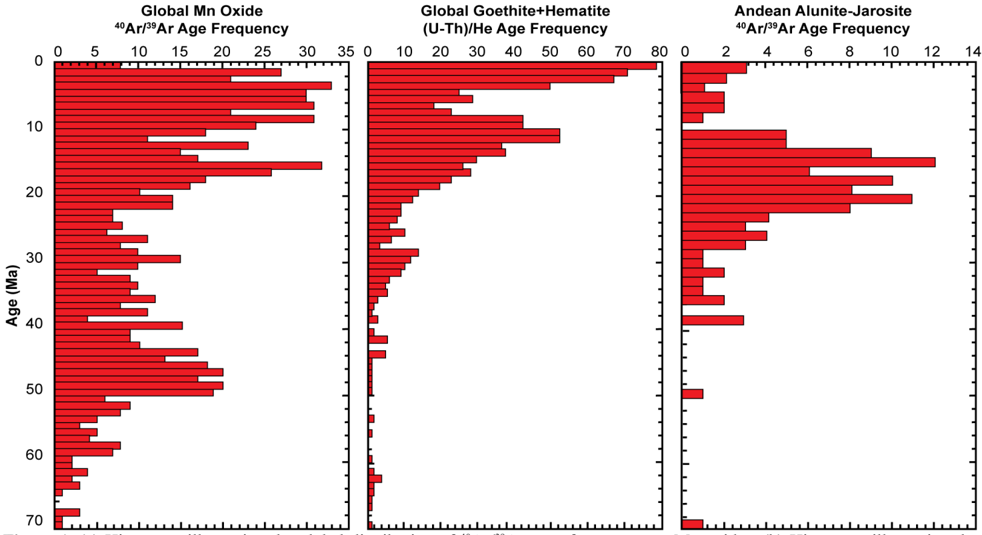
- Compiled supergene mineral ages span 0–70 Ma; the earliest is 70 Ma, just before the K-Pg boundary at 66 Ma, and frequency increases through the Cenozoic for Mn oxides (40Ar/39Ar), goethite + hematite (U-Th)/He, and Andean alunite-jarosite (40Ar/39Ar).
- Andean alunite-jarosite dates start around 40 Ma and peak around 15–20 Ma; Hamersley goethite (U-Th)/He ages span 70.5 Ma to 4.8 Ma, with intermediate ages of 68.0, 61.7, 47.3, 26.0, and 8.5 Ma.
- Supergene alteration of many ore deposit classes is only Cenozoic and related to the current land surface and climate, which the paper says is consistent with a single global Flood and short earth history, not a long-age model.
- The relative ages favor a Flood/post-Flood boundary at the K-Pg boundary (66 Ma); a few >66 Ma dates may reflect weathering before Noah left the Ark, while the Cenozoic spread reflects progressive exposure and weathering.
Methods
- Literature compilation of geochronological data from South American supergene copper deposits; supergene manganese deposits in South America, Africa, Australia, China, India, and Europe; and supergene iron deposits in Australia and Brazil.
- Dating methods used in the compiled studies: 40Ar/39Ar laser incremental heating of K-bearing supergene minerals (hollandite-group K-Mn oxides and alunite-jarosite) and (U-Th)/He analysis of supergene goethite and hematite.
- Data were plotted as histograms of conventional ages from 0–70 Ma in 1 Ma increments by mineral and dating method; the frequency of mineral precipitation through time was used to infer periods conducive to chemical weathering and supergene ore genesis.
Limitations
- The paper states that radioisotope dating methods cannot produce absolute ages because of violated assumptions, so the ages are used only as relative ages, and much caution is needed in interpreting the data.
- The paper notes that supergene weathering requires an oxidizing zone above the water table and decades for chemical weathering, and that some weathering may have begun before the Flood ended, so the ages may not directly date the boundary.
- Evident from the text: the argument depends on a creationist Flood chronology and on the assumption that accelerated radioisotope decay during the Flood was systematic; no new primary geochronology is presented, only a compilation of existing conventional ages.
Model-written summary. Check it against the paper before relying on it.
Integrity signals
Registry
Cites
Statistics
Figures
Verification
Claims the paper makes
0 Valid · 0 Not valid · 46 Not checked · 28 Own results and interpretations
A result the paper reports from its own data — it cites no other source for it, so there is none to check. The quote shows it is in the paper.
In the paper
“The distribution of these supergene minerals through time appears to help to identify periods in the geological past conducive to the dissolution and reprecipitation of ore elements in the weathering environment.”
§ Flood Boundary Using the Relative Dating Locating the Flood/post-Flood Boundary Using the Relative Dating of the Weathering of Ore Deposits of the Weathering of Ore Deposits > RESULTS
hedgedstates an association- Asserted: passes — The authors put it forward as true.
- Checkable: passes — It can be checked against evidence.
- Load-bearing: passes — The paper’s conclusions depend on it.
- Based: passes — The paper gives a reason why it holds.
None of the sources cited for this claim have been checked yet.
In the paper
“However, the rate at which the waters receded is unclear, though the water level likely dropped slowly at first because it was only some 74 days later on Day 224 that”
§ Flood Boundary Using the Relative Dating Locating the Flood/post-Flood Boundary Using the Relative Dating of the Weathering of Ore Deposits of the Weathering of Ore Deposits > 3. The Chronology and Actions of the Retreating Flood Waters
What the sources say
- Not matchedcites Genesis 8:5
This doesn’t read as a citation we can look up.
- Not checked yetcites Austin et al. 1994
- Not matchedcites Snelling 2009
An author–year citation the paper’s reference list doesn’t settle. We don’t search these by name.
hedgedstates a possible cause- Asserted: passes — The authors put it forward as true.
- Checkable: passes — It can be checked against evidence.
- Load-bearing: unclear — It is unclear whether the paper’s conclusions depend on it.
- Based: passes — The paper gives a reason why it holds.
- Not matched
In the paper
“Austin (1998) has documented that volcanic activity has decreased since the Flood, and Austin et al. (1994) postulated decelerating plate movements and collisions into the early post-Flood era.”
§ Flood Boundary Using the Relative Dating Locating the Flood/post-Flood Boundary Using the Relative Dating of the Weathering of Ore Deposits of the Weathering of Ore Deposits > 3. The Chronology and Actions of the Retreating Flood Waters
What the sources say
- Not matchedcites Austin 1998
An author–year citation the paper’s reference list doesn’t settle. We don’t search these by name.
plainstates a cause- Asserted: passes — The authors put it forward as true.
- Checkable: passes — It can be checked against evidence.
- Load-bearing: unclear — It is unclear whether the paper’s conclusions depend on it.
- Based: passes — The paper gives a reason why it holds.
- Not matched
A conclusion the paper draws from its own results — it cites no other source for it, so there is none to check. The quote shows it is in the paper.
In the paper
“The key here is that the acceleration factor was systematic, which means that during the Flood the rocks would have”
§ Flood Boundary Using the Relative Dating Locating the Flood/post-Flood Boundary Using the Relative Dating of the Weathering of Ore Deposits of the Weathering of Ore Deposits > Snelling ◀ Flood/post-Flood boundary ▶ 2018 ICC
hedgedstates a cause- Asserted: passes — The authors put it forward as true.
- Checkable: passes — It can be checked against evidence.
- Load-bearing: passes — The paper’s conclusions depend on it.
- Based: passes — The paper gives a reason why it holds.
In the paper
“Seedorff et al. (2005, Fig. 2, p.255) document that the formation of about a third of the porphyry copper deposits conventionally date back through the Mesozoic and Paleozoic to almost 500 Ma, including in the Andean and Rockies regions.”
§ Flood Boundary Using the Relative Dating Locating the Flood/post-Flood Boundary Using the Relative Dating of the Weathering of Ore Deposits of the Weathering of Ore Deposits > 4. The Timing of Weathering and Formation of Supergene Minerals
What the sources say
- Not checked yetcites Seedorff et al. 2005 matched to “Porphyry Deposits: Characteristics and Origin of Hypogene Features” (2005) source
plain- Asserted: passes — The authors put it forward as true.
- Checkable: passes — It can be checked against evidence.
- Load-bearing: passes — The paper’s conclusions depend on it.
- Based: passes — The paper gives a reason why it holds.
33 more claims
Create a free account to see all 74 claims and to verify the 21 references still open.
- Probably not a substantial claim. 19
- It may state two separate claims as one. 22
Self-check
Percentages, sums and reported differences re-computed from the paper’s own numbers.
Each contradiction between two passages listed here was confirmed by an independent check.
Rated minor: it would not touch a result — a value no result rests on, a p-value that stays on the same side of the significance level, or a conflict that is clerical, resolved elsewhere in the paper, or outside its own findings.
In the paper
§ Flood Boundary Using the Relative Dating Locating the Flood/post-Flood Boundary Using the Relative Dating of the Weathering of Ore Deposits of the Weathering of Ore Deposits > RESULTS
“showing the frequencies of conventional ages in the range 0-70 Ma in 1 Ma increments.”
§ Flood Boundary Using the Relative Dating Locating the Flood/post-Flood Boundary Using the Relative Dating of the Weathering of Ore Deposits of the Weathering of Ore Deposits > 5. The Radioisotope Ages of the Supergene Minerals
“The goethite (U-Th)/He ages span the Cenozoic from 70.5 Ma to 4.8 Ma, with intermediate ages of 68.0 Ma, 61.7 Ma, 47.3 Ma, 26.0 Ma and 8.5 Ma (Miller et al. 2017).These ages plot within the spread of ages in the histogram in Fig. 1b”
Citations
Cites
Distribution, Character, and Genesis of Gold Deposits in Metamorphic Terran
Goldfarb, R. J., Baker, T., Dubé, B., Groves, D., Hart, C. J. R., & Gosselin, P. (2005) · doi:10.5382/av100.14 · Cited by 1,519 · cited 2×
“2005), gold deposits in metamorphic terranes (Goldfarb et al. 2005), and granite-related ore deposits (Černý et al.”
BackgroundGeological Characteristics of Epithermal Precious and Base Metal Deposits
Simmons, S. F., White, N. C., & John, D. A. (2005) · doi:10.5382/av100.16 · Cited by 924 · cited 4×
“Similarly, epithermal precious and base metal deposits (Simmons et al. 2005), iron oxide coppergold deposits (Williams et al.”
BackgroundInfluentialGradstein, F. M., Ogg, J. G., & Hilgen, F. J. (2012) · Newsletters on Stratigraphy · doi:10.1127/0078-0421/2012/0020 · Cited by 781
Volcanogenic Massive Sulfide Deposits
Franklin, J. M., Gibson, H. L., Jonasson, I. R., & Galley, A. G. (2005) · One Hundredth Anniversary Volume · doi:10.5382/av100.17 · Cited by 681 · cited 3×
“Volcanogenic massive sulfide deposits (Franklin et al. 2005), banded iron formations (Clout et al. 2005) and many sediment-hosted Pb-Zn deposits (Leach et al. 2005), of all conventional ages including Precambrian and early Phanerozoic, all formed at the sediments or volcanics surface/water…”
BackgroundČerný, P., Blevin, P. L., Cuney, M., & London, D. (2005) · doi:10.5382/av100.12 · Cited by 510
Sediment-Hosted Lead-Zinc Deposits<subtitle>A Global Perspective</subtitle>
Leach, D. L., Sangster, D. F., Kelley, K. D., Large, R. R., Garven, G., Allen, C. R., Gutzmer, J., & Walters, S. (2005) · One Hundredth Anniversary Volume · doi:10.5382/av100.18 · Cited by 498 · cited 2×
“Volcanogenic massive sulfide deposits (Franklin et al. 2005), banded iron formations (Clout et al. 2005) and many sediment-hosted Pb-Zn deposits (Leach et al. 2005), of all conventional ages including Precambrian and early Phanerozoic, all formed at the sediments or volcanics surface/water…”
BackgroundALPERS, C. N., & BRIMHALL, G. H. (1988) · Geological Society of America Bulletin · doi:10.1130/0016-7606(1988)100<1640:mmccit>2.3.co;2 · Cited by 348 · cited 1×
“Geochronological data was compiled from a number of studies – South American supergene copper deposits (Alpers and Brimhall 1988; Arancibia et al. 2006; Mote et al. 2001; Sillitoe and McKee 1996; Vasconcelos 1999a); South American supergene manganese deposits (de Oliveira Carmo and Vasconcelos…”
MethodOre-Forming Processes Related to Lateritic Weathering
Freyssinet, P., Butt, C. R. M., Morris, R. C., & Piantone, P. (2005) · One Hundredth Anniversary Volume · doi:10.5382/av100.21 · Cited by 292 · cited 3×
“The fact is that lateritic deposits formed by supergene weathering acting on primary ore deposits and suitable source rocks are all Cenozoic (Freyssinet et al. 2005).”
BackgroundAge of supergene oxidation and enrichment in the Chilean porphyry copper province
Sillitoe, R. H., & McKee, E. H. (1996) · Economic Geology · doi:10.2113/gsecongeo.91.1.164 · Cited by 196
K-Ar AND 40Ar/39Ar GEOCHRONOLOGY OF WEATHERING PROCESSES
Vasconcelos, P. M. (1999) · Annual Review of Earth and Planetary Sciences · doi:10.1146/annurev.earth.27.1.183 · Cited by 169 · cited 12×
“…2002; Vasconcelos 2002; Vasconcelos et al. 2013), China (Deng et al. 2014; Li et al. 2007), India (Bonnet et al. 2014), and Europe (Hautmann and Lippolt 2000); and supergene iron deposits in Australia (Heim et al. 2006; Vasconcelos 1999b; Vasconcelos et al. 2013), and Brazil (Monteiro et al. 2014).”
BackgroundMethodInfluentialWeathering geochronology by (U-Th)/He dating of goethite
Shuster, D. L., Vasconcelos, P. M., Heim, J. A., & Farley, K. A. (2005) · Geochimica et Cosmochimica Acta · doi:10.1016/j.gca.2004.07.028 · Cited by 152 · cited 3×
“For such samples forming at earth-surface conditions, their goethite (U-Th)/He ages are established upon mineral crystallization (Shuster et al., 2005).”
BackgroundMethodBeauvais, A. A., Ruffet, G., Hénocque, O., & Colin, F. (2008) · Journal of Geophysical Research Atmospheres · doi:10.1029/2008jf000996 · Cited by 141 · cited 11×
“2006; Vasconcelos 1999b); other supergene manganese deposits in Africa (Beauvais et al. 2008), Australia (Dammer et al.”
BackgroundInfluential(U–Th)/He geochronology of goethite and the origin and evolution of cangas
Monteiro, H. S., Vasconcelos, P. M., Farley, K. A., Spier, C. A., & Mello, C. L. (2014) · Geochimica et Cosmochimica Acta · doi:10.1016/j.gca.2014.01.036 · Cited by 128 · cited 8×
“The supergene iron and manganese ore deposits of Minas Gerais, Brazil have developed at the present land surface from early Precambrian banded iron formations and Mn-rich sedimentary units, so the 40Ar/39Ar ages for the supergene minerals are all Cenozoic (de Oliveira Carmo and Vasconcelos 2006; Spier et al. 2006).”
BackgroundMethodInfluentialVasconcelos, P. M., Heim, J. A., Farley, K. A., Monteiro, H. S., & Waltenberg, K. (2013) · Geochimica et Cosmochimica Acta · doi:10.1016/j.gca.2013.03.037 · Cited by 126
Porphyry Deposits: Characteristics and Origin of Hypogene Features
Seedorff, E., Dilles, J. H., Proffett, J. M., Einaudi, M. T., Zurcher, L., Stavast, W. J. A., Johnson, D. A., & Barton, M. D. (2005) · One Hundredth Anniversary Volume · doi:10.5382/av100.10 · Cited by 125
Spier, C. A., Vasconcelos, P. M., & de Oliviera, S. M. B. (2006) · Chemical Geology · doi:10.1016/j.chemgeo.2006.04.006 · Cited by 120 · cited 4×
“…Mote et al. 2001; Sillitoe and McKee 1996; Vasconcelos 1999a); South American supergene manganese deposits (de Oliveira Carmo and Vasconcelos 2006; Spier et al. 2006; Vasconcelos 1999b); other supergene manganese deposits in Africa (Beauvais et al. 2008), Australia (Dammer et al. 1999; Feng and…”
BackgroundInfluentialArancibia, G., Matthews, S. J., & de Arce, C. P. (2006) · Journal of the Geological Society · doi:10.1144/0016-764904-161 · Cited by 120 · cited 2×
“Geochronological data was compiled from a number of studies – South American supergene copper deposits (Alpers and Brimhall 1988; Arancibia et al. 2006; Mote et al. 2001; Sillitoe and McKee 1996; Vasconcelos 1999a); South American supergene manganese deposits (de Oliveira Carmo and Vasconcelos 2006; Spier et al.”
MethodHeim, J. A., Vasconcelos, P. M., Shuster, D. L., Farley, K. A., & Broadbent, G. (2006) · Geology · doi:10.1130/g22003.1 · Cited by 93
Hautmann, S., & Lippolt, H. J. (2000) · Chemical Geology · doi:10.1016/s0009-2541(99)00241-7 · Cited by 92
Mote, T. I., Becker, T., Renne, P. R., & Brimhall, G. H. (2001) · Economic Geology · doi:10.2113/gsecongeo.96.2.351 · Cited by 91 · cited 2×
“Geochronological data was compiled from a number of studies – South American supergene copper deposits (Alpers and Brimhall 1988; Arancibia et al. 2006; Mote et al. 2001; Sillitoe and McKee 1996; Vasconcelos 1999a); South American supergene manganese deposits (de Oliveira Carmo and Vasconcelos 2006; Spier et al.”
BackgroundMethodPrecambrian Iron Formations and Iron Formation-Hosted Iron Ore Deposits
Clout, J. M. F., & Simonson, B. M. (2005) · One Hundredth Anniversary Volume · doi:10.5382/av100.20 · Cited by 89
Geological and Economic Significance of Supergene Metal Deposits
Reich, M., & Vasconcelos, P. M. (2015) · Elements · doi:10.2113/gselements.11.5.305 · Cited by 81
Bonnet, N. J., Beauvais, A. A., Arnaud, N., Chardon, D., & Jayananda, M. (2016) · Chemical Geology · doi:10.1016/j.chemgeo.2016.04.018 · Cited by 74 · cited 1×
“In China Mn oxides have developed at the surface on Devonian carbonates (Li et al. 2007), while in India Mn oxides have developed in laterites due to chemical weathering of the underlying Cretaceous Deccan basalts (Beauvais et al. 2016; Bonnet et al. 2014, 2016).”
BackgroundReich, M., Palacios, C., Vargas, G., Luo, S., Cameron, E. M., Leybourne, M. I., Parada, M. A., Zúñiga, A., & You, C.-F. (2009) · Mineralium Deposita · doi:10.1007/s00126-009-0229-3 · Cited by 74 · cited 2×
“…and landscape development was demonstrated conclusively by the U-series dating of supergene assemblages in Chilean porphyry copper deposits by Reich et al. (2009) It is similarly relevant and significant that the most recent set of goethite (U-Th)/He ages from the Hamersley region of…”
BackgroundColin, F., Beauvais, A. A., Ruffet, G., & Hénocque, O. (2005) · Earth and Planetary Science Letters · doi:10.1016/j.epsl.2005.06.052 · Cited by 73 · cited 2×
“…present land surface on Proterozoic (Precambrian) sedimentary units in the Katanga (De Putter et al. 2015), Kalahari (Gutzmer et al. 2012) and Burkina Faso regions (Colin et al. 2005; Beauvais et al. 2008), and the 40Ar/39Ar ages for Mn oxides are all Cenozoic, some of them being plotted in Fig.”
BackgroundSupergene Oxidized and Enriched Porphyry Copper and Related Deposits
Sillitoe, R. H. (2005) · One Hundredth Anniversary Volume · doi:10.5382/av100.22 · Cited by 68 · cited 2×
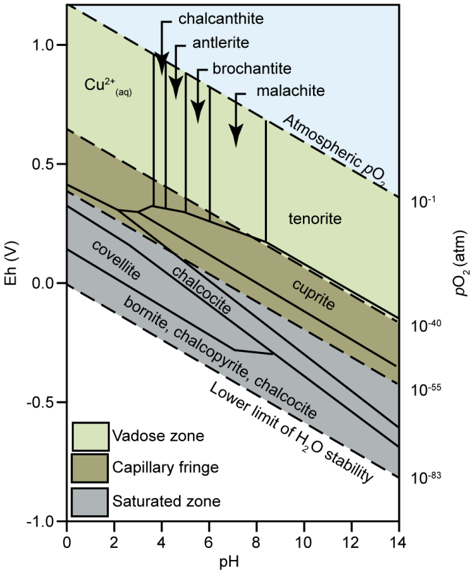
“Leaching processes also respond to changes in physicochemical properties, such as the partial pressure of oxygen (pO2), and its effect on the redox potential (Eh), as well as the activity of H+ of descending aqueous solutions (Reich et al. 2009; Sillitoe 2005).”
BackgroundPutter, T. D., Ruffet, G., Yans, J., & Mees, F. (2015) · Ore Geology Reviews · doi:10.1016/j.oregeorev.2015.06.015 · Cited by 65 · cited 1×
“…in Africa supergene manganese deposits have developed at the present land surface on Proterozoic (Precambrian) sedimentary units in the Katanga (De Putter et al. 2015), Kalahari (Gutzmer et al. 2012) and Burkina Faso regions (Colin et al. 2005; Beauvais et al. 2008), and the 40Ar/39Ar ages for Mn…”
BackgroundFirst 40Ar/39Ar dating of intense Late Palaeogene lateritic weathering in Peninsular India
Bonnet, N. J., Beauvais, A. A., Arnaud, N., Chardon, D., & Jayananda, M. (2013) · Earth and Planetary Science Letters · doi:10.1016/j.epsl.2013.11.002 · Cited by 64 · cited 6×
“In China Mn oxides have developed at the surface on Devonian carbonates (Li et al. 2007), while in India Mn oxides have developed in laterites due to chemical weathering of the underlying Cretaceous Deccan basalts (Beauvais et al. 2016; Bonnet et al. 2014, 2016).”
BackgroundInfluentialDammer, D., McDougall, I., & Chivas, A. R. (1999) · Economic Geology · doi:10.2113/gsecongeo.94.1.87 · Cited by 62 · cited 16×
“K-Ar ages of these supergene minerals are late Cenozoic, similar to 40Ar/39Ar ages for Mn oxides in the current weathering profile in a nearby part of Australia (Feng and Vasconcelos 2007).”
BackgroundInfluential40Ar/39Ar geochronology constraints on late miocene weathering rates in Minas Gerais, Brazil
Carmo, I. D. O., & Vasconcelos, P. M. (2005) · Earth and Planetary Science Letters · doi:10.1016/j.epsl.2005.09.056 · Cited by 62
The Paleoclimatic Signatures of Supergene Metal Deposits
Vasconcelos, P. M., Reich, M., & Shuster, D. L. (2015) · Elements · doi:10.2113/gselements.11.5.317 · Cited by 60 · cited 2×
“METHODS Results from applying this methodology are already available in the relevant literature (Vasconcelos et al. 2015).”
MethodLi, J., & Vasconcelos, P. M. (2002) · Earth and Planetary Science Letters · doi:10.1016/s0012-821x(02)00594-0 · Cited by 58
Very long-term stability of passive margin escarpment constrained by40Ar/39Ar dating of K-Mn oxides
Beauvais, A. A., Bonnet, N. J., Chardon, D., Arnaud, N., & Jayananda, M. (2016) · Geology · doi:10.1130/g37303.1 · Cited by 56 · cited 2×
“2007), while in India Mn oxides have developed in laterites due to chemical weathering of the underlying Cretaceous Deccan basalts (Beauvais et al. 2016; Bonnet et al. 2014, 2016).”
BackgroundYapp, C. J. (1991) · Geochimica et Cosmochimica Acta · doi:10.1016/0016-7037(91)90378-i · Cited by 55
Li, J., Vasconcelos, P. M., Duzgoren-Aydin, N. S., Yan, D., Zhang, W., Deng, X.-D., Zhao, X.-F., Zeng, Z.-P., & Ming-an, H. (2007) · Earth and Planetary Science Letters · doi:10.1016/j.epsl.2007.01.021 · Cited by 41 · cited 6×
“In China Mn oxides have developed at the surface on Devonian carbonates (Li et al. 2007), while in India Mn oxides have developed in laterites due to chemical weathering of the underlying Cretaceous Deccan basalts (Beauvais et al. 2016; Bonnet et al. 2014, 2016).”
BackgroundInfluentialTornos, F., Velasco, F., Slack, J. F., Delgado‐Huertas, A., Miguélez, N. G., Escobar, J. M., & Gómez, C. (2016) · Mineralium Deposita · doi:10.1007/s00126-016-0650-3 · Cited by 34 · cited 1×
“Similarly, in Spain the late Paleozoic Las Cruces volcanogenic massive sulfide deposit was exhumed and affected by subaerial oxidation connected to the current landscape (Tornos et al. 2017).”
BackgroundScott, K. M. (1990) · American Mineralogist · Cited by 34
40Ar/39Ar Geochronology of Supergene Processes in Ore Deposits
Vasconcelos, P. M. (1999) · doi:10.5382/rev.12.04 · Cited by 31 · cited 28×
“2014), and Europe (Hautmann and Lippolt 2000); and supergene iron deposits in Australia (Heim et al. 2006; Vasconcelos 1999b; Vasconcelos et al. 2013), and Brazil (Monteiro et al.”
BackgroundMethodInfluentialGutzmer, J., Plooy, A. P. D., & Beukes, N. J. (2012) · Ore Geology Reviews · doi:10.1016/j.oregeorev.2012.04.003 · Cited by 30
Supergene Alteration of Ore Deposits: From Nature to Humans
Dill, H. G. (2015) · Elements · doi:10.2113/gselements.11.5.311 · Cited by 30 · cited 3×
“Second, could oxygenated surface waters have been forced hydrodynamically downward in the receding waters phase of the Flood and accomplish the same supergene alteration? It is possible that some surface water would penetrate downwards, but as noted above, the chemical weathering that produces supergene minerals only…”
BackgroundInfluentialDeng, X.-D., Li, J., Vasconcelos, P. M., Cohen, B. E., & Kusky, T. (2014) · Geochimica et Cosmochimica Acta · doi:10.1016/j.gca.2014.04.036 · Cited by 28 · cited 5×
“In China Mn oxides have developed at the surface on Devonian carbonates (Li et al. 2007), while in India Mn oxides have developed in laterites due to chemical weathering of the underlying Cretaceous Deccan basalts (Beauvais et al. 2016; Bonnet et al. 2014, 2016).”
BackgroundInfluentialChronology of Pleistocene weathering processes, southeast Queensland, Australia
Feng, Y., & Vasconcelos, P. M. (2007) · Earth and Planetary Science Letters · doi:10.1016/j.epsl.2007.08.036 · Cited by 23
Miller, H. B. D., Vasconcelos, P. M., Eiler, J. M., & Farley, K. A. (2017) · Geology · doi:10.1130/g38989.1 · Cited by 22 · cited 3×
“1b (Miller et al. 2017).”
BackgroundInfluentialEvidence for a late Cainozoic Flood/postFlood boundary
Holt, R. D. (1996) · Cited by 21
Is the K/T the Post-Flood boundary?— part 1: introduction and the scale of sedimentary rocks
Oard, M. J. (2010) · Cited by 10
Geochronology of Weathering in the Mt Isa and Charters Towers Regions, Northern Queensland
Vasconcelos, P. M. (2002) · Cited by 10
The geological column is a general Flood order with many exceptions
Oard, M. J. (2010) · Cited by 5
Improving our understanding of creation and its history
Fm, N., Fm, G., & Fm, M. (2014) · Cited by 3
Geology indicates the terrestrial Flood/ post-Flood boundary is mostly in the Late Cenozoic
Oard, M. J. (2013) · Cited by 3
Research needed to resolve questions with late Cenozoic post-Flood boundary
Walker, T. (2014) · Cited by 2
The Flood/post- Flood boundary
Oard, M. J. (2013) · Cited by 1
(1994) · DigitalCommons-Cedarville (Cedarville University)
Self-citation(2013) · Proceedings of the International Conference on Creationism/Proceedings of the ... International Conference on Creationism
(2012)
(2003) · Proceedings of the International Conference on Creationism/Proceedings of the ... International Conference on Creationism
(1998) · Neues Jahrbuch für Mineralogie - Monatshefte
(2012)
(2008) · Proceedings of the International Conference on Creationism/Proceedings of the ... International Conference on Creationism
Research works printed but not linked: 23
- S.W. Boyd, and A.A. Snelling, pp.189-230.
- Clarey, T.L. 2016. The Ice Age as a mechanism for post-Flood dispersal. Journal of Creation 30, no.2:54-59.
- Faure, G., and T.M. Mensing. 2005. Isotopes: Principles and applications, 3rd ed. Hoboken, New Jersey: John Wiley & Sons, Inc.
- Leach, D.L., D.F. Sangster, K.D. Kelley, R.R. Large, G. Garven, C.R. Allen, J. Gutzmer, and S. Walters. 2005. Sediment-hosted lead-zinc deposits: A global perspective. In Economic geology: One hundredth anniversary volume, eds. J.W. Hedenquist, J.F.H. Thompson, R.J. Goldfarb, and J.P. Richards, pp. 561-607. Littleton, Colorado: Society of Economic Geologists.
- Morton, G.R. 1984. Global, continental and regional sedimentation systems and their implications. Creation Research Society Quarterly 21:23-33.
- Oard, M.J. 2004. Pediments formed by the Flood: Evidence for the Flood/ post-Flood boundary in the Late Cenozoic. Journal of Creation 18, no.2:15-27.
- Oard, M.J. 2007. Defining the Flood/post-Flood boundary in sedimentary rocks. Journal of Creation 21, no.1:98-110.
- Oard, M.J. 2010c. Is the K/T the post-Flood boundary? -Part 2: Paleoclimates and fossils. Journal of Creation 24, no.3:87-93.
- Oard, M.J. 2011. Is the K/T the post-Flood boundary? -Part 3: Volcanism and plate tectonics. Journal of Creation 25, no.1:57-62.
- Ross, M.R. 2014b. Reliable data disconfirm a late Cenozoic post-Flood boundary. Journal of Creation 28 no.2:66-68.
- Snelling, A.A. 2000. Geochemical processes in the mantle and crust. In Radioisotopes and the age of the earth: A young-earth creationist research initiative, eds. L. Vardiman, A.A. Snelling, and E.F. Chaffin, pp.123-304. El Cajon, California: Institute for Creation Research; St. Joseph, Missouri: Creation Research Society.
- Snelling, A.A. 2014a. Geological issues: Charting a scheme for correlating the rock layers with the biblical record. In Grappling with the chronology of the Genesis Flood: Navigating the flow of time in biblical narrative, eds. S.W. Boyd, and A.A. Snelling, pp.77-109. Green Forest, Arkansas: Master Books.
- Snelling, A.A. 2014b. Geophysical issues: Understanding the origin of the continents, their rock layers and mountains. In Grappling with the chronology of the Genesis Flood: Navigating the flow of time in biblical narrative, eds. S.W. Boyd, and A.A. Snelling, pp.111-143. Green Forest, Arkansas: Master Books.
- S.W. Boyd, and A.A. Snelling, pp.145-185. Green Forest, Arkansas: Master Books.
- Snelling, A.A. 2016a. Determination of the radioisotope decay constants and half-lives: Potassium-40 ( 40 K). Answers Research Journal 9:171- 196.
- Snelling, A.A. 2017a. Determination of the decay constants and half-lives of uranium-238 ( 238 U) and uranium-235 ( 235 U), and the implications for U-Pb and Pb-Pb radioisotope dating methodologies. Answers Research Journal 10:1-38.
- Tyler, D.J., and H.G. Coffin. 2006. Accept the column, reject the chronology. In The geologic column: Perspectives within diluvial geology, eds. J.K. Reed, and M.J. Oard, pp.53-69. Chino Valley, Arizona: Creation Research Society.
- R. L. Ivey, Jr., pp. 17-28. Pittsburgh, Pennsylvania: Creation Science Fellowship.
- Vardiman, L., A.A. Snelling, and E.F. Chaffin, eds. 2005. Radioisotopes and the age of the earth: Results of a young-earth research initiative, vol. 2. El Cajon, California: Institute for Creation Research; Chino Valley, Arizona: Creation Research Society.
- Walker, T. 2014a. Post-Flood boundary-a robust analysis flawed by hidden assumptions. Journal of Creation 28, no.2:60-61.
- Whitmore, J.H., and P. Garner. 2008. Using suites of criteria to recognize pre-Flood, Flood, and post-Flood strata in the rock record with application to Wyoming (USA). In Proceedings of the Sixth International Conference on Creationism, ed. A.A. Snelling, pp.425-448. Pittsburgh, Pennsylvania: Creation Science Fellowship; Dallas, Texas: Institute for Creation Research.
- A.A. Snelling, pp.449-457. Pittsburgh, Pennsylvania: Creation Science Fellowship; Dallas, Texas: Institute for Creation Research.
- J.W. Hedenquist, J.F.H. Thompson, R.J. Goldfarb, and J.P. Richards, pp. 371-405. Littleton, Colorado: Society of Economic Geologists.
Metadata
- Authors
- Snelling, A.
- Corresponding author
- Snelling, Andrew
- Venue
- The Proceedings of the International Conference on Creationism
- Publisher
- Centennial Library
- Published
- 2018
- Volume
- 8
- Issue
- 1
- Pages
- 553-566
- ISSN
- 2639-3999 (ISSN-L)
- 2639-4006
- OpenAlex
- W2893567028
- Semantic Scholar
- 42b9bc46892f3b85c2e2ac3a90f7fd828eb11469
- Cited by
- 0
- References
- 57
- FWCI
- 0.00
- Type
- conference paper
- Language
- en
- Open access
- hybrid
- doi.org
- Licence
- cc-by-nc-nd
- Locations
- Proceedings of the International Conference on Creationism/Proceedings of the ... International Conference on Creationism (publishedVersion, cc-by-nc-nd)
- DigitalCommons-Cedarville (Cedarville University) (submittedVersion, cc-by-nc-nd)
- Topics
- Physical Sciences › Earth and Planetary Sciences › Geochemistry and Petrology › Geological and Geochemical Analysis
- Physical Sciences › Earth and Planetary Sciences › Paleontology › Paleontology and Stratigraphy of Fossils
- Physical Sciences › Earth and Planetary Sciences › Atmospheric Science › Geology and Paleoclimatology Research
- Keywords
- supergene minerals, 40Ar/39Ar dating, (U-Th)/He dating, relative dating, manganese oxide, Cretaceous-Paleogene boundary, porphyry copper deposits, Cenozoic
About these checks
Registry, retraction, Cites and statistics results are computed, not judged, with one exception: a printed reference that no index lists is read once by a model before it counts as a citation error. Claims are extracted by a model and kept only when their quote appears verbatim in the text; each cited source is then checked, with a model’s help, for whether it says what the claim relies on. Those verdicts can be wrong — read the claim’s quote and the cited source before relying on one.
A language model drew the claims from the paper on 2026-11-27, under version 3 of the claim definition (model deepseek-v4.1-flash, prompt extract-v3).
A second model labelled each claim on 2026-11-27 (model jev-1.13-20260917, definition revision gold-guideline-v0.2).
Statistics and arithmetic are recomputed, not judged.
Confidence bands are shown only for fields calibrated on our annotated test set. None is calibrated yet, so no band is shown.
What counts as a claim ›How we measure confidence ›How we check this ›
Are you an author, or do you see a problem with this page? Request a review
Data sources
Bibliographic data: Semantic Scholar, OpenAlex, Crossref.
Contains information from the Semantic Scholar Academic Graph Datasets, made available under the ODC Attribution License (ODC-BY 1.0).
Semantic Scholar’s data is described in: Kinney, R., et al. (2023). The Semantic Scholar Open Data Platform. arXiv:2301.10140.
