

A creationist view of Gӧbekli Tepe: Timeline and other considerations
Open accessThe DOI matches its Crossref record; 26 of the 26 references it cites were found in a registry or an index; none of the 33 sources its claims cite is checked for support yet.
Abstract
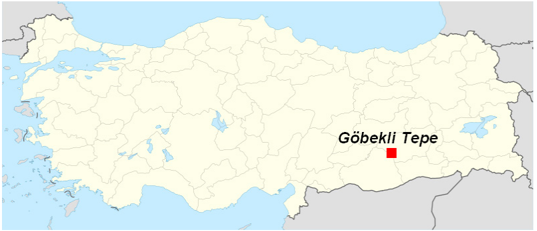
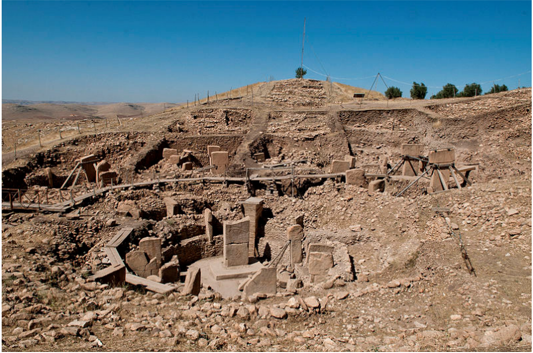
Gӧbekli Tepe is a prehistoric archaeological site in SE Turkey that has captured the attention of the world by how advanced it is for its age, an astounding 12,000 years old on the conventional timeline. This has required conventional scholars to readjust their thinking about the capabilities of ancient people because, according to their worldview, humans should not have been able to produce carved stone monuments like these that far back in time. Creationists do not find this difficult to accept because they believe that early man was a capable being, as created by God. In addition, because the creationist timeline is far shorter than the conventional one, Gӧbekli Tepe was not built as long ago as conventional scholars believe. In this paper we discuss the conventional versus biblical timelines and show the enormous telescoping of the conventional timeline in historical times that is necessary to correlate it to the two slightly variant biblical timelines (Masoretic and Septuagint). Using the end of the Neanderthals, the end of the Pleistocene, the Nile Delta formation, and Abraham’s visit to Egypt, it is proposed here that Gӧbekli Tepe was most likely founded somewhat more than one hundred years before Abraham’s visit to Egypt (Masoretic timeline) or, alternatively, around two hundred and fifty years before Abraham’s visit to Egypt (Septuagint timeline). It is postulated that geological events at the end of the Ice Age may have caused the builders of Gӧbekli Tepe to first migrate to the site, and then later abandon it.
Overview
CoChat Summary
TL;DR
This paper correlates conventional archaeological dates for Göbekli Tepe with Masoretic and Septuagint biblical timelines, arguing the site was founded shortly before Abraham’s visit to Egypt rather than around 12,000 years ago. It proposes that end-Ice-Age events may have caused the builders to migrate to the site and later abandon it.
Key findings
- Göbekli Tepe’s earliest excavated level is dated just under 10,000 BC(CT), with conventional building/reconstruction lasting somewhat under 2,000 years before abandonment. The paper proposes the site was founded somewhat more than 100 years before Abraham’s visit to Egypt on the Masoretic timeline, or about 250 years before on the Septuagint timeline.
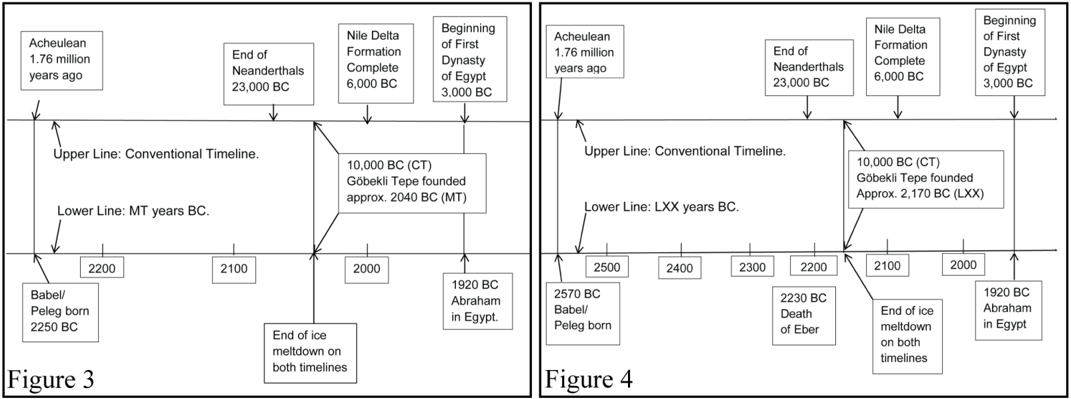
- The paper argues conventional time compresses drastically on biblical timelines: the 13,000 conventional years between the last Neanderthals at 23,000 BC(CT) and Göbekli Tepe at 10,000 BC(CT) become about 30 years (MT) or about 50 years (LXX); the conventional 2,000-year building span becomes as little as 25 years (MT) or about 50 years (LXX).
- Göbekli Tepe is placed about 210 years after Babel (MT) or about 400 years after Babel (LXX). The time from Göbekli Tepe to the Sumerian clay tablets is estimated at about 100 years (MT) or about 200 years (LXX), compared with close to 6,700 conventional years.
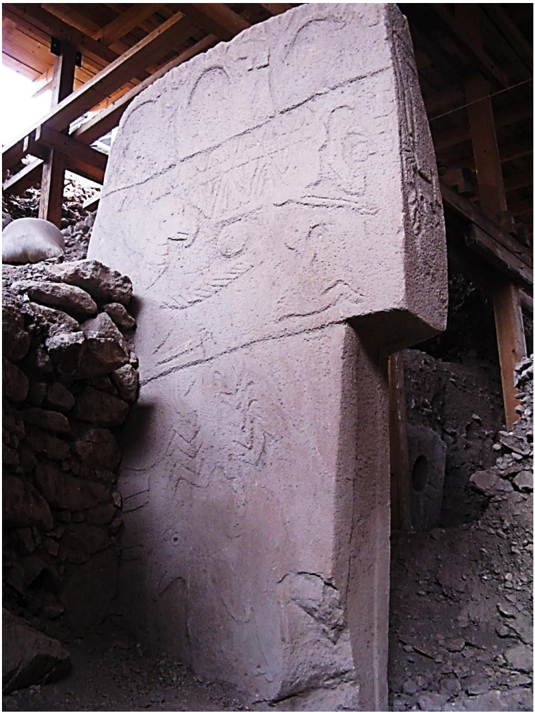
- The paper notes that the largest, most finely carved pillars are the oldest at Göbekli Tepe, with later pillars smaller and rougher, and argues this reverses evolutionary expectations. It postulates that end-Ice-Age deglaciation and related geological events may explain the builders’ arrival and later departure.
Methods
- Conceptual chronological correlation paper, not a new excavation or primary archaeological study. It uses published conventional dates and biblical genealogical timelines.
- Conventional timeline data points used: Acheulean tools about 1.76 million years ago; end of Neanderthals at 23,000 BC(CT); end of the Ice Age/founding of Göbekli Tepe at 10,000 BC(CT); formation of the Nile Delta about 6,000 BC(CT); beginning of Egypt’s 1st Dynasty about 3,000 BC(CT). These are aligned with Babel and Abraham’s visit to Egypt on the MT and LXX biblical timelines.
- Main analysis is visual/approximate alignment in Figs. 3 and 4, comparing conventional, MT, and LXX timelines and calculating approximate intervals between events.
Limitations
- The paper states that placement of data points on the conventional timelines is approximate, that conclusions are not precise, and that the necessary data for precision are lacking; it says only approximations can be made and further work is needed.
- The paper states it cannot prove that Göbekli Tepe’s builders migrated from a place devastated by ice melting, though it argues the timing does not seem coincidental.
- Evident from the text: the analysis depends on creationist assumptions, including a post-Flood setting, biblical timelines, and a revised Egyptian chronology identifying Imhotep as Joseph; the Göbekli Tepe/end-of-Ice-Age point on the biblical timeline is not independent of the conventional data point.
Model-written summary. Check it against the paper before relying on it.
Integrity signals
Registry
Cites
Statistics
Figures
Verification
Claims the paper makes
0 Valid · 0 Not valid · 25 Not checked · 29 Own results and interpretations
In the paper
“Currently archaeologists date the earliest level that they have excavated to just under 10,000 BC(CT); this is level III where the largest pillars are.”
§ A CREATIONIST VIEW OF GӦBEKLI TEPE: TIMELINE AND OTHER CONSIDERATIONS > CONVENTIONAL DATING OF THE GӦBEKLI TEPE SITE
What the sources say
- Not matchedcites Dietrich et al. 2013
An author–year citation the paper’s reference list doesn’t settle. We don’t search these by name.
plain- Asserted: passes — The authors put it forward as true.
- Checkable: passes — It can be checked against evidence.
- Load-bearing: passes — The paper’s conclusions depend on it.
- Based: passes — The paper gives a reason why it holds.
- Not matched
In the paper
“The site was built above Paleogene bedrock (Bingöl 1989) which is interpreted as post-Flood by most creation geologists (Whitmore and Garner 2008).”
§ A CREATIONIST VIEW OF GӦBEKLI TEPE: TIMELINE AND OTHER CONSIDERATIONS > BIBLICAL TIMELINE
What the sources say
- Not matchedcites Bingöl 1989
An author–year citation the paper’s reference list doesn’t settle. We don’t search these by name.
plain- Asserted: passes — The authors put it forward as true.
- Checkable: passes — It can be checked against evidence.
- Load-bearing: passes — The paper’s conclusions depend on it.
- Based: passes — The paper gives a reason why it holds.
- Not matched
In the paper
“The site was built above Paleogene bedrock (Bingöl 1989) which is interpreted as post-Flood by most creation geologists (Whitmore and Garner 2008).”
§ A CREATIONIST VIEW OF GӦBEKLI TEPE: TIMELINE AND OTHER CONSIDERATIONS > BIBLICAL TIMELINE
What the sources say
- Not matchedcites Whitmore and Garner 2008
An author–year citation the paper’s reference list doesn’t settle. We don’t search these by name.
plain- Asserted: passes — The authors put it forward as true.
- Checkable: passes — It can be checked against evidence.
- Load-bearing: passes — The paper’s conclusions depend on it.
- Based: passes — The paper gives a reason why it holds.
- Not matched
In the paper
“Our biblical timeline splits into two somewhat differing branches starting at Nahor, Abraham's grandfather, as we go back in time (Genesis 11:24).”
§ A CREATIONIST VIEW OF GӦBEKLI TEPE: TIMELINE AND OTHER CONSIDERATIONS > BIBLICAL TIMELINE
What the sources say
- Not matchedcites Genesis 11:24
This doesn’t read as a citation we can look up.
plain- Asserted: passes — The authors put it forward as true.
- Checkable: passes — It can be checked against evidence.
- Load-bearing: passes — The paper’s conclusions depend on it.
- Based: passes — The paper gives a reason why it holds.
- Not matched
A conclusion the paper draws from its own results — it cites no other source for it, so there is none to check. The quote shows it is in the paper.
In the paper
“Gӧbekli Tepe most certainly represents a post-Flood archeological site.”
§ A CREATIONIST VIEW OF GӦBEKLI TEPE: TIMELINE AND OTHER CONSIDERATIONS > BIBLICAL TIMELINE
boosted- Asserted: passes — The authors put it forward as true.
- Checkable: passes — It can be checked against evidence.
- Load-bearing: passes — The paper’s conclusions depend on it.
- Based: passes — The paper gives a reason why it holds.
- Rests on an assumption not shown here.
31 more claims
Create a free account to see all 54 claims and to verify the 12 references still open.
- It may state two separate claims as one. 8
- Probably not a substantial claim. 13
Citations
Cites
Walker, M., Johnsen, S., Rasmussen, S. O., Popp, T., Steffensen, J., Gibbard, P., Hoek, W., Lowe, J., Andrews, J., Björck, S., et al. (2009) · Journal of Quaternary Science · doi:10.1002/jqs.1227 · Cited by 741
Archaeology as Human Ecology: Method and Theory for a Contextual Approach
Butzer, K. W. (1982) · doi:10.1017/cbo9780511558245 · Cited by 531
The Origin of Cultivation and Proto-Weeds, Long Before Neolithic Farming
Snir, A., Nadel, D., Groman-Yaroslavski, I., Melamed, Y., Sternberg, M., Bar-Yosef, O., & Weiss, E. (2015) · PLOS ONE · doi:10.1371/journal.pone.0131422 · Cited by 263
The Origin of The Acheulean: The 1.7 Million-Year-Old Site of FLK West, Olduvai Gorge (Tanzania)
Diez-Martín, F., Sánchez Yustos, P., Uribelarrea, D., Baquedano, E., Mark, D. F., Mabulla, A., Fraile, C., Duque, J., Díaz, I., Pérez-González, A., et al. (2015) · Scientific Reports · doi:10.1038/srep17839 · Cited by 228
Archaeology as Human Ecology: Method and Theory for a Contextual Approach
Phillipson, D. W., & Butzer, K. W. (1983) · Geographical Journal · doi:10.2307/634034 · Cited by 155
Gorham's Cave, Gibraltar—The persistence of a Neanderthal population
Finlayson, C., Fa, D. A., Jiménez-Espejo, F. J., Carrión, J. S., Finlayson, G., Pacheco, F. G., Vidal, J. R., Stringer, C. B., & Martínez-Ruiz, F. (2007) · Quaternary International · doi:10.1016/j.quaint.2007.11.016 · Cited by 143
North Versus South, Mesopotamian Style
Lawler, A. (2006) · Science · doi:10.1126/science.312.5779.1458 · Cited by 100
Muhs, D. R., Roskin, J., Tsoar, H., Skipp, G., Budahn, J. R., Sneh, A., Porat, N., Stanley, J.-D., Katra, I., & Blumberg, D. G. (2013) · Quaternary Science Reviews · doi:10.1016/j.quascirev.2013.02.022 · Cited by 88
Woodward, J., Macklin, M., Fielding, L., Millar, I., Spencer, N., Welsby, D., & Williams, M. (2015) · Quaternary Science Reviews · doi:10.1016/j.quascirev.2015.10.040 · Cited by 82
Modified human crania from Göbekli Tepe provide evidence for a new form of Neolithic skull cult
Gresky, J., Haelm, J., & Clare, L. (2017) · Science Advances · doi:10.1126/sciadv.1700564 · Cited by 63
Research works printed but not linked: 2
- Gleick, P.H., W.C.G. Burns, E.L. Chalecki, M. Cohen, K.K. Cushing, A.S. Mann, R. Reyes, G.H. Wolff, and A.K. Wong. 2002. Washington, DC: Island Press.
- Shaw, I. 2003. Chronology. In The Oxford History of Ancient Egypt, ed. I. Shaw, pp. 480-489. Oxford, England: Oxford University Press.
Cited by
Still being checked.
Metadata
- Authors
- Habermehl, A.
- Corresponding author
- Habermehl, Anne
- Venue
- The Proceedings of the International Conference on Creationism
- Publisher
- Centennial Library
- Published
- 2018
- Volume
- 8
- Issue
- 1
- Pages
- 7-13
- ISSN
- 2639-3999 (ISSN-L)
- 2639-4006
- OpenAlex
- W2890255636
- Semantic Scholar
- 20742c45305f97441296fdfe8dff4f0f063564bf
- Cited by
- 0
- References
- 26
- FWCI
- 0.00
- Type
- conference paper
- Language
- en
- Open access
- hybrid
- doi.org
- Licence
- cc-by-nc-nd
- Locations
- Proceedings of the International Conference on Creationism/Proceedings of the ... International Conference on Creationism (publishedVersion, cc-by-nc-nd)
- DigitalCommons-Cedarville (Cedarville University) (submittedVersion, cc-by-nc-nd)
- Topics
- Social Sciences › Arts and Humanities › Religious studies › Biblical Studies and Interpretation
- Social Sciences › Anthropology › Pleistocene-Era Hominins and Archaeology
- Social Sciences › Arts and Humanities › History and Philosophy of Science › Evolution and Science Education
- Keywords
- Göbeklitepe, creationism, biblical chronology, Neanderthal extinction, ice ages, prehistoric stone monuments, site abandonment
About these checks
Registry, retraction, Cites and statistics results are computed, not judged, with one exception: a printed reference that no index lists is read once by a model before it counts as a citation error. Claims are extracted by a model and kept only when their quote appears verbatim in the text; each cited source is then checked, with a model’s help, for whether it says what the claim relies on. Those verdicts can be wrong — read the claim’s quote and the cited source before relying on one.
A language model drew the claims from the paper on 2026-11-23, under version 3 of the claim definition (model deepseek-v4.1-flash, prompt extract-v3).
A second model labelled each claim on 2026-11-23 (model jev-1.13-20260917, definition revision gold-guideline-v0.2).
Statistics and arithmetic are recomputed, not judged.
Confidence bands are shown only for fields calibrated on our annotated test set. None is calibrated yet, so no band is shown.
What counts as a claim ›How we measure confidence ›How we check this ›
Are you an author, or do you see a problem with this page? Request a review
How to cite
Cite CoChat for the checks on this page, and the paper for its own findings.
- This page
- CoChat. (2026). Citation check: A creationist view of Gӧbekli Tepe: Timeline and other considerations. https://app.cochat.ai/papers/10.15385/jpicc.2018.8.1.5
- The paper
- Habermehl, A. (2018). A creationist view of Gӧbekli Tepe: Timeline and other considerations. The Proceedings of the International Conference on Creationism. https://doi.org/10.15385/jpicc.2018.8.1.5
Data sources
Bibliographic data: Semantic Scholar, OpenAlex, Crossref.
Contains information from the Semantic Scholar Academic Graph Datasets, made available under the ODC Attribution License (ODC-BY 1.0).
Semantic Scholar’s data is described in: Kinney, R., et al. (2023). The Semantic Scholar Open Data Platform. arXiv:2301.10140.
