

Educación combinada en tiempos de pandemia: un estudio de caso en la Dirección Regional de Educación Norte-Norte, Costa Rica
Open accessThe DOI matches its Crossref record; 17 of the 17 references it cites were found in a registry or an index; none of the 19 sources its claims cite is checked for support yet.
Abstract
En 2020, la pandemia que surgió a raíz del COVID-19 afectó los sistemas educativos del mundo. En Costa Rica, el Ministerio de Educación Pública (MEP) interrumpió el curso lectivo en marzo y adoptó una modalidad educativa basada en la educación a distancia. A finales de ese mismo año, las autoridades decidieron realizar un retorno paulatino a la presencialidad durante el curso lectivo 2021. Esta nueva modalidad se conoció como Educación Combinada. El propósito del estudio fue describir las percepciones de seis docentes de inglés de primaria de la región Huetar Norte con respecto a la modalidad de educación combinada para una visión más amplia de los procesos de mediación pedagógica y del contexto inmediato de las personas docentes durante la crisis sanitaria. El presente estudio de investigación cualitativo-inductivo, con un diseño de estudio de caso descriptivo, recolectó y trianguló datos mediante el uso de entrevistas semiestructuras, recolección de documentación y fotoelicitación. Mediante el análisis de contenido, se categorizaron y analizaron los datos obtenidos de seis personas docentes de inglés de primaria mediante el uso del software ATLAS.ti. Los resultados exponen sentimientos vividos por las personas docentes, así como mecanismos de autoeficacia que emplearon durante la pandemia. También, se presentan conclusiones sobre la gestión de los aspectos pedagógicos correspondientes al planeamiento didáctico, mediación pedagógica, evaluación de los aprendizajes, procesos de aprendizajes y alcance de los contenidos priorizados del año lectivo. Es crucial que se impulsen estrategias para reducir el impacto del rezago educativo y que se fomenten iniciativas que fortalezcan el empoderamiento regional, donde las escuelas y direcciones regionales de educación asuman un papel central en sus propias comunidades, dado que son ellos quienes poseen un conocimiento directo de las realidades educativas locales.
Overview
CoChat Summary
TL;DR
This qualitative descriptive case study examined six rural primary English teachers’ perceptions of Costa Rica’s 2021 “Educación Combinada” during the COVID-19 pandemic. Teachers reported persistent negative emotions and heavy workloads, while also describing self-efficacy strategies and pedagogical adaptations amid limited connectivity, low attendance, and educational lag.
Key findings
- Negative feelings predominated: affliction, tiredness, difficulty, stress, frustration, impotence, worry, uncertainty, confusion, inequality, and work overload. Tiredness was present in all six participants, and stress affected them physically and mentally; one participant said, “No termina uno de trabajar ni a las 10:00 p. m.”
- Pedagogical management was strained: GTA (Guías de Trabajo Autónomo) became the main planning and mediation tool, designed in English and translated into Spanish for guardians, often printed because communities lacked internet. A minority used Microsoft Teams, while most used WhatsApp as their exclusive educational resource; some in-person classes served only to explain the GTA.
- Evaluation and learning processes were weak: feedback was “prácticamente nulo,” delivery times stretched from one week or 15 days to one or two months, and evaluation periods changed from trimesters to semesters. Although participants considered combined education more effective than 2020 distance education, they reported a large educational lag, especially in speaking and listening.
- Positive aspects included the desire to return to in-person teaching, empathy, gratitude, and responsibility. Regional training on GTA creation, though late, was described as effective and helped strengthen self-efficacy; teachers also adapted GTA weekly and dedicated vacation time to improving them.
Methods
- Qualitative, inductive, descriptive case study grounded in constructivism; the unit of analysis was combined education.
- Participants were six primary English teachers in the Dirección Regional de Educación Norte-Norte, specifically Upala and Guatuso cantons. All worked in rural schools, had students in scenarios 3 or 4, had no prior combined-education experience, and had 5–15 years of MEP experience.
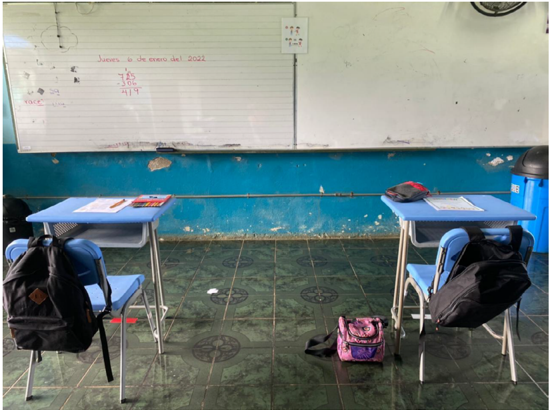
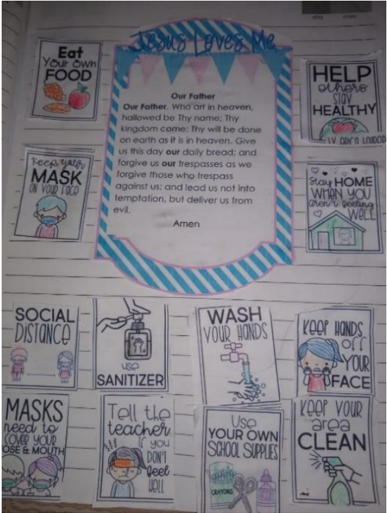
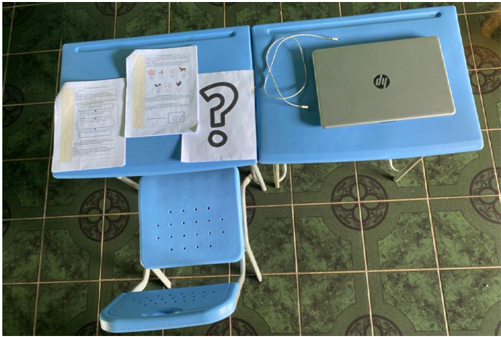
- Data were collected and triangulated through semi-structured interviews via Zoom, document collection (didactic planning/GTA), and photo elicitation with two photographs per participant plus written reflection. Content analysis was conducted with ATLAS.ti, and results were validated with participants and strategic allies.
Limitations
- The paper does not explicitly label limitations, but it states the study focused only on Upala and Guatuso even though the Dirección Regional de Educación Norte-Norte also includes Bagaces and Los Chiles, because most schools were in the two selected cantons.
- The paper states that other results were generated but only selected ones were emphasized in the article, and it recommends future studies on the perceptions of students and families as main actors in combined education.
- Evident from the text: the sample is small and purposive (six teachers), relies on self-reported perceptions, documents, and photographs, and does not measure student learning outcomes directly; findings are context-specific to rural Costa Rican schools during the pandemic.
Model-written summary. Check it against the paper before relying on it.
Integrity signals
Registry
Cites
Statistics
Figures
Verification
Claims the paper makes
0 Valid · 0 Not valid · 13 Not checked · 89 Own results and interpretations
A result the paper reports from its own data — it cites no other source for it, so there is none to check. The quote shows it is in the paper.
In the paper
“la división de grupos de acuerdo con las dimensiones del aula para cumplir con las directrices del Ministerio de salud”
plainstates a cause- Asserted: passes — The authors put it forward as true.
- Checkable: passes — It can be checked against evidence.
- Load-bearing: unclear — It is unclear whether the paper’s conclusions depend on it.
- Based: passes — The paper gives a reason why it holds.
A result the paper states — it cites no source for it, so there is none to check. The quote shows it is in the paper.
In the paper
“Esto generó dificultad para verificar si los procesos de aprendizaje habían sido efectivos dada la poca contextualización de las escuelas y las comunidades, así como la escasez de recursos educativos y tecnológicos.”
plainstates a cause- Asserted: passes — The authors put it forward as true.
- Checkable: passes — It can be checked against evidence.
- Load-bearing: passes — The paper’s conclusions depend on it.
- Based: passes — The paper gives a reason why it holds.
A result the paper reports from its own data — it cites no other source for it, so there is none to check. The quote shows it is in the paper.
In the paper
“las GTA terminaron fungiendo como el planeamiento de ambas poblaciones: las que iban presencial y las que se quedaron a distancia”
plain- Asserted: passes — The authors put it forward as true.
- Checkable: passes — It can be checked against evidence.
- Load-bearing: unclear — It is unclear whether the paper’s conclusions depend on it.
- Based: passes — The paper gives a reason why it holds.
A result the paper reports from its own data — it cites no other source for it, so there is none to check. The quote shows it is in the paper.
In the paper
“Las personas participantes expresaron mucha preocupación, decepción y frustración sobre el nivel de aprendizaje, pues que el estudiantado no tenga el nivel de conocimiento que debería”
plain- Asserted: passes — The authors put it forward as true.
- Checkable: passes — It can be checked against evidence.
- Load-bearing: passes — The paper’s conclusions depend on it.
- Based: passes — The paper gives a reason why it holds.
A result the paper reports from its own data — it cites no other source for it, so there is none to check. The quote shows it is in the paper.
In the paper
“Por otro lado, el MEP enviaba directrices que no eran contextualizadas a la realidad rural de las escuelas de las personas participantes.”
plain- Asserted: passes — The authors put it forward as true.
- Checkable: passes — It can be checked against evidence.
- Load-bearing: passes — The paper’s conclusions depend on it.
- Based: passes — The paper gives a reason why it holds.
- Rests on an assumption not shown here.
41 more claims
Create a free account to see all 102 claims and to verify the 2 references still open.
- Probably not a substantial claim. 23
- It may state two separate claims as one. 40
Citations
Cites
(2017) · Cited by 9,643
Talking about pictures: A case for photo elicitation
Harper, D. (2002) · Visual Studies · doi:10.1080/14725860220137345 · Cited by 3,966
Doing Qualitative Research in Education Settings
(2002) · doi:10.1353/book4583 · Cited by 3,502
Qualitative Data Analysis: An Introduction
Grbich, C. (2013) · SAGE Publications Ltd eBooks · doi:10.4135/9781529799606 · Cited by 2,032
Qualitative Research in Education: A User’s Guide
Papamichael, E. (2007) · Educate~/Educate · Cited by 967
Qualitative Data Analysis: An Introduction
Kzillen, M., & Jarrett, N. (2007) · Journal of Advanced Nursing · doi:10.1111/j.1365-2648.2007.04365.x · Cited by 846
Visual sociology: Expanding sociological vision
Harper, D. (1988) · The American Sociologist · doi:10.1007/bf02692374 · Cited by 316
Aretio, L. G. (2020) · RIED Revista Iberoamericana de Educación a Distancia · doi:10.5944/ried.23.1.25495 · Cited by 235
La educación a distancia como respuesta a las necesidades educativas del siglo XXI
Torres, A. N. C. (2017) · Academia y Virtualidad · doi:10.18359/ravi.2241 · Cited by 206
Imágenes experienciales y foto-elicitación en la formación del profesorado
García-Vera, A. B., Rumayor, L. R., & Cuenca, A. M. D. L. H. (2018) · Educatio Siglo XXI · doi:10.6018/j/333001 · Cited by 36
Can you picture it? Photo elicitation in qualitative cardiovascular health research
Lauck, S., Oliffe, J. L., Stephenson, A., & Adhami, N. (2021) · European Journal of Cardiovascular Nursing · doi:10.1093/eurjcn/zvab077 · Cited by 16
Larenas, C. H. D., Solar, M. I., Hernández, V. S., & del Solar, M. C. (2015) · Actualidades Investigativas en Educación · doi:10.15517/aie.v15i2.18960 · Cited by 10
López-Estrada, P., Elizondo-Mejías, J., & Pérez-Hidalgo, E. (2022) · Lecture notes in networks and systems · doi:10.1007/978-3-031-04680-3_11 · Cited by 10
Self-citationAguilar, C. Y., Farías, B. B. F., Savoy, M. P. F., Núñez, P. I. M., & Pérez, M. I. P. (2023) · Revista Educación · doi:10.15517/revedu.v47i1.52029 · Cited by 10
Educación remota de emergencia, virtualidad y desigualdades: pedagogía en tiempos de pandemia
López-Morocho, L. (2020) · 593 Digital Publisher CEIT · doi:10.33386/593dp.2020.5-2.347 · Cited by 9
Propuesta metodológica de un estudio de caso sobre la educación a distancia en tiempos de pandemia
Elizondo-Mejías, J., López-Estrada, P., & Pérez-Hidalgo, E. (2021) · Revista Espiga · doi:10.22458/re.v20i42.3669 · Cited by 9
Self-citationElacqua, G., Navarro-Palau, P., Prada, M. F., & Soares, S. (2020) · doi:10.18235/0002998 · Cited by 2
Research works printed but not linked: 2
- Baxter, P. y Jack, S. (2008). Qualitative Case Study Methodology: Study design and imple- mentation for novice researchers [Metodología de estudio de caso cualitativo: diseño de estudio e implementación para investigadores novatos]. The Qualitative Report, 13(4), 544-559. https://nsuworks.nova.edu/tqr/vol13/iss4/2
- Flyvbjerg, B. (2011). Case Study [Estudio de caso]. En K. D. Norman y S. L. Yvonna (Eds.), The Sage Handbook of Qualitative Research (4a ed., pp. 301-316). Sage.
Cited by
Elizondo-Mejías, J., López-Estrada, P., & Pérez-Hidalgo, E. (2025) · Innovaciones Educativas · doi:10.22458/ie.v27i42.5206 · Cited by 2
Self-citationLópez-Estrada, P., Elizondo-Mejías, J., Sancho-Chacón, S., & Hurtado-Laguna, K. (2026) · Frontiers in Education · doi:10.3389/feduc.2026.1830374 · Cited by 2
Self-citation
Metadata
- Authors
- López Estrada, P., Pérez Hidalgo, E., & Elizondo Mejías, J.
- Venue
- Revista Educación
- Publisher
- Universidad de Costa Rica
- Published
- 2024-06-30
- Pages
- 1-22
- ISSN
- 0379-7082 (ISSN-L)
- 2215-2644
- OpenAlex
- W4400336311
- Semantic Scholar
- 8ea824f2488acb0e44a3926e14cb47f562df19bd
- Cited by
- 2
- References
- 15
- Citations by year
- 2026: 1 · 2025: 1
- FWCI
- 0.79
- Type
- journal article
- Language
- es
- Open access
- diamond
- doi.org
- Licence
- Locations
- Revista Educación (publishedVersion, cc-by-nc-nd)
- DOAJ (DOAJ: Directory of Open Access Journals) (submittedVersion)
- Topics
- Social Sciences › Education › Education during COVID-19 pandemic
- Social Sciences › Education › Online Learning Methods and Innovations
- Social Sciences › Education › Educational Innovations and Technology
- Keywords
- blended learning, COVID-19 pandemic, primary school English teachers, teacher perceptions, pedagogical mediation, teacher self-efficacy, distance education, return to in-person classes, educational lag, regional education administration, Huetar Norte, photo-elicitation
About these checks
Registry, retraction, Cites and statistics results are computed, not judged, with one exception: a printed reference that no index lists is read once by a model before it counts as a citation error. Claims are extracted by a model and kept only when their quote appears verbatim in the text; each cited source is then checked, with a model’s help, for whether it says what the claim relies on. Those verdicts can be wrong — read the claim’s quote and the cited source before relying on one.
A language model drew the claims from the paper on 2026-11-16, under version 3 of the claim definition (model deepseek-v4.1-flash, prompt extract-v3).
A second model labelled each claim on 2026-11-16 (model jev-1.13-20260917, definition revision gold-guideline-v0.2).
Statistics and arithmetic are recomputed, not judged.
Confidence bands are shown only for fields calibrated on our annotated test set. None is calibrated yet, so no band is shown.
What counts as a claim ›How we measure confidence ›How we check this ›
Are you an author, or do you see a problem with this page? Request a review
Data sources
Bibliographic data: Semantic Scholar, OpenAlex, Crossref.
Contains information from the Semantic Scholar Academic Graph Datasets, made available under the ODC Attribution License (ODC-BY 1.0).
Semantic Scholar’s data is described in: Kinney, R., et al. (2023). The Semantic Scholar Open Data Platform. arXiv:2301.10140.
