

The DOI matches its Crossref record; 9 of the 11 references it cites were found in a registry or an index.
Hepatitis C virus infection among women giving birth—Tennessee and United States, 2009–2014.
Open accessAbstract
Hepatitis C virus (HCV) affects an estimated 3.5 million persons in the United States (1), making it the most common bloodborne infection in the country. Recent surveillance data showed increased rates of HCV infection among adolescents and adults who are predominantly white, live in nonurban areas, and have a history of injection drug use.* U.S. birth certificate data were used to analyze trends and geographic variations in rates of HCV infection among women giving birth during 2009-2014. Birth certificates from Tennessee were used to examine individual characteristics and outcomes associated with HCV infection, using a multivariable model to calculate adjusted odds of HCV-related diagnosis in pregnancy among women with live births. During 2009-2014, HCV infection present at the time of delivery among pregnant women from states reporting HCV on the birth certificate increased 89%, from 1.8 to 3.4 per 1,000 live births. The highest infection rate in 2014 (22.6 per 1,000 live births) was in West Virginia; the rate in Tennessee was 10.1. In adjusted analyses of Tennessee births, the odds of HCV infection were approximately threefold higher among women residing in rural counties than among those in large urban counties, 4.5-fold higher among women who smoked cigarettes during pregnancy, and nearly 17-fold higher among women with concurrent hepatitis B virus (HBV) infection. HCV infection among pregnant women is an increasing and potentially modifiable threat to maternal and child health. Clinicians and public health officials should consider individual and population-level opportunities for prevention and risk mitigation.
Overview
The claims and statistics of this paper haven’t been checked yet.
Run the check — free, no account needed. It reads the open-access text and checks the sources it cites.
Integrity signals
Registry
Cites
Statistics
Figures
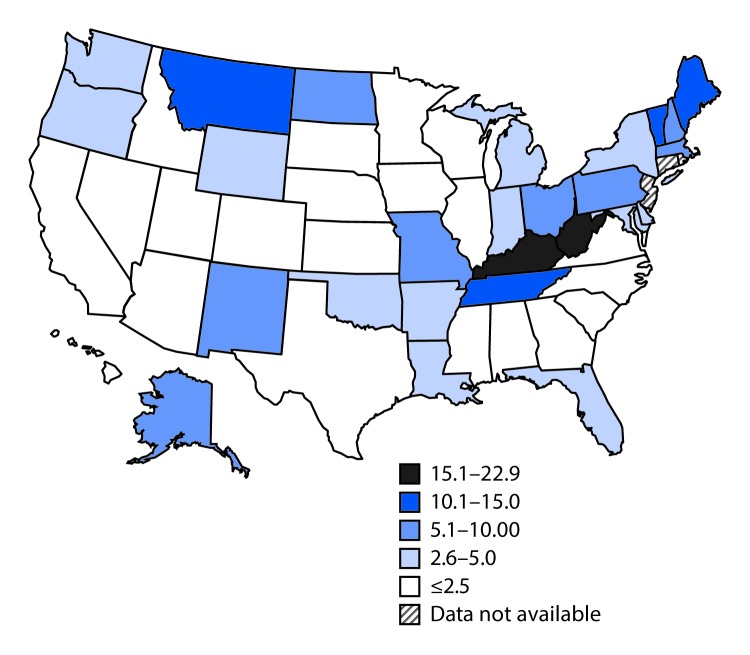
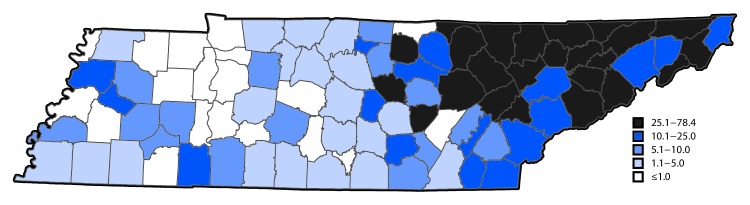
Verification
Claims the paper makes
The claims and statistics of this paper haven’t been checked yet.
Run the check — free, no account needed. It reads the open-access text and checks the sources it cites.
Claims other papers make about this one
Each is checked against this paper’s own text: does it say what the citing paper says it does?
The cited source says what the claim attributes to it.
In the citing paper
“The rate of hepatitis C virus (HCV) infection has increased among pregnant women in recent years (150–153).”
From Sexually Transmitted Infections Treatment Guidelines, 2021 (2021) · cites this paper as [151]
Self-check
Percentages, sums and reported differences re-computed from the paper’s own numbers.
The self-check needs the paper’s full text.
Citations
Cites
Zibbell, J. E., Iqbal, K., Patel, R. C., Suryaprasad, A. G., Sanders, K. J., Moore-Moravian, L., Serrecchia, J., Blankenship, S., Ward, J. W., & Holtzman, D. J. (2015) · PubMed Central · Cited by 507
Suryaprasad, A. G., White, J. Z., Xu, F., Eichler, B. A., Hamilton, J. J., Patel, A. S., Hamdounia, S. B., Church, D., Barton, K., Fisher, C., et al. (2014) · Clinical Infectious Diseases · doi:10.1093/cid/ciu643 · Cited by 500
Vertical Transmission of Hepatitis C Virus: Systematic Review and Meta-analysis
Beňová, L., Mohamoud, Y. A., Calvert, C., & Abu-Raddad, L. J. (2014) · Clinical Infectious Diseases · doi:10.1093/cid/ciu447 · Cited by 477
Toward a more accurate estimate of the prevalence of hepatitis C in the United States
Edlin, B. R., Eckhardt, B. J., Shu, M. A., Holmberg, S. D., & Swan, T. (2015) · Hepatology · doi:10.1002/hep.27978 · Cited by 437
Community Outbreak of HIV Infection Linked to Injection Drug Use of Oxymorphone—Indiana, 2015
Conrad, C., Bradley, H. M., Broz, D., Buddha, S., Chapman, E., Galang, R. R., Hillman, D., Hon, J., Hoover, K. W., Patel, M. R., et al. (2015) · Annals of Emergency Medicine · doi:10.1016/j.annemergmed.2015.05.031 · Cited by 361
Prescription Opioid Epidemic and Infant Outcomes
Patrick, S. W., Dudley, J. A., Martin, P., Harrell, F. E., Warren, M. D., Hartmann, K. E., Ely, E. W., Grijalva, C. G., & Cooper, W. O. (2015) · PEDIATRICS · doi:10.1542/peds.2014-3299 · Cited by 316
Self-citationACOG Practice Bulletin No. 86: Viral Hepatitis in Pregnancy
(2007) · Obstetrics and Gynecology · doi:10.1097/01.aog.0000263930.28382.2a · Cited by 168
Koneru, A., Nelson, N. P., Hariri, S., Canary, L., Sanders, K. J., Maxwell, J. F., Huang, X., Leake, J. A. D., Ward, J. W., & Vellozzi, C. J. (2016) · MMWR Morbidity and Mortality Weekly Report · doi:10.15585/mmwr.mm6528a2 · Cited by 138
Failure to Test and Identify Perinatally Infected Children Born to Hepatitis C Virus–Infected Women
Kuncio, D. E., Newbern, E. C., Johnson, C. C., & Viner, K. M. (2016) · Clinical Infectious Diseases · doi:10.1093/cid/ciw026 · Cited by 118
Cited by
Sorted by citations
Sexually Transmitted Infections Treatment Guidelines, 2021
Workowski, K. A., Bachmann, L. H., Chan, P. A., Johnston, C. M., Muzny, C. A., Park, I., Reno, H., Zenilman, J. M., & Bolan, G. A. (2021) · MMWR. Recommendations and Reports · doi:10.15585/mmwr.rr7004a1 · Cited by 3,018
Panel, A.-I. H. G., Chung, R. T., Ghany, M. G., Kim, A. Y., Marks, K., Naggie, S., Vargas, H. E., Aronsohn, A. I., Bhattacharya, D., Broder, T., et al. (2018) · Clinical Infectious Diseases · doi:10.1093/cid/ciy585 · Cited by 734
CDC Recommendations for Hepatitis C Screening Among Adults — United States, 2020
Schillie, S. F., Wester, C., Osborne, M. C., Wesolowski, L. G., & Ryerson, A. B. (2020) · MMWR Recommendations and Reports · doi:10.15585/mmwr.rr6902a1 · Cited by 565
Self-citationNeonatal Opioid Withdrawal Syndrome
Patrick, S. W., Barfield, W. D., Poindexter, B. B., Cummings, J. J., Hand, I. L., Adams-Chapman, I. S., Aucott, S. W., Puopolo, K. M., Goldsmith, J. P., Kaufman, D., et al. (2020) · PEDIATRICS · doi:10.1542/peds.2020-029074 · Cited by 386
Self-citationThe Micro-Elimination Approach to Eliminating Hepatitis C: Strategic and Operational Considerations
Safreed‐Harmon, K., Thursz, M. R., Dillon, J. F., El-Sayed, M. H., Elsharkawy, A. M., Hatzakis, A. E., Jadoul, M. Y., Prestileo, T., Razavi, H. A., Rockstroh, J. K., et al. (2018) · Seminars in Liver Disease · doi:10.1055/s-0038-1666841 · Cited by 262
Metadata
- Authors
- Patrick, S. W., Bauer, A. M., Warren, M. D., Jones, T. F., & Wester, C.
- Affiliations
- Vanderbilt University (US)
- Corresponding author
- Patrick, Stephen W.
- Venue
- MMWR Morbidity and Mortality Weekly Report
- Published
- 2017-05-12
- Volume
- 66
- Issue
- 18
- Pages
- 470-473
- ISSN
- 0149-2195 (ISSN-L)
- 1545-861X
- PMC
- PMC5657980
- OpenAlex
- W2614087325
- Cited by
- 113
- References
- 11
- Citations by year
- 2026: 1 · 2025: 1 · 2024: 8 · 2023: 11 · 2022: 6 · 2021: 13 · 2020: 25 · 2019: 22 · 2018: 26
- FWCI
- 12.32
- Type
- journal article
- Language
- en
- Open access
- bronze
- doi.org
- Locations
- MMWR Morbidity and Mortality Weekly Report (publishedVersion)
- PubMed Central (publishedVersion, cc-by)
- PubMed (publishedVersion)
- Funders
- Vanderbilt University
- Harvard University
- Office of National Drug Control Policy
- Centers for Disease Control and Prevention
- National Institute on Drug Abuse (K23DA038720)
- Topics
- Health Sciences › Medicine › Hepatology › Hepatitis C virus research
- Health Sciences › Medicine › Epidemiology › Cytomegalovirus and herpesvirus research
- Health Sciences › Medicine › Epidemiology › HIV, Drug Use, Sexual Risk
- Keywords
- hepatitis C virus, pregnant women, urban-rural differences, cigarette smoking during pregnancy, hepatitis B coinfection, maternal and child health, Tennessee, United States
- MeSH terms
- Female, Hepatitis C, Humans, Pregnancy, Pregnancy Complications, Infectious, Risk Factors, Tennessee, United States, Prevalence
About these checks
Registry, retraction, Cites and statistics results are computed, not judged, with one exception: a printed reference that no index lists is read once by a model before it counts as a citation error. Claims are extracted by a model and kept only when their quote appears verbatim in the text; each cited source is then checked, with a model’s help, for whether it says what the claim relies on. Those verdicts can be wrong — read the claim’s quote and the cited source before relying on one.
Statistics and arithmetic are recomputed, not judged.
Confidence bands are shown only for fields calibrated on our annotated test set. None is calibrated yet, so no band is shown.
What counts as a claim ›How we measure confidence ›How we check this ›
Are you an author, or do you see a problem with this page? Request a review
