

The DOI matches its Crossref record; 6 of the 6 references it cites were found in a registry or an index.
Progress in childhood vaccination data in immunization information systems—United States, 2013–2016.
Open accessAbstract
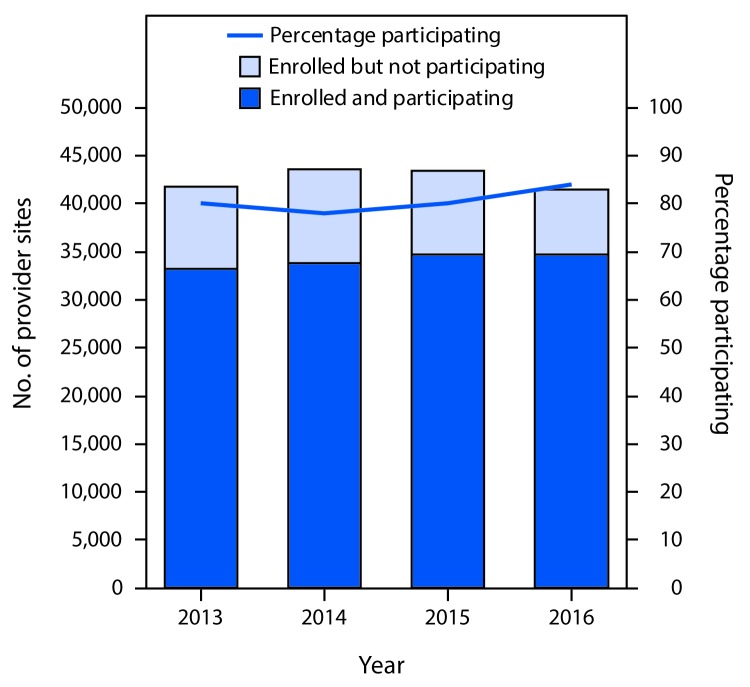
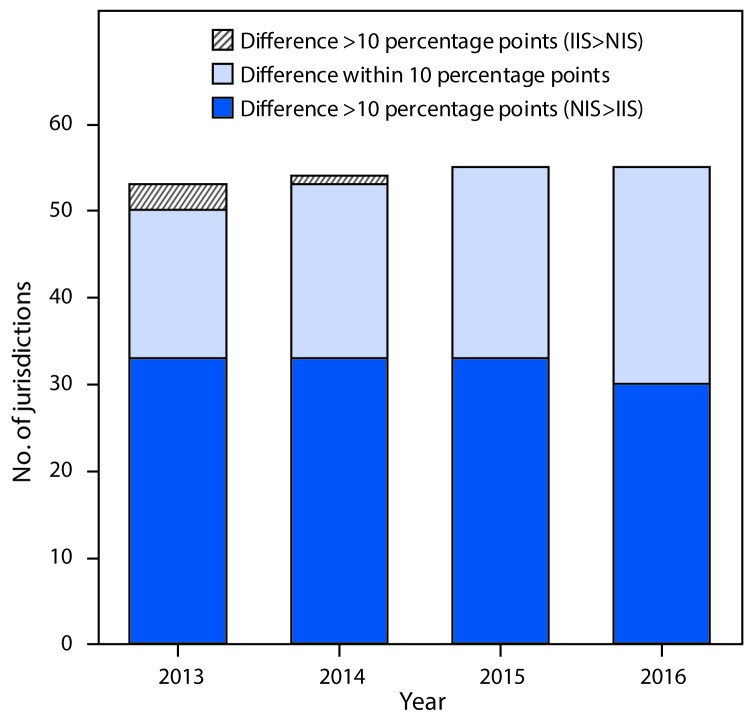
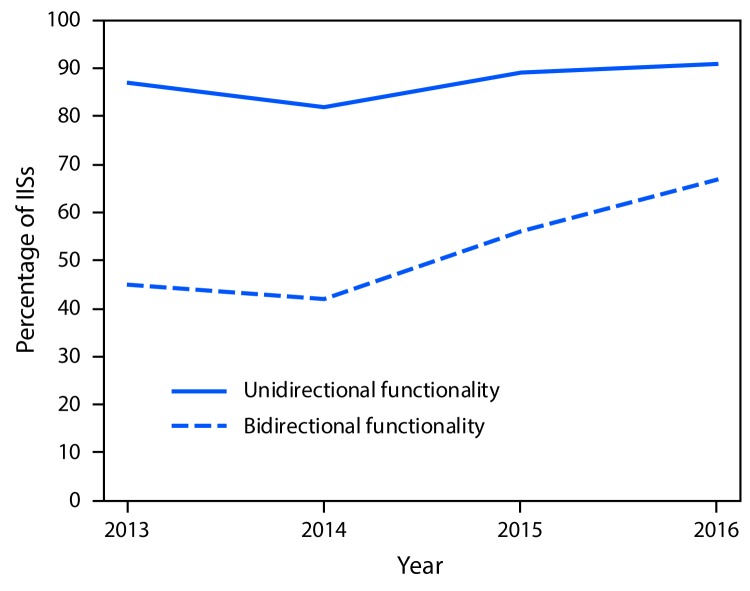
In 2016, 55 jurisdictions in 49 states and six cities in the United States* used immunization information systems (IISs) to collect and manage immunization data and support vaccination providers and immunization programs.To monitor progress toward achieving IIS program goals, CDC surveys jurisdictions through an annual self-administered IIS Annual Report (IISAR).Data from the 2013-2016 IISARs were analyzed to assess progress made in four priority areas: 1) data completeness, 2) bidirectional exchange of data with electronic health record systems, 3) clinical decision support for immunizations, and 4) ability to generate childhood vaccination coverage estimates.IIS participation among children aged 4 months through 5 years increased from 90% in 2013 to 94% in 2016, and 33 jurisdictions reported ≥95% of children aged 4 months through 5 years participating in their IIS in 2016.Bidirectional messaging capacity in IISs increased from 25 jurisdictions in 2013 to 37 in 2016.In 2016, nearly all jurisdictions (52 of 55) could provide automated provider-level coverage reports, and 32 jurisdictions reported that their IISs could send vaccine forecasts to providers via Health Level 7 (HL7) messaging, up from 17 in 2013.Incremental progress was made in each area since 2013, but continued effort is needed to implement these critical functionalities among all IISs.Success in these priority areas, as defined by the IIS Functional Standards (1), bolsters clinicians' and public health practitioners' ability to attain high vaccination coverage in pediatric populations, and prepares IISs to develop more advanced functionalities to support state/ local immunization services.Success in these priority areas also supports the achievement of federal immunization objectives, including the use of IISs as supplemental sampling frames for vaccination coverage surveys like the National Immunization Survey (NIS)-Child, reducing data collection costs, and supporting increased precision of state-level estimates.IISs, also known as immunization registries, are confidential, computerized, population-based systems that collect and consolidate vaccination data from providers in a jurisdiction (2).IISs increase vaccination rates and reduce vaccine-preventable diseases by enabling effective interventions (e.g., client reminder and recall, provider assessment and feedback), tracking patient immunizations, estimating vaccination coverage, * Excluding the U.S. territories.
Overview
The claims and statistics of this paper haven’t been checked yet.
Run the check — free, no account needed. It reads the open-access text and checks the sources it cites.
Integrity signals
Registry
Cites
Statistics
Figures
Verification
Claims the paper makes
The claims and statistics of this paper haven’t been checked yet.
Run the check — free, no account needed. It reads the open-access text and checks the sources it cites.
Self-check
Percentages, sums and reported differences re-computed from the paper’s own numbers.
The self-check needs the paper’s full text.
Citations
Cites
Vaccination Coverage Among Children Aged 19–35 Months — United States, 2017
Hill, H. A., Elam–Evans, L. D., Yankey, D., Singleton, J. A., & Kang, Y. (2018) · MMWR Morbidity and Mortality Weekly Report · doi:10.15585/mmwr.mm6740a4 · Cited by 251
Immunization Information Systems to Increase Vaccination Rates
Groom, H. C., Hopkins, D. P., Pabst, L. J., et al. (2014) · Journal of Public Health Management and Practice · doi:10.1097/phh.0000000000000069 · Cited by 196
Self-citationVaccination Coverage Among Children Aged 19–35 Months — United States, 2016
Hill, H. A., Elam–Evans, L. D., Yankey, D., Singleton, J. A., & Kang, Y. (2017) · MMWR Morbidity and Mortality Weekly Report · doi:10.15585/mmwr.mm6643a3 · Cited by 115
Progress in immunization information systems - United States, 2008.
Kelly, J. M., Heboyan, V., & Rasulnia, B. B. (2010) · Cited by 112
Progress in Immunization Information Systems — United States, 2011
Cardemil, C. V., Ng, T., & Pabst, L. J. (2013) · PubMed Central · Cited by 77
Self-citationProgress in immunization information systems - United States, 2012.
(2013) · PubMed · Cited by 35
Cited by
Sorted by citations
Patel Murthy, B., Zell, E., Kirtland, K., Jones-Jack, N., Harris, L., Sprague, C., Schultz, J., Le, Q., Bramer, C. A., Kuramoto, S., et al. (2021) · MMWR. Morbidity and Mortality Weekly Report · doi:10.15585/mmwr.mm7023a2 · Cited by 192
Metadata
- Authors
- Murthy, N., Rodgers, L., Pabst, L., Fiebelkorn, A. P., & Ng, T.
- Affiliations
- Centers for Disease Control and Prevention (US)
- Corresponding author
- Murthy, Neil
- Venue
- MMWR Morbidity and Mortality Weekly Report
- Published
- 2017-11-03
- Volume
- 66
- Issue
- 43
- Pages
- 1178-1181
- ISSN
- 0149-2195 (ISSN-L)
- 1545-861X
- PMC
- PMC5689214
- OpenAlex
- W2766191202
- Cited by
- 48
- References
- 6
- Citations by year
- 2025: 3 · 2023: 7 · 2022: 7 · 2021: 7 · 2020: 10 · 2019: 10 · 2018: 3 · 2017: 1
- FWCI
- 9.00
- Type
- journal article
- Language
- en
- Open access
- bronze
- doi.org
- Locations
- MMWR Morbidity and Mortality Weekly Report (publishedVersion)
- PubMed Central (publishedVersion, cc-by)
- PubMed (publishedVersion)
- Funders
- Centers for Disease Control and Prevention
- Topics
- Health Sciences › Health Professions › Health Information Management › Electronic Health Records Systems
- Social Sciences › Health › Vaccine Coverage and Hesitancy
- Health Sciences › Health Professions › Health Information Management › Medical Coding and Health Information
- Keywords
- immunization information systems, immunization registry, childhood vaccination coverage, bidirectional data exchange, electronic health records, clinical decision support, HL7 messaging, immunization program monitoring, United States jurisdiction
- MeSH terms
- Child, Preschool, Humans, Immunization, Infant, Information Systems, United States, Program Evaluation, Immunization Programs, Health Care Surveys
About these checks
Registry, retraction, Cites and statistics results are computed, not judged, with one exception: a printed reference that no index lists is read once by a model before it counts as a citation error. Claims are extracted by a model and kept only when their quote appears verbatim in the text; each cited source is then checked, with a model’s help, for whether it says what the claim relies on. Those verdicts can be wrong — read the claim’s quote and the cited source before relying on one.
Statistics and arithmetic are recomputed, not judged.
Confidence bands are shown only for fields calibrated on our annotated test set. None is calibrated yet, so no band is shown.
What counts as a claim ›How we measure confidence ›How we check this ›
Are you an author, or do you see a problem with this page? Request a review
How to cite
Cite CoChat for the checks on this page, and the paper for its own findings.
- This page
- CoChat. (2026). Citation check: Progress in childhood vaccination data in immunization information systems—United States, 2013–2016. https://app.cochat.ai/papers/10.15585/mmwr.mm6643a4
- The paper
- Murthy, N., Rodgers, L., Pabst, L., Fiebelkorn, A. P., & Ng, T. (2017). Progress in childhood vaccination data in immunization information systems—United States, 2013–2016. MMWR Morbidity and Mortality Weekly Report. https://doi.org/10.15585/mmwr.mm6643a4
