

Notes from the Field: Surveillance for Candida auris — Colombia, September 2016–May 2017
Open accessThe DOI matches its Crossref record; 4 of the 4 references it cites were found in a registry or an index.
Abstract
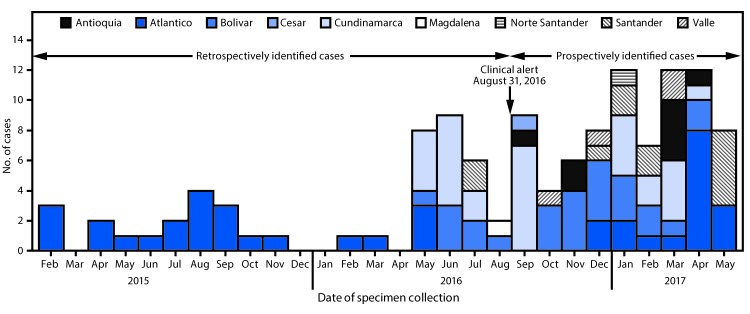
After a 2016 CDC alert describing infections caused by the multidrug-resistant fungus Candida auris (1), the Colombian Instituto Nacional de Salud (INS) queried the country's WHONET † database of invasive Candida isolates to detect previous C. auris infections.No C. auris isolates were identified during 2012-2016.However, C. auris is often misidentified as Candida haemulonii (2), a yeast that rarely causes invasive infections, and 75 C. haemulonii isolates were reported during May 2013-August 2016.These isolates came primarily from patients in intensive care units in the country's north region, approximately 350-600 km (220-375 miles) from Maracaibo, Venezuela, where C. auris cases were first identified in 2012 (3).Of the 75 reported Colombian C. haemulonii isolates in WHONET, INS obtained 45 isolates from six medical institutions dating from February 2015 through August 2016, all of which were confirmed to be C. auris by matrix-assisted laser desorption ionization-time of flight (MALDI-TOF) mass spectrometry.Based on these findings, INS issued a national alert and mandated reporting of suspected isolates on August 30, 2016 § (3,4).In September 2016, a team from INS, CDC, and medical staff members from hospitals with documented C. auris cases investigated the 45 MALDI-TOF-confirmed C. auris cases identified before the INS alert.This investigation involved two hospitals in the north region and two in the central region.Cases were clustered within specific hospital units, and surveillance sampling demonstrated transmission in health care settings (INS and CDC, unpublished data, 2018).After release of the Colombian clinical alert, INS received suspected C. auris isolates for confirmatory testing, and during September 2016-May 2017, an additional 78 C. auris cases were identified from 24 health care facilities in nine states, resulting in a total of 123 confirmed C. auris cases (Figure ), more than half (54.5%) recovered from the northern coastal * These authors contributed equally.† WHONET is a free software program developed by the World Health Organization (WHO) Collaborating Centre for Surveillance of Antimicrobial Resistance to support national surveillance activities in more than 120 countries
Overview
The claims and statistics of this paper haven’t been checked yet.
Free: it reads the open-access text and checks the first 5 claims that cite a source we can check. Create a free account to check every claim.
Integrity signals
Registry
Cites
Statistics
Figures
Verification
Claims the paper makes
The claims and statistics of this paper haven’t been checked yet.
Free: it reads the open-access text and checks the first 5 claims that cite a source we can check. Create a free account to check every claim.
Claims other papers make about this one
Each is checked against this paper’s own text: does it say what the citing paper says it does?
The source backs part of the claim, not all of it — or backs it for a different population, condition or comparison.
In the citing paper
“Infections with other rare and drug-resistant Candida species, including Candida haemulonii, Candida duobushaemulonii, and Candida rugosa, have been reported from surveillance in other countries (70,71).”
From Population-Based Active Surveillance for Culture-Confirmed Candidemia — Four Sites, United States, 2012–2016 (2019) · cites this paper as [71]
Experimental — accuracy not yet measured
Self-check
Percentages, sums and reported differences re-computed from the paper’s own numbers.
The self-check needs the paper’s full text.
Citations
Cites
Reference method for broth dilution antifungal susceptibility testing of yeasts : Approved standard
Rex, J. H., & Clinical (2008) · Clinical and Laboratory Standards Institute eBooks · Cited by 1,052
Calvo, B., Melo, A. S. A., Perozo-Mena, A., Hernandez, M., Francisco, E. C., Hagen, F., Meis, J. F., & Colombo, A. L. (2016) · Journal of Infection · doi:10.1016/j.jinf.2016.07.008 · Cited by 448 · cited 2×
“auris cases were first identified in 2012 (3).”
BackgroundNew Clonal Strain of Candida auris, Delhi, India
Chowdhary, A., Sharma, C., Duggal, S., Agarwal, K., Prakash, A., Singh, P. K., Jain, S., Kathuria, S., Randhawa, H. S., Hagen, F., et al. (2013) · Emerging Infectious Diseases · doi:10.3201/eid1910.130393 · Cited by 418 · cited 1×
“Based on these findings, INS issued a national alert and mandated reporting of suspected isolates on August 30, 2016§ (3,4).”
BackgroundInvasive Infections with Multidrug-Resistant Yeast Candida auris , Colombia
Morales-López, S. E., Parra-Giraldo, C. M., Ceballos-Garzón, A., Martínez, H. P., Rodríguez, G. J., Álvarez-Moreno, C. A., & Rodríguez, J. Y. (2017) · Emerging Infectious Diseases · doi:10.3201/eid2301.161497 · Cited by 243 · cited 1×
“The number of reported cases likely does not reflect the true number of infected and colonized persons because of underreporting and underdiagnosis, as well as misdiagnosis as other yeast species (6).”
Background
Cited by
Epidemiology, clinical characteristics, resistance, and treatment of infections by Candida auris
Cortegiani, A., Misseri, G., Fasciana, T., Giammanco, A., Giarratano, A., & Chowdhary, A. (2018) · Journal of Intensive Care · doi:10.1186/s40560-018-0342-4 · Cited by 329
Candida auris—the growing menace to global health
Lone, S. A., & Ahmad, A. (2019) · Mycoses · doi:10.1111/myc.12904 · Cited by 208
Candida auris and multidrug resistance: Defining the new normal
Lockhart, S. R. (2019) · Fungal Genetics and Biology · doi:10.1016/j.fgb.2019.103243 · Cited by 205
Self-citationToda, M., Williams, S. R., Berkow, E. L., Farley, M. M., Harrison, L. H., Bonner, L., Marceaux, K. M., Hollick, R., Zhang, A. Y., Schaffner, W., et al. (2019) · MMWR Surveillance Summaries · doi:10.15585/mmwr.ss6808a1 · Cited by 198
Self-citationChen, J., Tian, S., Han, X., Chu, Y., Wang, Q., Zhou, B., & Shang, H. (2020) · BMC Infectious Diseases · doi:10.1186/s12879-020-05543-0 · Cited by 159
Epidemiologic Shift in Candidemia Driven by Candida auris, South Africa, 2016–20171
van Schalkwyk, E., Mpembe, R. S., Thomas, J., Shuping, L., Ismail, H., Lowman, W., Karstaedt, A. S., Chibabhai, V., Wadula, J., Avenant, T., et al. (2019) · Emerging Infectious Diseases · doi:10.3201/eid2509.190040 · Cited by 137
Identification of Drug Resistant Candida auris
Kordalewska, M., & Perlin, D. S. (2019) · Frontiers in Microbiology · doi:10.3389/fmicb.2019.01918 · Cited by 124
Quindós, G., Marcos‐Arias, C., San-Millán, R., Mateo, E., & Eraso, E. (2018) · International Microbiology · doi:10.1007/s10123-018-0014-1 · Cited by 132
Kim, H. Y., Nguyen, T. A., Kidd, S. E., Chambers, J., Alastruey‐Izquierdo, A., Shin, J.-H., Dao, A., Forastiero, A., Wahyuningsih, R., Chakrabarti, A., et al. (2024) · Medical Mycology · doi:10.1093/mmy/myae042 · Cited by 123
“28 , 85 The wide MICs distributions to other azoles suggest variable acquired resistance.”
BackgroundCandida auris: An emerging drug resistant yeast – A mini-review
Bidaud, A. L., Chowdhary, A., & Dannaoui, E. (2018) · Journal de Mycologie Médicale · doi:10.1016/j.mycmed.2018.06.007 · Cited by 94
“auris into their close environment and contaminate surfaces at varying distances thereby posing a risk for continuous transmission [54,55].”
BackgroundAntifungal Resistance in Candida auris: Molecular Determinants
Frías-De-León, M. G., Hernández-Castro, R., Vite-Garín, T., Arenas, R., Bonifaz, A., Castañón-Olivares, L., Acosta-Altamirano, G., & Martínez-Herrera, E. (2020) · Antibiotics · doi:10.3390/antibiotics9090568 · Cited by 93
“In an effort to understand how the molecular resistance mechanism to AMB is generated, Escandón et al., 2018 identified a single nucleotide polymorphism (SNPs) in a transcription factor, similar to that of C. albicans, called FLO8 in an anonymous protein that supposedly encodes for a…”
ResultOverview about Candida auris: What's up 12 years after its first description?
Désoubeaux, G., Coste, A. T., Imbert, C., & Hennequin, C. (2022) · Journal de Mycologie Médicale · doi:10.1016/j.mycmed.2022.101248 · Cited by 43
A Cluster of Neonatal Infections Caused by Candida auris at a Large Referral Center in Colombia
Alvarado-Socarrás, J. L., Soler, J. A. V., Franco‐Paredes, C., Lamus, K. C. V., Rojas-Torres, J. P., & Rodriguez-Morales, A. J. (2021) · Journal of the Pediatric Infectious Diseases Society · doi:10.1093/jpids/piaa152 · Cited by 38
Carvajal, S. K., Alvarado, M., Rodríguez, Y. M., Parra-Giraldo, C. M., Varón, C., Morales-López, S. E., Rodríguez, J. Y., Gómez, B. L., & Escandón, P. (2021) · Journal of Fungi · doi:10.3390/jof7060401 · Cited by 36
Self-citationMethods for identification of Candida auris, the yeast of global public health concern: A review
Mahmoudi, S., Afshari, S. A. K., Gharehbolagh, S. A., Mirhendi, H., & Makimura, K. (2019) · Journal de Mycologie Médicale · doi:10.1016/j.mycmed.2019.04.004 · Cited by 33
Emergence and Genomic Characterization of Multidrug Resistant Candida auris in Nigeria, West Africa
Oladele, R. O., Uwanibe, J. N., Olawoye, I. B., Ettu, A.-W. O.-O., Meis, J. F. G. M., & Happi, C. T. (2022) · Journal of Fungi · doi:10.3390/jof8080787 · Cited by 36
Cáceres, D. H., Rivera, S. M., Armstrong, P. A., Escandón, P., Chow, N. A., Ovalle, M. V., Díaz, J., Derado, G., Salcedo, S., Berrío, I., et al. (2020) · Mycopathologia · doi:10.1007/s11046-020-00478-1 · Cited by 32
Self-citationAshkenazi‐Hoffnung, L., & Danziger, C. R. (2023) · Journal of Fungi · doi:10.3390/jof9020176 · Cited by 29
Lanna, M., Lovatto, J. E., de Almeida, J. N., Medeiros, E. A., Colombo, A. L., & García‐Effrón, G. (2025) · Journal de Mycologie Médicale · doi:10.1016/j.mycmed.2025.101546 · Cited by 16
Key Factors to Consider for Candida auris Screening in Healthcare Settings: A Systematic Review
Danielsen, A. S., Ødeskaug, L. E., Raastad, R., Kjerulf, A., Andersen, A., Tornes, R. A., Himmels, J. P. W., Dahle, U. R., Sare, M., Kristensen, B., et al. (2025) · Mycoses · doi:10.1111/myc.70043 · Cited by 14
Infection Control Measures against Candidaauris in Healthcare Facilities
Alfouzan, W. A., Dhar, R., Alabbad, J., & Rabaan, A. A. (2022) · Processes · doi:10.3390/pr10081625 · Cited by 10
Molecular investigation of the incidence of Candida auris infections at selected hospitals in Iran
Safari, F., Madani, M., Kheirollahi, M., & Mirhendi, H. (2022) · Mycoses · doi:10.1111/myc.13504 · Cited by 12
Candida auris: un agente patógeno global que se ha arraigado en Colombia
Escandón, P., Lockhart, S. R., Chow, N. A., & Chiller, T. M. (2023) · Biomédica · doi:10.7705/biomedica.7082 · Cited by 11
“The identification of C. auris in the northern and central regions of Colombia urged public health authorities to issue a national alert for C. auris invasive infections (4,22,23).”
BackgroundMethodInfluentialSelf-citationOpportunistic Yeast Infections and Climate Change: The Emergence of Candida auris
León, M. G. F.-D., García-Salazar, E., Reyes-Montes, M. D. R., Duarte-Escalante, E., & Acosta‐Altamirano, G. (2022) · Fungal biology · doi:10.1007/978-3-030-89664-5_10 · Cited by 5
Candida auris: estrategias y retos para prevenir un brote
Zuluaga, A. (2020) · Biomédica · doi:10.7705/biomedica.5454 · Cited by 7
“Al momento de dicho reporte, la mitad de los casos habían sido identificados en instituciones médicas de la Costa Caribe del país (Atlántico, Bolívar y Cesar) (5).”
BackgroundDissemination of Candida auris to deep organs in neonatal murine invasive candidiasis
Flores-Maldonado, O. E., González, G. M., Andrade, Á., Montoya, A. M., Treviño‐Rangel, R. D. J., Silva-Sánchez, A., & Becerril-García, M. A. (2021) · Microbial Pathogenesis · doi:10.1016/j.micpath.2021.105285 · Cited by 4
Detection and Control of Candida auris in Healthcare Settings
Kwon, Y. J., & Shin, J. H. (2022) · Korean Journal of Healthcare-Associated Infection Control and Prevention · doi:10.14192/kjicp.2022.27.1.4 · Cited by 3
Romero, M., Chitiva, L. C., Bravo-Chaucanés, C. P., Hernández, A. X., Parra‐Giraldo, C. M., & Costa, G. M. (2023) · Universitas Scientiarum · doi:10.11144/javeriana.sc282.besv · Cited by 3
“In Colombia, a national alert on the circulation of this emerging resistant fungus was issued in 2016, with mortality rates varying significantly across geographic regions globally from 32:5% to 72% [13, 14].”
BackgroundCandida auris in a tertiary healthcare setting in south India: A case series.
Ashraf, A. A., Pinto, R. S., & Karnaker, V. K. (2023) · PubMed Central · doi:10.22034/cmm.2024.345186.1502 · Cited by 5
“Given its pattern of resistance to antifungals, C. auris has emerged as a significant pathogen [10, 14].”
BackgroundRegional spread of Candida auris
Barantsevich, N. E., Levanova, V. V., & Barantsevich, E. P. (2021) · Clinical Microbiology and Antimicrobial Chemotherapy · doi:10.36488/cmac.2021.2.117-125 · Cited by 2
Sabri, R., Hussain, M., Wahab, S., & Zia‐Ul‐Haq, M. (2023) · Springer eBooks · doi:10.1007/978-3-031-35403-8_44 · Cited by 1
Convergent evolution on RBA1 regulates Candidozyma auris host adaptationPreprint
Doorley, L. A., Bella, A. A. L., Jones, S. J., Zhao, G., Asadzadeh, M., Choudhury, Q. J., Ahmad, S., Mokaddas, E. M., Al‐Obaid, I., Alfouzan, W. A., et al. (2025) · bioRxiv (Cold Spring Harbor Laboratory) · doi:10.64898/2025.12.04.692421 · Cited by 1
Candida auris: A New, Threatening Yeast
Pemán, J., & Gaitán, A. C. R. (2019) · Elsevier eBooks · doi:10.1016/b978-0-12-809633-8.21000-5
Chen, J., Tian, S., Han, X., Chu, Y., Wang, Q., Zhou, B., & Shang, H. (2020) · Figshare · doi:10.6084/m9.figshare.13226135
Chen, J., Tian, S., Han, X., Chu, Y., Wang, Q., Zhou, B., & Shang, H. (2020) · Figshare · doi:10.6084/m9.figshare.13226126
Chen, J., Tian, S., Han, X., Chu, Y., Wang, Q., Zhou, B., & Shang, H. (2020) · Figshare · doi:10.6084/m9.figshare.13226132
Chen, J., Tian, S., Han, X., Chu, Y., Wang, Q., Zhou, B., & Shang, H. (2020) · Figshare · doi:10.6084/m9.figshare.13226129
Chen, J., Tian, S., Han, X., Chu, Y., Wang, Q., Zhou, B., & Shang, H. (2020) · Figshare · doi:10.6084/m9.figshare.13226123
Seyer, A. (2026) · Cyprus Journal of Medical Sciences · doi:10.4274/cjms.2026.2025-153
Metadata
- Authors
- Escandón, P., Cáceres, D. H., Espinosa-Bode, A., Rivera, S., Armstrong, P., Vallabhaneni, S., Berkow, E. L., Lockhart, S. R., Chiller, T., Jackson, B. R., & Duarte, C.
- Affiliations
- National Center for Emerging and Zoonotic Infectious Diseases (US)
- ORCID
- Venue
- MMWR. Morbidity and Mortality Weekly Report
- Published
- 2018-04-20
- Volume
- 67
- Issue
- 15
- Pages
- 459-460
- ISSN
- 0149-2195 (ISSN-L)
- 1545-861X
- PMC
- PMC6191104
- OpenAlex
- W2800561268
- Cited by
- 42
- References
- 4
- Citations by year
- 2026: 1 · 2025: 3 · 2024: 2 · 2023: 5 · 2022: 7 · 2021: 4 · 2020: 10 · 2019: 7 · 2018: 3
- FWCI
- 4.53
- Type
- journal article
- Language
- en
- Open access
- bronze
- doi.org
- Locations
- MMWR Morbidity and Mortality Weekly Report (publishedVersion)
- Europe PMC (PubMed Central) (publishedVersion, cc-by)
- PubMed Central (publishedVersion, cc-by)
- PubMed (publishedVersion)
- Funders
- World Health Organization
- Pontificia Universidad Javeriana
- Centers for Disease Control and Prevention
- Topics
- Health Sciences › Medicine › Infectious Diseases › Antifungal resistance and susceptibility
- Life Sciences › Immunology and Microbiology › Microbiology › Yeasts and Rust Fungi Studies
- Health Sciences › Medicine › Infectious Diseases › Fungal Infections and Studies
- Keywords
- Candida auris, invasive fungal infections, nosocomial transmission, hospital outbreak investigation, MALDI-TOF mass spectrometry, Colombia, intensive care unit, fungal surveillance
- MeSH terms
- Adolescent, Adult, Candida, Candidiasis, Child, Child, Preschool, Colombia, Female, Humans, Male, Middle Aged, Population Surveillance, Young Adult
About these checks
Registry, retraction, Cites and statistics results are computed, not judged, with one exception: a printed reference that no index lists is read once by a model before it counts as a citation error. Claims are extracted by a model and kept only when their quote appears verbatim in the text; each cited source is then checked, with a model’s help, for whether it says what the claim relies on. Those verdicts can be wrong — read the claim’s quote and the cited source before relying on one.
Statistics and arithmetic are recomputed, not judged.
Confidence bands are shown only for fields calibrated on our annotated test set. None is calibrated yet, so no band is shown.
What counts as a claim ›How we measure confidence ›How we check this ›
Are you an author, or do you see a problem with this page? Request a review
Data sources
Bibliographic data: Semantic Scholar, OpenAlex, Crossref.
Contains information from the Semantic Scholar Academic Graph Datasets, made available under the ODC Attribution License (ODC-BY 1.0).
Semantic Scholar’s data is described in: Kinney, R., et al. (2023). The Semantic Scholar Open Data Platform. arXiv:2301.10140.
