

The DOI matches its Crossref record; 14 of the 14 references it cites were found in a registry or an index.
Flavored tobacco product use among middle and high school students—United States, 2014–2018
Open accessAbstract
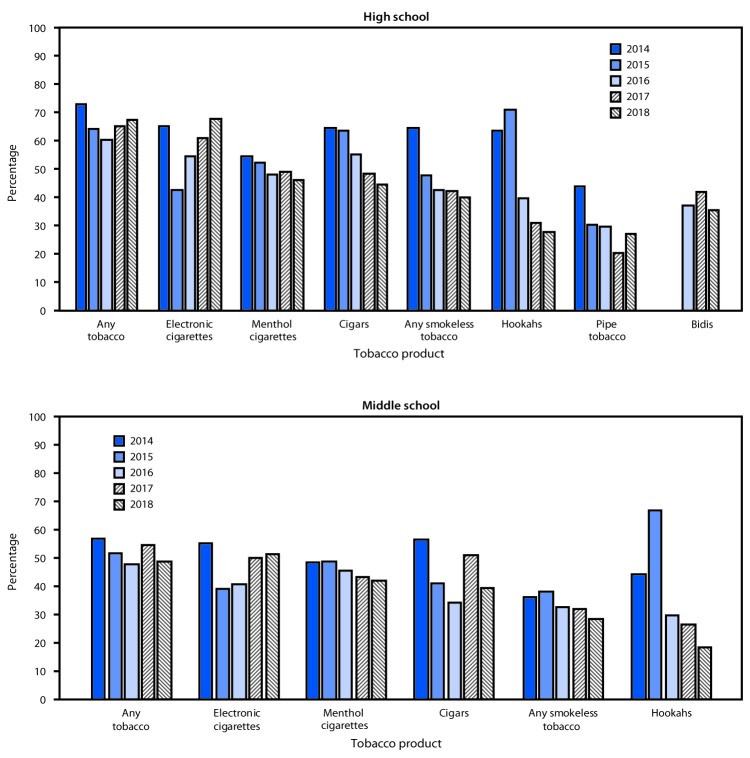
The 2009 Family Smoking Prevention and Tobacco Control Act prohibits the inclusion of characterizing flavors (e.g., candy or fruit) other than tobacco and menthol in cigarettes; however, characterizing flavors are not currently prohibited in other tobacco products at the federal level.*Flavored tobacco products can appeal to youths and young adults and influence initiation and establishment of tobacco-use patterns (1).The Food and Drug Administration (FDA) and CDC analyzed data from the 2014-2018 National Youth Tobacco Surveys (NYTS) to determine prevalence of current (past 30-day) use of flavored tobacco products, including electronic cigarettes (e-cigarettes), hookah tobacco, cigars, pipe tobacco, smokeless tobacco, bidis, and menthol cigarettes among U.S. middle school (grades 6-8) and high school (grades 9-12) students.In 2018, an estimated 3.15 million (64.1%) youth tobacco product users currently used one or more flavored tobacco products, compared with 3.26 million (70.0%) in 2014.Despite this overall decrease in use of flavored tobacco products, current use of flavored e-cigarettes increased among high school students during 2014-2018; among middle school students, current use of flavored e-cigarettes increased during 2015-2018, following a decrease during 2014-2015.During 2014-2018, current use of flavored hookah tobacco decreased among middle and high school students; current use of flavored smokeless tobacco, cigars, pipe tobacco, and menthol cigarettes decreased among high school students.Full implementation of comprehensive tobacco prevention and control strategies, coupled with regulation of tobacco products by FDA, can help prevent and reduce use of tobacco products, including flavored tobacco products, among U.S. youths (2,3).NYTS is an annual cross-sectional, school-based, selfadministered, pencil-and-paper questionnaire administered to U.S. middle and high school students.† A three-stage cluster sampling procedure was used to generate a nationally representative sample of U.S. students attending public or private schools in grades 6-12.This report uses data from five NYTS waves (2014)(2015)(2016)(2017)(2018).Sample sizes and response * Family Smoking Prevention and Tobacco Control Act [Pub.L. No. 111-31, H.R.
Overview
The claims and statistics of this paper haven’t been checked yet.
Run the check — free, no account needed. It reads the open-access text and checks the sources it cites.
Integrity signals
Registry
Cites
Statistics
Figures
Verification
Claims the paper makes
The claims and statistics of this paper haven’t been checked yet.
Run the check — free, no account needed. It reads the open-access text and checks the sources it cites.
Claims other papers make about this one
Each is checked against this paper’s own text: does it say what the citing paper says it does?
The source backs part of the claim, not all of it — or backs it for a different population, condition or comparison.
In the citing paper
“Whereas the use of tobacco cigarettes has declined in the United States within recent years, the use of electronic cigarettes (e-cigarettes) has increased exponentially (Cullen et al., 2019; Miech et al., 2019).”
From Unique, long-term effects of nicotine on adolescent brain. (2020) · cites this paper as Cullen et al., 2019
Experimental — accuracy not yet measuredThe source backs part of the claim, not all of it — or backs it for a different population, condition or comparison.
In the citing paper
“In absolute numbers, the National Youth Tobacco Survey shows that ~5 million students in grades 6–12 have tried e-cigarettes within the past 30 days, an increase from ~3.6 million in 2018 (Cullen et al., 2019).”
From Unique, long-term effects of nicotine on adolescent brain. (2020) · cites this paper as Cullen et al., 2019
Experimental — accuracy not yet measuredThe source backs part of the claim, not all of it — or backs it for a different population, condition or comparison.
In the citing paper
“Although there has been a decline in teen use of cigarettes in recent years, there has been a huge increase in nicotine vaping.”
From Unique, long-term effects of nicotine on adolescent brain. (2020) · cites this paper as Cullen et al., 2019
Experimental — accuracy not yet measuredThe source backs part of the claim, not all of it — or backs it for a different population, condition or comparison.
In the citing paper
“the advent of electronic cigarette products has led to a resurgence of nicotine use among adolescents [167, 168]”
From Consequences of adolescent drug use (2023) · cites this paper as [167]
Experimental — accuracy not yet measuredThe check wasn’t confident either way, so it gives no verdict — never disputed.
In the citing paper
“Of these, nearly 1 million are vaping daily.”
From Unique, long-term effects of nicotine on adolescent brain. (2020) · cites this paper as Cullen et al., 2019
Experimental — accuracy not yet measured
Self-check
Percentages, sums and reported differences re-computed from the paper’s own numbers.
The self-check needs the paper’s full text.
Citations
Cites
The Health consequences of smoking—50 years of progress : a report of the Surgeon General
Lushniak, B. D., Samet, J. M., Pechacek, T. F., Norman, L., & Taylor, P. A. (2014) · Cited by 4,990
Public Health Consequences of E-Cigarettes
Board on Population Health and Public Health Practice, Division, H. A. M., & National Academies of Sciences, E. (2018) · National Academies Press eBooks · doi:10.17226/24952 · Cited by 1,594
Preventing Tobacco Use among Youth and young Adults: A Report of the Surgeon General
(2012) · PsycEXTRA Dataset · doi:10.1037/e603152012-001 · Cited by 1,459
Tobacco Use Among Middle and High School Students—United States, 1999
(2000) · JAMA · doi:10.1001/jama.283.9.1134-jwr0301-2-1 · Cited by 787
Family Smoking Prevention and Tobacco Control Act
Luke, D. A., Ribisl, K. M., Smith, C. A., & Sorg, A. (2011) · American Journal of Preventive Medicine · doi:10.1016/j.amepre.2010.11.018 · Cited by 441
Recognition, use and perceptions of JUUL among youth and young adults
Willett, J. G., Bennett, M., Hair, E. C., Xiao, H., Greenberg, M. S., Harvey, E. J., Cantrell, J., & Vallone, D. (2018) · Tobacco Control · doi:10.1136/tobaccocontrol-2018-054273 · Cited by 256
Differential trends in cigarette smoking in the USA: is menthol slowing progress?
Giovino, G. A., Villanti, A. C., Mowery, P., Sevilimedu, V., NIAURA, R. S., Vallone, D., & Abrams, D. B. (2013) · Tobacco Control · doi:10.1136/tobaccocontrol-2013-051159 · Cited by 215
Electronic Cigarette Sales in the United States, 2013-2017
King, B. A., Gammon, D. G., Marynak, K., & Rogers, T. (2018) · JAMA · doi:10.1001/jama.2018.10488 · Cited by 193
Self-citationPreference for flavoured cigar brands among youth, young adults and adults in the USA
Delnevo, C. D., Giovenco, D. P., Ambrose, B. K., Corey, C. G., & Conway, K. P. (2014) · Tobacco Control · doi:10.1136/tobaccocontrol-2013-051408 · Cited by 179
E-Cigarette Market Trends in Traditional U.S. Retail Channels, 2012–2013
Giovenco, D. P., Hammond, D. G., Corey, C. G., Ambrose, B. K., & Delnevo, C. D. (2014) · Nicotine & Tobacco Research · doi:10.1093/ntr/ntu282 · Cited by 119
Cited by
Sorted by citations
Overview of Electronic Nicotine Delivery Systems: A Systematic Review
Glasser, A., Collins, L. K., Pearson, J., Abudayyeh, H., NIAURA, R. S., Abrams, D. B., & Villanti, A. C. (2016) · American Journal of Preventive Medicine · doi:10.1016/j.amepre.2016.10.036 · Cited by 489
Münzel, T. F., Hahad, O., Kuntić, M., Keaney, J. F., Deanfield, J. E., & Daiber, A. (2020) · European Heart Journal · doi:10.1093/eurheartj/ehaa460 · Cited by 418
Villanti, A., Johnson, A. L., Ambrose, B. K., Cummings, K., Stanton, C. A., Rose, S., Feirman, S. P., Tworek, C., Glasser, A. M., Pearson, J. L., et al. (2017) · American Journal of Preventive Medicine · doi:10.1016/j.amepre.2017.01.026 · Cited by 92
Flavored Tobacco Product Use Among US Youth Aged 12-17 Years, 2013-2014
Ambrose, B. K., Day, H., Rostron, B. L., Conway, K. P., Borek, N., Hyland, A. J., & Villanti, A. C. (2015) · JAMA · doi:10.1001/jama.2015.13802 · Cited by 305
Reasons for current E -cigarette use among U.S. adults
Patel, D., Davis, K., Cox, S. N., Bradfield, B. R., King, B. A., Shafer, P. R., Caraballo, R. S., & Bunnell, R. E. (2016) · Preventive Medicine · doi:10.1016/j.ypmed.2016.09.011 · Cited by 289
Self-citation
Metadata
- Authors
- Cullen, K. A., Liu, S. T., Bernat, J. K., Slavit, W. I., Tynan, M. A., King, B. A., & Neff, L. J.
- Affiliations
- Centers for Disease Control and Prevention (US)
- Corresponding author
- Cullen, Karen A.
- Venue
- MMWR. Morbidity and Mortality Weekly Report
- Published
- 2019-10-04
- Volume
- 68
- Issue
- 39
- Pages
- 839-844
- ISSN
- 0149-2195 (ISSN-L)
- 1545-861X
- PMC
- PMC6776376
- OpenAlex
- W2978784026
- Cited by
- 181
- References
- 14
- Citations by year
- 2026: 3 · 2025: 8 · 2024: 10 · 2023: 12 · 2022: 17 · 2021: 23 · 2020: 22 · 2019: 26
- FWCI
- 15.08
- Type
- journal article
- Language
- en
- Open access
- diamond
- doi.org
- Locations
- MMWR Morbidity and Mortality Weekly Report (publishedVersion)
- Europe PMC (PubMed Central) (publishedVersion, cc-by)
- PubMed Central (publishedVersion, cc-by)
- PubMed (publishedVersion)
- Topics
- Health Sciences › Medicine › Public Health, Environmental and Occupational Health › Smoking Behavior and Cessation
- Health Sciences › Medicine › Epidemiology › Substance Abuse Treatment and Outcomes
- Health Sciences › Medicine › Public Health, Environmental and Occupational Health › Global Public Health Policies and Epidemiology
- Keywords
- flavored tobacco products, youth tobacco use, electronic cigarettes, hookah tobacco, menthol cigarettes, cigars, pipe tobacco, smokeless tobacco, bidis, tobacco product regulation, Family Smoking Prevention and Tobacco Control Act, junior high school students, high school students, National Youth Tobacco Survey
- MeSH terms
- Smoking Prevention, Adolescent, Child, Female, Flavoring Agents, Health Surveys, Humans, Male, Schools, Students, Tobacco, Smokeless, United States, United States Food and Drug Administration, Prevalence, Tobacco Products, Tobacco Use, Electronic Nicotine Delivery Systems
About these checks
Registry, retraction, Cites and statistics results are computed, not judged, with one exception: a printed reference that no index lists is read once by a model before it counts as a citation error. Claims are extracted by a model and kept only when their quote appears verbatim in the text; each cited source is then checked, with a model’s help, for whether it says what the claim relies on. Those verdicts can be wrong — read the claim’s quote and the cited source before relying on one.
Statistics and arithmetic are recomputed, not judged.
Confidence bands are shown only for fields calibrated on our annotated test set. None is calibrated yet, so no band is shown.
What counts as a claim ›How we measure confidence ›How we check this ›
Are you an author, or do you see a problem with this page? Request a review
