

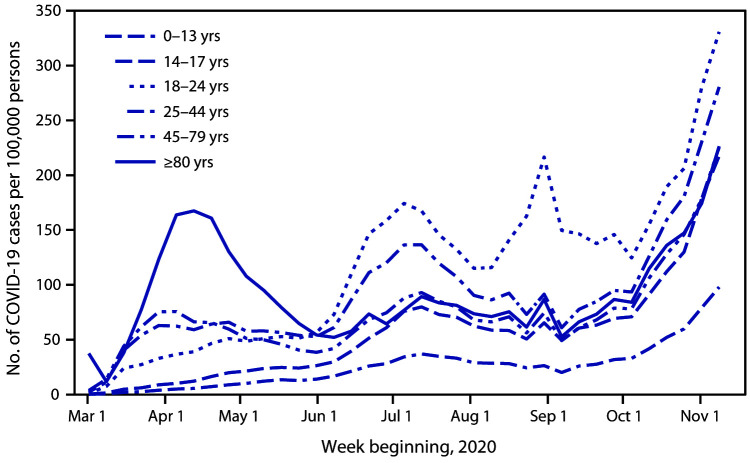
COVID-19 Stats: COVID-19 Incidence,* by Age Group† — United States, March 1–November 14, 2020§
Open accessThe DOI matches its Crossref record.
Abstract
44 yrs 45-79 yrs ≥80 yrs Abbreviation: COVID-19 = coronavirus disease 2019.* Incidence = cases per 100,000 calculated using 2019 U.S. Census population.† Age data for COVID-19 cases are based on case report forms submitted by state and territorial jurisdictions for confirmed and probable cases.Reporting for some jurisdictions is incomplete.Age is missing for 1% of case reports.§ Data are provisional and subject to change.During late March-late May, COVID-19 incidence was highest among adults aged ≥80 years, with a peak in incidence in the week beginning April 12.In June, incidence increased in all age groups, with the most rapid rate of increase and highest overall incidence among young adults aged 18-24 years; the rate in this group continues to be the highest among all age groups.Incidence steadily increased among children and adolescents (aged 0-17 years).The incidence in high school-aged persons (aged 14-17 years) was markedly higher than that in younger children by early July, then decreased before increasing in September.During late September-early October, weekly incidence decreased among young adults aged 18-24 years only, then continued to steadily increase among all age groups through November 14.
Overview
The claims and statistics of this paper haven’t been checked yet.
Free: it reads the open-access text and checks the first 5 claims that cite a source we can check. Create a free account to check every claim.
Integrity signals
Registry
Cites
Statistics
Figures
Verification
Claims the paper makes
The claims and statistics of this paper haven’t been checked yet.
Free: it reads the open-access text and checks the first 5 claims that cite a source we can check. Create a free account to check every claim.
Claims other papers make about this one
Each is checked against this paper’s own text: does it say what the citing paper says it does?
The source backs part of the claim, not all of it — or backs it for a different population, condition or comparison.
In the citing paper
“Epidemiological evidence indicates that individuals aged 80 and above have approximately three times higher incidence of COVID-19 compared to those aged 45 to 79, and significantly greater than individuals under the age of 24 during the initial phase of the American epidemic.275”
From Antiageing strategy for neurodegenerative diseases: from mechanisms to clinical advances (2025) · cites this paper as [275]
Experimental — accuracy not yet measured
Self-check
Percentages, sums and reported differences re-computed from the paper’s own numbers.
The self-check needs the paper’s full text.
Citations
Cites
Still being checked.
Cited by
Yonker, L. M., Gilboa, T., Ogata, A. F., Senussi, Y., Lazarovits, R., Boribong, B. P., Bartsch, Y. C., Loiselle, M., Rivas, M. N., Porritt, R. A., et al. (2021) · Journal of Clinical Investigation · doi:10.1172/jci149633 · Cited by 243
COVID-19 Vaccination Coverage Among Adults — United States, December 14, 2020–May 22, 2021
Diesel, J., Sterrett, N., Dasgupta, S., Kriss, J. L., Barry, V., Vanden Esschert, K., Whiteman, A., Cadwell, B. L., Weller, D., Qualters, J. R., et al. (2021) · MMWR. Morbidity and Mortality Weekly Report · doi:10.15585/mmwr.mm7025e1 · Cited by 175
Antiageing strategy for neurodegenerative diseases: from mechanisms to clinical advances
Jiang, Q., Liu, J., Huang, S., Wang, X.-Y., Chen, X., Liu, G.-H., Ye, K., Song, W., Masters, C. L., Wang, J., et al. (2025) · Signal Transduction and Targeted Therapy · doi:10.1038/s41392-025-02145-7 · Cited by 165
“275 Infection with SARS-CoV-2 triggers a cytokine storm, in fl ammation, cellular senescence, age-related immunosenescence, as well as diminished physiological reserves in the respiratory system and other organs.”
Obesity in COVID-19: A Systematic Review and Meta-analysis
Ho, J. S. Y., Fernando, D. I., Chan, M. Y., & Sia, C. (2020) · Annals of the Academy of Medicine Singapore · doi:10.47102/annals-acadmedsg.2020299 · Cited by 111
Hurst, J. H., McCumber, A. W., Aquino, J. N., Rodriguez, J., Heston, S. M., Lugo, D. J., Rotta, A. T., Turner, N., Pfeiffer, T. S., Gurley, T. C., et al. (2022) · Clinical Infectious Diseases · doi:10.1093/cid/ciac184 · Cited by 66
Willems, S. H., Rao, J., Bhambere, S., Patel, D., Biggins, Y., & Guite, J. W. (2021) · JMIR mhealth and uhealth · doi:10.2196/25021 · Cited by 43
Bahadur, G. A., Bhat, M., Acharya, S., JANGA, D., Campbell, B. K., Huirne, J. A. F., Yoong, W., Govind, A., Pardo, J., & Homburg, R. (2021) · Facts Views and Vision in ObGyn · doi:10.52054/fvvo.13.1.001 · Cited by 28
Prospective arrhythmia surveillance after a COVID-19 diagnosis
Dewland, T. A., Whitman, I. R., Win, S., Sanchez, J. M., Olgin, J. E., Pletcher, M. J., Santhosh, L., Kumar, U., Joyce, S., Yang, V. B., et al. (2022) · Open Heart · doi:10.1136/openhrt-2021-001758 · Cited by 25
Non-Invasive Antibody Assessment in Saliva to Determine SARS-CoV-2 Exposure in Young Children
Heinzel, C., Pinilla, Y. T., Elsner, K., Friessinger, E., Mordmüller, B. G., Kremsner, P. G., Held, J., Fendel, R., & Kreidenweiss, A. (2021) · Frontiers in Immunology · doi:10.3389/fimmu.2021.753435 · Cited by 23
Wiegand, T. L. T., Jung, L., Gudera, J. A., Schuhmacher, L. S., Moehrle, P., Rischewski, J., Mehrzad, P., Jeong, S., Nguyen, L. H., Poeschla, M., et al. (2025) · npj Digital Medicine · doi:10.1038/s41746-025-01817-6 · Cited by 22
Henneghan, A. M., Lewis, K., Gill, E. R., Franco‐Rocha, O. Y., Vela, R. D., Medick, S., & Kesler, S. R. (2021) · Journal of the American Association of Nurse Practitioners · doi:10.1097/jxx.0000000000000647 · Cited by 19
Sasse, K., Mahabir, R., Gkountouna, O., Crooks, A. T., & Croitoru, A. (2024) · PLoS ONE · doi:10.1371/journal.pone.0301488 · Cited by 16
Biden, COVID and Mental Health in America
Blanchflower, D. G., & Bryson, A. (2021) · National Bureau of Economic Research · doi:10.3386/w29040 · Cited by 16
Dombrowski, R. D., Hill, A. B., Bode, B., Knoff, K. A. G., Dastgerdizad, H., Kulik, N. L., Mallare, J., Blount-Dorn, K., & Bynum, W. (2022) · Nutrients · doi:10.3390/nu14102130 · Cited by 14
The Impact of Coronavirus Disease 2019 on Pediatric Asthma in the United States
Navalpakam, A., Secord, E. A., & Pansare, M. V. (2021) · Pediatric Clinics of North America · doi:10.1016/j.pcl.2021.05.012 · Cited by 13
Wan, A. W. L., Hagger, M. S., Zhang, C., Chung, J. S. K., Lee, K. L., Bautista, A., & Chan, D. K. C. (2022) · Psychology and Health · doi:10.1080/08870446.2022.2111681 · Cited by 12
Burns, J., Rivers, P. S., LeClair, L. B., Jovel, K. S., Rai, R. P., Lowe, A. A., Edwards, L., Khan, S. R., Mathenge, C., Ferraris, M., et al. (2022) · JMIR Research Protocols · doi:10.2196/37929 · Cited by 11
Truskinovsky, Y., & Wiemers, E. (2023) · Health Affairs Scholar · doi:10.1093/haschl/qxad040 · Cited by 11
Pharmacotherapy for older people with obesity
Boyle, L. D., Akbaş, F., Yazıcı, D., McGowan, B. M., & Yumuk, V. (2024) · European Journal of Internal Medicine · doi:10.1016/j.ejim.2024.05.006 · Cited by 10
Muzammil, T. S., Gangu, K., Nasrullah, A., Majeed, H., Chourasia, P. K., Bobba, A., Shekhar, R., Bartlett, C., & Sheikh, A. B. (2023) · Heart & Lung · doi:10.1016/j.hrtlng.2023.05.014 · Cited by 10
COVID-19 infection differences among people with disabilities
Friedman, C. (2022) · Dialogues in Health · doi:10.1016/j.dialog.2022.100083 · Cited by 8
Ojeda, G. M., Muñóz-Valle, J. F., Yokogawa-Teraoka, P., Machado-Sulbarán, A. C., Loza-Rojas, M. G., García-Arredondo, A. C., Tejeda-Constantini, R., Vega‐Magaña, N., González-Estévez, G., García‐Chagollán, M., et al. (2021) · International Journal of Environmental Research and Public Health · doi:10.3390/ijerph18178995 · Cited by 7
Missing science: A scoping study of COVID-19 epidemiological data in the United States
Bhatia, R., Sledge, I., & Baral, S. (2022) · PLoS ONE · doi:10.1371/journal.pone.0248793 · Cited by 6
Lopez, M. J., Mack, C., Bliss, T., Wasserman, E. B., Myers, E., Solomon, G., Lynch, J., Casolaro, A., Osterholm, M. T., Hanfling, D., et al. (2021) · Epidemiology · doi:10.1097/ede.0000000000001416 · Cited by 6
Serological and RT-PCR Surveillance for COVID-19 in an Asymptomatic US Army Trainee Population
Hakre, S., Sanborn, A. D., Krauss, S. W., Burns, J. L., Jackson, K. N., McCauley, M., Shepherd, B. L. O., McHenry, S., Stahlman, S. L., Bianchi, E. J., et al. (2021) · Open Forum Infectious Diseases · doi:10.1093/ofid/ofab407 · Cited by 5
Asif, S., Jun, B., Bustamante, F. E., & Rula, J. P. (2021) · ACM Internet Measurement Conference (IMC) · doi:10.1145/3487552.3487831 · Cited by 4
COVID-19 prevention behaviors, trust, and intent to vaccinate among youth at risk for HIV
Christodoulou, J., Fehrenbacher, A. E., Shaw, E. H., Vincent, E., & Saleska, J. L. (2022) · PLoS ONE · doi:10.1371/journal.pone.0266321 · Cited by 4
Mercer, M. P., Day, L. W., Ansari, M. N., Kwan, E., Kotis, D., Caplan, V., Nguyen, T. Q., Lee, C., Smith, M., Tenner, A. G., et al. (2024) · NEJM Catalyst · doi:10.1056/cat.23.0330 · Cited by 3
Truskinovsky, Y., Freedman, V. A., Hoffman, G. J., Leggett, A. N., & Wiemers, E. (2025) · Innovation in Aging · doi:10.1093/geroni/igaf003 · Cited by 2
Post-COVID symptoms and health-related quality of life in extended postpartum period
Gupta, V., Sharma, A., Sharma, S., & Sharma, A. (2022) · Asian Journal of Medical Sciences · doi:10.3126/ajms.v13i8.44469 · Cited by 2
de Família, M., Ferreira, M. G., Brandão, B., de Família, M., Cassamo, S., de Família, M., Silva, A. C., de Família, M., Jorge, M., & de Família, M. (2022) · Revista Portuguesa de Clínica Geral · doi:10.32385/rpmgf.v38i3.13243 · Cited by 2
COVID-19 ethics: unique aspects and a review as of early 2024
Shandera, W. X. (2024) · Bioethics News · doi:10.1007/s40592-024-00199-x · Cited by 1
Dukes, K. A., Ni, P., Alperen, J. K., Cesare, N., LaValley, M. P., Tripp, T. J., Lane, K., Mohammed, S., Patil, P., Emig, D., et al. (2025) · Scientific Reports · doi:10.1038/s41598-025-25074-5 · Cited by 1
STUDY OF INTRAUTERINE FETAL DEATH (IUFD) A 3 YEARS RETROSPECTIVE STUDY
Sumitra Reddy, T. S. K., Apte, A., Godbole, R. R., & Sharma, R. K. (2022) · Indian Journal Of Applied Research · doi:10.36106/ijar/1403439
A Scoping Review of Excessive Prenatal Ultrasonography as a Potential Risk Factor for Autism
Moammar, H., Desch, L. W., & Sulayman, R. (2021) · American Journal of Pediatrics · doi:10.11648/j.ajp.20210704.12
Beron, A. J., Yukich, J. O., Berry, A. A., Correa, A., Keating, J. A., Bott, M., Wierzba, T. F., Weintraub, W. S., Friedman-Klabanoff, D. J., Mongraw‐Chaffin, M., et al. (2024) · PLoS ONE · doi:10.1371/journal.pone.0293787
Modeling individual self-protective behavior during epidemics
Yu, G., Garee, M. J., Ventresca, M., & Yih, Y. (2026) · PLoS Computational Biology · doi:10.1371/journal.pcbi.1014252
UPDATE ON CARDIOVASCULAR IMPLICATIONS OF COVID 19
Radhakrishnan, P. K., Ambat, G. A., Ambat, R., Basha, S. I., Prakash, H., Jyothi Padmaja, I., Raju, R., Padmakumar, P., Kumar, A., Murugan, U. S., et al. (2021) · GLOBAL JOURNAL FOR RESEARCH ANALYSIS · doi:10.36106/gjra/8013840
AWARENESS & ACCEPTANCE OF COVID19 VACCINES AMONG PREGNANT WOMEN
Talwar, K., & Smitha, K. (2022) · INTERNATIONAL JOURNAL OF SCIENTIFIC RESEARCH · doi:10.36106/ijsr/8102573
Bangura, S. (2022) · Texila international journal of public health · doi:10.21522/tijph.2013.10.01.art026
Ciepłucha, H. D., Zalewska, M., Kujawa, K., & Szetela, B. (2022) · COVID · doi:10.3390/covid2120125
Halim, S. A., Aris, N. A. M., Fadzil, M. Z., & Mahir, H. M. A. (2021) · Borneo Epidemiology Journal · doi:10.51200/bej.v2i2.3633
Mayfield, A. L. (2023) · IUScholarWorks (Indiana University)
Heinzel, C., Pinilla, Y. T., Elsner, K., Friessinger, E., Mordmüller, B., Kremsner, P. G., Held, J., Fendel, R., & Kreidenweiss, A. (2021) · doi:10.3389/fimmu.2021.753435.s001
Metadata
- Venue
- MMWR. Morbidity and Mortality Weekly Report
- Published
- 2021-01-01
- Volume
- 69
- Issue
- 5152
- Pages
- 1664
- ISSN
- 0149-2195 (ISSN-L)
- 1545-861X
- PMC
- PMC9191900
- OpenAlex
- W4206728741
- Cited by
- 36
- References
- 0
- Citations by year
- 2025: 4 · 2024: 5 · 2023: 2 · 2022: 13 · 2021: 11
- FWCI
- 1.06
- Type
- journal article
- Language
- en
- Open access
- diamond
- doi.org
- Locations
- MMWR Morbidity and Mortality Weekly Report (publishedVersion)
- PubMed Central (publishedVersion, public-domain)
- PubMed (publishedVersion)
- Topics
- Physical Sciences › Mathematics › Modeling and Simulation › COVID-19 epidemiological studies
- Health Sciences › Medicine › Infectious Diseases › SARS-CoV-2 and COVID-19 Research
- Health Sciences › Medicine › Infectious Diseases › COVID-19 Clinical Research Studies
- Keywords
- COVID-19 pandemic, SARS-CoV-2, disease incidence, age groups, young adults, children and adolescents, older adults, seasonal patterns, United States
- MeSH terms
- COVID-19, Adolescent, Adult, Aged, Aged, 80 and over, Child, Child, Preschool, Humans, Infant, Infant, Newborn, Middle Aged, United States, Incidence, Age Distribution, Young Adult
About these checks
Registry, retraction, Cites and statistics results are computed, not judged, with one exception: a printed reference that no index lists is read once by a model before it counts as a citation error. Claims are extracted by a model and kept only when their quote appears verbatim in the text; each cited source is then checked, with a model’s help, for whether it says what the claim relies on. Those verdicts can be wrong — read the claim’s quote and the cited source before relying on one.
Statistics and arithmetic are recomputed, not judged.
Confidence bands are shown only for fields calibrated on our annotated test set. None is calibrated yet, so no band is shown.
What counts as a claim ›How we measure confidence ›How we check this ›
Are you an author, or do you see a problem with this page? Request a review
Data sources
Bibliographic data: Semantic Scholar, OpenAlex, Crossref.
Contains information from the Semantic Scholar Academic Graph Datasets, made available under the ODC Attribution License (ODC-BY 1.0).
Semantic Scholar’s data is described in: Kinney, R., et al. (2023). The Semantic Scholar Open Data Platform. arXiv:2301.10140.
