

State-Level Economic Costs of Opioid Use Disorder and Fatal Opioid Overdose — United States, 2017
Open accessThe DOI matches its Crossref record; 8 of the 8 references it cites were found in a registry or an index; 5 of the 6 sources its claims cite were checked for support.
Abstract
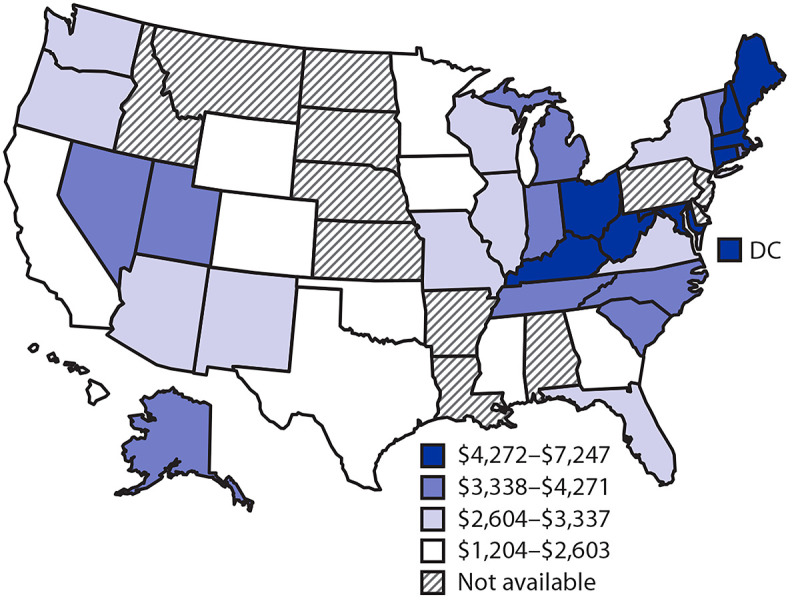
Cases and costs of state-level opioid use disorder and fatal opioid overdose and per capita costs were calculated for each of the 38 states and the District of Columbia (DC) that met drug specificity requirements for mortality data in 2017. Combined costs of opioid use disorder and fatal opioid overdose varied substantially, ranging from $985 million in Wyoming to $72,583 million in Ohio. Per capita combined costs ranged from $1,204 in Hawaii to $7,247 in West Virginia.
Overview
CoChat Summary
TL;DR
CDC estimated state-level economic costs of opioid use disorder (OUD) and fatal opioid overdose for 2017 using national cost-per-case estimates applied to state case counts. Combined costs varied widely across the 38 states and DC studied, from $985 million in Wyoming to $72,583 million in Ohio, with the highest per capita costs concentrated in the Ohio Valley and New England.
Key findings
- The national 2017 economic cost was $1,021 billion: $471 billion for OUD and $550 billion for fatal opioid overdose.
- State combined costs ranged from $985 million in Wyoming to $72,583 million in Ohio; per capita combined costs ranged from $1,204 in Hawaii to $7,247 in West Virginia.
- High per capita combined costs were mainly in the Ohio Valley and New England; West Virginia, Ohio, and Kentucky ranked first, second, and fourth ($7,247, $6,226, and $5,491, respectively).
- Reduced quality of life was the largest OUD cost component, and value of statistical life lost was the largest fatal overdose component; together these accounted for approximately 84% of combined costs.
Methods
- CDC used national cost estimates to calculate state-level costs for OUD and fatal opioid overdose in 2017, limited to the 38 states and DC that met drug specificity requirements for mortality data.
- OUD case counts came from the National Survey on Drug Use and Health 2-Year Restricted-Use Data Analysis System (2016–2017); fatal opioid overdose counts and population estimates came from CDC’s WONDER database for 2017.
- State costs were calculated by multiplying national cost per case—$221,219 for OUD and $11.548 million for fatal opioid overdose—by state case counts; per capita costs divided combined state costs by state population.
Limitations
- The paper states four limitations: results are limited to 38 states and DC, so rankings do not apply to all 50 states; OUD cost was measured for a single year rather than lifetime; NSDUH likely underrepresents OUD prevalence because it excludes incarcerated and homeless persons; and national cost-per-case estimates were applied to states rather than calculating state-specific costs, which could bias estimates if state case characteristics differ from national ones.
- The text also makes evident that state cost differences are driven by applying uniform national unit costs to state case counts and populations, rather than by state-specific cost data.
Model-written summary. Check it against the paper before relying on it.
Integrity signals
Registry
Cites
Statistics
Figures
Verification
Claims the paper makes
5 Valid · 0 Not valid · 1 Not checked · 20 Own results and interpretations
Every source the paper cites for this claim was checked and supports it.
In the paper
“Cost per case of fatal opioid overdose ($11.548 million) was derived by dividing the total cost of fatal opioid overdose ($549,691 million) by the number of fatal opioid overdose cases (47,600) (3).”
What the sources say
- Supportedcites [3] Florence C, Luo F, Rice K. The economic burden of opioid use disorder and fatal opioid overdose in the United States, 2017. Drug Alcohol Depend 2021; 218: 108350. 10.1016/j.drugalcdep.2020.108350 33121867 PMC8091480 source
The Results report 47,600 fatal opioid overdoses in 2017 and total costs of $1,020.7 billion, including $471.0 billion attributable to opioid use disorder. The remainder is approximately $549.7 billion for fatal overdose; dividing it by 47,600 gives approximately $11.548 million per case. The copy reports rounded totals rather than the cited $549,691 million figure. (LLM, conf=0.88)
plain- Asserted: passes — The authors put it forward as true.
- Checkable: passes — It can be checked against evidence.
- Load-bearing: passes — The paper’s conclusions depend on it.
- Based: passes — The paper gives a reason why it holds.
- Supported
The cited sources support only part of this claim — read each source’s verdict below.
In the paper
“However, previous reports have shown that these states had low per capita lifetime medical and work-loss costs from all fatal injuries (including opioid overdose) in 2014 (7).”
§ State-Level Economic Costs of Opioid Use Disorder and Fatal Opioid Overdose — United States, 2017 > Discussion
What the sources say
- Partly supportedcites [7] Luo F, Florence C. State-level lifetime medical and work-loss costs of fatal injuries—United States, 2014. MMWR Morb Mortal Wkly Rep 2017; 66: 1– 11. 10.15585/mmwr.mm6601a1 28081055 PMC5687268 sourceExperimental — accuracy not yet measured
The “Injuries from All Intents” table reports 2014 per-capita costs of $608 for Connecticut, $722 for Maine, and $550 for Massachusetts. The accompanying text identifies Massachusetts, but not Connecticut or Maine, among the five lowest-cost states. The Discussion says drug overdoses were included within unintentional fatal injuries, though their costs were not reported separately. (LLM, conf=0.85)
plain- Asserted: passes — The authors put it forward as true.
- Checkable: passes — It can be checked against evidence.
- Load-bearing: passes — The paper’s conclusions depend on it.
- Based: passes — The paper gives a reason why it holds.
- Partly supported
The cited sources support only part of this claim — read each source’s verdict below.
In the paper
“Cost per case of opioid use disorder ($221,219) was derived by dividing the total U.S. cost of opioid use disorder ($470,975 million) during 2017 by the number of opioid use disorder cases the same year (2.129 million) (3).”
What the sources say
- Partly supportedcites [3] Florence C, Luo F, Rice K. The economic burden of opioid use disorder and fatal opioid overdose in the United States, 2017. Drug Alcohol Depend 2021; 218: 108350. 10.1016/j.drugalcdep.2020.108350 33121867 PMC8091480 sourceExperimental — accuracy not yet measured
The Results report approximately $471.0 billion in 2017 opioid use disorder costs and approximately 2.1 million people with the disorder, consistent with the claimed calculation in broad terms. Our copy does not give the more precise $470,975 million or 2.129 million figures, or state the resulting $221,219 cost per case. (LLM, conf=0.84)
plain- Asserted: passes — The authors put it forward as true.
- Checkable: passes — It can be checked against evidence.
- Load-bearing: passes — The paper’s conclusions depend on it.
- Based: passes — The paper gives a reason why it holds.
- Partly supported
Every source the paper cites for this claim was checked and supports it.
In the paper
“Cases and costs of state-level opioid use disorder and fatal opioid overdose and per capita costs were calculated for each of the 38 states and the District of Columbia (DC) that met drug specificity requirements for mortality data (4).”
- Also stated in: § State-Level Economic Costs of Opioid Use Disorder and Fatal Opioid Overdose — United States, 2017 · plain
“This report is limited to DC and the 38 states that met the requirement that at least one specific drug is named on the death certificate (4).”
What the sources say
- Supportedcites [4] Wilson N, Kariisa M, Seth P, Smith H 4th, Davis NL. Drug and opioid-involved overdose deaths—United States, 2017–2018. MMWR Morb Mortal Wkly Rep 2020; 69: 290– 7. 10.15585/mmwr.mm6911a4 32191688 PMC7739981 source
The source paper’s methods state that its state-level analyses included 38 states and the District of Columbia with adequate drug specificity for 2017 and 2018. Its Discussion repeats that adequate drug-specificity data were available from only those jurisdictions. The citation supports the selection criterion, not the citing authors’ cost calculations. (LLM, conf=0.94)
plain- Asserted: passes — The authors put it forward as true.
- Checkable: passes — It can be checked against evidence.
- Load-bearing: passes — The paper’s conclusions depend on it.
- Based: passes — The paper gives a reason why it holds.
- Also stated in: § State-Level Economic Costs of Opioid Use Disorder and Fatal Opioid Overdose — United States, 2017 · plain
A result the paper reports from its own data — it cites no other source for it, so there is none to check. The quote shows it is in the paper.
In the paper
“Reduced quality of life was the largest component of the cost of opioid use disorder, and the value of statistical life lost was the largest component of the cost of fatal opioid overdose (Table 2).”
plain- Asserted: passes — The authors put it forward as true.
- Checkable: passes — It can be checked against evidence.
- Load-bearing: unclear — It is unclear whether the paper’s conclusions depend on it.
- Based: passes — The paper gives a reason why it holds.
14 more claims
Create a free account to see all 26 claims and every source verdict.
- It may state two separate claims as one. 7
- Probably not a substantial claim. 2
Self-check
Percentages, sums and reported differences re-computed from the paper’s own numbers.
Each contradiction between two passages listed here was confirmed by an independent check.
Rated minor: it would not touch a result — a value no result rests on, a p-value that stays on the same side of the significance level, or a conflict that is clerical, resolved elsewhere in the paper, or outside its own findings.
In the paper
§ State-Level Economic Costs of Opioid Use Disorder and Fatal Opioid Overdose — United States, 2017
“2.0 million persons met the diagnostic criteria for an opioid use disorder in 2017”
§ State-Level Economic Costs of Opioid Use Disorder and Fatal Opioid Overdose — United States, 2017
“the number of opioid use disorder cases the same year (2.129 million)”
Citations
Cites
Drug Overdose Deaths in the United States, 1999–2020
Hedegaard, H., Miniño, A., Spencer, M. R., & Warner, M. (2021) · doi:10.15620/cdc:112340 · Cited by 1,283
Drug and Opioid-Involved Overdose Deaths — United States, 2017–2018
Wilson, N., Kariisa, M., Seth, P., Smith, H., & Davis, N. L. (2020) · MMWR. Morbidity and Mortality Weekly Report · doi:10.15585/mmwr.mm6911a4 · Cited by 1,123
Walley, A. Y., Xuan, Z., Hackman, H. H., Quinn, E., Doe-Simkins, M., Sorensen-Alawad, A., Ruiz, S., & Ozonoff, A. (2013) · BMJ · doi:10.1136/bmj.f174 · Cited by 999
Medications for Opioid Use Disorder Save Lives
Committee on Medication-Assisted Treatment for Opioid Use Disorder, Board on Health Sciences Policy, Division, H. A. M., & National Academies of Sciences, E. (2019) · National Academies Press eBooks · doi:10.17226/25310 · Cited by 715
The economic burden of opioid use disorder and fatal opioid overdose in the United States, 2017
Florence, C., Luo, F., & Rice, K. (2021) · Drug and Alcohol Dependence · doi:10.1016/j.drugalcdep.2020.108350 · Cited by 511
Self-citationDowell, D., Zhang, K., Noonan, R. K., & Hockenberry, J. M. (2016) · Health Affairs · doi:10.1377/hlthaff.2016.0448 · Cited by 264
State-level lifetime medical and work-loss costs of fatal injuries—United States, 2014.
Luo, F., & Florence, C. (2017) · MMWR Morbidity and Mortality Weekly Report · doi:10.15585/mmwr.mm6601a1 · Cited by 136
Self-citationNational Survey on Drug Use and Health: 8-Year R-DAS (2002 to 2009)
United States Department Of Health And Human Services. Substance Abuse And Mental Health Services Administration. Center For Behavioral Health Statistics And Quality (2012) · ICPSR Data Holdings · doi:10.3886/icpsr32101 · Cited by 24
Cited by
Items 101–168 of 168
Ghobadi, A., Hanna, M., Tovar, S., Do, D., Duan, L., Lee, M. S., Samuels, E. A., Davis, C. S., & Sharp, A. L. (2024) · Journal of the American College of Emergency Physicians Open · doi:10.1002/emp2.13236 · Cited by 1
Cole, J., & Logan, T. (2025) · Substance Use & Misuse · doi:10.1080/10826084.2025.2533981 · Cited by 1
“…for Disease Control and Prevention & National Health Center for Health Statistics, 2022) and the fourth highest per-capita costs of opioid use (Luo et al., 2021) was used to investigate if individuals who co-use opioids and methamphetamine differ in risk factors and treatment outcomes from…”
Kuklinski, M. R., Gibbons, B., H, D. B. M. P., McCollister, K. E., Smart, R., Dunlap, L. J., Shenkar, E., Bonar, E. E., Pendergrass, T. M., Campbell, M. R., et al. (2025) · Prevention Science · doi:10.1007/s11121-025-01835-6 · Cited by 1
“Comprehensive study summaries are published in several protocol papers and on the HPC website (Komro et al., 2023; Larochelle et al., 2021; Lee et al., 2025; Lu et al., 2021; Luo et al., 2021; Miech et al., 2023).”
Beyond REMS & PDMPs: A Proposed Framework for Next-Generation Opioid Regulation
Rana, A., & Ram, K. (2025) · Therapeutic Innovation & Regulatory Science · doi:10.1007/s43441-025-00882-z · Cited by 5
Allen, B., & Harocopos, A. (2026) · PLoS ONE · doi:10.1371/journal.pone.0341062 · Cited by 1
“The annual economic toll of the epidemic is in excess of $1 trillion [12], including an estimated $14.8 billion annually in criminal justice costs [13].”
InfluentialHurley, R. W., Guth, D., Hill, E., & Adams, M. C. B. (2026) · PLoS ONE · doi:10.1371/journal.pone.0347943 · Cited by 1
Han, X., Li, H., Tang, Y., Palfrey, J. S., & Zhu, J. (2022) · Health & Social Care in the Community · doi:10.1111/hsc.13862 · Cited by 4
Model of Family Caregiver Resilience and Burden in Opioid Use Disorder
Tyo, M. B., & McCurry, M. K. (2022) · Advances in Nursing Science · doi:10.1097/ans.0000000000000448 · Cited by 2
Tan, K. P., & Daud, A. A. M. (2022) · Journal of Mathematics and Computer Science · doi:10.22436/jmcs.028.04.06 · Cited by 1
Military service and risk of subsequent drug use disorders among Swedish men
Edwards, A. C., Ohlsson, H., Barr, P. B., Sundquist, J., Kendler, K. S., & Sundquist, K. (2023) · Social Psychiatry and Psychiatric Epidemiology · doi:10.1007/s00127-023-02426-y · Cited by 1
“Substance misuse also exacts steep interpersonal and economic [8, 9] tolls.”
BackgroundHarden, R., Dawkins, D., Stallings-Saints, K., et al. (2023) · MCN The American Journal of Maternal/Child Nursing · doi:10.1097/nmc.0000000000000899 · Cited by 1
The Opioid Overdose Epidemic and Response
Weleff, J., Knio, L., & Capurso, N. A. (2023) · Elsevier eBooks · doi:10.1016/b978-0-323-95702-1.00025-7 · Cited by 1
Bindra, J., Chopra, I., Hayes, K., Niewoehner, J., Panaccio, M. P., & Wan, G. J. (2023) · ClinicoEconomics and Outcomes Research · doi:10.2147/ceor.s428466 · Cited by 1
Lewis, K. N., Zhang, D., Corrales, G., Eswaran, H., Hayes, C. J., & Gressler, L. E. (2024) · Telemedicine Journal and e-Health · doi:10.1089/tmj.2024.0122 · Cited by 1
Evaluating diversion and treatment policies for opioid use disorder
White, V. M., & Albert, L. A. (2025) · IISE Transactions on Healthcare Systems Engineering · doi:10.1080/24725579.2025.2523273 · Cited by 3
“The opioid-related arrest cost was estimated from the 2017 Wisconsin CJS burden from Luo et al. (2021) (i.e., $383 million) and dividing it by the opioid-related arrests in 2017 in Wisconsin (i.e., 6 , 872) (Wisconsin Department of Justice, 2016).”
InfluentialIbogaine: Ibogaine therapy as a method of care treatment for opioid dependence
Mash, D. C. (2023) · Oxford University Press eBooks · doi:10.1093/med/9780192863607.003.0007 · Cited by 2
Machine Learned Classification of Ligand Intrinsic Activities at Human µ -Opioid ReceptorPreprint
Oh, M., Shen, M., Liu, R., et al. (2024) · bioRxiv (Cold Spring Harbor Laboratory) · doi:10.1101/2024.04.07.588485 · Cited by 1
Economic costs of opioid-use disorder and fatal opioid overdose substantial in the US 2017
(2021) · PharmacoEconomics & Outcomes News · doi:10.1007/s40274-021-7651-x
Drug-Related Morbidity and Mortality in Maine: Lost Productivity from 2015 to 2020
Daley, A., Sarker, P. M., Sigaud, L., Sorg, M. H., & Wren, J. A. (2022) · Maine policy review · doi:10.53558/abva2612
“In the study by Luo et al. ( 2021 ), a large share of the cost was attributable to reduced quality of life from opioid use disorder and the value of life lost due to overdose deaths, followed by lost productivity.”
BackgroundInfluentialLinking fMRI, Pain, and Addictions
Aytur, S., Roy, G., Doyle, M., Ray, K. L., Meier, S. K., & Robin, D. A. (2022) · Springer eBooks · doi:10.1007/978-3-030-67928-6_33-1
Evaluating the Use of Parenteral Naloxone in the Emergency Department of a Community Hospital
Watts, R. P., Pardo, W., Sanchez, E. M., DeGelorm, A., Jalice, A., & Amofah, S. (2022) · Hospital Pharmacy · doi:10.1177/00185787221126673 · Cited by 1
Linking fMRI, Pain, and Addictions
Aytur, S., Roy, G., Doyle, M., Ray, K. L., Meier, S. K., & Robin, D. A. (2022) · Springer eBooks · doi:10.1007/978-3-030-92392-1_33
Medication-assisted treatment 24-hr waiver training for opioid use disorder: Lessons learned
Oh, K. M., Oetjen, C. A., Beran, K., Harvey, M., & Zamilus-Osabu, M. (2023) · Journal of the American Association of Nurse Practitioners · doi:10.1097/jxx.0000000000000870
The Economic Performance of Las Vegas: Shaping Culture and Identity Through Economic Policy
Civera, A., Craig, K., Erdhofer, N., Larkin, E., Leidinger, K. P., & Reichert, A. (2023) · Future of business and finance · doi:10.1007/978-3-031-29463-1_4 · Cited by 1
Valenzi, N. (2023) · Western Journal of Emergency Medicine · doi:10.5811/westjem.61594
The drug overdose death epidemic: evidence from U.S. Counties
Ovaska, T., Sumell, A. J., & Uppal, Y. (2023) · Applied Economics Letters · doi:10.1080/13504851.2023.2257020
Abousamra, E., Andres, G., & Litman, A. J. (2023) · medRxiv · doi:10.1101/2023.11.27.23299105
Thompson, R. L., Sabounchi, N. S., Ali, S. S., Heimer, R., D’Onofrio, G., & Heckmann, R. (2023) · Research Square · doi:10.21203/rs.3.rs-3688043/v1
Mincer, W. (2023) · University of North Texas Digital Library (University of North Texas) · doi:10.12794/metadc2179275
A Pilot Study of the Signal ReliefTM Patch for the Treatment of Musculoskeletal Pain
DuPree, B. B., Wesley, J., Farrell, E., & Lewis, P. B. (2023) · Anesthesia & Pain Research · doi:10.33425/2639-846x.1075
Pain education research: Advances, innovations, and challenges
(2024) · Frontiers research topics · doi:10.3389/978-2-8325-4792-2
Gorman, J. A., Lindvig-Springborn, A., Lee, J. C., Khazanov, G. K., & DePhilippis, D. (2024) · Journal of Substance Use · doi:10.1080/14659891.2024.2351019 · Cited by 3
“Opioid use disorders (OUD) account for many societal costs associated with substance use, including financial and loss of life (Luo et al., 2021).”
Hidden Costs of Ban The Box Laws: Unraveling the Effects on Drug-Related DeathsPreprint
Cheipesh, O. (2024) · SSRN Electronic Journal · doi:10.2139/ssrn.4860126
Tang, V. M., & Blumberger, D. M. (2024) · Expert Review of Medical Devices · doi:10.1080/17434440.2024.2404962 · Cited by 1
“For example, it has been estimated that the opioid epidemic cost $1,021 billion in 2017 in the US and has only continued to escalate [4].”
King, A., Langenecker, S., Gorka, S., Turner, J., Wang, L., Wastler, H., Carpenter, L., Keck, C., Olsen, R., Kim, H., et al. (2024) · medRxiv · doi:10.1101/2024.11.19.24316679
Olawole, W., Li, G., Zhou, Z., Wu, Z., & Chen, Q. (2024) · Injury Epidemiology · doi:10.1186/s40621-024-00548-8
Elser, H. C., Kiang, M. V., Humphreys, K. N., & Zhang, J. (2025) · American Journal of Epidemiology · doi:10.1093/aje/kwaf002 · Cited by 1
Wang, K., Mai, F., Shan, Z., Zhang, D. (., & Peng, X. (2025) · Production and Operations Management · doi:10.1177/10591478251318885 · Cited by 5
Economic Opportunity and Opioid Regulation: The Case of Codeine in FrancePreprint
Natali, I. (2025) · SSRN Electronic Journal · doi:10.2139/ssrn.5342051 · Cited by 2
Comparison of Prescribing Patterns of Intranasal Naloxone in a Veteran Population
Hebenstreit, M. (2025) · Federal Practitioner · doi:10.12788/fp.0591
Boasi, R., Hertelendy, A. J., Issa, F. S., Woodward, C. A., Dutta, A., Santarisi, A., Mathew, D., Kenyan, V., Curtis, T. J., Miller, E. D., et al. (2025) · American Journal of Disaster Medicine · doi:10.5055/ajdm.0504
Health Insurance Protections and Ex Ante Moral Hazard in Risky Health Behaviors
Yörük, B. K., Sabia, J. J., Krishna, T., et al. (2025) · National Bureau of Economic Research · doi:10.3386/w33935
Hidden Costs of Ban the Box Laws: Unraveling the Effects on Drug‐Related Deaths
Cheipesh, O. (2025) · Health Economics · doi:10.1002/hec.70018
“Apart from the pain and suffering caused by substance abuse, the economic costs attributable to opioid use disorder alone were estimated to be $1.02 trillion in 2017 (Luo et al. 2021).”
InfluentialChoi, J. H., Patil, S., Brooks, R. P., Hansen, L., Pulitzer, Z., Pankow, J., Colon, R., Frank, C. A., Leyva, R. P. P., Kuo, I. C., et al. (2025) · Journal of Correctional Health Care · doi:10.1177/10783458251378125
“Furthermore, fatal opioid overdose per capita is nearly 2.75 times higher in CT than in TX (Luo et al., 2021).”
InfluentialZafarnejad, R., Griffin, P. M., Zgierska, A. E., & Zhang, A. (2025) · Medical Decision Making · doi:10.1177/0272989x251367719
Wu, X., Fitzpatrick, T., Wu, G., Chen, Y., Fu, L., & Zou, H. (2025) · Journal of Addiction Medicine · doi:10.1097/adm.0000000000001587
Pharmacologic and Clinical Considerations of Buprenorphine
Kaye, A. D., Serio, M. A., Dethloff, D. R., Ahmadzadeh, S., Shekoohi, S., & Kaye, A. M. (2025) · Springer eBooks · doi:10.1007/978-3-032-07407-2_14
King, A. P. J., Langenecker, S. A., Gorka, S. M., Turner, J. A., Wang, L., Wastler, H. M., Gonzalez, M. R., Christian, L. M., Keck, C., Olsen, R., et al. (2025) · BMJ Open · doi:10.1136/bmjopen-2025-099525
Yousif, Z. K., Shammami, M. A., & Atayee, R. S. (2025) · Journal of Pain & Palliative Care Pharmacotherapy · doi:10.1080/15360288.2025.2588358
“This shift reflects national efforts to expand access to buprenorphine due to its improved safety profile and less restrictive prescribing requirements compared to methadone, which is only available through OTPs (20,21).”
Kitt-Lewis, E. A., & Adam, M. T. (2025) · Journal of Addictions Nursing · doi:10.1097/jan.0000000000000643
Emary, P. C., Corcoran, K. L., Coleman, B. C., Brown, A. L., Ciraco, C., DiDonato, J., Wang, L., Couban, R., Sud, A., & Busse, J. W. (2025) · PAIN Reports · doi:10.1097/pr9.0000000000001374 · Cited by 3
Feng, Z., Chen, Q., Griffin, P. M., & Bao, L. (2026) · Statistics in Medicine · doi:10.1002/sim.70707
“In addition to the devastating mortality burden, the opioid epidemic has had a sub - stantial economic burden on healthcare, criminal justice, and lost productivity [ 6, 7], with the total economic toll of the opioid epidemic estimated to reach nearly $1.5 trillion in 2020 alone [ 8].”
InfluentialModeling opioid use disorder in hand surgery patients
Bowman, G. I., Blackwood, J. C., Montovan, K. J., et al. (2026) · Mathematical Medicine and Biology A Journal of the IMA · doi:10.1093/imammb/dqag001
Forman, S., Park, S., Hom, B. L., et al. (2025) · The Journal of Trauma: Injury, Infection, and Critical Care · doi:10.1097/ta.0000000000004828
Economic Evaluation of Mindfulness-Oriented Recovery Enhancement for the Treatment of Opioid MisusePreprint
Wilson, F. A., & Garland, E. L. (2026) · medRxiv · doi:10.64898/2026.02.23.26346912
Sangalli, L., Santacruz, V., Pan, A., & Kapos, F. P. (2026) · Journal of General Internal Medicine · doi:10.1007/s11606-026-10422-6
Graziane, N. (2026) · Frontiers in Psychiatry · doi:10.3389/fpsyt.2026.1741907
Insurance Coverage and Provision of Opioid Disorder Treatment: Evidence From Medicare
Agniel, D., Cantor, J. H., Maclean, J. C., Taylor, E. A., & Simon, K. I. (2026) · Journal of Policy Analysis and Management · doi:10.1002/pam.70106 · Cited by 1
Preventing overdose deaths with effective naloxone inventory distribution
Anzoom, R., Kang, H., Nagi, R., & Vogiatzis, C. (2026) · IISE Transactions on Healthcare Systems Engineering · doi:10.1080/24725579.2026.2663284
“The opioid crisis is widely regarded as one of the most severe public health challenges in the history of the United States (Vadivelu et al., 2018; Volkow & Blanco, 2021), causing profound social and economic harm across the nation (see (Luo et al., 2021) for a detailed analysis).”
Schneider, J. E. (2026) · Global perspectives on wealth and distribution · doi:10.1007/978-3-032-20355-7_6
Schneider, J. E. (2026) · Global perspectives on wealth and distribution · doi:10.1007/978-3-032-20355-7_3
Schneider, J. E. (2026) · Global perspectives on wealth and distribution · doi:10.1007/978-3-032-20355-7_7
Hackworth, J. C., Schneider, J. E., Valle, M. L. D., Fam, D. S., Ohsfeldt, R. L., Offidani, E., & Potenziano, J. (2026) · Frontiers in Public Health · doi:10.3389/fpubh.2026.1824038
“The analysis of indirect costs associated with SAEs was derived primarily from literature focused on OUD and fatal overdose-related productivity costs (31).”
Atoui, Z., Fakhri, A., Malhotra, A., & Tang, Y. (2026) · Journal of Addictive Diseases · doi:10.1080/10550887.2026.2695127
Economic Evaluation of Mindfulness-Oriented Recovery Enhancement for the Treatment of Opioid Misuse
Wilson, F. A., & Garland, E. L. (2026) · Value in Health · doi:10.1016/j.jval.2026.06.022
Who Funds the Police? Fiscal Determinants of Opioid Settlement Spending on Law Enforcement
Lindenfeld, Z., & Mauri, A. I. (2026) · Journal of Addiction Medicine · doi:10.1097/adm.0000000000001756
Metadata
- Authors
- Luo, F., Li, M., & Florence, C.
- Affiliations
- National Center for Injury Prevention and Control (US)
- Corresponding author
- Luo, Feijun
- Venue
- MMWR Morbidity and Mortality Weekly Report
- Published
- 2021-04-16
- Volume
- 70
- Issue
- 15
- Pages
- 541-546
- ISSN
- 0149-2195 (ISSN-L)
- 1545-861X
- PMC
- PMC8344997
- OpenAlex
- W3153902266
- Cited by
- 166
- References
- 7
- Citations by year
- 2026: 16 · 2025: 37 · 2024: 33 · 2023: 41 · 2022: 29 · 2021: 10
- FWCI
- 24.42
- Type
- journal article
- Language
- en
- Open access
- diamond
- doi.org
- Locations
- MMWR Morbidity and Mortality Weekly Report (publishedVersion)
- PubMed Central (publishedVersion, cc-by)
- PubMed (publishedVersion)
- Topics
- Health Sciences › Medicine › Public Health, Environmental and Occupational Health › Opioid Use Disorder Treatment
- Health Sciences › Medicine › Epidemiology › Substance Abuse Treatment and Outcomes
- Social Sciences › Economics, Econometrics and Finance › Economics and Econometrics › Healthcare Policy and Management
- Keywords
- opioid use disorder, economic costs, per capita cost, opioid epidemic, health care costs, drug overdose deaths, resource allocation
- MeSH terms
- Opiate Overdose, Humans, Opioid-Related Disorders, United States, Cost of Illness
About these checks
Registry, retraction, Cites and statistics results are computed, not judged, with one exception: a printed reference that no index lists is read once by a model before it counts as a citation error. Claims are extracted by a model and kept only when their quote appears verbatim in the text; each cited source is then checked, with a model’s help, for whether it says what the claim relies on. Those verdicts can be wrong — read the claim’s quote and the cited source before relying on one.
The claim verdicts this report counts are experimental: their accuracy is not yet measured.
A language model drew the claims from the paper on 2026-10-10, under version 3 of the claim definition (model deepseek-v4.1-flash, prompt extract-v3).
A second model labelled each claim on 2026-10-10 (model jev-1.13-20260917, definition revision gold-guideline-v0.2).
Cited sources are checked with a language model’s help (gpt-6-sol).
Statistics and arithmetic are recomputed, not judged.
Confidence bands are shown only for fields calibrated on our annotated test set. None is calibrated yet, so no band is shown.
What counts as a claim ›How we measure confidence ›How we check this ›
Are you an author, or do you see a problem with this page? Request a review
Data sources
Bibliographic data: Semantic Scholar, OpenAlex, Crossref.
Contains information from the Semantic Scholar Academic Graph Datasets, made available under the ODC Attribution License (ODC-BY 1.0).
Semantic Scholar’s data is described in: Kinney, R., et al. (2023). The Semantic Scholar Open Data Platform. arXiv:2301.10140.
