

The DOI matches its Crossref record; 5 of the 5 references it cites were found in a registry or an index.
Update: COVID-19 pandemic–associated changes in emergency department visits—United States, December 2020–January 2021.
Open accessAbstract
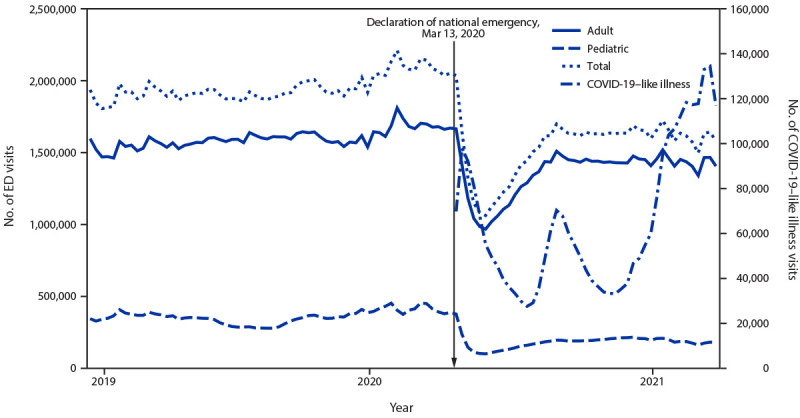
During March 29-April 25, 2020, emergency department (ED) visits in the United States declined by 42% after the declaration of a national emergency for COVID-19 on March 13, 2020. Among children aged ≤10 years, ED visits declined by 72% compared with prepandemic levels (1). To assess the continued impact of the COVID-19 pandemic on EDs, CDC examined trends in visits since December 30, 2018, and compared the numbers and types of ED visits by patient demographic and geographic factors during a COVID-19 pandemic period (December 20, 2020-January 16, 2021) with a prepandemic period 1 year earlier (December 15, 2019-January 11, 2020). After an initial decline during March-April 2020 (1), ED visits increased through July 2020, but at levels below those during the previous year, until December 2020-January 2021 when visits again fell to 25% of prepandemic levels. During this time, among patients aged 0-4, 5-11, 12-17, and ≥18 years, ED visits were lower by 66%, 63%, 38%, and 17%, respectively, compared with ED visits for each age group during the same period before the pandemic. Differences were also observed by region and reasons for ED visits during December 2020-January 2021; more visits during this period were for infectious diseases or mental and behavioral health-related concerns and fewer visits were for gastrointestinal and upper-respiratory-related illnesses compared with ED visits during December 2019-January 2020. Although the numbers of ED visits associated with socioeconomic factors and mental or behavioral health conditions are low, the increased visits by both adults and children for these concerns suggest that health care providers should maintain heightened vigilance in screening for factors that might warrant further treatment, guidance, or intervention during the COVID-19 pandemic.
Overview
The claims and statistics of this paper haven’t been checked yet.
Run the check — free, no account needed. It reads the open-access text and checks the sources it cites.
Integrity signals
Registry
Cites
Statistics
Figures
Verification
Claims the paper makes
The claims and statistics of this paper haven’t been checked yet.
Run the check — free, no account needed. It reads the open-access text and checks the sources it cites.
Claims other papers make about this one
Each is checked against this paper’s own text: does it say what the citing paper says it does?
The source backs part of the claim, not all of it — or backs it for a different population, condition or comparison.
In the citing paper
“The current trends in the number and proportion of MHC-related ED visits, along with previous research ( 1 , 2 , 4 -8 ), indicate that the mental health effects of the pandemic might be particularly high among adolescent girls.”
From Pediatric Emergency Department Visits Associated with Mental Health Conditions Before and During the COVID-19 Pandemic — United States, January 2019–January 2022 (2022) · cites this paper as [8]
Experimental — accuracy not yet measuredThe cited source says what the claim attributes to it.
In the citing paper
“Declines in MHC-related visits during 2020 align with previous research ( 2 ), and with reported declines in overall volume of pediatric ED visits during the pandemic ( 8 ).”
Self-check
Percentages, sums and reported differences re-computed from the paper’s own numbers.
The self-check needs the paper’s full text.
Citations
Cites
Taquet, M., Luciano, S., Geddes, J. R., & Harrison, P. J. (2021) · The Lancet Psychiatry · doi:10.1016/s2215-0366(20)30462-4 · Cited by 1,484
Hartnett, K. P., Kite-Powell, A., DeVies, J., Coletta, M. A., Boehmer, T. K., Adjemian, J., Gundlapalli, A. V., & Practice, N. S. S. P. C. O. (2020) · MMWR Morbidity and Mortality Weekly Report · doi:10.15585/mmwr.mm6923e1 · Cited by 1,139
Pan, K.-Y., Kok, A. A. L., Eikelenboom, M., Horsfall, M., Jörg, F., Luteijn, R. A., Rhebergen, D., Oppen, P. V., Giltay, E. J., & Penninx, B. W. J. H. (2021) · The Lancet Psychiatry · doi:10.1016/s2215-0366(20)30491-0 · Cited by 585
Healthcare Cost and Utilization Project
(2008) · Encyclopedia of Epidemiology · doi:10.4135/9781412953948.n196 · Cited by 505
Emergency department use: a reflection of poor primary care access?
Weisz, D., Gusmano, M. K., Wong, G., & Trombley, J. E. (2015) · PubMed · Cited by 36
Cited by
Sorted by citations
The effects of the COVID-19 pandemic on community respiratory virus activity
Chow, E. J., Uyeki, T. M., & Chu, H. Y. (2022) · Nature Reviews Microbiology · doi:10.1038/s41579-022-00807-9 · Cited by 694
National Trends in Mental Health–Related Emergency Department Visits Among Youth, 2011-2020
Bommersbach, T. J., McKean, A. J. S., Olfson, M., & Rhee, T. G. (2023) · JAMA · doi:10.1001/jama.2023.4809 · Cited by 363
Radhakrishnan, L., Leeb, R. T., Bitsko, R. H., Carey, K., Gates, A., Holland, K. M., Hartnett, K. P., Kite-Powell, A., DeVies, J., Smith, A. R., et al. (2022) · MMWR. Morbidity and Mortality Weekly Report · doi:10.15585/mmwr.mm7108e2 · Cited by 169
“Declines in MHC-related visits during 2020 align with previous research (2), and with reported declines in overall volume of pediatric ED visits during the pandemic (8).”
ResultRodgers, L., Sheppard, M., Smith, A. R., Dietz, S., Jayanthi, P., Yuan, Y., Bull–Otterson, L., Wotiz, S., Schwarze, T., Azondékon, R., et al. (2021) · Clinical Infectious Diseases · doi:10.1093/cid/ciab311 · Cited by 123
Liu, S. V., O’Donnell, J. K., Gladden, R. M., McGlone, L., & Chowdhury, F. (2021) · MMWR Morbidity and Mortality Weekly Report · doi:10.15585/mmwr.mm7034a2 · Cited by 110
Metadata
- Authors
- Adjemian, J., Hartnett, K. P., Kite-Powell, A., DeVies, J., Azondekon, R., Radhakrishnan, L., van Santen, K. L., & Rodgers, L.
- Affiliations
- United States Department of Health and Human Services (US)
- ICF International (United States) (US)
- Corresponding author
- Adjemian, Jennifer
- Venue
- MMWR Morbidity and Mortality Weekly Report
- Published
- 2021-04-16
- Volume
- 70
- Issue
- 15
- Pages
- 552-556
- ISSN
- 0149-2195 (ISSN-L)
- 1545-861X
- PMC
- PMC8344998
- OpenAlex
- W3152793249
- Cited by
- 120
- References
- 5
- Citations by year
- 2026: 11 · 2025: 7 · 2024: 11 · 2023: 30 · 2022: 41 · 2021: 20
- FWCI
- 9.28
- Type
- journal article
- Language
- en
- Open access
- diamond
- doi.org
- Locations
- MMWR Morbidity and Mortality Weekly Report (publishedVersion)
- PubMed Central (publishedVersion, cc-by)
- PubMed (publishedVersion)
- Topics
- Health Sciences › Medicine › Oncology › COVID-19 and healthcare impacts
- Health Sciences › Medicine › Emergency Medicine › Emergency and Acute Care Studies
- Physical Sciences › Mathematics › Modeling and Simulation › COVID-19 epidemiological studies
- Keywords
- COVID-19 pandemic, emergency department visits, emergency department utilization, reasons for emergency visits, socioeconomic factors, children, adults
- MeSH terms
- COVID-19, Adolescent, Adult, Child, Child, Preschool, Emergency Service, Hospital, Humans, Infant, Infant, Newborn, United States, Pandemics
About these checks
Registry, retraction, Cites and statistics results are computed, not judged, with one exception: a printed reference that no index lists is read once by a model before it counts as a citation error. Claims are extracted by a model and kept only when their quote appears verbatim in the text; each cited source is then checked, with a model’s help, for whether it says what the claim relies on. Those verdicts can be wrong — read the claim’s quote and the cited source before relying on one.
Statistics and arithmetic are recomputed, not judged.
Confidence bands are shown only for fields calibrated on our annotated test set. None is calibrated yet, so no band is shown.
What counts as a claim ›How we measure confidence ›How we check this ›
Are you an author, or do you see a problem with this page? Request a review
