

Surveillance to Track Progress Toward Polio Eradication-Worldwide, 2019–2020
Open accessThe DOI matches its Crossref record; 8 of the 8 references it cites were found in a registry or an index.
Abstract
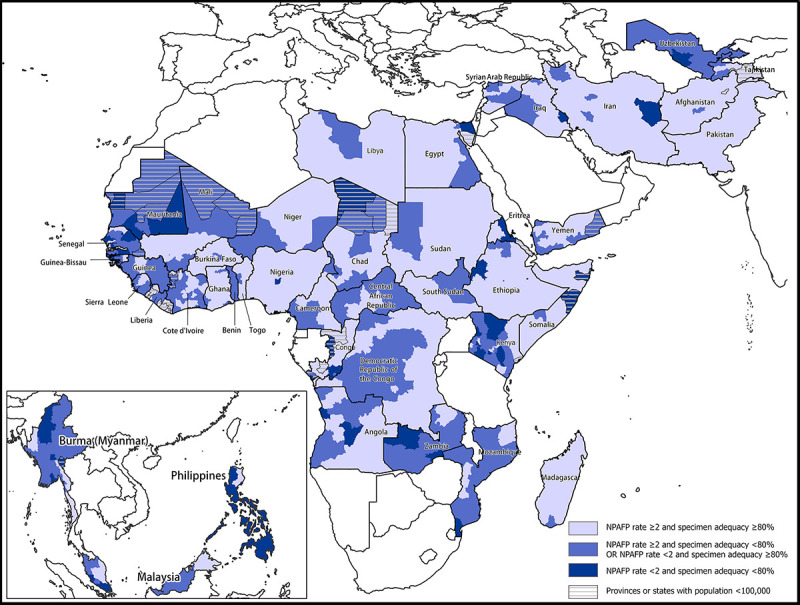
When the Global Polio Eradication Initiative (GPEI) was established in 1988, an estimated 350,000 poliomyelitis cases were reported worldwide.In 2020, 140 wild poliovirus (WPV) cases were confirmed, representing a 99.99% reduction since 1988.WPV type 1 transmission remains endemic in only two countries (Pakistan and Afghanistan), but outbreaks of circulating vaccine-derived poliovirus (cVDPV) occurred in 33 countries during 2019-2020 (1,2).Poliovirus transmission is detected primarily through syndromic surveillance for acute flaccid paralysis (AFP) among children aged <15 years, with confirmation by laboratory testing of stool specimens.Environmental surveillance supplements AFP surveillance and plays an increasingly important role in detecting poliovirus transmission.Within 2 weeks of COVID-19 being declared a global pandemic (3), GPEI recommended continuing surveillance activities with caution and paused all polio supplementary immunization activities (4).This report summarizes surveillance performance indicators for 2019 and 2020 in 42 priority countries at high risk for poliovirus transmission and updates previous reports (5).In 2020, 48% of priority countries* in the African Region, 90% in the Eastern Mediterranean Region, and 40% in other regions met AFP surveillance performance indicators nationally.The number of priority countries rose from 40 in 2019 to 42 in 2020.† Analysis of 2019-2020 AFP surveillance data from 42 countries at high risk for poliovirus transmission indicates that national and subnational nonpolio AFP rates and stool specimen adequacy declined in many priority countries, particularly in the African Region, suggesting a decline in surveillance sensitivity and quality.The findings in this report can be used to guide improvements to restore a sensitive surveillance system that can track poliovirus transmission and provide evidence of interruption of transmission.
Overview
The claims and statistics of this paper haven’t been checked yet.
Free: it reads the open-access text and checks the first 5 claims that cite a source we can check. Create a free account to check every claim.
Integrity signals
Registry
Cites
Statistics
Figures
Verification
Claims the paper makes
The claims and statistics of this paper haven’t been checked yet.
Free: it reads the open-access text and checks the first 5 claims that cite a source we can check. Create a free account to check every claim.
Claims other papers make about this one
Each is checked against this paper’s own text: does it say what the citing paper says it does?
The source backs part of the claim, not all of it — or backs it for a different population, condition or comparison.
In the citing paper
“However, OPV strains can mutate and evolve into VDPV, which may be neurovirulent in vaccinated individuals due to their intrinsic genetic instability [78,79,80,81].”
From The Fight against Poliovirus Is Not Over (2023) · cites this paper as [80]
Experimental — accuracy not yet measuredIn the citing paper
“Several AFR countries’ subnational performance on surveillance indicators in 2021 improved compared with their prepandemic performance in 2019, including Burkina Faso, Côte d’Ivoire, Democratic Republic of the Congo, and Niger (4).”
From Surveillance to track progress toward polio eradication—worldwide, 2020–2021. (2022) · cites this paper as [4]
Self-check
Percentages, sums and reported differences re-computed from the paper’s own numbers.
The self-check needs the paper’s full text.
Citations
Cites
Global polio eradication initiative
Koenig‐Archibugi, M. (2011) · London School of Economics and Political Science Research Online (London School of Economics and Political Science) · Cited by 523
Environmental surveillance for polioviruses in the Global Polio Eradication Initiative.
Asghar, H., Diop, O. M., Weldegebriel, G., Malik, F., Shetty, S., El Bassioni, L., Akande, A. O., Al Maamoun, E., Zaidi, S., Adeniji, A. J., et al. (2014) · Journal of Infectious Diseases · doi:10.1093/infdis/jiu384 · Cited by 427 · cited 1×
“Environmental surveillance is the systematic testing of sewage samples to identify populations shedding polioviruses; environmental surveillance in some locations, might be more sensitive to detection of poliovirus transmission than AFP surveillance, given that paralysis occurs in <1% of poliovirus infections (6).”
BackgroundSelf-citationUpdate on Vaccine-Derived Poliovirus Outbreaks — Worldwide, July 2019–February 2020
Alleman, M. M., Jorba, J., Greene, S. A., Diop, O. M., Iber, J., Tallis, G., Goel, A., Wiesen, E., Wassilak, S. G. F., & Burns, C. C. (2020) · MMWR. Morbidity and Mortality Weekly Report · doi:10.15585/mmwr.mm6916a1 · Cited by 93 · cited 1×
“WPV type 1 transmission remains endemic in only two countries (Pakistan and Afghanistan), but outbreaks of circulating vaccine-derived poliovirus (cVDPV) occurred in 33 countries during 2019–2020 (1,2).”
Self-citationProgress toward polio eradication—worldwide, January 2018–March 2020.
Chard, A. N., Datta, S. D., Tallis, G., Burns, C. C., Wassilak, S. G. F., Vertefeuille, J. F., & Zaffran, M. (2020) · MMWR. Morbidity and Mortality Weekly Report · doi:10.15585/mmwr.mm6925a4 · Cited by 83 · cited 1×
“WPV type 1 transmission remains endemic in only two countries (Pakistan and Afghanistan), but outbreaks of circulating vaccine-derived poliovirus (cVDPV) occurred in 33 countries during 2019–2020 (1,2).”
BackgroundDiop, O. M., Kew, O. M., de Gourville, E. M., & Pallansch, M. A. (2017) · The Journal of Infectious Diseases · doi:10.1093/infdis/jix092 · Cited by 42
Self-citationImpact of COVID-19 pandemic on global poliovirus surveillance.
Zomahoun, D. J., Burman, A. L., Snider, C. J., Chauvin, C., Gardner, T., Lickness, J. S., Ahmed, J. A., Diop, O., Gerber, S., & Anand, A. (2021) · MMWR Morbidity and Mortality Weekly Report · doi:10.15585/mmwr.mm695152a4 · Cited by 39 · cited 2×
“The COVID-19 pandemic substantially affected polio eradication activities in 2020 (9).”
BackgroundSelf-citationSurveillance to Track Progress Toward Polio Eradication — Worldwide, 2018–2019
Lickness, J. S., Gardner, T., Diop, O. M., Chavan, S., Jorba, J., Ahmed, J., Gumede, N., Johnson, T., Butt, O., Asghar, H., et al. (2020) · MMWR. Morbidity and Mortality Weekly Report · doi:10.15585/mmwr.mm6920a3 · Cited by 36 · cited 1×
“This report summarizes surveillance performance indicators for 2019 and 2020 in 42 priority countries at high risk for poliovirus transmission and updates previous reports (5).”
BackgroundSelf-citationProgress Toward Poliomyelitis Eradication — Pakistan, January 2019−September 2020
Hsu, C. H., Rehman, M. S. U., Bullard, K., Jorba, J. C., Kader, M., Young, H., Safdar, M. R., Jafari, H. S., & Ehrhardt, D. T. (2020) · MMWR Morbidity and Mortality Weekly Report · doi:10.15585/mmwr.mm6946a5 · Cited by 27 · cited 11×
“WPV1 isolates from AFP patients (two in Afghanistan and three in Pakistan) and in 2020 for 18 of 140 (13”
BackgroundInfluentialSelf-citation
Cited by
Progress toward polio eradication—worldwide, January 2019–June 2021.
Bigouette, J. P., Wilkinson, A. L., Tallis, G., Burns, C. C., Wassilak, S. G. F., & Vertefeuille, J. F. (2021) · MMWR. Morbidity and Mortality Weekly Report · doi:10.15585/mmwr.mm7034a1 · Cited by 62
Self-citationThe Fight against Poliovirus Is Not Over
Mbani, C. J., Nekoua, M. P., Moukassa, D., & Hober, D. (2023) · Microorganisms · doi:10.3390/microorganisms11051323 · Cited by 34
Surveillance to track progress toward polio eradication—worldwide, 2020–2021.
Wilkinson, A. L., Diop, O. M., Jorba, J., Gardner, T., Snider, C. J., & Ahmed, J. (2022) · MMWR Morbidity and Mortality Weekly Report · doi:10.15585/mmwr.mm7115a2 · Cited by 30
“In Nigeria, the number of cVDPV2-positive environmental surveillance samples increased from five samples collected from two sites in 2020 to 299 samples collected from 77 sites in 2021.”
BackgroundInfluentialSelf-citationThe Last Mile in Polio Eradication: Program Challenges and Perseverance
Cavestany, R. L., Eisenhawer, M., Diop, O. M., Verma, H., Quddus, A., & Mach, O. (2024) · Pathogens · doi:10.3390/pathogens13040323 · Cited by 31
“The COVID-19 pandemic negatively affected both AFP and ES surveillance systems [18,19].”
BackgroundSelf-citationSurveillance To Track Progress Toward Poliomyelitis Eradication — Worldwide, 2021–2022
Stehling-Ariza, T., Wilkinson, A. L., Diop, O. M., Jorba, J. C., Asghar, H., Avagnan, T., Grabovac, V., Johnson, T. M., Joshi, S., Kfutwah, A. K. W., et al. (2023) · MMWR Morbidity and Mortality Weekly Report · doi:10.15585/mmwr.mm7223a1 · Cited by 22
“Priority countries by region in 2022 included the following: African Region (24): Angola, Benin, Burkina Faso, Cameroon, Central African Republic, Chad, Côte d’Ivoire, Democratic Republic of the Congo, Equatorial Guinea, Ethiopia, Guinea, Guinea-Bissau, Kenya, Madagascar, Malawi, Mali, Mozambique, Niger, Nigeria, Sout…”
BackgroundMethodInfluentialSelf-citationCharnesky, A. J., Faust, J. E., Lee, H., Puligedda, R. D., Goetschius, D. J., DiNunno, N. M., Thapa, V., Bator, C. M., Cho, S.-H., Wahid, R., et al. (2023) · Nature Communications · doi:10.1038/s41467-023-41052-9 · Cited by 19
Kitamura, K., & Shimizu, H. (2021) · Viruses · doi:10.3390/v13071407 · Cited by 14
Ali, A. S. M. A., Allzain, H., Ahmed, O. M., Mahgoub, E., Musa, M. B., & Gorish, B. M. T. (2023) · BMC Public Health · doi:10.1186/s12889-023-15019-w · Cited by 14
Azizatunnisa’, L., Cintyamena, U., Mahendradhata, Y., & Ahmad, R. A. (2021) · BMC Public Health · doi:10.1186/s12889-021-11642-7 · Cited by 20
KITAMURA, K., & Shimizu, H. (2022) · Japanese Journal of Infectious Diseases · doi:10.7883/yoken.jjid.2022.312 · Cited by 7
Travel-Associated Infections & Diseases
Nemhauser, J. B. (2023) · Oxford University Press eBooks · doi:10.1093/oso/9780197570944.003.0005 · Cited by 7
Mashal, M. T., Eltayeb, D., Higgins‐Steele, A., Sheikh, I. S. E., Abid, N. S., Shukla, H., Machado, L., & Jafari, H. S. (2024) · BMC Public Health · doi:10.1186/s12889-023-15675-y · Cited by 5
“Sudan has an established poliovirus surveillance system and network in all 18 states in the country which has been meeting globally established performance indicators [13].”
BackgroundGeorge, U. E., Faleye, T. O. C., Coninck, L. D., Agbaje, S. T., Ifeorah, I. M., Onoja, A. B., Elijah, O. I., Olayinka, A. O., Ajileye, T. G., Oragwa, A. O., et al. (2024) · Pathogens · doi:10.3390/pathogens13030264 · Cited by 4
“Samples were collected from children aged 15 years and below diagnosed with AFP in Nigeria in 2020 [44].”
BackgroundIfeorah, I. M., Faleye, T. O. C., Coninck, L. D., Agbaje, S. T., George, U. E., Onoja, A. B., Olayinka, O. A., Elijah, O. I., Ajileye, T. G., Oragwa, A. O., et al. (2024) · Journal of Medical Virology · doi:10.1002/jmv.29489 · Cited by 3
“20,32 The topology of our trees and Simplot analysis with bootstrap support suggests that recombination events contributed to the emergence of A15_AFP5_NGR_2020 and/or the lineage to which it belongs (see Figure 6 and Supporting Information S2: Figure S3).”
BackgroundObodai, E., Boakye, J. D., Ntim, N. A. A., Agbotse, G. D., Antwi, C. N., Duker, E. O., Bimpong, S. A., Odame, D., Adams, P. L., Nayan, J., et al. (2024) · Tropical Medicine and Infectious Disease · doi:10.3390/tropicalmed9110271 · Cited by 2
“The primary indicator for assessing the sensitivity of an AFP surveillance system is the non-polio AFP, which assesses the system’s capacity to detect in the event of re-importation into the country [15,19].”
Estívariz, C. F., Burns, C. C., & Macklin, G. (2023) · Elsevier eBooks · doi:10.1016/b978-0-323-79058-1.00050-5 · Cited by 7
Edukugho, A. A., Etapelong, S. G., Gidado, S., Abbott, S. L., Hamisu, A. W., Hassan, I. A., Mawashi, K. Y., Erbeto, T. B., Waziri, N. E., Nguku, P., et al. (2023) · Pan African Medical Journal · doi:10.11604/pamj.supp.2023.45.2.38261 · Cited by 2
“For the standard NPAFP rate, at least 1 AFP case is detected that has been discarded as not being polio per 100,000 population aged 15 years annually in non-endemic areas, while in endemic regions or those endemic prior to 2014, the target rate is 2 per 100,000 [9,10].”
BackgroundMethodBolu, O. O., Adamu, U., Franka, R., Umeokonkwo, C. D., An, Q., Greby, S. M., McDonald, S. L., Mainou, B. A., Mba, N., Agala, N. P., et al. (2023) · Pan African Medical Journal · doi:10.11604/pamj.supp.2023.45.2.38098 · Cited by 2
Kashitu-Mujinga, G., Makaka-Mutondo, A., Matondo-Kuamfumu, M., Mambu-Mbika, F., Bulabula-Penge, J., Mampuela, T. K., N’Kawa, F., Wanet-Tayele, G., Nsunda, B., Mutantu, P. N., et al. (2025) · Vaccines · doi:10.3390/vaccines13070680 · Cited by 1
Neutralizing human monoclonal antibodies to poliovirus map to the receptor binding site
Waddey, B. T., Charnesky, A. J., Faust, J. E., DiNunno, N. M., Puligedda, R. D., Cho, S. H., Bator, C. M., Dong, S. D., Mahmood, K., Chumakov, K., et al. (2026) · Nature Communications · doi:10.1038/s41467-025-68226-x · Cited by 4
“The mode of binding is similar to the monovalent binding of 9H2 FAb to PV capsids, which was suf fi cient to neutralize serotypes 1 and 3 of poliovirus in-vitro 23 .”
Salazar, M. A., Dalmacio, L. M. M., Orbecido, A. H., Abanador, R., Promentilla, M. A. B., Beltran, A. B., Tanhueco, R. M., & Balolong, M. P. (2022) · Western Pacific surveillance response journal · doi:10.5365/wpsar.2022.13.2.930 · Cited by 1
Experience and findings from surveillance peer review in Nigeria, August 2017-May 2019
Hamisu, A. W., Etapelong, S. G., Isiaka, A., Banda, R., Braka, F., Gidado, S., Abbott, S. L., Edukugho, A. A., Bolu, O. O., Asekun, A., et al. (2023) · Pan African Medical Journal · doi:10.11604/pamj.supp.2023.45.2.39450 · Cited by 1
“…(timeliness) may mean that the DSNOs did not have the required skills to elicit the correct date of paralysis onset, deliberately altered onset or specimen collection dates to make this indicator appear timely, or omitted the inclusion of cases reported and investigated late after onset [18].”
BackgroundMetagenomic Detection and Genetic Characterization of Human Sapovirus among Children in NigeriaPreprint
George, U. E., Faleye, T. O. C., Coninck, L. D., Agbaje, S. T., Ifeorah, I. M., Onoja, A. B., Elijah, O. I., Olayinka, O. A., Ajileye, T. G., Oragwa, A. O., et al. (2023) · bioRxiv (Cold Spring Harbor Laboratory) · doi:10.1101/2023.12.20.572641
Tarawally, A., Hargono, A., Susanto, H., & Wulandari, W. (2024) · Jurnal Berkala Epidemiologi · doi:10.20473/jbe.v12i32024.238-247
Enhancing Global Poliomyelitis Surveillance Performance is Crucial for Eradication Efforts
Ibrahim, A. H., Abdullah, M. K., & Salman, M. Q. (2024) · Academia Open · doi:10.21070/acopen.9.2024.10317
Enteroviruses and Parechoviruses
Stellrecht, K. A., Lamson, D. M., & Romero, J. R. (2023) · Wiley eBooks · doi:10.1002/9781683674849.mcm0091
Enteroviruses and Parechoviruses
Stellrecht, K. A., Lamson, D. M., & Romero, J. R. (2023) · Wiley eBooks · doi:10.1002/9781683670438.mcm0091
Agbaje, S. T., George, U. E., Coninck, L. D., Faleye, T. O. C., Ifeorah, I. M., Onoja, B. A., Olayinka, O. A., Ajileye, T. G., Oragwa, A. O., Akinleye, T. E., et al. (2025) · The Microbe · doi:10.1016/j.microb.2025.100532
Tracking poliovirus through wastewater: environmental surveillance insights from Haïti (2020–2023)
Belgasmi, H., Hill, J., Miles, S. J., Sayyad, L., Elahi, H., Patterson, N. E., Deas, A., Heberlienne, A., Wilkinson, A. L., Vega, E. M., et al. (2025) · Applied and Environmental Microbiology · doi:10.1128/aem.01179-25 · Cited by 1
“The political instability, insecurity, the COVID-19 pandemic in 2020, the cholera outbreak in 2022, and natural disasters, such as the 2021 earthquake and a hurricane, hindered routine annual site evaluations by CDC-Atlanta and PAHO staff and delayed sample shipment to CDC-Atlanta (61–65).”
Self-citationBakumba-Kiulu, V., Tshiminyi-Munkamba, P., Mampuela, T. K., Matondo-Kuamfumu, M., Kashitu-Mujinga, G., Bulabula-Penge, J., Pukuta-Nsimbu, E., Muyamuna, E., Lay, Y., Mukangala-Changa-Changa, J. C., et al. (2026) · Pathogens · doi:10.3390/pathogens15090917
“Previous studies assessing AFP and environmental surveillance performance indicators have shown substantial variations across countries and WHO regions [7,12].”
Influential
Metadata
- Authors
- Tuma, J. N., Wilkinson, A. L., Diop, O. M., Jorba, J., Gardner, T., Snider, C. J., Anand, A., & Ahmed, J.
- Affiliations
- National Center for Immunization and Respiratory Diseases (US)
- Corresponding author
- Tuma, Jude N.
- Venue
- MMWR. Morbidity and Mortality Weekly Report
- Published
- 2021-05-07
- Volume
- 70
- Issue
- 18
- Pages
- 667-673
- ISSN
- 0149-2195 (ISSN-L)
- 1545-861X
- PMC
- PMC9368747
- OpenAlex
- W3159926165
- Cited by
- 30
- References
- 8
- Citations by year
- 2026: 2 · 2025: 3 · 2024: 7 · 2023: 12 · 2022: 3 · 2021: 3
- FWCI
- 4.19
- Type
- journal article
- Language
- en
- Open access
- diamond
- doi.org
- Locations
- MMWR Morbidity and Mortality Weekly Report (publishedVersion)
- PubMed Central (publishedVersion, cc-by)
- PubMed (publishedVersion)
- Topics
- Health Sciences › Medicine › Infectious Diseases › Viral Infections and Immunology Research
- Social Sciences › Health › Vaccine Coverage and Hesitancy
- Health Sciences › Medicine › Epidemiology › Data-Driven Disease Surveillance
- Keywords
- polio eradication, acute flaccid paralysis surveillance, wild poliovirus, circulating vaccine-derived poliovirus, environmental surveillance, poliovirus transmission, surveillance sensitivity, supplementary immunization activities, COVID-19 pandemic, Global Polio Eradication Initiative
- MeSH terms
- Humans, Poliomyelitis, Population Surveillance, Global Health, Disease Eradication
About these checks
Registry, retraction, Cites and statistics results are computed, not judged, with one exception: a printed reference that no index lists is read once by a model before it counts as a citation error. Claims are extracted by a model and kept only when their quote appears verbatim in the text; each cited source is then checked, with a model’s help, for whether it says what the claim relies on. Those verdicts can be wrong — read the claim’s quote and the cited source before relying on one.
Statistics and arithmetic are recomputed, not judged.
Confidence bands are shown only for fields calibrated on our annotated test set. None is calibrated yet, so no band is shown.
What counts as a claim ›How we measure confidence ›How we check this ›
Are you an author, or do you see a problem with this page? Request a review
Data sources
Bibliographic data: Semantic Scholar, OpenAlex, Crossref.
Contains information from the Semantic Scholar Academic Graph Datasets, made available under the ODC Attribution License (ODC-BY 1.0).
Semantic Scholar’s data is described in: Kinney, R., et al. (2023). The Semantic Scholar Open Data Platform. arXiv:2301.10140.
