

The DOI matches its Crossref record; 4 of the 5 references it cites were found in a registry or an index.
Disparities in COVID-19 Vaccination Coverage Between Urban and Rural Counties — United States, December 14, 2020–April 10, 2021
Open accessAbstract
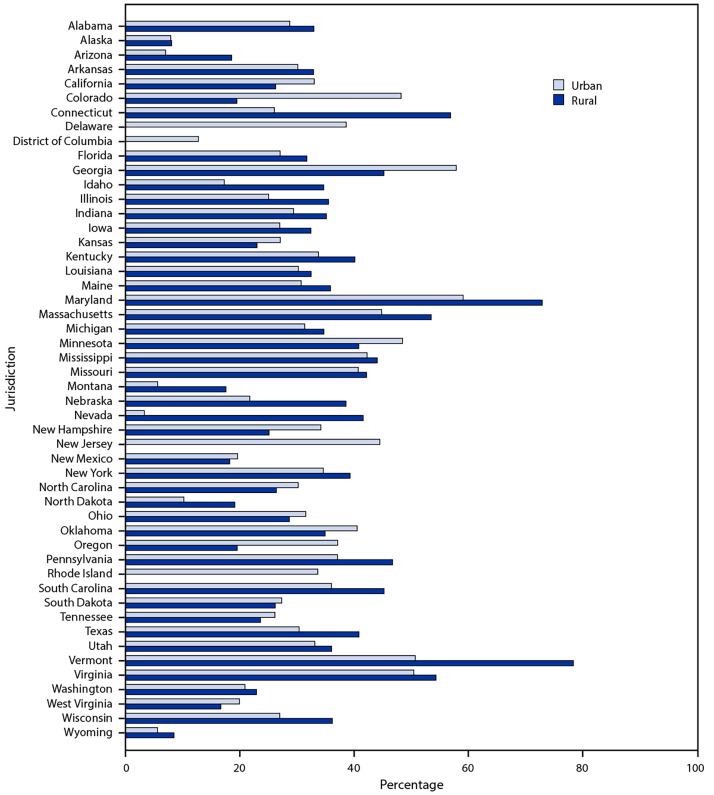
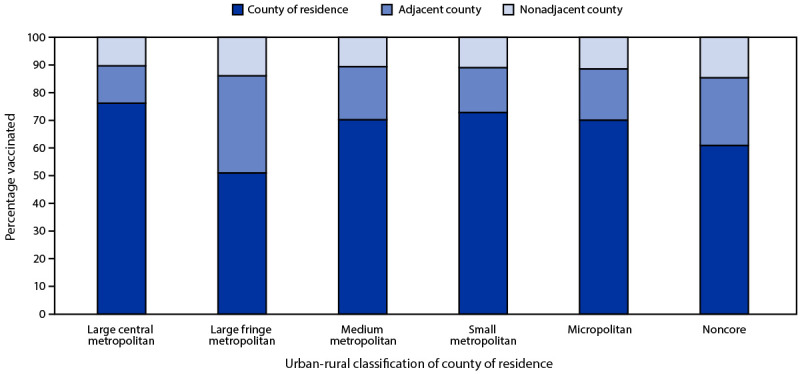
Approximately 60 million persons in the United States live in rural counties, representing almost one fifth (19.3%) of the population.* In September 2020, COVID-19 incidence (cases per 100,000 population) in rural counties surpassed that in urban counties (1). Rural communities often have a higher proportion of residents who lack health insurance, live with comorbidities or disabilities, are aged ≥65 years, and have limited access to health care facilities with intensive care capabilities, which places these residents at increased risk for COVID-19-associated morbidity and mortality (2,3). To better understand COVID-19 vaccination disparities across the urban-rural continuum, CDC analyzed county-level vaccine administration data among adults aged ≥18 years who received their first dose of either the Pfizer-BioNTech or Moderna COVID-19 vaccine, or a single dose of the Janssen COVID-19 vaccine (Johnson & Johnson) during December 14, 2020-April 10, 2021 in 50 U.S. jurisdictions (49 states and the District of Columbia [DC]). Adult COVID-19 vaccination coverage was lower in rural counties (38.9%) than in urban counties (45.7%) overall and among adults aged 18-64 years (29.1% rural, 37.7% urban), those aged ≥65 years (67.6% rural, 76.1% urban), women (41.7% rural, 48.4% urban), and men (35.3% rural, 41.9% urban). Vaccination coverage varied among jurisdictions: 36 jurisdictions had higher coverage in urban counties, five had higher coverage in rural counties, and five had similar coverage (i.e., within 1%) in urban and rural counties; in four jurisdictions with no rural counties, the urban-rural comparison could not be assessed. A larger proportion of persons in the most rural counties (14.6%) traveled for vaccination to nonadjacent counties (i.e., farther from their county of residence) compared with persons in the most urban counties (10.3%). As availability of COVID-19 vaccines expands, public health practitioners should continue collaborating with health care providers, pharmacies, employers, faith leaders, and other community partners to identify and address barriers to COVID-19 vaccination in rural areas (2).
Overview
The claims and statistics of this paper haven’t been checked yet.
Run the check — free, no account needed. It reads the open-access text and checks the sources it cites.
Integrity signals
Registry
Cites
Statistics
Figures
Verification
Claims the paper makes
The claims and statistics of this paper haven’t been checked yet.
Run the check — free, no account needed. It reads the open-access text and checks the sources it cites.
Claims other papers make about this one
Each is checked against this paper’s own text: does it say what the citing paper says it does?
The cited source says what the claim attributes to it.
In the citing paper
“Rurality may also contribute to the errors, because it correlates with vaccine status 8 and home internet access 40 .”
From Unrepresentative big surveys significantly overestimated US vaccine uptake (2021) · cites this paper as [8]
Self-check
Percentages, sums and reported differences re-computed from the paper’s own numbers.
The self-check needs the paper’s full text.
Citations
Cites
Gender Differences in Utilization of Preventive Care Services in the United States
Vaidya, V., Partha, G., & Karmakar, M. (2011) · Journal of Women s Health · doi:10.1089/jwh.2011.2876 · Cited by 441
The Vaccine Uptake Continuum: Applying Social Science Theory to Shift Vaccine Hesitancy
Piltch-Loeb, R. N., & DiClemente, R. J. (2020) · Vaccines · doi:10.3390/vaccines8010076 · Cited by 69
(2020) · MMWR Morbidity and Mortality Weekly Report · doi:10.15585/mmwr.mm6946a6 · Cited by 50
Duca, L. M., Coyle, J. P., McCabe, C., & McLean, C. A. (2020) · Cited by 18
Cited by
Sorted by citations
Items 201–229 of 229
Tarfa, A., Fadul, N. A., Stohs, E. J., Wetherhold, J., Kebede, M., Mirghani, N., & Ashraf, M. S. (2023) · Research Square · doi:10.21203/rs.3.rs-2742627/v1
Caring for community members during the COVID-19 pandemic: results of a statewide survey
Jewell, T., Gillespie, K. H., Schmuhl, N. B., Gilbert, S., Grant, B. S., Watts, L., & Ehrenthal, D. B. (2023) · Journal of Public Health · doi:10.1007/s10389-023-01953-x
Proposal of a vaccination needs index to prioritize municipal interventions in BrazilPreprint
Díaz-Quijano, F. A., Schrarstzhaupt, I. N., Fantinato, F. F. S. T., Barrera, L. S. G., & Croda, J. (2023) · medRxiv · doi:10.1101/2023.09.09.23295306
Ghannouchi, I. (2023) · International Journal of Clinical Case Reports and Reviews · doi:10.31579/2690-4861/270
Epidemiología sociocultural de la crisis del COVID-19
Plaza, R. G. (2023) · Gredos (University of Salamanca) · doi:10.14201/gredos.153227
Faraz, A., Hina, M., Ali, A., Sumbul, D., Mahmood, S. E., Riaz, F., Khan, M. S., Ahmad, A., Ahmad, M. T., Parvez, A., et al. (2023) · Medicine · doi:10.1097/md.0000000000035747
Otho, M. S., & Perveen, S. (2024) · Journal of Public Health and Primary Care · doi:10.4103/jphpc.jphpc_42_22
Give me your best shot! Diffusion of complete versus booster COVID-19 vaccines across US counties
Alfano, V., Capasso, S., Goel, R. K., & Nelson, M. A. (2024) · Journal of Economics and Finance · doi:10.1007/s12197-024-09688-5
AlMahasis, S. O., Fox, B. I., Ha, D. R., Qian, J., Wang, C.-H., & Westrick, S. C. (2024) · Exploratory Research in Clinical and Social Pharmacy · doi:10.1016/j.rcsop.2024.100520
Ding, K., Naqvi, O. H., Seeberger, R. J., Bratzler, D. W., & Wendelboe, A. M. (2024) · Emerging infectious diseases · doi:10.3201/eid3011.231582
Nguyen, K. H., Chung, L., Bednarczyk, R. A., & Vasudevan, L. (2025) · American Journal of Epidemiology · doi:10.1093/aje/kwaf009
Bozer, A. L. H., Gandhi, S., & Edwards, D. C. (2025) · Journal of American College Health · doi:10.1080/07448481.2025.2472184
Irshad, C. V., & Dash, U. (2025) · Journal of Health Management · doi:10.1177/09720634251341027
Variation of COVID-19 vaccination percentage by industry and occupation in Michigan
Rosenman, K. D., & Wang, L. (2025) · Vaccine · doi:10.1016/j.vaccine.2025.127349
Tao, D., Agor, J., McGregor, J. C., Douglass, T., Gibler, A., & Vergara, H. A. (2025) · Healthcare · doi:10.3390/healthcare13121368
Jabbar, A. B. A., Ismayl, M., Klisares, M. J., Osborne, J., Azouz, M., Tak, H. J., Aboeata, A., Kabach, A., & Goldsweig, A. M. (2025) · Cardiovascular revascularization medicine · doi:10.1016/j.carrev.2025.08.021
Iacocca, K., Vallen, B., Strandberg, A. G., & Meinzen‐Dick, L. (2025) · Health Care Management Science · doi:10.1007/s10729-025-09727-5
Ge, Y., Zahid, A., Kuchur, R., Martínez, L., Wang, B., Zhang, L., Aras, S., Raynee, P., Dike, A., Navarro, C., et al. (2025) · Vaccine · doi:10.1016/j.vaccine.2025.127799
Noroozi, A., Esha, S. M., & Ghari, M. (2025) · Vaccine · doi:10.1016/j.vaccine.2025.127902
Freedom, Fairness, and Trust: Speaking the Language of Public Health Across the Political Divide
Castrucci, B. C., Rivera, J. M., & Kwong, A. (2025) · American Journal of Public Health · doi:10.2105/ajph.2025.308327
Sanghai, A. A., Vohra, M., Mahyavanshi, D., Babariya, M. J., & Khan, V. (2026) · Discover Public Health · doi:10.1186/s12982-026-01650-6
Geographic Heterogeneity in Racial and Ethnic Disparities in COVID-19 Vaccination in the US
Costello, N., Merritt, A., & Bansal, S. (2026) · Journal of Racial and Ethnic Health Disparities · doi:10.1007/s40615-026-02909-z
Ease and Equity of Point of Interest Accessibility via Public Transit in the U.S.
Li, A., Racas, A., Syed, J., Liu, M., Zientala, P., & Santanam, T. (2025) · IEEE International Conference on Future Machine Learning and Data Science (FMLDS) · doi:10.1109/fmlds67896.2025.00132
Religion in Shaping Public Health During the COVID-19 Pandemic Across US Counties
Hajilo, M., Steel, S., & James, W. L. (2026) · Society · doi:10.1007/s12115-026-01233-w
Duza, S. S., Blackburn, C. C., Rico, M., & Boyce, M. R. (2026) · Vaccines · doi:10.3390/vaccines14070601
Implementation evaluation of the COVID-19 vaccination: Speed, equity and mortality trends
Matthew, I., Viljoen, M., & McCartney, J. (2026) · African Journal of Primary Health Care & Family Medicine · doi:10.4102/phcfm.v18i1.5248
Post-COVID-19 Reflections of Family Caregivers and Individuals With Disabilities in Northern Arizona
Lee, M. S., Bear, C. R., Metzger‐Riftkin, J., & Lindly, O. J. (2026) · Inclusion · doi:10.1080/23266988.2026.2685646
Kochersperger, E. (2026) · Journal of Public Health Management and Practice · doi:10.1097/phh.0000000000002427
Rurality as a Risk Factor for Excess Mortality in Nebraska During the COVID-19 Pandemic
EINSPAHR, E., Du, Y., Lawler, J. V., Donahue, M. A., Paritala, S., & Maloney, P. (2026) · Journal of Primary Care & Community Health · doi:10.1177/21501319261498009
Metadata
- Authors
- Murthy, B. P., Sterrett, N., Weller, D., Zell, E., Reynolds, L., Toblin, R. L., Murthy, N., Kriss, J., Rose, C., Cadwell, B., Wang, A., Ritchey, M. D., Gibbs-Scharf, L., Qualters, J. R., Shaw, L., Brookmeyer, K. A., Clayton, H., Eke, P., Adams, L., Zajac, J., Patel, A., Fox, K., Williams, C., Stokley, S., Flores, S., Barbour, K. E., & Harris, L. Q.
- Affiliations
- National Center for Immunization and Respiratory Diseases (US)
- Corresponding author
- Murthy, Bhavini Patel
- ORCID
- Venue
- MMWR. Morbidity and Mortality Weekly Report
- Published
- 2021-05-21
- Volume
- 70
- Issue
- 20
- Pages
- 759-764
- ISSN
- 0149-2195 (ISSN-L)
- 1545-861X
- PMC
- PMC8136424
- OpenAlex
- W3160434659
- Cited by
- 230
- References
- 5
- Citations by year
- 2026: 13 · 2025: 27 · 2024: 21 · 2023: 59 · 2022: 77 · 2021: 33
- FWCI
- 26.24
- Type
- journal article
- Language
- en
- Open access
- diamond
- doi.org
- Locations
- MMWR Morbidity and Mortality Weekly Report (publishedVersion)
- PubMed Central (publishedVersion, cc-by)
- PubMed (publishedVersion)
- Funders
- U.S. Department of Defense
- Centers for Disease Control and Prevention
- Topics
- Social Sciences › Health › Vaccine Coverage and Hesitancy
- Health Sciences › Medicine › Infectious Diseases › SARS-CoV-2 and COVID-19 Research
- Physical Sciences › Mathematics › Modeling and Simulation › COVID-19 epidemiological studies
- Keywords
- COVID-19 vaccination coverage, urban-rural disparities, rural counties, vaccine hesitancy, vaccine access, BNT162b2, Moderna vaccine, Janssen vaccine, health disparities, older adults, COVID-19 pandemic
- MeSH terms
- Vaccination Coverage, COVID-19, COVID-19 Vaccines, Adolescent, Adult, Aged, Female, Humans, Male, Middle Aged, Rural Population, United States, Urban Population, Healthcare Disparities, Young Adult
About these checks
Registry, retraction, Cites and statistics results are computed, not judged, with one exception: a printed reference that no index lists is read once by a model before it counts as a citation error. Claims are extracted by a model and kept only when their quote appears verbatim in the text; each cited source is then checked, with a model’s help, for whether it says what the claim relies on. Those verdicts can be wrong — read the claim’s quote and the cited source before relying on one.
Statistics and arithmetic are recomputed, not judged.
Confidence bands are shown only for fields calibrated on our annotated test set. None is calibrated yet, so no band is shown.
What counts as a claim ›How we measure confidence ›How we check this ›
Are you an author, or do you see a problem with this page? Request a review
