

The DOI matches its Crossref record; 8 of the 8 references it cites were found in a registry or an index.
Sustained Effectiveness of Pfizer-BioNTech and Moderna Vaccines Against COVID-19 Associated Hospitalizations Among Adults — United States, March–July 2021
Open accessAbstract
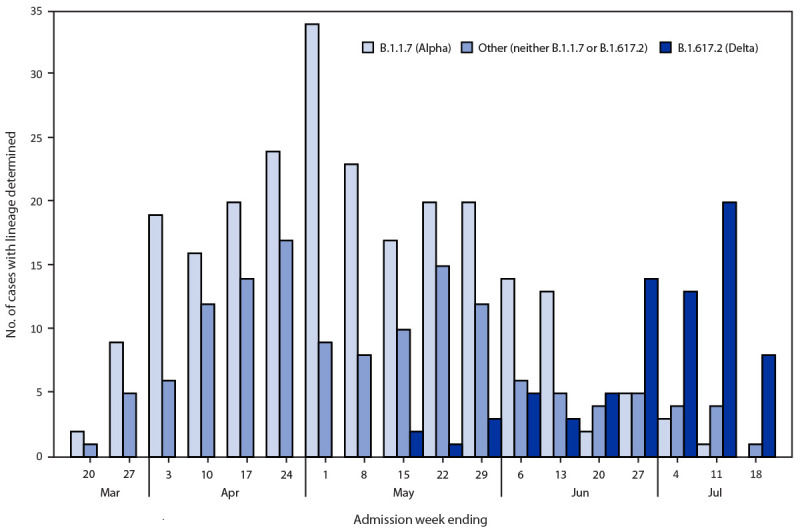
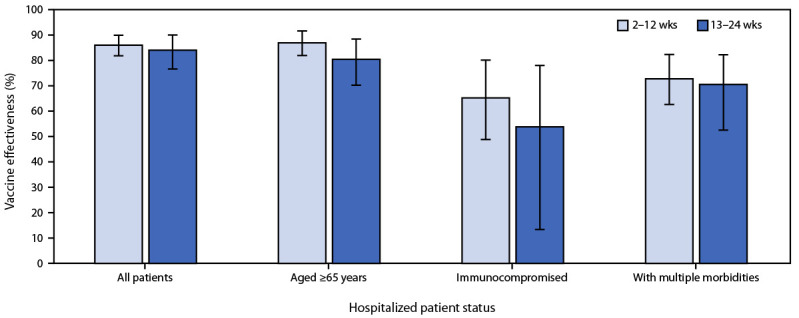
Real-world evaluations have demonstrated high effectiveness of vaccines against COVID-19-associated hospitalizations (1-4) measured shortly after vaccination; longer follow-up is needed to assess durability of protection. In an evaluation at 21 hospitals in 18 states, the duration of mRNA vaccine (Pfizer-BioNTech or Moderna) effectiveness (VE) against COVID-19-associated hospitalizations was assessed among adults aged ≥18 years. Among 3,089 hospitalized adults (including 1,194 COVID-19 case-patients and 1,895 non-COVID-19 control-patients), the median age was 59 years, 48.7% were female, and 21.1% had an immunocompromising condition. Overall, 141 (11.8%) case-patients and 988 (52.1%) controls were fully vaccinated (defined as receipt of the second dose of Pfizer-BioNTech or Moderna mRNA COVID-19 vaccines ≥14 days before illness onset), with a median interval of 65 days (range = 14-166 days) after receipt of second dose. VE against COVID-19-associated hospitalization during the full surveillance period was 86% (95% confidence interval [CI] = 82%-88%) overall and 90% (95% CI = 87%-92%) among adults without immunocompromising conditions. VE against COVID-19- associated hospitalization was 86% (95% CI = 82%-90%) 2-12 weeks and 84% (95% CI = 77%-90%) 13-24 weeks from receipt of the second vaccine dose, with no significant change between these periods (p = 0.854). Whole genome sequencing of 454 case-patient specimens found that 242 (53.3%) belonged to the B.1.1.7 (Alpha) lineage and 74 (16.3%) to the B.1.617.2 (Delta) lineage. Effectiveness of mRNA vaccines against COVID-19-associated hospitalization was sustained over a 24-week period, including among groups at higher risk for severe COVID-19; ongoing monitoring is needed as new SARS-CoV-2 variants emerge. To reduce their risk for hospitalization, all eligible persons should be offered COVID-19 vaccination.
Overview
The claims and statistics of this paper haven’t been checked yet.
Run the check — free, no account needed. It reads the open-access text and checks the sources it cites.
Integrity signals
Registry
Cites
Statistics
Figures
Verification
Claims the paper makes
The claims and statistics of this paper haven’t been checked yet.
Run the check — free, no account needed. It reads the open-access text and checks the sources it cites.
Claims other papers make about this one
Each is checked against this paper’s own text: does it say what the citing paper says it does?
In the citing paper
“Patients from the testnegative and syndrome-negative control groups were pooled for this analysis in accordance with a prior analysis showing similar results with each control group individually.4,15”
From Association Between mRNA Vaccination and COVID-19 Hospitalization and Disease Severity (2021) · cites this paper as [15]
In the citing paper
“Sustained vaccine effectiveness against severe disease has been shown for previous doses also.20 34”
In the citing paper
“Protection from previous doses against severe disease has been shown to wane more slowly than protection against infection.20 34”
Self-check
Percentages, sums and reported differences re-computed from the paper’s own numbers.
The self-check needs the paper’s full text.
Citations
Cites
Haas, E. J., Angulo, F. J., McLaughlin, J. M., Anis, E., Singer, S. R., Khan, F., Brooks, N., Smaja, M., Mircus, G., Pan, K., et al. (2021) · The Lancet · doi:10.1016/s0140-6736(21)00947-8 · Cited by 1,564
Lopez Bernal, J., Andrews, N., Gower, C., Robertson, C., Stowe, J., Tessier, E., Simmons, R., Cottrell, S., Roberts, R., O’Doherty, M., et al. (2021) · BMJ · doi:10.1136/bmj.n1088 · Cited by 1,389
SARS-CoV-2 mRNA vaccines induce persistent human germinal centre responses
Turner, J. S., O’Halloran, J. A., Kalaidina, E., Kim, W., Schmitz, A. J., Zhou, J. Q., Lei, T., Thapa, M., Chen, R. E., Case, J. B., et al. (2021) · Nature · doi:10.1038/s41586-021-03738-2 · Cited by 831
Prevention and Attenuation of Covid-19 with the BNT162b2 and mRNA-1273 Vaccines
Thompson, M. G., Burgess, J. L., Naleway, A. L., Tyner, H. L., Yoon, S. K., Meece, J. K., Olsho, L. E. W., Caban-Martinez, A. J., Fowlkes, A., Lutrick, K., et al. (2021) · New England Journal of Medicine · doi:10.1056/nejmoa2107058 · Cited by 482
Self-citationTenforde, M. W., Olson, S. M., Self, W. H., Talbot, H. K., Lindsell, C. J., Steingrub, J. S., Shapiro, N. I., Ginde, A. A., Douin, D. J., Prekker, M. E., et al. (2021) · MMWR Morbidity and Mortality Weekly Report · doi:10.15585/mmwr.mm7018e1 · Cited by 286
Self-citationProspects for durable immune control of SARS-CoV-2 and prevention of reinfection
Cromer, D., Juno, J. A., Khoury, D., Reynaldi, A., Wheatley, A. K., Kent, S. J., & Davenport, M. P. (2021) · Nature Reviews Immunology · doi:10.1038/s41577-021-00550-x · Cited by 265
Ferdinands, J. M., Gaglani, M., Martin, E. T., Monto, A. S., Middleton, D. B., Silveira, F. P., Talbot, H. K., Zimmerman, R. K., & Patel, M. M. (2021) · Clinical Infectious Diseases · doi:10.1093/cid/ciab045 · Cited by 59
Self-citationFeng, S., Chiu, S. S. S., Chan, E. L. Y., Kwan, M. Y. W., Wong, J. S. C., Leung, C., Lau, Y. C., Sullivan, S. G., Peiris, M. J. S., & Cowling, B. J. (2018) · The Lancet Respiratory Medicine · doi:10.1016/s2213-2600(18)30419-3 · Cited by 39
Research works printed but not linked: 1
- Tenforde, Clin Infect Dis
Cited by
Sorted by citations
Molnupiravir for oral treatment of COVID-19 in nonhospitalized patients.
Jayk Bernal, A., Gomes da Silva, M. M., Musungaie, D. B., Kovalchuk, E., Gonzalez, A., Delos Reyes, V., Martín-Quirós, A., Caraco, Y., Williams-Diaz, A., Brown, M. L., et al. (2022) · New England Journal of Medicine · doi:10.1056/nejmoa2116044 · Cited by 1,857
Feikin, D. R., Higdon, M. M., Abu-Raddad, L. J., Andrews, N., Araos, R., Goldberg, Y., Groome, M. J., Huppert, A., O'Brien, K. L., Smith, P. G., et al. (2022) · The Lancet · doi:10.1016/s0140-6736(22)00152-0 · Cited by 1,237
Self-citationTartof, S. Y., Slezak, J. M., Fischer, H., Hong, V., Ackerson, B. K., Ranasinghe, O. N., Frankland, T. B., Ogun, O. A., Zamparo, J. M., Gray, S., et al. (2021) · The Lancet · doi:10.1016/s0140-6736(21)02183-8 · Cited by 1,167
Duration of Protection against Mild and Severe Disease by Covid-19 Vaccines
Andrews, N., Tessier, E., Stowe, J., Gower, C., Kirsebom, F., Simmons, R., Gallagher, E., Thelwall, S., Groves, N., Dabrera, G., et al. (2022) · New England Journal of Medicine · doi:10.1056/nejmoa2115481 · Cited by 807
Protection against SARS-CoV-2 after Covid-19 Vaccination and Previous Infection
Hall, V., Foulkes, S., Insalata, F., Kirwan, P., Saei, A., Atti, A., Wellington, E., Khawam, J., Munro, K., Cole, M., et al. (2022) · New England Journal of Medicine · doi:10.1056/nejmoa2118691 · Cited by 711
Metadata
- Authors
- Tenforde, M. W., Self, W. H., Naioti, E. A., Ginde, A. A., Douin, D. J., Olson, S. M., Talbot, H. K., Casey, J. D., Mohr, N. M., Zepeski, A., Gaglani, M., McNeal, T., Ghamande, S., Shapiro, N. I., Gibbs, K. W., Files, D. C., Hager, D. N., Shehu, A., Prekker, M. E., Erickson, H. L., Gong, M. N., Mohamed, A., Henning, D. J., Steingrub, J. S., Peltan, I. D., Brown, S. M., Martin, E. T., Monto, A. S., Khan, A., Hough, C. L., Busse, L. W., ten Lohuis, C. C., Duggal, A., Wilson, J. G., Gordon, A. J., Qadir, N., Chang, S. Y., Mallow, C., Rivas, C., Babcock, H. M., Kwon, J. H., Exline, M. C., Halasa, N., Chappell, J. D., Lauring, A. S., Grijalva, C. G., Rice, T. W., Jones, I. D., Stubblefield, W. B., Baughman, A., Womack, K. N., Lindsell, C. J., Hart, K. W., Zhu, Y., Stephenson, M., Schrag, S. J., Kobayashi, M., Verani, J. R., Patel, M. M., IVY Network Investigators, IVY Network, Calhoun, N., Murthy, K., Herrick, J., McKillop, A., Hoffman, E., Zayed, M., Smith, M., Settele, N., Ettlinger, J., Priest, E., Thomas, J., Arroliga, A., Beeram, M., Kindle, R., Kozikowski, L.-A., De Souza, L., Ouellette, S., Thornton-Thompson, S., Tyler, P., Mehkri, O., Ashok, K., Gole, S., King, A., Poynter, B., Stanley, N., Hendrickson, A., Maruggi, E., Scharber, T., Jorgensen, J., Bowers, R., King, J., Aston, V., Armbruster, B., Rothman, R. E., Nair, R., Chen, J.-T. (., Karow, S., Robart, E., Maldonado, P. N., Khan, M., So, P., Levitt, J., Perez, C., Visweswaran, A., Roque, J., Rivera, A., Frankel, T., Howell, M., Friedel, J., Goff, J., Huynh, D., Tozier, M., Driver, C., Carricato, M., Foster, A., Nassar, P., Stout, L., Sibenaller, Z., Walter, A., Mares, J., Olson, L., Clinansmith, B., Rivas, C., Gershengorn, H., McSpadden, E., Truscon, R., Kaniclides, A., Thomas, L., Bielak, R., Valvano, W. D., Fong, R., Fitzsimmons, W. J., Blair, C., Valesano, A. L., Gilbert, J., Crider, C. D., Steinbock, K. A., Paulson, T. C., Anderson, L. A., Kampe, C., Johnson, J., McHenry, R., Blair, M., Conway, D., LaRose, M., Landreth, L., Hicks, M., Parks, L., Bongu, J., McDonald, D., Cass, C., Seiler, S., Park, D., Hink, T., Wallace, M., Burnham, C.-A., & Arter, O. G.
- Affiliations
- Montefiore Medical Center (US)
- Beth Israel Deaconess Medical Center (US)
- Baylor Scott & White Health (US)
- Baystate Medical Center (US)
- Cleveland Clinic (US)
- Emory University (US)
- Hennepin County Medical Center (US)
- Intermountain Medical Center (US)
- Johns Hopkins University (US)
- The Ohio State University (US)
- Stanford University (US)
- University of California, Los Angeles (US)
- University of Colorado Hospital (US)
- University of Iowa (US)
- University of Miami (US)
- University of Michigan (US)
- University of Washington (US)
- Vanderbilt University Medical Center (US)
- Wake Forest University (US)
- Washington University in St. Louis (US)
- Corresponding author
- Tenforde, Mark W.
- ORCID
- Tenforde, Mark W.
- Self, Wesley H.
- Ginde, Adit A.
- Douin, David J.
- Olson, Samantha M.
- Talbot, H. Keipp
- Casey, Jonathan D.
- Mohr, Nicholas M.
- Zepeski, Anne
- Gaglani, Manjusha
- McNeal, Tresa
- Ghamande, Shekhar
- Shapiro, Nathan I.
- Gibbs, Kevin W.
- Files, D. Clark
- Hager, David N.
- Shehu, Arber
- Prekker, Matthew E.
- Erickson, Heidi L.
- Gong, Michelle N.
- Mohamed, Amira
- Steingrub, Jay S.
- Peltan, Ithan D.
- Brown, Samuel M.
- Martin, Emily T.
- Monto, Arnold S.
- Khan, Akram
- Hough, Catherine L.
- Busse, Laurence W.
- Duggal, Abhijit
- Wilson, Jennifer G.
- Gordon, Alexandra June
- Qadir, Nida
- Chang, Steven Y.
- Mallow, Christopher
- Babcock, Hilary M.
- Kwon, Jennie H.
- Exline, Matthew C.
- Halasa, Natasha
- Chappell, James D.
- Lauring, Adam S.
- Grijalva, Carlos G.
- Rice, Todd W.
- Stubblefield, William B.
- Womack, Kelsey N.
- Lindsell, Christopher J.
- Hart, Kimberly W.
- Zhu, Yuwei
- Schrag, Stephanie J.
- Kobayashi, Miwako
- Verani, Jennifer R.
- Patel, Manish M.
- Murthy, Kempapura
- Smith, Michael
- Ettlinger, Jason
- Priest, Elisa
- Thomas, Jennifer
- Arroliga, Alejandro
- Kozikowski, Lori-Ann
- Ouellette, Scott
- Tyler, Patrick
- Mehkri, Omar
- King, Jennifer
- Rothman, Richard E.
- Huynh, David
- Sibenaller, Zita
- Gershengorn, Hayley
- Truscon, Rachel
- Thomas, Lara
- Valvano, Weronika Damek
- Fitzsimmons, William J.
- Valesano, Andrew L.
- Blair, Marcia
- Wallace, Meghan
- Burnham, Carey-Ann
- Venue
- MMWR. Morbidity and Mortality Weekly Report
- Published
- 2021-08-27
- Volume
- 70
- Issue
- 34
- Pages
- 1156-1162
- ISSN
- 0149-2195 (ISSN-L)
- 1545-861X
- PMC
- PMC8389395
- OpenAlex
- W3195990721
- Cited by
- 204
- References
- 8
- Citations by year
- 2026: 1 · 2025: 10 · 2024: 22 · 2023: 43 · 2022: 86 · 2021: 42
- FWCI
- 15.28
- Type
- journal article
- Language
- en
- Open access
- diamond
- doi.org
- Locations
- MMWR Morbidity and Mortality Weekly Report (publishedVersion)
- PubMed Central (publishedVersion, public-domain)
- PubMed (publishedVersion)
- eScholarship (California Digital Library) (submittedVersion)
- Funders
- U.S. Department of Defense
- Pfizer
- Sanofi
- Vanderbilt University
- University of Miami
- Brigham Young University
- Ohio State University
- Emory University
- Medpace
- United Therapeutics Corporation
- Wake Forest University
- Cleveland Clinic
- University of Washington
- Johns Hopkins University
- Hennepin County Medical Center
- Cumberland Pharmaceuticals
- Regeneron Pharmaceuticals
- Vanderbilt University Medical Center
- Incyte
- Marcus Foundation
- University of Oxford
- Seqirus
- National Institutes of Health
- Agency for Healthcare Research and Quality
- University of California, Los Angeles
- National Heart, Lung, and Blood Institute (T32HL087738)
- National Institute of General Medical Sciences (T32GM135169)
- Janssen Pharmaceuticals
- Topics
- Health Sciences › Medicine › Infectious Diseases › SARS-CoV-2 and COVID-19 Research
- Social Sciences › Health › Vaccine Coverage and Hesitancy
- Physical Sciences › Mathematics › Modeling and Simulation › COVID-19 epidemiological studies
- Keywords
- mRNA vaccines, BNT162b2, Moderna vaccine, COVID-19 pandemic, vaccine effectiveness, hospitalization, immunocompromising conditions, SARS-CoV-2 variants, hospitalized adults, real-world effectiveness, whole genome sequencing
- MeSH terms
- COVID-19, COVID-19 Vaccines, mRNA Vaccines, Adolescent, Adult, Aged, Female, Hospitalization, Humans, Male, Middle Aged, Time Factors, United States, Vaccination, Vaccines, Synthetic, Young Adult
About these checks
Registry, retraction, Cites and statistics results are computed, not judged, with one exception: a printed reference that no index lists is read once by a model before it counts as a citation error. Claims are extracted by a model and kept only when their quote appears verbatim in the text; each cited source is then checked, with a model’s help, for whether it says what the claim relies on. Those verdicts can be wrong — read the claim’s quote and the cited source before relying on one.
Statistics and arithmetic are recomputed, not judged.
Confidence bands are shown only for fields calibrated on our annotated test set. None is calibrated yet, so no band is shown.
What counts as a claim ›How we measure confidence ›How we check this ›
Are you an author, or do you see a problem with this page? Request a review
