

Progress Toward Polio Eradication-Worldwide, January 2020–April 2022
Open accessThe DOI matches its Crossref record; 7 of the 7 references it cites were found in a registry or an index; 4 of the 26 sources its claims cite were checked for support.
Abstract
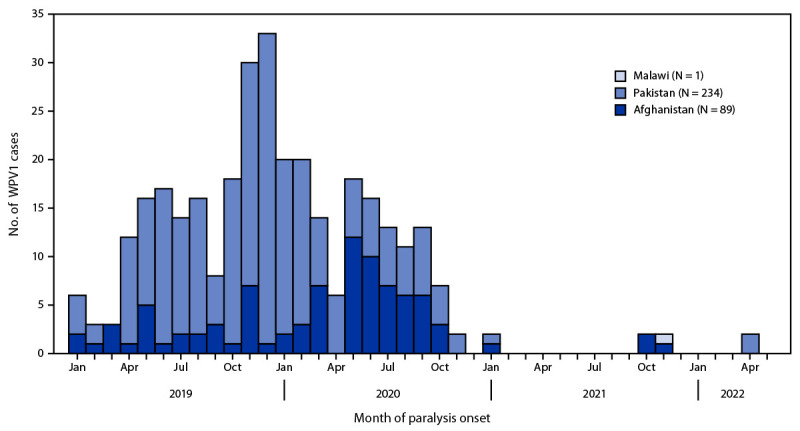
In 1988, the World Health Assembly established the Global Polio Eradication Initiative (GPEI). Since then, wild poliovirus (WPV) cases have decreased approximately 99.99%, and WPV types 2 and 3 have been declared eradicated. Only Afghanistan and Pakistan have never interrupted WPV type 1 (WPV1) transmission. This report describes global progress toward polio eradication during January 1, 2020-April 30, 2022, and updates previous reports (1,2). This activity was reviewed by CDC and was conducted consistent with applicable federal law and CDC policy.* Five WPV1 cases were reported from Afghanistan and Pakistan in 2021, compared with 140 in 2020. In 2022 (as of May 5), three WPV1 cases had been reported: one from Afghanistan and two from Pakistan. WPV1 genetically linked to virus circulating in Pakistan was identified in Malawi in a child with paralysis onset in November 2021. Circulating vaccine-derived polioviruses (cVDPVs), with neurovirulence and transmissibility similar to that of WPV, emerge in populations with low immunity following prolonged circulation of Sabin strain oral poliovirus vaccine (OPV) (3). During January 2020-April 30, 2022, a total of 1,856 paralytic cVDPV cases were reported globally: 1,113 in 2020 and 688 in 2021, including cases in Afghanistan and Pakistan. In 2022 (as of May 5), 55 cVDPV cases had been reported. Intensified programmatic actions leading to more effective outbreak responses are needed to stop cVDPV transmission. The 2022-2026 GPEI Strategic Plan objective of ending WPV1 transmission by the end of 2023 is attainable (4). However, the risk for children being paralyzed by polio remains until all polioviruses, including WPV and cVDPV, are eradicated.
Overview
CoChat Summary
TL;DR
This report updates global poliovirus eradication progress from January 2020 to April 2022, showing a sharp decline in WPV1 cases in Afghanistan and Pakistan in 2021 but continued transmission in both countries. It also documents substantial ongoing cVDPV2 activity and emphasizes that eradication progress must be sustained to prevent exportation and paralysis.
Key findings
- In 2021, only 5 WPV1 cases were reported globally, all from the two endemic countries: 4 in Afghanistan and 1 in Pakistan, compared with 140 in 2020.
- In 2022 (as of May 5), 3 WPV1 cases had been reported: 1 in Afghanistan and 2 in Pakistan.
- During January 2020–April 2022, a total of 1,856 paralytic cVDPV cases were reported globally; by serotype, 1,804 were cVDPV2, 51 were cVDPV1, and 1 was cVDPV3.
- Global cVDPV2 cases fell by 37.7% in 2021: 672 cases in 21 countries versus 1,079 cases in 24 countries in 2020.
Methods
- Descriptive global surveillance update using routine poliovirus program data from January 1, 2020–April 30, 2022.
- Data sources included AFP case-based syndromic surveillance, stool testing through the Global Polio Laboratory Network, and environmental surveillance of sewage samples.
- The report summarizes counts and proportions of cases, isolates, vaccine coverage, and surveillance indicators across countries and years; no formal inferential analysis is described.
Limitations
- The paper states that subnational AFP surveillance performance was highly variable, and that gaps often exist in poliovirus detection subnationally even when national targets are met.
- The text states that COVID-19 prevention efforts affected AFP surveillance sensitivity and routine immunization globally.
- Evident from the report format: it is a descriptive surveillance report, so it cannot by itself establish causality for the observed declines in WPV1 or cVDPV2 transmission.
Model-written summary. Check it against the paper before relying on it.
Integrity signals
Registry
Cites
Statistics
Figures
Verification
Claims the paper makes
4 Valid · 0 Not valid · 19 Not checked · 39 Own results and interpretations
Every source the paper cites for this claim was checked and supports it.
In the paper
“Among the 43 priority countries, 32 (74%) met both surveillance indicator targets nationally in 2021.”
§ Progress Toward Polio Eradication — Worldwide, January 2020–April 2022 In 1988, the World Health Assembly established the Global Polio Eradication Initiative (GPEI). Since then, wild poliovirus (WPV) cases have decreased approximately 99.99%, and WPV types 2 and 3 have been declared eradicated. Only Afghanistan and Pakistan have never interrupted WPV type 1 (WPV1) transmission. This report describes global progress toward polio eradication during January 1, 2020–April 30, 2022, and updates previous reports (1,2). This activity was reviewed by CDC and was conducted consistent with applicable federal law and CDC policy.* Five WPV1 cases were reported from Afghanistan and Pakistan in 2021, compared with 140 in 2020. In 2022 (as of May 5), three WPV1 cases had been reported: one from Afghanistan and two from Pakistan. WPV1 genetically linked to virus circulating in Pakistan was identified in Malawi in a child with paralysis onset in November 2021. Circulating vaccine-derived polioviruses (cVDPVs), with neurovirulence and transmissibility similar to that of WPV, emerge in populations with low immunity following prolonged circulation of Sabin strain oral poliovirus vaccine (OPV) (3). During January 2020–April 30, 2022, a total of 1,856 paralytic cVDPV cases were reported globally: 1,113 in 2020 and 688 in 2021, including cases in Afghanistan and Pakistan. In 2022 (as of May 5), 55 cVDPV cases had been reported. Intensified programmatic actions leading to more effective outbreak responses are needed to stop cVDPV transmission. The 2022–2026 GPEI Strategic Plan objective of ending WPV1 transmission by the end of 2023 is attainable (4). However, the risk for children being paralyzed by polio remains until all polioviruses, including WPV and cVDPV, are eradicated. > Poliovirus Surveillance
What the sources say
- Supportedcites [7] Wilkinson AL, Diop OM, Jorba J, Gardner T, Snider CJ, Ahmed J. Surveillance to track progress toward polio eradication—worldwide, 2020–2021. MMWR Morb Mortal Wkly Rep 2022; 71: 538– 44. 10.15585/mmwr.mm7115a2 35421079 PMC9020859 source
The paper’s opening summary states that it assessed 43 priority countries and that, in 2021, 32 (74%) met both surveillance performance indicator targets nationally. This directly matches the claim. (LLM, conf=0.95)
plain- Asserted: passes — The authors put it forward as true.
- Checkable: passes — It can be checked against evidence.
- Load-bearing: unclear — It is unclear whether the paper’s conclusions depend on it.
- Based: passes — The paper gives a reason why it holds.
- Supported
Every source the paper cites for this claim was checked and supports it.
In the paper
“Subnational performance was highly variable (7).”
§ Progress Toward Polio Eradication — Worldwide, January 2020–April 2022 In 1988, the World Health Assembly established the Global Polio Eradication Initiative (GPEI). Since then, wild poliovirus (WPV) cases have decreased approximately 99.99%, and WPV types 2 and 3 have been declared eradicated. Only Afghanistan and Pakistan have never interrupted WPV type 1 (WPV1) transmission. This report describes global progress toward polio eradication during January 1, 2020–April 30, 2022, and updates previous reports (1,2). This activity was reviewed by CDC and was conducted consistent with applicable federal law and CDC policy.* Five WPV1 cases were reported from Afghanistan and Pakistan in 2021, compared with 140 in 2020. In 2022 (as of May 5), three WPV1 cases had been reported: one from Afghanistan and two from Pakistan. WPV1 genetically linked to virus circulating in Pakistan was identified in Malawi in a child with paralysis onset in November 2021. Circulating vaccine-derived polioviruses (cVDPVs), with neurovirulence and transmissibility similar to that of WPV, emerge in populations with low immunity following prolonged circulation of Sabin strain oral poliovirus vaccine (OPV) (3). During January 2020–April 30, 2022, a total of 1,856 paralytic cVDPV cases were reported globally: 1,113 in 2020 and 688 in 2021, including cases in Afghanistan and Pakistan. In 2022 (as of May 5), 55 cVDPV cases had been reported. Intensified programmatic actions leading to more effective outbreak responses are needed to stop cVDPV transmission. The 2022–2026 GPEI Strategic Plan objective of ending WPV1 transmission by the end of 2023 is attainable (4). However, the risk for children being paralyzed by polio remains until all polioviruses, including WPV and cVDPV, are eradicated. > Poliovirus Surveillance
What the sources say
- Supportedcites [7] Wilkinson AL, Diop OM, Jorba J, Gardner T, Snider CJ, Ahmed J. Surveillance to track progress toward polio eradication—worldwide, 2020–2021. MMWR Morb Mortal Wkly Rep 2022; 71: 538– 44. 10.15585/mmwr.mm7115a2 35421079 PMC9020859 source
The Summary (p. 1) and 'What is added by this report?' state that 'substantial national and subnational gaps persist' despite 74% of priority countries meeting both national targets in 2021, and the Discussion (p. 5) notes 'Subnational surveillance gaps were apparent among one or more priority countries in each WHO region.' The Acute Flaccid Paralysis Surveillance section (pp. 3-4) documents the range underlying that variability: 75% of first subnational administrative level areas met both targets in AFR in 2021, most EMR countries performed well subnationally except Djibouti, Tajikistan improved significantly, while none of the subnational areas met both targets in Myanmar or Papua New Guinea and only 20.5% of the Philippine population lived in areas meeting both. 'Highly variable' is a fair paraphrase of this reported heterogeneity, within the source's scope of 43 priority countries in 2020-2021. (LLM, conf=0.85)
plain- Asserted: passes — The authors put it forward as true.
- Checkable: passes — It can be checked against evidence.
- Load-bearing: unclear — It is unclear whether the paper’s conclusions depend on it.
- Based: passes — The paper gives a reason why it holds.
- Supported
Every source the paper cites for this claim was checked and supports it.
In the paper
“Whether or not AFP surveillance performance indicator targets are met, gaps often exist in poliovirus detection subnationally.”
§ Progress Toward Polio Eradication — Worldwide, January 2020–April 2022 In 1988, the World Health Assembly established the Global Polio Eradication Initiative (GPEI). Since then, wild poliovirus (WPV) cases have decreased approximately 99.99%, and WPV types 2 and 3 have been declared eradicated. Only Afghanistan and Pakistan have never interrupted WPV type 1 (WPV1) transmission. This report describes global progress toward polio eradication during January 1, 2020–April 30, 2022, and updates previous reports (1,2). This activity was reviewed by CDC and was conducted consistent with applicable federal law and CDC policy.* Five WPV1 cases were reported from Afghanistan and Pakistan in 2021, compared with 140 in 2020. In 2022 (as of May 5), three WPV1 cases had been reported: one from Afghanistan and two from Pakistan. WPV1 genetically linked to virus circulating in Pakistan was identified in Malawi in a child with paralysis onset in November 2021. Circulating vaccine-derived polioviruses (cVDPVs), with neurovirulence and transmissibility similar to that of WPV, emerge in populations with low immunity following prolonged circulation of Sabin strain oral poliovirus vaccine (OPV) (3). During January 2020–April 30, 2022, a total of 1,856 paralytic cVDPV cases were reported globally: 1,113 in 2020 and 688 in 2021, including cases in Afghanistan and Pakistan. In 2022 (as of May 5), 55 cVDPV cases had been reported. Intensified programmatic actions leading to more effective outbreak responses are needed to stop cVDPV transmission. The 2022–2026 GPEI Strategic Plan objective of ending WPV1 transmission by the end of 2023 is attainable (4). However, the risk for children being paralyzed by polio remains until all polioviruses, including WPV and cVDPV, are eradicated. > Poliovirus Surveillance
What the sources say
- Supportedcites [7] Wilkinson AL, Diop OM, Jorba J, Gardner T, Snider CJ, Ahmed J. Surveillance to track progress toward polio eradication—worldwide, 2020–2021. MMWR Morb Mortal Wkly Rep 2022; 71: 538– 44. 10.15585/mmwr.mm7115a2 35421079 PMC9020859 source
The Summary/Introduction (p. 1) states that although 32 (74%) of 43 priority countries met both key AFP surveillance performance indicator targets nationally in 2021 (up from 53% in 2020), 'substantial national and subnational gaps persist,' and the 'What is added by this report' box repeats this. The Discussion (p. 2) adds that 'Subnational surveillance gaps were apparent among one or more priority countries in each WHO region,' and the regional results give examples where national targets were met while subnational areas were not (EMR/Djibouti, SEAR/Myanmar, WPR/Philippines). The Discussion's limitation that high NPAFP rates do not necessarily indicate highly sensitive surveillance because some actual AFP cases might go undetected, together with the stated link between surveillance performance and 'the overall sensitivity and timelines of poliovirus detection,' supports the claim's framing of these gaps as gaps in poliovirus detection. (LLM, conf=0.85)
plain- Asserted: passes — The authors put it forward as true.
- Checkable: passes — It can be checked against evidence.
- Load-bearing: passes — The paper’s conclusions depend on it.
- Based: passes — The paper gives a reason why it holds.
- Supported
The cited sources support only part of this claim — read each source’s verdict below.
In the paper
“The single case reported from Balochistan province in Pakistan in 2021 represents a 99% decrease from 84 WPV1 cases in five provinces during 2020 (8).”
§ Progress Toward Polio Eradication — Worldwide, January 2020–April 2022 In 1988, the World Health Assembly established the Global Polio Eradication Initiative (GPEI). Since then, wild poliovirus (WPV) cases have decreased approximately 99.99%, and WPV types 2 and 3 have been declared eradicated. Only Afghanistan and Pakistan have never interrupted WPV type 1 (WPV1) transmission. This report describes global progress toward polio eradication during January 1, 2020–April 30, 2022, and updates previous reports (1,2). This activity was reviewed by CDC and was conducted consistent with applicable federal law and CDC policy.* Five WPV1 cases were reported from Afghanistan and Pakistan in 2021, compared with 140 in 2020. In 2022 (as of May 5), three WPV1 cases had been reported: one from Afghanistan and two from Pakistan. WPV1 genetically linked to virus circulating in Pakistan was identified in Malawi in a child with paralysis onset in November 2021. Circulating vaccine-derived polioviruses (cVDPVs), with neurovirulence and transmissibility similar to that of WPV, emerge in populations with low immunity following prolonged circulation of Sabin strain oral poliovirus vaccine (OPV) (3). During January 2020–April 30, 2022, a total of 1,856 paralytic cVDPV cases were reported globally: 1,113 in 2020 and 688 in 2021, including cases in Afghanistan and Pakistan. In 2022 (as of May 5), 55 cVDPV cases had been reported. Intensified programmatic actions leading to more effective outbreak responses are needed to stop cVDPV transmission. The 2022–2026 GPEI Strategic Plan objective of ending WPV1 transmission by the end of 2023 is attainable (4). However, the risk for children being paralyzed by polio remains until all polioviruses, including WPV and cVDPV, are eradicated. > Reported Poliovirus Cases and Isolations
What the sources say
- Partly supportedcites [8] Sadigh KS, Akbar IE, Wadood MZ, Progress toward poliomyelitis eradication—Afghanistan, January 2020–November 2021. MMWR Morb Mortal Wkly Rep 2022; 71: 85– 9. 10.15585/mmwr.mm7103a3 35051135 PMC8774155 sourceExperimental — accuracy not yet measured
Split into 2 atoms — 0 confirmed, 2 partially supported, 0 disputed, 0 misattributed, 0 unverifiable. Expand the claim to see per-atom verdicts.
plainn = 84- Asserted: passes — The authors put it forward as true.
- Checkable: passes — It can be checked against evidence.
- Load-bearing: unclear — It is unclear whether the paper’s conclusions depend on it.
- Based: passes — The paper gives a reason why it holds.
- Partly supported
None of the sources cited for this claim have been checked yet.
In the paper
“In November 2020, the World Health Organization (WHO) granted Emergency Use Listing** for novel OPV2 (nOPV2), designed to be more genetically stable than the Sabin strain and less likely to revert to neurovirulence (6).”
§ Progress Toward Polio Eradication — Worldwide, January 2020–April 2022 In 1988, the World Health Assembly established the Global Polio Eradication Initiative (GPEI). Since then, wild poliovirus (WPV) cases have decreased approximately 99.99%, and WPV types 2 and 3 have been declared eradicated. Only Afghanistan and Pakistan have never interrupted WPV type 1 (WPV1) transmission. This report describes global progress toward polio eradication during January 1, 2020–April 30, 2022, and updates previous reports (1,2). This activity was reviewed by CDC and was conducted consistent with applicable federal law and CDC policy.* Five WPV1 cases were reported from Afghanistan and Pakistan in 2021, compared with 140 in 2020. In 2022 (as of May 5), three WPV1 cases had been reported: one from Afghanistan and two from Pakistan. WPV1 genetically linked to virus circulating in Pakistan was identified in Malawi in a child with paralysis onset in November 2021. Circulating vaccine-derived polioviruses (cVDPVs), with neurovirulence and transmissibility similar to that of WPV, emerge in populations with low immunity following prolonged circulation of Sabin strain oral poliovirus vaccine (OPV) (3). During January 2020–April 30, 2022, a total of 1,856 paralytic cVDPV cases were reported globally: 1,113 in 2020 and 688 in 2021, including cases in Afghanistan and Pakistan. In 2022 (as of May 5), 55 cVDPV cases had been reported. Intensified programmatic actions leading to more effective outbreak responses are needed to stop cVDPV transmission. The 2022–2026 GPEI Strategic Plan objective of ending WPV1 transmission by the end of 2023 is attainable (4). However, the risk for children being paralyzed by polio remains until all polioviruses, including WPV and cVDPV, are eradicated. > Poliovirus Vaccination
plain- Asserted: passes — The authors put it forward as true.
- Checkable: passes — It can be checked against evidence.
- Load-bearing: unclear — It is unclear whether the paper’s conclusions depend on it.
- Based: passes — The paper gives a reason why it holds.
38 more claims
Create a free account to see all 62 claims and to verify the 22 references still open.
- It may state two separate claims as one. 14
- Probably not a substantial claim. 5
Claims other papers make about this one
Each is checked against this paper’s own text: does it say what the citing paper says it does?
The source backs part of the claim, not all of it — or backs it for a different population, condition or comparison.
In the citing paper
“As a result of its efforts, progress has been impressive: the number of paralytic polio cases worldwide has been reduced by more than 99%, and the number of countries where the disease is endemic has fallen dramatically [59].”
From The Fight against Poliovirus Is Not Over (2023) · cites this paper as [59]
Experimental — accuracy not yet measuredThe cited source says what the claim attributes to it.
In the citing paper
“In 2021, five cases of WPV1 were reported in these two countries, which represents a significant decrease compared to the previous year.”
From The Fight against Poliovirus Is Not Over (2023) · cites this paper as [59]
Citations
Cites
Global polio eradication initiative
Koenig‐Archibugi, M. (2011) · London School of Economics and Political Science Research Online (London School of Economics and Political Science) · Cited by 523
Progress toward polio eradication—worldwide, January 2018–March 2020.
Chard, A. N., Datta, S. D., Tallis, G., Burns, C. C., Wassilak, S. G. F., Vertefeuille, J. F., & Zaffran, M. (2020) · MMWR. Morbidity and Mortality Weekly Report · doi:10.15585/mmwr.mm6925a4 · Cited by 83
Self-citationProgress toward polio eradication—worldwide, January 2019–June 2021.
Bigouette, J. P., Wilkinson, A. L., Tallis, G., Burns, C. C., Wassilak, S. G. F., & Vertefeuille, J. F. (2021) · MMWR. Morbidity and Mortality Weekly Report · doi:10.15585/mmwr.mm7034a1 · Cited by 62
Self-citationUpdate on Vaccine-Derived Poliovirus Outbreaks — Worldwide, January 2020–June 2021
Alleman, M. M., Jorba, J., Henderson, E., Diop, O. M., Shaukat, S., Traoré, M. A., Wiesen, E., Wassilak, S. G. F., & Burns, C. C. (2021) · MMWR. Morbidity and Mortality Weekly Report · doi:10.15585/mmwr.mm7049a1 · Cited by 62
Self-citationSurveillance to Track Progress Toward Polio Eradication — Worldwide, 2017–2018
Patel, J. C., Diop, O. M., Gardner, T., Chavan, S., Jorba, J., Wassilak, S. G. F., Ahmed, J., & Snider, C. J. (2019) · MMWR. Morbidity and Mortality Weekly Report · doi:10.15585/mmwr.mm6813a4 · Cited by 48
Self-citationSurveillance to track progress toward polio eradication—worldwide, 2020–2021.
Wilkinson, A. L., Diop, O. M., Jorba, J., Gardner, T., Snider, C. J., & Ahmed, J. (2022) · MMWR Morbidity and Mortality Weekly Report · doi:10.15585/mmwr.mm7115a2 · Cited by 30
Self-citationProgress toward poliomyelitis eradication—Afghanistan, January 2020–November 2021.
Sadigh, K. S., Akbar, I. E., Wadood, M. Z., Shukla, H., Jorba, J., Chaudhury, S., & Martinez, M. (2022) · MMWR. Morbidity and Mortality Weekly Report · doi:10.15585/mmwr.mm7103a3 · Cited by 21
Self-citation
Cited by
Progress Toward Poliomyelitis Eradication — Worldwide, January 2021–March 2023
Lee, S. E., Greene, S. A., Burns, C. C., Tallis, G. F., Wassilak, S. G. F., & Bolu, O. O. (2023) · MMWR Morbidity and Mortality Weekly Report · doi:10.15585/mmwr.mm7219a3 · Cited by 72
“This report summarizes progress toward global polio eradication during January 1, 2021–March 31, 2023, and updates previous reports (1,2).”
BackgroundInfluentialSelf-citationOpportunities and challenges for T cell-based influenza vaccines
Mosmann, T. R., McMichael, A. J., LeVert, A., McCauley, J. W., & Almond, J. W. (2024) · Nature reviews. Immunology · doi:10.1038/s41577-024-01030-8 · Cited by 57
“…the polio, measles, rubella, mumps and hepa titis A vaccines, can also be far more effective than those against influenza, and even provide the basis for future eradication of polio 41 , rubella and measles 42,43 (Measles & Rubella Partnership, WHO: Measles, Polio Global Eradication Initiative).”
Update on Vaccine-Derived Poliovirus Outbreaks — Worldwide, January 2021–December 2022
Bigouette, J. P., Henderson, E., Traore, M. A., Wassilak, S. G. F., Jorba, J. C., Mahoney, F. J., Bolu, O. O., Diop, O. M., & Burns, C. C. (2023) · MMWR Morbidity and Mortality Weekly Report · doi:10.15585/mmwr.mm7214a3 · Cited by 59
Self-citationPoliomyelitis is a current challenge: long-term sequelae and circulating vaccine-derived poliovirus
Quarleri, J. F. (2022) · GeroScience · doi:10.1007/s11357-022-00672-7 · Cited by 46
Progress Toward Poliomyelitis Eradication — Worldwide, January 2022–December 2023
Geiger, K., Stehling-Ariza, T., Bigouette, J. P., Bennett, S. D., Burns, C. C., Quddus, A., Wassilak, S. G. F., & Bolu, O. O. (2024) · MMWR Morbidity and Mortality Weekly Report · doi:10.15585/mmwr.mm7319a4 · Cited by 44
“This report summarizes the status of polio eradication during January 1, 2022–December 31, 2023, and updates previous reports ( 1 , 6 ).”
BackgroundSelf-citationZuckerman, N. S., Bar-Or, I., Sofer, D., Bucris, E. D., Morad, H., Shulman, L. M., Levi, N., Weiss, L., Aguvaev, I., Cohen, Z. R., et al. (2022) · Eurosurveillance · doi:10.2807/1560-7917.es.2022.27.37.2200694 · Cited by 43
“During 2022, a new challenge in the World Health Organization (WHO) poliovirus eradication programme includes controlling PV2 events not only in low-income countries [12] but also in countries with high vaccination coverage such as the US (New York), the United Kingdom and Israel [13].”
BackgroundMolecular mechanisms of secretory autophagy and its potential role in diseases
Li, Q., Peng, G., Liu, H., Wang, L., Lu, R., & Li, L. (2024) · Life Sciences · doi:10.1016/j.lfs.2024.122653 · Cited by 38
The Fight against Poliovirus Is Not Over
Mbani, C. J., Nekoua, M. P., Moukassa, D., & Hober, D. (2023) · Microorganisms · doi:10.3390/microorganisms11051323 · Cited by 34
“To date, among the three serotypes of WPV, only WPV1 remains endemic in two countries in the world, Pakistan and Afghanistan [5].”
BackgroundInfluentialProgress Toward Poliomyelitis Eradication — Pakistan, January 2021–July 2022
Mbaeyi, C., Baig, S., Safdar, M. R., Khan, Z. A., Young, H., Jorba, J. C., Wadood, M. Z., Jafari, H. S., Alam, M. M., & Franka, R. (2022) · MMWR Morbidity and Mortality Weekly Report · doi:10.15585/mmwr.mm7142a1 · Cited by 31
Self-citationWilkinson, A. L., Zaman, K., Hoque, M., Estívariz, C. F., Burns, C. C., Konopka‐Anstadt, J. L., Mainou, B. A., Kovacs, S., An, Q., Lickness, J. S., et al. (2023) · The Lancet Infectious Diseases · doi:10.1016/s1473-3099(23)00139-1 · Cited by 29
Self-citationPolio vaccination activities in conflict-affected areas
Mbaeyi, C. (2023) · Human Vaccines & Immunotherapeutics · doi:10.1080/21645515.2023.2237390 · Cited by 28
“Only two countries (Afghanistan and Pakistan) remain endemic for transmission of wild poliovirus (WPV) type 1, the only wild poliovirus serotype still in circulation.(15,18)”
BackgroundProgress Toward Poliomyelitis Eradication — Pakistan, January 2022–June 2023
Mbaeyi, C., Baig, S., Safdar, R. M., Khan, Z. A., Young, H., Jorba, J. C., Wadood, M. Z., Jafari, H. S., Alam, M. M., & Franka, R. (2023) · MMWR Morbidity and Mortality Weekly Report · doi:10.15585/mmwr.mm7233a1 · Cited by 27
“Introduction Endemic transmission of indigenous wild poliovirus (WPV) type 1 (WPV1) has never been interrupted in Pakistan, which, along with Afghanistan, is one of two remaining countries where WPV1 remains endemic (1,2).”
BackgroundSelf-citationHistória da poliomielite: da eliminação ao risco de reintrodução
Santos, M. E. S., Rodrigues, J. A., & de Araújo, T. A. (2023) · Research Society and Development · doi:10.33448/rsd-v12i1.39118 · Cited by 23
Surveillance To Track Progress Toward Poliomyelitis Eradication — Worldwide, 2021–2022
Stehling-Ariza, T., Wilkinson, A. L., Diop, O. M., Jorba, J. C., Asghar, H., Avagnan, T., Grabovac, V., Johnson, T. M., Joshi, S., Kfutwah, A. K. W., et al. (2023) · MMWR Morbidity and Mortality Weekly Report · doi:10.15585/mmwr.mm7223a1 · Cited by 22
“Priority countries by region in 2022 included the following: African Region (24): Angola, Benin, Burkina Faso, Cameroon, Central African Republic, Chad, Côte d’Ivoire, Democratic Republic of the Congo, Equatorial Guinea, Ethiopia, Guinea, Guinea-Bissau, Kenya, Madagascar, Malawi, Mali, Mozambique, Niger, Nigeria, Sout…”
BackgroundInfluentialSelf-citationProgress Toward Poliomyelitis Eradication ― Afghanistan, January 2021–September 2022
Mohamed, A., Akbar, I. E., Chaudhury, S., Wadood, M. Z., Ather, F., Jorba, J. C., & Martinez, M. (2022) · MMWR Morbidity and Mortality Weekly Report · doi:10.15585/mmwr.mm7149a1 · Cited by 22
Self-citationProgress Toward Poliomyelitis Eradication — Afghanistan, January 2022–June 2023
Bjork, A., Akbar, I. E., Chaudhury, S., Wadood, M. Z., Ather, F., Jorba, J. C., & Martinez, M. (2023) · MMWR Morbidity and Mortality Weekly Report · doi:10.15585/mmwr.mm7238a1 · Cited by 24
Self-citationBigouette, J. P., Callaghan, A. W., Donadel, M., Porter, A. M., Rosencrans, L., Lickness, J. S., Blough, S., Li, X., Perry, R. T., Williams, A. J., et al. (2022) · Emerging infectious diseases · doi:10.3201/eid2813.220088 · Cited by 15
“Although AFP surveillance for poliovirus may have been adversely affected in many countries by the pandemic, it is notable that AFP surveillance systems were still able to identify circulating vaccine-derived and wild poliovirus in the African Region (11).”
BackgroundZuckerman, N. S., Bucris, E. D., Eliyahu, H., Weiss, L., Vasserman, R., Fratty, I. S., Aguvaev, I., Cohen-Said, Z., Matar, R., Erster, O., et al. (2024) · The Lancet Microbe · doi:10.1016/s2666-5247(24)00116-2 · Cited by 19
Health economic analysis of vaccine options for the polio eradication endgame: 2022-2036
Thompson, K. M., Kalkowska, D. A., & Badizadegan, K. (2022) · Expert Review of Vaccines · doi:10.1080/14760584.2022.2128108 · Cited by 13
Gwinji, P. T., Musuka, G., Murewanhema, G., Moyo, P. N., Moyo, E., & Dzinamarira, T. (2022) · IJID Regions · doi:10.1016/j.ijregi.2022.11.001 · Cited by 12
Dodoo, C. C., Hanson-Yamoah, E., Adedia, D., Erzuah, I., Yamoah, P., Brobbey, F. S., Cobbold, C. C., & Mensah, J. A. (2024) · Vaccine X · doi:10.1016/j.jvacx.2024.100466 · Cited by 13
“Even with the wide-spread coverage of vaccines, limited epidemics of vaccine-preventable diseases such as mumps and polio have been reported in several countries around the world [31,35].”
BackgroundWorst‐case scenarios: Modeling uncontrolled type 2 polio transmission
Kalkowska, D. A., Wiesen, E., Wassilak, S. G. F., Burns, C. C., Pallansch, M. A., Badizadegan, K., & Thompson, K. M. (2023) · Risk Analysis · doi:10.1111/risa.14159 · Cited by 10
“With more than 500 million nOPV2 doses deployed to date (Rachlin et al., 2022), the data on the performance of nOPV2 in the field (e.g., effectiveness, potential to revert) remain preliminary (Martin et al., 2022) and the vaccine is yet to receive a full license.”
BackgroundSelf-citationComprehensive profiling of neutralizing polyclonal sera targeting coxsackievirus B3
Álvarez‐Rodríguez, B., Buceta, J., & Geller, R. (2023) · Nature Communications · doi:10.1038/s41467-023-42144-2 · Cited by 10
“See capsid_roadmaps for capsid roadmaps labeled by residue and dms_view for interactive visualization on GitHub 23 . and confers protection from reinfection 19,20,31 .”
Endemic, epidemic and pandemic infections: the roles of natural and acquired herd immunity
Stevens, D. L., & Bryant, A. E. (2023) · Current Opinion in Infectious Diseases · doi:10.1097/qco.0000000000000916 · Cited by 9
“uary 2020 through 30 April 2022 a total of 1856 cases of cVDPV-attributable polio were reported globally [11].”
BackgroundInfluentialRodríguez, R., Juárez, E., Estívariz, C. F., Cajas, C., Rey-Benito, G. J., Amezquita, M., Miles, S. J., Orantes, O., Freire, M. C., Chévez, A. E., et al. (2023) · Emerging infectious diseases · doi:10.3201/eid2908.230236 · Cited by 8
“Since the OBRA evaluation, declining polio vaccination coverage during the COVID-19 pandemic (7,23,24) has built a pool of susceptible children representing a risk for polio reemergence (25,26).”
BackgroundTracking down the recent surge of polio virus in endemic and outbreak countries
Malik, S., & Waheed, Y. (2022) · Journal of Medical Virology · doi:10.1002/jmv.28265 · Cited by 6
“Resultantly, the incidence rates of paralytic cases caused by cVDPV2 are increasing especially in Africa and Asia.9 Thus to deal with the sustaining trends of polio cases, GPEI is continuously tracking changes and adjustment channels to cope with the needs of emerging cases.”
BackgroundInfluentialBurnett, E., Riaz, A., Anwari, P., Myat, T. W., Chavers, T., Talat, N., Safi, N., Aung, N. N. T., Cortese, M. M., Sultana, S., et al. (2023) · Vaccine · doi:10.1016/j.vaccine.2023.10.042 · Cited by 6
Raharinantoanina, J., Joffret, M., Bessaud, M., Rakoto, D. A. D., Dussart, P., Lacoste, V., & Razafindratsimandresy, R. (2024) · Virology · doi:10.1016/j.virol.2024.110253 · Cited by 5
Threat of resurgence or hope for global eradication of poliovirus?
Kim, C. Y., Piamonte, B. L. C., Allen, R., & Thakur, K. T. (2023) · Current Opinion in Neurology · doi:10.1097/wco.0000000000001156 · Cited by 5
Navigating the route to polio eradication in the WHO AFRO region
Chia, J. E., Faye, M., Jermaine, K., Tesfaye, B., Ndoutabé, M., Ahmed, J., & Kfutwah, A. K. W. (2024) · The Lancet · doi:10.1016/s0140-6736(24)02148-2 · Cited by 5
Lemrabet, S., Qazoui, M. E., Azzouzi, L. M. I., Rguig, A., Elhamdaoui, M., Filali‐Maltouf, A., Medraoui, L., & Oumzil, H. (2022) · Advances in Public Health · doi:10.1155/2022/2729937 · Cited by 5
“Transmission of WPV type 1 (WPV1) is still uninterrupted only in Afghanistan and Pakistan [3].”
BackgroundNwachukwu, B., Alatishe-Muhammad, B., Ibizugbe, S., Alake, D., & Bolarinwa, O. A. (2023) · Nigerian Journal of Clinical Practice · doi:10.4103/njcp.njcp_652_22 · Cited by 4
The resurgence of polio: The effect of the Covid-19 pandemic on polio eradication
Niaz, F., Tariq, S., Rana, M. S., Nashwan, A. J., Fatima, I., Afzal, Y., & Tariq, R. (2022) · Ethics Medicine and Public Health · doi:10.1016/j.jemep.2022.100858 · Cited by 4
“[3] Rachlin A, Patel JC, Burns CC, Jorba J, Tallis G, O’Leary A, et al.”
BackgroundInfluentialShould more attention be paid to polio sequela cases in China?
Zang, J., Feng, L., Wang, J., Wang, X., Li, K., & Zhai, X. (2023) · Frontiers in Public Health · doi:10.3389/fpubh.2022.1076970 · Cited by 4
“As new cases occur in Pakistan (18) Afghanistan (19) and New York (20) there are many reports issued by those who pay attention to and promote the Global Polio Eradication Initiative (21).”
BackgroundHalting vaccine-derived poliovirus circulation: the novel type 2 oral vaccine might not be enough
Nyenswah, T., & Schue, J. L. (2023) · The Lancet Global Health · doi:10.1016/s2214-109x(23)00161-4 · Cited by 4
Wong, W., Gauld, J., & Famulare, M. (2023) · Virus Evolution · doi:10.1093/ve/vead044 · Cited by 5
Poliomielitis y síndrome pospoliomielítico en Argentina
Centurión, E., Jiménez, Y. D. V., Cataldo, M. G., Fabre, C., Torres, S., Robles, G., Cecilia, F., Rey, R., & Bendersky, M. (2024) · Neurología Argentina · doi:10.1016/j.neuarg.2024.04.002 · Cited by 3
Xu, N., Shen, Y., Huang, W., & Nie, J. (2025) · Viruses · doi:10.3390/v17020171 · Cited by 3
“However, endemic transmission has still occurred in Pakistan, Afghanistan and Mozambique from 2022 onwards [8,9].”
Scaling Biosafety Up During and Down After the COVID-19 Pandemic
Dittmer, D. P., Eason, A. B., & Juarez, A. (2022) · Applied Biosafety · doi:10.1089/apb.2022.0008 · Cited by 4
“14 Poliovirus is a special case as vaccination was initially dependent on a live replication-competent vaccine.”
Sharma, A. K., Verma, H., Estívariz, C. F., Bajracharaya, L., Rai, G., Shah, G., Sherchand, J. B., Jones, K. A. V., Mainou, B. A., Chavan, S. S., et al. (2023) · The Lancet Microbe · doi:10.1016/s2666-5247(23)00215-x · Cited by 4
Travel-Associated Infections and Diseases
Halsey, E. S. (2025) · Oxford University Press eBooks · doi:10.1093/oso/9780197788547.003.0004 · Cited by 3
Liu, Y., Liu, X., Zhang, L., Chang, X., Xiong, P., Guan, Y., Li, Y., Zhang, W., Xuan, L., Li, Y., et al. (2025) · Vaccines · doi:10.3390/vaccines13111094 · Cited by 2
“Since the launch of the initiative, the incidence of wild poliovirus has decreased by over 99%, from an estimated 350,000 cases in more than 125 endemic countries to only five reported cases in 2021 [3,4].”
Nwachukwu, B., Alatishe-Muhammad, B., Ibizugbe, S., Alake, I., & Bolarinwa, O. A. (2023) · Nigerian Journal of Clinical Practice · doi:10.4103/njcp.njcp_640_22 · Cited by 2
Agimas, M. C., Belew, A. K., Muhammad, E. A., Tesfie, T. K., Azmeraw, M., Abate, B. B., & Kassaw, A. (2024) · BMJ Open · doi:10.1136/bmjopen-2023-083648 · Cited by 2
“But globally, it was targeted to achieve 85% 28 to uptake the dual-protective polio vaccine.”
Estívariz, C. F., Burns, C. C., & Macklin, G. (2023) · Elsevier eBooks · doi:10.1016/b978-0-323-79058-1.00050-5 · Cited by 7
Self-citationHuang, T., Wu, C., Ying, Z., Zhang, Z., Li, Q., Lu, W., Yu, G., Hao, P., Liu, S., Guo, H., et al. (2026) · Scandinavian Journal of Immunology · doi:10.1111/sji.70097 · Cited by 1
“Currently, only WPV1 remains endemic in Pakistan and Afghanistan [8].”
Gemechu, H., Biru, G., Gebremeskel, E., Teshome, F., Nemomssa, H. D., Dese, K., Wakjira, E., Tefera, M., Alayu, M., Ayana, G., et al. (2026) · Virology · doi:10.1016/j.virol.2026.110863 · Cited by 2
Chen, L., Qiu, Q., Zhu, Q., Li, J., Xie, X., Shao, X., Liang, J., Zhang, W. Y., Zheng, H., Li, B., et al. (2024) · Human Vaccines & Immunotherapeutics · doi:10.1080/21645515.2023.2300156 · Cited by 1
Bartlett, A. H., & Ross, L. F. (2022) · The Journal of Pediatrics · doi:10.1016/j.jpeds.2022.06.035
From Polio to Covid-19: Anti-Vaccine Misinformation and Rumors in Pakistan
Ullah, Z., Khan, S. S., & Shah, S. F. A. (2023) · Springer eBooks · doi:10.1007/978-3-031-24490-2_8
Population Medicine and Health Economics
(2024) · Frontiers research topics · doi:10.3389/978-2-8325-5520-0
Polio outbreaks in the post-COVID-19 pandemic era: causes and solutions
Alijanzadeh, D., Karimi, H., Masoumi, N., Kazemzadeh, K., Samieefar, N., & Mesdaghi, M. (2024) · Pathogens and Global Health · doi:10.1080/20477724.2024.2439740 · Cited by 1
“The Global Polio Eradication Initiative, a resolution adopted by the World Health Assembly since 1988, has led to the eradication of WPV2 and WPV3 and a 99.99% decrease in cases [90].”
InfluentialEpidemiological Profile of Acute Flaccid Paralysis in the Lomami Province from 2018 to 2022
Bosalo, R. I., Sambu, M. N., Losangola, G. B., Bosungi, S. I., Gakumu, D. N., Gambolipay, C. Z., Mazembe, D. E., Kasaï, E. T., & Likwela, J. L. (2025) · Voice of the Publisher · doi:10.4236/vp.2025.112018
Zarzeczny, A., Kahar, P., & Weiss, V. (2025) · Ethics Medicine and Public Health · doi:10.1016/j.jemep.2025.101152
Poliovirus in London sewage – what you need to know
Stamataki, Z. (2022) · The Conversation · doi:10.64628/ab.wjnhvgqrj
Polioviren in Deutschland – Stand der Eradikationsbemühungen und jüngstes Auftreten im Abwasser
Zacharias, N., Böttcher, S., & Mutters, N. T. (2025) · Infektiologie up2date · doi:10.1055/a-2728-0884
“…existiert noch ein weiterer Impfsto ff , das orale Poliovakzin (OPV), für dessen Herstellung attenuierte und replikationsfähige Viren eingesetzt werden Dieser Impf-sto ff wird noch in weiten Teilen der Welt verwendet, hat aber im Vergleich zum IPV die Eigenschaft, dass diese Impfviren von…”
Polioviren in Deutschland – Stand der Eradikationsbemühungen und jüngstes Auftreten im Abwasser
Zacharias, N., Böttcher, S., & Mutters, N. T. (2025) · Krankenhaushygiene up2date · doi:10.1055/a-2565-6329
Αναζήτηση του ιού της Πολιομυελίτιδας σε λύματα από αστικές περιοχές και δομές φιλοξενίας προσφύγων
Kola, K. (2023) · University of Thessaly Institutional Repository (University of Thessaly) · doi:10.26253/heal.uth.39221
Vaccine Utilisation in the Prevention of Viral Diseases in Africa
Hassnain, M., Subhan, A., Beig, M. M., Akram, W., Ahmad, F., Mushtaq, S., & Ahmad, W. (2025) · Springer eBooks · doi:10.1007/978-3-032-09613-5_6
To vaccinate your child, not always an obvious choice : A systematic literature review
Lindh, C., & Sara, T. (2023) · Digitala vetenskapliga arkivet (Diva) (Karlstad University)
Abdullahi, W. H., Anfumbom, K. W. K., Johnson, M. T., Jimoh, A., Ibrahim, I. I., Silemane, O., Jean, C. K.-O., Idah, N., Egbonoumi, F. M. G. E. D., Chia, J. E., et al. (2025) · African Journal of Environmental Science and Technology · doi:10.5897/ajest2025.3438
A formal approach towards IoT-enabled mechanism for digital polio system using Colured Petri Net
Ahmad, S., Ahmed, A., Alturki, N. M., Hussain, S., & Abdullah, S. (2026) · Egyptian Informatics Journal · doi:10.1016/j.eij.2026.100894 · Cited by 1
Prevention of Enterovirus Infection and New Treatment Methods
Žiaugaitė, A. (2024) · Lithuanian University of Health Sciences
Hussain, M., Hassan, M., Athar, M., Khan, S., Azam, D. M. T., Rathi, D., & Nawaz, J. (2026) · Vaccine · doi:10.1016/j.vaccine.2026.128643
Development of a new RT-PCR multiplex assay for poliovirus detection
Kreibich, J., Beyer, S., Fuchs, J., Kallies, R., Selinka, H., Walther, B., Diedrich, S., & Böttcher, S. (2026) · International Journal of Medical Microbiology · doi:10.1016/j.ijmm.2026.151743
Metadata
- Authors
- Rachlin, A., Patel, J. C., Burns, C. C., Jorba, J., Tallis, G., O’Leary, A., Wassilak, S. G. F., & Vertefeuille, J. F.
- Affiliations
- National Center for Immunization and Respiratory Diseases (US)
- Corresponding author
- Rachlin, Audrey
- ORCID
- Venue
- MMWR Morbidity and Mortality Weekly Report
- Published
- 2022-05-13
- Volume
- 71
- Issue
- 19
- Pages
- 650-655
- ISSN
- 0149-2195 (ISSN-L)
- 1545-861X
- PMC
- PMC9098249
- OpenAlex
- W4280493380
- Cited by
- 61
- References
- 7
- Citations by year
- 2026: 5 · 2025: 9 · 2024: 11 · 2023: 23 · 2022: 13
- FWCI
- 9.75
- Type
- journal article
- Language
- en
- Open access
- diamond
- doi.org
- Locations
- MMWR Morbidity and Mortality Weekly Report (publishedVersion)
- PubMed Central (publishedVersion, public-domain)
- PubMed (publishedVersion)
- Funders
- World Health Organization
- Centers for Disease Control and Prevention
- National Center for Immunization and Respiratory Diseases
- Topics
- Health Sciences › Medicine › Infectious Diseases › Viral Infections and Immunology Research
- Social Sciences › Health › Vaccine Coverage and Hesitancy
- Health Sciences › Medicine › Epidemiology › Virology and Viral Diseases
- Keywords
- polio eradication, wild poliovirus type 1, circulating vaccine-derived poliovirus, oral polio vaccine, Global Polio Eradication Initiative, Afghanistan, Pakistan, Malawi, paralysis, vaccination coverage
- MeSH terms
- Child, Humans, Poliomyelitis, Poliovirus Vaccine, Oral, Population Surveillance, Immunization Programs, Poliovirus, Disease Eradication
About these checks
Registry, retraction, Cites and statistics results are computed, not judged, with one exception: a printed reference that no index lists is read once by a model before it counts as a citation error. Claims are extracted by a model and kept only when their quote appears verbatim in the text; each cited source is then checked, with a model’s help, for whether it says what the claim relies on. Those verdicts can be wrong — read the claim’s quote and the cited source before relying on one.
The claim verdicts this report counts are experimental: their accuracy is not yet measured.
A language model drew the claims from the paper on 2026-10-11, under version 3 of the claim definition (model deepseek-v4.1-flash, prompt extract-v3).
A second model labelled each claim on 2026-10-11 (model jev-1.13-20260917, definition revision gold-guideline-v0.2).
Cited sources are checked with a language model’s help (gpt-6-sol and qwen3.8-omni-flash).
Statistics and arithmetic are recomputed, not judged.
Confidence bands are shown only for fields calibrated on our annotated test set. None is calibrated yet, so no band is shown.
What counts as a claim ›How we measure confidence ›How we check this ›
Are you an author, or do you see a problem with this page? Request a review
Data sources
Bibliographic data: Semantic Scholar, OpenAlex, Crossref.
Contains information from the Semantic Scholar Academic Graph Datasets, made available under the ODC Attribution License (ODC-BY 1.0).
Semantic Scholar’s data is described in: Kinney, R., et al. (2023). The Semantic Scholar Open Data Platform. arXiv:2301.10140.
