

The DOI matches its Crossref record; 8 of the 8 references it cites were found in a registry or an index.
Coverage with selected vaccines and exemption rates among children in kindergarten—United States, 2023–24 school year
Open accessAbstract
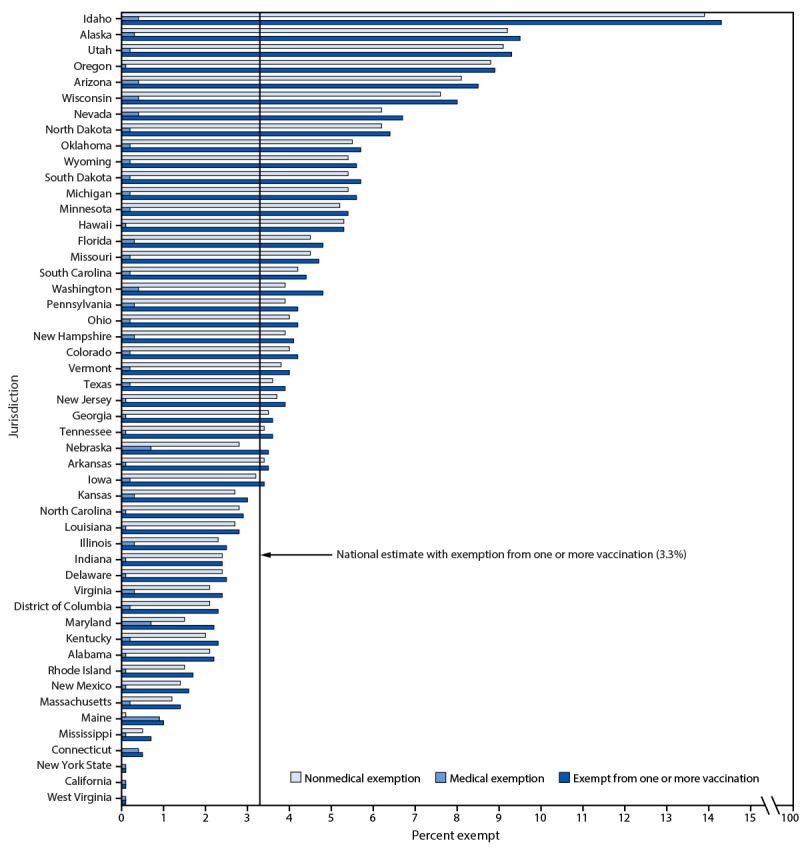
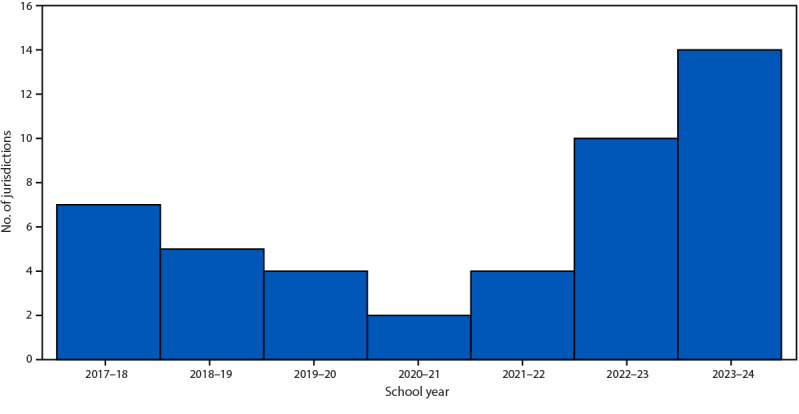
In the United States, states and local jurisdictions set vaccination requirements for school attendance, conditions and procedures for exemptions from these requirements, grace periods for submitting documentation, and provisional enrollment for students who need more time to be vaccinated.States annually report data to CDC on the number of children in kindergarten who meet, are exempt from, or are in the process of meeting requirements.Data reported by 49 states and the District of Columbia (DC) for the 2023-24 school year were used for national-and state-level estimates of the following measures: complete vaccination with required doses of measles, mumps, and rubella vaccine (MMR), diphtheria, tetanus, and acellular pertussis vaccine (DTaP), poliovirus vaccine (polio), and varicella vaccine (VAR); exemptions from vaccination; and school attendance while meeting requirements.The 2023-24 kindergarten class became age-eligible to complete most staterequired vaccinations during the COVID-19 pandemic, after schools had returned to routine in-person learning.Compared with approximated national coverage levels across all reported vaccines for the 2019-20 (95%) and 2022-23 (93%) school years, coverage dropped below 93% for the 2023-24 school year, ranging from 92.3% for DTaP to 92.7% for MMR.Exemptions increased to 3.3%, compared with those during the 2022-23 (3.0%) and 2021-22 school years (2.6%).Coverage with MMR, DTaP, polio, and VAR decreased in 35, 32, 33, and 36 jurisdictions, respectively, compared with the 2022-23 school year.Exemptions increased in 41 jurisdictions, with 14 reporting that >5% of kindergartners had an exemption from one or more vaccine.Efforts by health departments, schools, and providers are needed to ensure that students begin school fully vaccinated.* Jurisdictions reported coverage with all doses of MMR required by the jurisdiction.All states except Wyoming require 2 doses of a measles-containing vaccine.Seven states (Alaska, Georgia, New Jersey, New York, North Carolina, Oregon, and Virginia) require only 1 dose of rubella vaccine.Alaska, New Jersey, and Oregon require only 1 dose of mumps vaccine; mumps vaccine is not required in Iowa.Wyoming requires 1 dose of MMR for kindergarten entry, allowing students until the day before their seventh birthday to receive their second dose.pertussis vaccine (DTaP) † ; poliovirus vaccine (polio) § ; and varicella vaccine (VAR) ¶ declined to approximately 93% over the 2020-21 and 2021-22 school years and remained essentially unchanged during the 2022-23 school year (2).These declines persisted after impacts of the COVID-19 pandemic diminished.This analysis summarizes state and local immunization program** data on vaccination coverage and exemptions from vaccination among kindergartners as reported to CDC by 49 states † † and the District of Columbia (DC), and provisional enrollment or grace period status for kindergartners reported by 31 states § § for the 2023-24 school year.
Overview
The claims and statistics of this paper haven’t been checked yet.
Free: it reads the open-access text and checks the first 5 claims that cite a source we can check. Create a free account to check every claim.
Integrity signals
Registry
Cites
Statistics
Figures
Verification
Claims the paper makes
The claims and statistics of this paper haven’t been checked yet.
Free: it reads the open-access text and checks the first 5 claims that cite a source we can check. Create a free account to check every claim.
Self-check
Percentages, sums and reported differences re-computed from the paper’s own numbers.
The self-check needs the paper’s full text.
Citations
Cites
Vaccine Refusal, Mandatory Immunization, and the Risks of Vaccine-Preventable Diseases
Omer, S. B., Salmon, D. A., Orenstein, W. A., deHart, M. P., & Halsey, N. (2009) · New England Journal of Medicine · doi:10.1056/nejmsa0806477 · Cited by 997
The guide to community preventive services
Kleinman, D. V. (2002) · American Journal of Preventive Medicine · doi:10.1016/s0749-3797(02)00436-1 · Cited by 442
Consequences of Undervaccination — Measles Outbreak, New York City, 2018–2019
Zucker, J. R., Rosen, J. B., Iwamoto, M., Arciuolo, R. J., Langdon-Embry, M., Vora, N. M., Rakeman, J. L., Isaac, B. M., Jean, A., Asfaw, M., et al. (2020) · New England Journal of Medicine · doi:10.1056/nejmoa1912514 · Cited by 164
Blank, N. R., Caplan, A. L., & Constable, C. (2013) · Health Affairs · doi:10.1377/hlthaff.2013.0239 · Cited by 108
Salmon, D. A., Omer, S. B., Moulton, L. H., Stokley, S. K., deHart, M. P., Lett, S. M., Norman, B. A., Teret, S. P., & Halsey, N. A. (2005) · American Journal of Public Health · doi:10.2105/ajph.2004.046201 · Cited by 73
Poliovirus Infections in Four Unvaccinated Children--Minnesota, August-October 2005
(2005) · JAMA · doi:10.1001/jama.294.21.2689 · Cited by 61
Varicella Outbreak Surveillance in Schools in Sentinel Jurisdictions, 2012–2015
Lopez, A. S., LaClair, B., Buttery, V., Zhang, Y., Rosen, J. B., Taggert, E., Robinson, S., Davis, M. C., Waters, C., Thomas, C. A., et al. (2018) · Journal of the Pediatric Infectious Diseases Society · doi:10.1093/jpids/piy010 · Cited by 26
Poliovirus infections in four unvaccinated children--Minnesota, August-October 2005.
(2005) · PubMed · Cited by 17
Cited by
Haeuser, E., Byrne, S., Nguyen, J., Raggi, C., McLaughlin, S. A., Bisignano, C., Harris, A. A., Smith, A. E., Lindstedt, P. A., Smith, G., et al. (2025) · The Lancet · doi:10.1016/s0140-6736(25)01037-2 · Cited by 143
Measles Update — United States, January 1–April 17, 2025
Mathis, A. D., Raines, K., Filardo, T. D., Wiley, N., Leung, J. W. T., Rota, P. A., Martínez, D., Rai, S., Shetty, V. U., Holzinger, N., et al. (2025) · MMWR Morbidity and Mortality Weekly Report · doi:10.15585/mmwr.mm7414a1 · Cited by 88
Kaushik, A., Fomicheva, J., Boonstra, N., Faber, E., Gupta, S., & Kest, H. (2025) · Vaccines · doi:10.3390/vaccines13020115 · Cited by 37
Measles: the urgent need for global immunisation and preparedness
Kuppalli, K., & Omer, S. B. (2025) · The Lancet · doi:10.1016/s0140-6736(25)00675-0 · Cited by 18
The 2025 United States Measles Crisis: When Vaccine Hesitancy Meets Reality
Adeoye, A., Umoru, D. O., Gomez, O., Onifade, I. A., Akangbe, B. O., Elechi, U. S., & Barrah, V. U. (2025) · Cureus · doi:10.7759/cureus.88196 · Cited by 16
“Concerningly, kindergarten coverage with the recommended two doses of the measles-mumps-rubella (MMR) vaccine fell from 95.2% in the 2019-2020 school year to 92.7% in 2023-2024, leaving an estimated 280,000 children susceptible [3].”
Influential
Metadata
- Authors
- Seither, R., Yusuf, O. B., Dramann, D., Calhoun, K., Mugerwa-Kasujja, A., Knighton, C. L., Kriss, J. L., Miller, R., & Peacock, G.
- Affiliations
- National Center for Immunization and Respiratory Diseases (US)
- Corresponding author
- Seither, Ranee
- Venue
- MMWR. Morbidity and Mortality Weekly Report
- Published
- 2024-10-17
- Volume
- 73
- Issue
- 41
- Pages
- 925-932
- ISSN
- 0149-2195 (ISSN-L)
- 1545-861X
- PMC
- PMC11486350
- OpenAlex
- W4403483627
- Cited by
- 88
- References
- 8
- Citations by year
- 2026: 38 · 2025: 49 · 2024: 1
- FWCI
- 39.90
- Type
- journal article
- Language
- en
- Open access
- diamond
- doi.org
- Locations
- MMWR Morbidity and Mortality Weekly Report (publishedVersion)
- PubMed Central (publishedVersion, public-domain)
- PubMed (publishedVersion)
- Funders
- Association of Schools and Programs of Public Health
- Centers for Disease Control and Prevention
- National Center for Immunization and Respiratory Diseases
- Topics
- Social Sciences › Health › Vaccine Coverage and Hesitancy
- Health Sciences › Medicine › Epidemiology › Virology and Viral Diseases
- Health Sciences › Medicine › Pediatrics, Perinatology and Child Health › Child and Adolescent Health
- Keywords
- kindergarten children, school immunization requirements, vaccine exemptions, MMR vaccine, DTaP vaccine, polio vaccine, varicella vaccine, COVID-19 pandemic impact on vaccination, school attendance, United States, Washington, D.C.
- MeSH terms
- Vaccination Coverage, COVID-19, Child, Child, Preschool, Humans, Schools, United States, Vaccination, Vaccines, Measles-Mumps-Rubella Vaccine
About these checks
Registry, retraction, Cites and statistics results are computed, not judged, with one exception: a printed reference that no index lists is read once by a model before it counts as a citation error. Claims are extracted by a model and kept only when their quote appears verbatim in the text; each cited source is then checked, with a model’s help, for whether it says what the claim relies on. Those verdicts can be wrong — read the claim’s quote and the cited source before relying on one.
Statistics and arithmetic are recomputed, not judged.
Confidence bands are shown only for fields calibrated on our annotated test set. None is calibrated yet, so no band is shown.
What counts as a claim ›How we measure confidence ›How we check this ›
Are you an author, or do you see a problem with this page? Request a review
How to cite
Cite CoChat for the checks on this page, and the paper for its own findings.
- This page
- CoChat. (2026). Citation check: Coverage with selected vaccines and exemption rates among children in kindergarten—United States, 2023–24 school year. https://app.cochat.ai/papers/10.15585/mmwr.mm7341a3
- The paper
- Seither, R., Yusuf, O. B., Dramann, D., Calhoun, K., Mugerwa-Kasujja, A., Knighton, C. L., Kriss, J. L., Miller, R., & Peacock, G. (2024). Coverage with selected vaccines and exemption rates among children in kindergarten—United States, 2023–24 school year. MMWR. Morbidity and Mortality Weekly Report. https://doi.org/10.15585/mmwr.mm7341a3
Data sources
Bibliographic data: Semantic Scholar, OpenAlex, Crossref.
Contains information from the Semantic Scholar Academic Graph Datasets, made available under the ODC Attribution License (ODC-BY 1.0).
Semantic Scholar’s data is described in: Kinney, R., et al. (2023). The Semantic Scholar Open Data Platform. arXiv:2301.10140.
