

Collaborative place-based health governance systems: stakeholders’ perceptions in the Portuguese Baixo Vouga sub-region
Open accessThe DOI matches its Crossref record; 14 of the 14 references it cites were found in a registry or an index.
Abstract
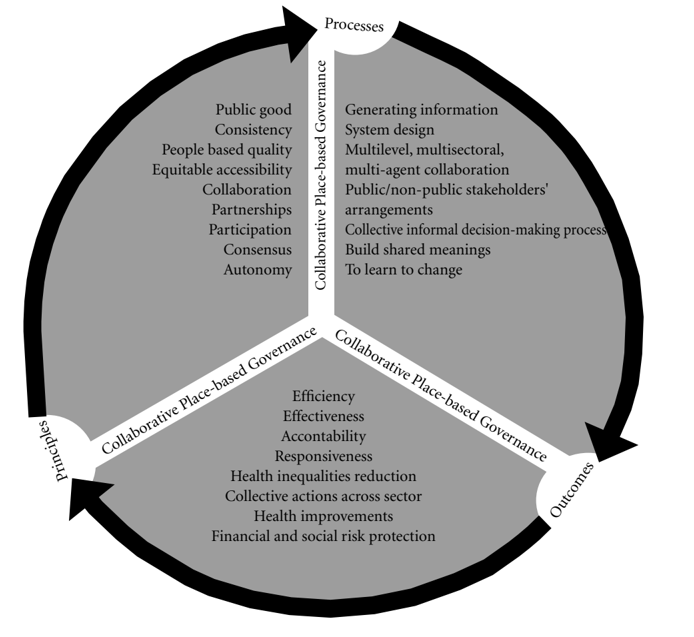
This study aimed to assess the Baixo Vouga sub-region (Portugal) governance system through 15 interviews with leaders of institutions with decision-making power and provide healthcare. The interviews were subjected to a content analysis, organized in matrices by cases, categories, subcategories, and indicators. Recording units were extracted from the interviews to produce data for each indicator. A Collaborative Place-based Governance Framework systematizing operational definitions of collaborative governance was implemented to serve as a benchmark for assessing the collaborative and place-based dimensions. The Baixo Vouga sub-Region governance system is collaborative because it is based on a shared structure of principles that translates into the services provided. It has a multilevel and multisector collaboration, and can undertake shared decisions. These dimensions could be reinforced through increased participation, autonomy, subsidiarity if more place-based information and practical knowledge were sought. The system would also benefit from an extensive adoption of bottom-up methods to formulate and implement policies.
Overview
The claims and statistics of this paper haven’t been checked yet.
Free: it reads the open-access text and checks the first 5 claims that cite a source we can check. Create a free account to check every claim.
Integrity signals
Registry
Cites
Statistics
Figures
Verification
Claims the paper makes
The claims and statistics of this paper haven’t been checked yet.
Free: it reads the open-access text and checks the first 5 claims that cite a source we can check. Create a free account to check every claim.
Claims other papers make about this one
Each is checked against this paper’s own text: does it say what the citing paper says it does?
The source backs part of the claim, not all of it — or backs it for a different population, condition or comparison.
In the citing paper
“Also, technology can create spaces for collaboration, such as place-based health systems (Gonçalves et al., 2021).”
From Redefining Collaborative Governance in the Digital Age: insights from an integrative systematic review on the role of ICT in collaboration (2025) · cites this paper as Gonçalves et al., 2021
Experimental — accuracy not yet measured
Self-check
Percentages, sums and reported differences re-computed from the paper’s own numbers.
The self-check needs the paper’s full text.
Citations
Cites
Collaborative Governance in Theory and Practice
Ansell, C., & Gash, A. (2008) · Journal of Public Administration Research and Theory · doi:10.1093/jopart/mum032 · Cited by 8,256
Lasker, R. D., Weiss, E. S., & Miller, R. (2001) · The Milbank Quarterly · doi:10.1111/1468-0009.00203 · Cited by 1,053
Portugal:: Health System review, 2017
Simões, J., Augusto, G. F., Fronteira, I., & Hernández‐Quevedo, C. (2017) · London School of Economics and Political Science Theses Online (London School of Economics and Political Science) · Cited by 351
Good Health at Low Cost 25 years on: lessons for the future of health systems strengthening
Balabanova, D., Mills, A., Conteh, L., Akkazieva, B., Banteyerga, H., Dash, U., Gilson, L., Harmer, A., Ibraimova, A., Islam, Z., et al. (2013) · The Lancet · doi:10.1016/s0140-6736(12)62000-5 · Cited by 339
A review of health governance: Definitions, dimensions and tools to govern
Barbazza, E., & Tello, J. E. (2014) · Health Policy · doi:10.1016/j.healthpol.2014.01.007 · Cited by 237
Abímbọ́lá, Ṣ., Negin, J., Jan, S., & Martiniuk, A. L. C. (2014) · Health Policy and Planning · doi:10.1093/heapol/czu069 · Cited by 193 · cited 2×
“2417 C iên cia & Saú de C oletiva 26(Su pl. 1):2415-2430, 2021 Regarding practical strategies to address primary health care, Abimbola et al.5 put forward a multilevel framework where interactions are defined as: i) operational governance (providers) in the process by which individual local healthcare system players m…”
BackgroundHealth governance: principal-agent linkages and health system strengthening
Brinkerhoff, D. W., & Bossert, T. J. (2014) · Health Policy and Planning · doi:10.1093/heapol/czs132 · Cited by 181
Frameworks to assess health systems governance: a systematic review
Pyone, T., Smith, H., & van den Broek, N. (2017) · Health Policy and Planning · doi:10.1093/heapol/czx007 · Cited by 159 · cited 2×
“Pyone et al.(11) put forward an overview of various review methods’ qualities, considering multiple analytical focal points, targets, and potential applications.”
BackgroundHealth-Promoting Spatial Planning: Approaches for Strengthening Urban Policy Integration
Lowe, M., Whitzman, C., & Giles‐Corti, B. (2017) · Planning Theory & Practice · doi:10.1080/14649357.2017.1407820 · Cited by 66 · cited 2×
“Lowe et al.6 identify four policymaking elements that should be considered for these purposes: players, context, processes, and content.”
BackgroundPrehoda, E. W., Winkler, R. L., & Schelly, C. (2019) · Social Sciences · doi:10.3390/socsci8010011 · Cited by 43 · cited 2×
“However, it shows constraints in basing its decisions on local-based information, as Prehoda et al.12 argue.”
Background
Research works printed but not linked: 2
- Pisco L, Pinto LF. From Alma-Ata to Astana : the path of Primary Health Care in Portugal, 1978-2018 and the genesis of Family Medicine. Cien Saude Colet 2020; 25(4):1197-1204.
- ARS Centro. Plano de Atividades [Internet]. Admi- nistração Regional de Saúde do Centro, IP. 2019. [ci- ted 2019 Mar 12]. Available from: http://dx.doi.or- g/10.1016/j.tws.2012.02.007 Article submitted on 10/03/2020 Approved on 05/08/2020 Final version submitted on 07/08/2020 · doi:10.1016/j.tws.2012.02.007articlesubmittedon10/03/2020approvedon05/08/2020
Cited by
Abbas, A., Ar, A. Y., Fard, R. G., Mannan, A., & Hosseini, S. (2022) · Ciência & Saúde Coletiva · doi:10.1590/1413-81232022278.06282021 · Cited by 10
Viana, L. B. F. (2025) · Technium Social Sciences Journal · doi:10.47577/tssj.v67i1.12358 · Cited by 5
Rigo, A., Pisani, E., & Secco, L. (2025) · International Journal of Environmental Research and Public Health · doi:10.3390/ijerph22020202 · Cited by 6
Basabih, M., Prasojo, E., & Rahayu, A. Y. S. (2025) · Global Transitions · doi:10.1016/j.glt.2025.01.001 · Cited by 7
Santa, S. L. B., Basil, D. G., Cembranel, P., Finatto, C. P., Guerra, J. B. S. O. D. A., & Soares, T. C. (2024) · Revista de Ciências da Administração · doi:10.5007/2175-8077.2023.e96277 · Cited by 2
Metadata
- Authors
- Gonçalves, C., Santinha, G., Santiago, A., & Barros, G.
- Affiliations
- University of Aveiro (PT)
- Corresponding author
- Santiago, Anabela
- Venue
- Ciência & Saúde Coletiva
- Publisher
- FapUNIFESP (SciELO)
- Published
- 2021-06
- Volume
- 26
- Issue
- suppl 1
- Pages
- 2415-2430
- ISSN
- 1413-8123 (ISSN-L)
- 1678-4561
- OpenAlex
- W3167208702
- Semantic Scholar
- ec93134aef0ec4f1406d2fd757acec21c66fef22
- Cited by
- 5
- References
- 14
- Citations by year
- 2025: 3 · 2024: 1 · 2022: 1
- FWCI
- 0.56
- Type
- journal article
- Language
- en
- Open access
- diamond
- doi.org
- Licence
- cc-by
- creativecommons.org/licenses/by/4.0/ (vor)
- creativecommons.org/licenses/by/4.0/ (am)
- creativecommons.org/licenses/by/4.0/ (tdm)
- Locations
- Ciência & Saúde Coletiva (publishedVersion, cc-by)
- PubMed (publishedVersion)
- LA Referencia (Red Federada de Repositorios Institucionales de Publicaciones Científicas) (publishedVersion, other-oa)
- DOAJ (DOAJ: Directory of Open Access Journals) (submittedVersion, cc-by-sa)
- Topics
- Health Sciences › Medicine › Public Health, Environmental and Occupational Health › Community Health and Development
- Health Sciences › Health Professions › General Health Professions › Health Services Management and Policy
- Health Sciences › Medicine › Public Health, Environmental and Occupational Health › Healthcare Systems and Practices
- Keywords
- collaborative governance, stakeholder perspectives, intersectoral collaboration, shared decision-making, subsidiarity
- MeSH terms
- Delivery of Health Care, Government Programs, Humans, Perception, Portugal
About these checks
Registry, retraction, Cites and statistics results are computed, not judged, with one exception: a printed reference that no index lists is read once by a model before it counts as a citation error. Claims are extracted by a model and kept only when their quote appears verbatim in the text; each cited source is then checked, with a model’s help, for whether it says what the claim relies on. Those verdicts can be wrong — read the claim’s quote and the cited source before relying on one.
Statistics and arithmetic are recomputed, not judged.
Confidence bands are shown only for fields calibrated on our annotated test set. None is calibrated yet, so no band is shown.
What counts as a claim ›How we measure confidence ›How we check this ›
Are you an author, or do you see a problem with this page? Request a review
Data sources
Bibliographic data: Semantic Scholar, OpenAlex, Crossref.
Contains information from the Semantic Scholar Academic Graph Datasets, made available under the ODC Attribution License (ODC-BY 1.0).
Semantic Scholar’s data is described in: Kinney, R., et al. (2023). The Semantic Scholar Open Data Platform. arXiv:2301.10140.
