

The DOI matches its Crossref record; 2 of the 2 references it cites were found in a registry or an index.
Neuropsychiatric symptoms of dementia and caregivers’ burden: a study among Indian caregivers
Open accessAbstract
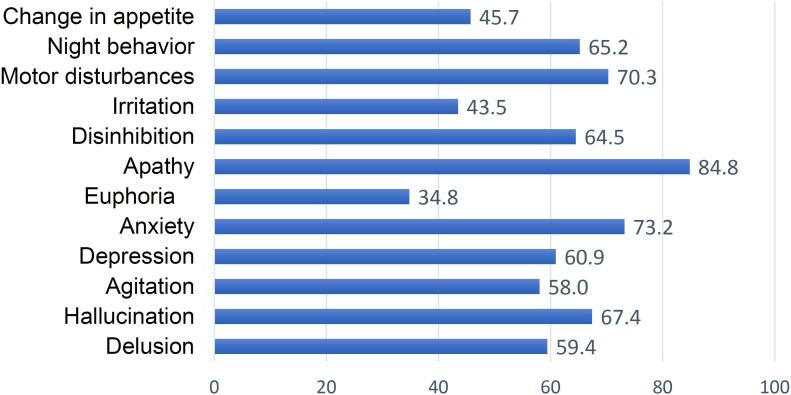
ABSTRACT Dementia is considered a most serious and disabling condition, affecting both the individual suffering from it and their caregiver. Objective: The study aimed to evaluate the relationship between neuropsychiatric problems of dementia and caregiver burden. Methods: A total of 138 caregivers of people with dementia participated in this cross-sectional study. The caregivers completed the questionnaires containing sociodemographic information as well as neuropsychiatric problems of dementia and caregiver burden. Results: The findings showed that all of the care-recipients were suffering from some kind of neuropsychiatric symptoms, the most common being apathy, anxiety, motor disturbance, and hallucination. Out of 12 symptoms, 11 were significantly associated with caregivers’ burden. The most important finding is that the severity of neuropsychiatric symptoms is highly responsible for severe caregivers’ burden. Conclusions: The identification of neuropsychiatric symptoms of dementia that influence caregiver burden is very critical for both caregivers’ and care-recipients’ health perspective. These findings can also be utilized to create care settings for demented people and help determine policies in the future.
Overview
The claims and statistics of this paper haven’t been checked yet.
Run the check — free, no account needed. It reads the open-access text and checks the sources it cites.
Integrity signals
Registry
Cites
Statistics
Figures
Verification
Claims the paper makes
The claims and statistics of this paper haven’t been checked yet.
Run the check — free, no account needed. It reads the open-access text and checks the sources it cites.
Claims other papers make about this one
Each is checked against this paper’s own text: does it say what the citing paper says it does?
The check wasn’t confident either way, so it gives no verdict — never disputed.
In the citing paper
“More severe neuropsychiatric symptoms predicting more unmet needs have been extensively reported [5, 29].”
From Unmet Needs in Dementia Care: The Predictive Role of Caregiver Challenges (2025) · cites this paper as [29]
Experimental — accuracy not yet measured
Self-check
Percentages, sums and reported differences re-computed from the paper’s own numbers.
The self-check needs the paper’s full text.
Citations
Cites
Kok, J. S., Berg, I. J., & Scherder, E. J. A. (2013) · Dementia and Geriatric Cognitive Disorders Extra · doi:10.1159/000353441 · Cited by 20,589
Tulek, Z., Baykal, D., Erturk, S., Bilgic, B., Hanagasi, H., & Gurvit, I. H. (2020) · Issues in Mental Health Nursing · doi:10.1080/01612840.2019.1705945 · Cited by 76
Research works printed but not linked: 30
- Ferrara M, 2008, Prevalence of stress, anxiety and depression in with Alzheimer caregivers, Health Qual Life Outcomes, 6, 93, 10.1186/1477-7525-6-93 · DOI · Paper page
- Harada CN, 2013, Normal cognitive aging, Clin Geriatr Med, 29, 737, 10.1016/j.cger.2013.07.002 · DOI
- Taub A, 2004, Dementia caregiver burden: reliability of the Brazilian version of the Zarit caregiver burden interview, Cad Saúde Pública, 20, 372, 10.1590/S0102-311X2004000200004 · DOI
- Serrano-Aguilar PG, 2006, Impact on health-related quality of life and perceived burden of informal caregivers of individuals with Alzheimer’s disease, Neuroepidemiology, 27, 136, 10.1159/000095760 · DOI
- Kasuya RT, 2000, Caregiver burden and burnout. A guide for primary care physicians, Postgrad Med, 108, 119, 10.3810/pgm.2000.12.1324 · DOI
- Basu I, 2019, Factors related to adverse mental health condition of demented family caregivers: a study in West Bengal, India, Anthropological Review, 82, 373, 10.2478/anre-2019-0028 · DOI
- Famakinwa A, 2009, Caregiver stress: the physician’s role, Geriatr Aging, 12, 267
- Ory MG, 2017, Prevalence and impact of caregiving: a detailed comparison between dementia and nondementia caregivers, Gerontologist, 39, 177, 10.1093/geront/39.2.177 · DOI · Paper page
- Papastavrou E, 2007, Caring for a relative with dementia: family caregiver burden, J Adv Nurs, 58, 446, 10.1111/j.1365-2648.2007.04250.x · DOI · Paper page
- Gold DP, 1995, When home caregiving ends: a longitudinal study of outcomes for caregivers of relatives with dementia, J Am Geriatr Soc, 43, 10, 10.1111/j.1532-5415.1995.tb06235.x · DOI
- Basu I, 2020, Family caregiving in dementia: caregivers’ mental health and nature of caregiving, Antrocom Journal of Anthropology, 16, 201
- Gilhooly KJ, 2016, A meta-review of stress, coping and interventions in dementia and dementia caregiving, BMC Geriatr, 16, 106, 10.1186/s12877-016-0280-8 · DOI · Paper page
- Shim SH, 2016, Factors associated with caregiver burden in dementia: 1-year follow-up study, Psychiatry Investig, 13, 43, 10.4306/pi.2016.13.1.43 · DOI
- Finkel IS, 1996, Behavioral and psychological signs and symptoms of dementia: a consensus statement on current knowledge and implications for research and treatment, Int Psychogeriatr, 8, 497, 10.1017/S1041610297003943 · DOI
- Finkel SI, 1998, Behavioral and psychological symptoms of dementia: a consensus statement on current knowledge and implications for research and treatment, American Journal of Geriatratric Psychiatry, 6, 97
- McCarty HJ, 2000, Longitudinal course of behavioral problems during Alzheimer’s disease: linear versus curvilinear patterns of decline, J Gerontol A Biol Sci Med Sci, 55, M200, 10.1093/gerona/55.4.M200 · DOI
- Gaugler JE, 2000, Modeling caregiver adaptation over time: the longitudinal impact of behavior problems, Psychol Aging, 15, 437, 10.1037/0882-7974.15.3.437 · DOI
- Müller-Spahn F, 2003, Behavioral disturbances in dementia, Dialogues Clin Neurosci, 5, 49, 10.31887/DCNS.2003.5.1/fmuellerspahn · DOI
- Siders C, 2004, Evidence for implementing nonpharmacological interventions for wandering, Rehabil Nurs, 29, 195
- Basu I, 2021, Psychological health of dementia caregivers: an overview, 199
- Cummings JL, 1994, The Neuropsychiatric Inventory: comprehensive assessment of psychopathology in dementia, Neurology, 44, 2308, 10.1212/WNL.44.12.2308 · DOI · Paper page
- Tiel C, 2019, Neuropsychiatric symptoms and executive function impairments in Alzheimer’s disease and vascular dementia: the role of subcortical circuits, Dement Neuropsychol, 13, 293, 10.1590/1980-57642018dn13-030005 · DOI
- Frisoni GB, 1999, Behavioral syndromes in Alzheimer’s disease: description and correlates, Dement Geriatr Cogn Disord, 10, 130, 10.1159/000017113 · DOI
- Gallicchio L, 2002, Gender differences in burden and depression among informal caregivers of demented elders in the community, Int J Geriatr Psychiatry, 17, 154, 10.1002/gps.538 · DOI
- Gaugler JE, 2005, Unmet care needs and key outcomes in dementia, J Am Geriatr Soc, 53, 2098, 10.1111/j.1532-5415.2005.00495.x · DOI
- Bozgeyik G, 2019, Behavioural and psychological symptoms of Alzheimer’s disease associated with caregiver burden and depression, Psychiatry and Clinical Psychopharmacology, 29, 656, 10.1080/24750573.2018.1541646 · DOI
- Huang SS, 2012, Caregiver burden associated with behavioral and psychological symptoms of dementia (BPSD) in Taiwanese elderly, Arch Gerontol Geriatr, 55, 55, 10.1016/j.archger.2011.04.009 · DOI
- Laks J, 2016, Caregiving for patients with Alzheimer’s disease or dementia and its association with psychiatric and clinical comorbidities and other health outcomes in Brazil, Int J Geriatr Psychiatry, 31, 176, 10.1002/gps.4309 · DOI
- Matsumoto N, 2007, Caregiver burden associated with behavioral and psychological symptoms of dementia in elderly people in the local community, Dement Geriatr Cogn Disord, 23, 219, 10.1159/000099472 · DOI
- Brodaty H, 2009, Family caregivers of people with dementia, Dialogues Clin Neurosci, 11, 217, 10.31887/DCNS.2009.11.2/hbrodaty · DOI · Paper page
Cited by
Unmet Needs in Dementia Care: The Predictive Role of Caregiver Challenges
Bertola, L., da Mata, F., Ramos, A. A., Godoy, C., de Faria, F. M., Lucchetta, R., de Oliveira Junior, H. A., & Ferri, C. P. (2025) · International Journal of Geriatric Psychiatry · doi:10.1002/gps.70164 · Cited by 2
“More severe neuropsychiatric symptoms predicting more unmet needs have been extensively reported [5, 29].”
Metadata
- Authors
- Basu, I., & Mukhopadhyay, S.
- Affiliations
- Indian Statistical Institute (IN)
- Venue
- Dementia & Neuropsychologia
- Publisher
- FapUNIFESP (SciELO)
- Published
- 2022-09
- Volume
- 16
- Issue
- 3
- Pages
- 332-340
- ISSN
- 1980-5764 (ISSN-L)
- PMC
- PMC9762380
- OpenAlex
- W4297341540
- Cited by
- 22
- References
- 2
- Citations by year
- 2026: 8 · 2025: 6 · 2024: 4 · 2023: 4
- FWCI
- 2.28
- Type
- journal article
- Language
- en
- Open access
- diamond
- doi.org
- Licence
- Locations
- Dementia & Neuropsychologia (publishedVersion, cc-by)
- PubMed Central (publishedVersion, cc-by)
- PubMed (publishedVersion)
- LA Referencia (Red Federada de Repositorios Institucionales de Publicaciones Científicas) (publishedVersion, other-oa)
- DOAJ (DOAJ: Directory of Open Access Journals) (submittedVersion, cc-by-sa)
- Topics
- Health Sciences › Medicine › Psychiatry and Mental health › Dementia and Cognitive Impairment Research
- Health Sciences › Nursing › Research and Theory › Nursing care and research
- Social Sciences › Psychology › Clinical Psychology › Family Caregiving in Mental Illness
- Keywords
- dementia, neuropsychiatric symptoms, caregiver burden, apathy, anxiety, motor disturbances, hallucinations, symptom severity
About these checks
Registry, retraction, Cites and statistics results are computed, not judged, with one exception: a printed reference that no index lists is read once by a model before it counts as a citation error. Claims are extracted by a model and kept only when their quote appears verbatim in the text; each cited source is then checked, with a model’s help, for whether it says what the claim relies on. Those verdicts can be wrong — read the claim’s quote and the cited source before relying on one.
Statistics and arithmetic are recomputed, not judged.
Confidence bands are shown only for fields calibrated on our annotated test set. None is calibrated yet, so no band is shown.
What counts as a claim ›How we measure confidence ›How we check this ›
Are you an author, or do you see a problem with this page? Request a review
Data sources
Bibliographic data: Semantic Scholar, OpenAlex, Crossref.
Contains information from the Semantic Scholar Academic Graph Datasets, made available under the ODC Attribution License (ODC-BY 1.0).
Semantic Scholar’s data is described in: Kinney, R., et al. (2023). The Semantic Scholar Open Data Platform. arXiv:2301.10140.
