

Adverse life events and coping skills in panic disorder
Open accessThe DOI matches its Crossref record; 22 of the 24 references it cites were found in a registry or an index.
Abstract
Research literature and clinical experience shows that panic patients are often able to identify stressors that preceded the onset of their first attacks. In this study we investigated the relation between life events, coping skills, and panic disorder. METHODS: Forty-tree panic patients were compared with 29 control subjects regarding the occurrence and the impact of stressful life events in a 1-year period preceding the onset of panic attacks using the Social Readjustment Rating Scale and London Life Event and Difficulty Schedule. Coping skills were measured using the Ways of Coping Questionnaire. RESULTS: No differences were observed between panic patients and controls regarding the number of reported stressful life events in the previous year. Panic patients compared to controls reported loss of social support as the most meaningful class of events significantly more often. In response to stressful situations, panic patients more often used coping skills judged as ineffective. CONCLUSIONS: The present study suggests that the type of life event and the coping skills used in response to them, more than the occurrence of stressful events itself, may be associated with the onset of panic disorder.
Overview
The claims and statistics of this paper haven’t been checked yet.
Free: it reads the open-access text and checks the first 5 claims that cite a source we can check. Create a free account to check every claim.
Integrity signals
Registry
Cites
Statistics
Figures
Verification
Claims the paper makes
The claims and statistics of this paper haven’t been checked yet.
Free: it reads the open-access text and checks the first 5 claims that cite a source we can check. Create a free account to check every claim.
Claims other papers make about this one
Each is checked against this paper’s own text: does it say what the citing paper says it does?
The cited source says what the claim attributes to it.
In the citing paper
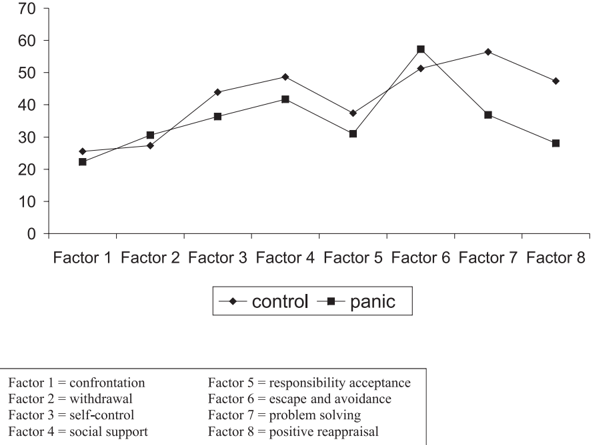
“PD patients reported the use of 'problem solving' strategies (38.87% vs. 56.46%, f = 19.59; P <0.01) and positive reappraisal (28.02% vs. 47. 45%, f = 19.43; P <0.001) less frequently than controls”
From Managing emotions in panic disorder: A systematic review of studies related to emotional intelligence, alexithymia, emotion regulation, and coping (2023) · cites this paper as Savoia et al (2004)
Experimental — accuracy not yet measuredThe cited source says what the claim attributes to it.
In the citing paper
“PD patients reported the use of 'problem solving' strategies (38.87% vs. 56.46%, f = 19.59; P <0.01) and positive reappraisal (28.02% vs. 47. 45%, f = 19.43; P <0.001) less frequently than controls”
From Managing emotions in panic disorder: A systematic review of studies related to emotional intelligence, alexithymia, emotion regulation, and coping (2023) · cites this paper as Savoia et al (2004)
Self-check
Percentages, sums and reported differences re-computed from the paper’s own numbers.
The self-check needs the paper’s full text.
Citations
Cites
The social readjustment rating scale
Holmes, T. H., & Rahe, R. H. (1967) · Journal of Psychosomatic Research · doi:10.1016/0022-3999(67)90010-4 · Cited by 11,067 · cited 4×
“Stressful life events were assessed retrospectively using the Holmes and Rahe Social Readjustment Scale.17 Instead of using the scale as a self-assessment instrument, we used the methodology described by Katsching18 in which questions were clarified and answers discussed in a structured interview.”
MethodInfluentialMultivariate Statistical Methods
(2008) · Encyclopedia of Public Health · doi:10.1007/978-1-4020-5614-7_2263 · Cited by 5,580
Folkman, S., & Lazarus, R. S. (1985) · Journal of Personality and Social Psychology · doi:10.1037/0022-3514.48.1.150 · Cited by 4,845
Dynamics of a stressful encounter: Cognitive appraisal, coping, and encounter outcomes.
Folkman, S., Lazarus, R. S., Dunkel‐Schetter, C., DeLongis, A., & Gruen, R. J. (1986) · Journal of Personality and Social Psychology · doi:10.1037//0022-3514.50.5.992 · Cited by 4,836
Multivariate Statistical Methods.
Clarke, G. M., & Morrison, D. F. (1977) · Journal of the Royal Statistical Society. Series A (General) · doi:10.2307/2344930 · Cited by 2,165
Schmidt, N. B., Lerew, D. R., & Jackson, R. J. (1997) · Journal of Abnormal Psychology · doi:10.1037//0021-843x.106.3.355 · Cited by 646 · cited 1×
“a direct correlation between stressful life events and the first episode of panic, and by Schmidt et al..(7) who observed that the most important predictor of panic attacks onset during an intense period of stress (military training) was a personal history of panic attacks.”
BackgroundNeuroanatomy and neurotransmitter regulation of defensive behaviors and related emotions in mammals.
Graeff, F. G. (1994) · PubMed · Cited by 337
Recent life events and panic disorder
(1989) · American Journal of Psychiatry · doi:10.1176/ajp.146.5.622 · Cited by 173
The Phobic Anxiety-depersonalization Syndrome [Abridged]
Roth, M. (1959) · Proceedings of the Royal Society of Medicine · doi:10.1177/003591575905200802 · Cited by 162
Life events and psychiatric disorders : controversial issues
Katschnig, H. (1987) · Cambridge University Press eBooks · Cited by 149
Research works printed but not linked: 5
- 10. Randall D. Concepts of health and mental health: laying the groundwork for intervention. Canada Mental Health 1981;1 (Suppl):1-6.
- 15. American Psychiatry Association. Diagnostic Statistic Manual of Mental Disorders -Third Edition Revised, Washington: 1987.
- 16. Wiens AN, Matarazzo JD. Diagnostic interviewing. In: Kasdin A, Bellack A. Clinical Pscychology Handbook. New York: Pergamon Press;1991. p. 309-338.
- 18. Katschinig H. Prospects for future research In: Katschinig H. Life events in psychiatric disorders: controversial issues. Cambridge: Cambridge University Press;1986. p. 246-256.
- 23. Klein D. Anxiety: new research and change in concepts. New York: New York Raven Press;1980.
Cited by
Animal models of anxiety disorders and stress
Campos, A. C., Fogaca, M. V., Aguiar, D. C., & Guimaraes, F. S. (2013) · Revista Brasileira de Psiquiatria · doi:10.1590/1516-4446-2013-1139 · Cited by 471
Klauke, B., Deckert, J., Reif, A., Pauli, P., & Domschke, K. (2010) · Depression and Anxiety · doi:10.1002/da.20667 · Cited by 117
“Batinic et al.[15] focused on negative events of the Stressful Life Event Scale only and found an influence of the number of LEs, whereas Roy-Byrne et al.[26] and Savoia and Bernik[27] analyzed a broader range of LEs from contextual clusters, such as work, family, household, etc., including not only negative events bu…”
BackgroundInfluentialThe burdened life of adults with ADHD: Impairment beyond comorbidity
Garcia, C. R., Bau, C. H. D., Silva, K. L., Callegari-Jacques, S. M., Salgado, C. A. I., Fischer, A. G., Victor, M. M., Sousa, N. O., Karam, R. G., Rohde, L. A., et al. (2012) · European Psychiatry · doi:10.1016/j.eurpsy.2010.08.002 · Cited by 75
“Several studies have shown that life events [12,15,23,24,43,51,54,57] and environmental adversities [7,8,25,60,61] increase the risk of psychiatric disorders and psychosocial dysfunctions.”
BackgroundStress, allostatic load, and periodontal diseases
Sabbah, W., Gomaa, N. A., & Gireesh, A. (2018) · Periodontology 2000 · doi:10.1111/prd.12238 · Cited by 91
Oussi, A., Hamid, K., & Bouvet, C. (2023) · Journal of Behavior Therapy and Experimental Psychiatry · doi:10.1016/j.jbtep.2023.101835 · Cited by 40
Morero, J. A. P., Bragagnollo, G. R., & Santos, M. T. S. (2018) · Revista CUIDARTE · doi:10.15649/cuidarte.v9i2.503 · Cited by 106
Effect of cognitive-behavioral group therapy for panic disorder in changing coping strategies
Viana, A. C. W., Gomes, J. B., da Silva, T. D., Blaya, C., Manfro, G. G., & Heldt, E. (2013) · Comprehensive Psychiatry · doi:10.1016/j.comppsych.2013.06.008 · Cited by 28
“However, the use of effective coping strategies, such as problem solving and positive reappraisal, in response to stressful situationswas significantly less frequent in patients as compared to controls [14].”
BackgroundResultOzdemir, O., Selvi, Y., Ozkol, H., Tuluce, Y., Besiroglu, L., & Aydin, A. (2012) · Neuropsychobiology · doi:10.1159/000341880 · Cited by 22
Viana, A. C. W., Gomes, J. B., da Silva, T. D., Guimarães, L. S. P., & Heldt, E. (2014) · Behavioural and Cognitive Psychotherapy · doi:10.1017/s1352465814000289 · Cited by 31
“A previous study showed that patients with PD use less adaptive and effective coping strategies compared to the control group with individuals without mental disease (Savoia and Bernik, 2004).”
BackgroundAs contribuições da personalidade e dos eventos de vida para o bem-estar subjetivo
Woyciekoski, C., Natividade, J. C., & Hutz, C. S. (2014) · Psicologia Teoria e Pesquisa · doi:10.1590/s0102-37722014000400005 · Cited by 45
Oussi, A., & Bouvet, C. (2022) · Current Psychology · doi:10.1007/s12144-022-03842-0 · Cited by 12
“Other studies have noted that in PD, people use fewer problem-solving coping strategies than healthy subjects (Savoia and Bernik, 2004), but use the same coping strategies as subjects with other anxiety disorders such as GAD, social anxiety disorder, and hypochondria (Pozzi et al.”
BackgroundStress em servidores públicos do instituto nacional de seguro social
Minari, M. R. T., & de Souza, J. C. (2011) · Estudos de Psicologia (Campinas) · doi:10.1590/s0103-166x2011000400012 · Cited by 19
Woyciekoski, C., Natividade, J. C., & Hutz, C. S. (2014) · Temas em Psicologia · doi:10.9788/tp2014.1-02 · Cited by 7
“…categorias de eventos, com base na análise de juízes, sem referências à validade de construto (ver Bifulco et al., 1989; Gomez, Krings, Bangerter, & Grob, 2009; Kolarik, 2010; Lüdtke et al., 2011; Murray & Cox, 2005; Paykel, 1997; Savoia & Bernik, 2004; Tessner et al., 2011; Voss et al., 2006).”
BackgroundAnálisis comparativo de los pacientes con y sin trastorno mental diagnosticable
Serrano, C. L., Lobo, A. O., & González, R. (2011) · Revista de la Asociación Española de Neuropsiquiatría · doi:10.4321/s0211-57352011000300003 · Cited by 5
Barbosa, J. M. M., Dias, R. C., & Pereira, L. S. M. (2007) · Revista Brasileira de Geriatria e Gerontologia · doi:10.1590/1809-9823.2007.100310 · Cited by 9
Àgora de salut vol. V (número complet)
varios, A. (2018) · Àgora de salut · doi:10.6035/agorasalut.2018.5 · Cited by 3
Cognitive and emotional vulnerability to panic disorder: presenting an integrative model
Oussi, A., & Bouvet, C. (2023) · Current Psychology · doi:10.1007/s12144-023-05163-2 · Cited by 5
“…even before emotional responses have been fully generated, although studies have noted that people with PD had more difficulty in using cognitive reappraisal of their negative beliefs (Breuninger et al., 2017; Oguz et al., 2019; Savoia & Bernik, 2004) in comparison with healthy subjects.”
Reyes-Torres, F. G., Rachyla, I., Cerdá, S. F., Amposta, M. M., & Castellano, S. Q. (2018) · Àgora de salut · doi:10.6035/agorasalut.2018.5.19 · Cited by 1
A relação entre personalidade e eventos de vida e as suas contribuições para o bem-estar subjetivo
Woyciekoski, C. (2012) · Americanae (AECID Library) · Cited by 2
Eventos de Vida: Investigações sobre a Violência Sexual Contra Crianças e Adolescentes
Albornoz, A. C. G., & Bandeira, D. R. (2010) · DOAJ (DOAJ: Directory of Open Access Journals)
In the december 2004 issue of clinics
Rocha-e-Silva, M. (2004) · Revista do Hospital das Clínicas · doi:10.1590/s0041-87812004000600001
Garcia, C. R., & Alegre, P. (2004)
Transtorno do pânico: investigação sobre alterações de relato em terapia analítico-comportamental.
Siebert, G. (2006) · Americanae (AECID Library)
Serrano, C. L., Lobo, A. O., & González, R. G. (2011)
Évitement et exposition : perspective de personnes aux prises avec un trouble panique
Blouin, C., Lussier, R., Bélanger, C., & Perreault, M. (2026) · Revue québécoise de psychologie · doi:10.7202/1124384ar
Metadata
- Authors
- Savoia, M. G., & Bernik, M.
- Affiliations
- University of São Paulo, Brazil
- Universidade de São Paulo (BR)
- ORCID
- Bernik, Márcio
- Venue
- Revista do Hospital das Clínicas
- Publisher
- FapUNIFESP (SciELO)
- Published
- 2004
- Volume
- 59
- Issue
- 6
- Pages
- 337-340
- ISSN
- 0041-8781 (ISSN-L)
- OpenAlex
- W2144703954
- Semantic Scholar
- e32b20c8424fbdb58fb330fe060f70ae7cc743f6
- Cited by
- 25
- References
- 24
- Citations by year
- 2026: 1 · 2023: 2 · 2022: 1 · 2018: 4 · 2014: 3 · 2013: 2 · 2012: 2
- FWCI
- 1.88
- Type
- journal article
- Language
- en
- Open access
- diamond
- doi.org
- Licence
- cc-by-nc
- Locations
- Revista do Hospital das Clínicas (publishedVersion, cc-by-nc)
- PubMed (publishedVersion)
- LA Referencia (Red Federada de Repositorios Institucionales de Publicaciones Científicas) (publishedVersion, other-oa)
- Americanae (AECID Library) (submittedVersion, cc-by-nc)
- DOAJ (DOAJ: Directory of Open Access Journals) (submittedVersion)
- Topics
- Social Sciences › Psychology › Experimental and Cognitive Psychology › Anxiety, Depression, Psychometrics, Treatment, Cognitive Processes
- Social Sciences › Psychology › Clinical Psychology › Child and Adolescent Psychosocial and Emotional Development
- Social Sciences › Psychology › Clinical Psychology › Posttraumatic Stress Disorder Research
- Keywords
- panic disorder, life events, coping strategies, ineffective coping, Social Readjustment Rating Scale, Ways of Coping Questionnaire
- MeSH terms
- Adaptation, Psychological, Adult, Attitude to Health, Female, Humans, Life Change Events, Male, Middle Aged, Case-Control Studies, Panic Disorder
About these checks
Registry, retraction, Cites and statistics results are computed, not judged, with one exception: a printed reference that no index lists is read once by a model before it counts as a citation error. Claims are extracted by a model and kept only when their quote appears verbatim in the text; each cited source is then checked, with a model’s help, for whether it says what the claim relies on. Those verdicts can be wrong — read the claim’s quote and the cited source before relying on one.
Statistics and arithmetic are recomputed, not judged.
Confidence bands are shown only for fields calibrated on our annotated test set. None is calibrated yet, so no band is shown.
What counts as a claim ›How we measure confidence ›How we check this ›
Are you an author, or do you see a problem with this page? Request a review
Data sources
Bibliographic data: Semantic Scholar, OpenAlex, Crossref.
Contains information from the Semantic Scholar Academic Graph Datasets, made available under the ODC Attribution License (ODC-BY 1.0).
Semantic Scholar’s data is described in: Kinney, R., et al. (2023). The Semantic Scholar Open Data Platform. arXiv:2301.10140.
