

Fecal androgen levels in common marmoset (Callithrix jacchus) males living in captive family groups
The DOI matches its Crossref record; 35 of the 35 references it cites were found in a registry or an index.
Abstract
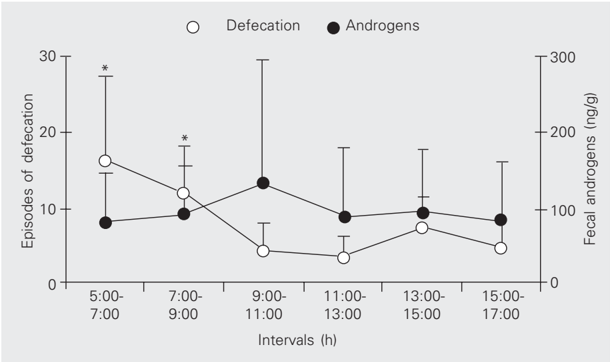
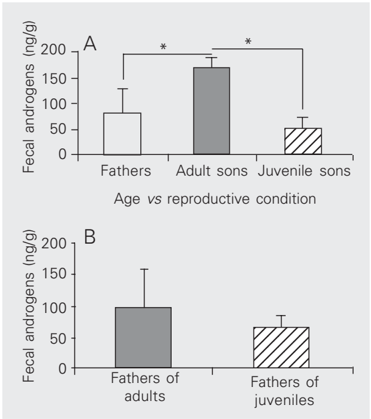
In captive common marmoset groups, the reproductive inhibition observed in subordinate female seems to be a result of olfactory, visual and behavioral cues from the dominant female. However, few studies have examined the relationship among adult males living in the same social group. These studies have shown that reproductive failure among peer males seems to be based on hormonal and behavioral mechanisms. New insights on sexual strategies in primates have been shown using fecal steroids, but so far no information is available for common marmoset males. In the present study, we evaluated the influence of light-dark cycle, age and reproductive condition on the profile of fecal androgens in males living in the same family group. Feces were collected from six fathers and six sons for androgen determination during the light phase of the 24-h cycle for eight days randomly distributed over a 4-week period. Androgen levels were determined by enzyme immunoassay technique. Adult sons showed higher androgen levels (166.97 +/- 22.95 ng/g) than fathers (80.69 +/- 44.38 ng/g) and juveniles (49.06 +/- 23.15 ng/g; P < 0.05). No diurnal variation (P > 0.05) in fecal androgen profile was observed in adults or juveniles. No indication of androgen-mediated social competition between fathers and adult sons was demonstrable. These results provide basic information on fecal androgen profile useful to investigate the socioendocrinology of free-ranging common marmoset males and verify that, in contrast to daughters, the reproductive suppression of sons is not based on physiological inhibition of their gonads.
Overview
The claims and statistics of this paper haven’t been checked yet.
Free: it reads the open-access text and checks the first 5 claims that cite a source we can check. Create a free account to check every claim.
Integrity signals
Registry
Cites
Statistics
Figures
Verification
Claims the paper makes
The claims and statistics of this paper haven’t been checked yet.
Free: it reads the open-access text and checks the first 5 claims that cite a source we can check. Create a free account to check every claim.
Claims other papers make about this one
Each is checked against this paper’s own text: does it say what the citing paper says it does?
The source backs part of the claim, not all of it — or backs it for a different population, condition or comparison.
In the citing paper
“Yet, there is no evidence to suggest that there is active suppression of reproductive endocrine systems in callitrichine sons that remain in their natal group [Baker et al., 1999; Castro & Sousa, 2005; Ginther et al., 2002; Huck et al., 2005], in contrast to the well-documented phenomenon of reproductive suppression in callitrichine daughters”
From Social and developmental influences on urinary androgen levels in young male white‐faced marmosets (Callithrix geoffroyi) (2011) · cites this paper as Castro & Sousa, 2005
Experimental — accuracy not yet measured
Self-check
Percentages, sums and reported differences re-computed from the paper’s own numbers.
The self-check needs the paper’s full text.
Citations
Cites
Marsden, P. D. (1985) · Revista da Sociedade Brasileira de Medicina Tropical · doi:10.1590/s0037-86821985000300013 · Cited by 473
The endocrine stress-response and social status in the wild baboon
Sapolsky, R. M. (1982) · Hormones and Behavior · doi:10.1016/0018-506x(82)90027-7 · Cited by 445
Behavioral and physiological suppression of fertility in subordinate marmoset monkeys
Abbott, D. H. (1984) · American Journal of Primatology · doi:10.1002/ajp.1350060305 · Cited by 232
Abbott, D. H., & Hearn, J. P. (1978) · Reproduction · doi:10.1530/jrf.0.0530155 · Cited by 212
Möhle, U., Heistermann, M., Palme, R., & Hodges, J. K. (2002) · General and Comparative Endocrinology · doi:10.1016/s0016-6480(02)00525-7 · Cited by 161
Lazaro-Perea, C. (2001) · Animal Behaviour · doi:10.1006/anbe.2000.1726 · Cited by 154
Communication of ovulatory state to mates by female pygmy marmosets, Cebuella pygmaea
Converse, L. J., Carlson, A. A., Ziegler, T. E., & Snowdon, C. T. (1995) · Animal Behaviour · doi:10.1016/0003-3472(95)80194-4 · Cited by 148
Social status constrains the stress response in the squirrel monkey
Coe, C. L., Mendoza, S. P., & Levine, S. (1979) · Physiology & Behavior · doi:10.1016/0031-9384(79)90151-3 · Cited by 140
Sousa, M. B. C., & Ziegler, T. E. (1998) · American Journal of Primatology · doi:10.1002/(sici)1098-2345(1998)46:2<105::aid-ajp1>3.0.co;2-# · Cited by 139
Self-citationFrench, J. A., Abbott, D. H., & Snowdon, C. T. (1984) · American Journal of Primatology · doi:10.1002/ajp.1350060304 · Cited by 138
Research works printed but not linked: 5
- French JA & Schaffner CM (1995). Social and developmental influ- ences on urinary testosterone levels in male black tufted-ear mar- moset (Callithrix kuhli ). American Journal of Primatology, 36: 123 (Abstract).
- Abbott DH (1993). Social conflict and reproductive suppression in marmosets and tamarin monkeys. In: Mason WA & Mendoza SP (Editors), Primates Social Conflict. State University of New York Press, Albany, NY, USA, 331-372.
- Lewy H, Hans E, Naor Z & Assikendazi IE (1998). Multifrequency time structure in LH, prolactin and cortisol plasma concentrations. In: Touitou Y (Editor), Biological Clocks. Mechanisms and Applica- tions. Elsevier Science, Amsterdam, The Netherlands, 431-434.
- Abbott DH (1978). The physical, hormonal and behavioural develop- ment of the common marmoset, Callithrix jacchus jacchus. In:
- Castro CSS (1998). Dieta, padrão de uso do espaço e interações agressivas entre grupos de sagüi do Nordeste, Callithrix jacchus (Primates: Callithrichidae). PhD thesis, Universidade Federal de São Carlos, São Carlos, SP, Brazil, 117.
Cited by
Birnie, A. K., Smith, A. S., Nali, C., & French, J. A. (2011) · American Journal of Primatology · doi:10.1002/ajp.20909 · Cited by 15
Metadata
- Authors
- Castro, D. C., & Sousa, M. B. C.
- Affiliations
- Universidade Federal do Rio Grande do Norte, Brasil
- Venue
- Brazilian Journal of Medical and Biological Research
- Publisher
- FapUNIFESP (SciELO)
- Published
- 2005-01
- Volume
- 38
- Issue
- 1
- Pages
- 65-72
- ISSN
- 0100-879X
- Semantic Scholar
- ec8d46ea173a5f2d7d9230360fecc2cda87e1241
- Cited by
- 10
- References
- 35
About these checks
Registry, retraction, Cites and statistics results are computed, not judged, with one exception: a printed reference that no index lists is read once by a model before it counts as a citation error. Claims are extracted by a model and kept only when their quote appears verbatim in the text; each cited source is then checked, with a model’s help, for whether it says what the claim relies on. Those verdicts can be wrong — read the claim’s quote and the cited source before relying on one.
Statistics and arithmetic are recomputed, not judged.
Confidence bands are shown only for fields calibrated on our annotated test set. None is calibrated yet, so no band is shown.
What counts as a claim ›How we measure confidence ›How we check this ›
Are you an author, or do you see a problem with this page? Request a review
Data sources
Bibliographic data: Semantic Scholar, OpenAlex, Crossref.
Contains information from the Semantic Scholar Academic Graph Datasets, made available under the ODC Attribution License (ODC-BY 1.0).
Semantic Scholar’s data is described in: Kinney, R., et al. (2023). The Semantic Scholar Open Data Platform. arXiv:2301.10140.
