

Adjusting the general growth balance method for migration
Open accessThe DOI matches its Crossref record; 23 of the 24 references it cites were found in a registry or an index.
Abstract
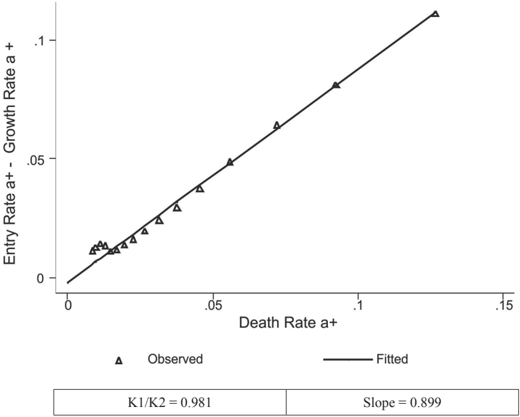
Death distribution methods proposed for death registration coverage by comparison with census age distributions assume no net migration. This assumption makes it problematic to apply these methods to sub-national and national populations affected by substantial net migration. In this paper, we propose and explore a two-step process in which the Growth Balance Equation is first used to estimate net migration rates, using a model of age-specific migration, and then it is used to compare the observed death rates over successive ages against residual estimates made up by the entry rate plus the net migration rate minus the growth rate. This methodology is predicated on the observation that migration rates have a very different age pattern from death rates; it is only when this condition is true that net migration and deaths can be distinguished. The procedure proposed here works reasonably well in populations that generally have good data and rather high net migration rates. There is no reason to prefer the revised migration model over the original Rogers-Castro formulation.
Overview
The claims and statistics of this paper haven’t been checked yet.
Free: it reads the open-access text and checks the first 5 claims that cite a source we can check. Create a free account to check every claim.
Integrity signals
Registry
Cites
Statistics
Figures



Verification
Claims the paper makes
The claims and statistics of this paper haven’t been checked yet.
Free: it reads the open-access text and checks the first 5 claims that cite a source we can check. Create a free account to check every claim.
Claims other papers make about this one
Each is checked against this paper’s own text: does it say what the citing paper says it does?
In the citing paper
“This is crucial in locations with large migration flows, such as the United Arab Emirates and Qatar, where current methods for these corrections might not perform well.78, 79”
From Global age-sex-specific mortality, life expectancy, and population estimates in 204 countries and territories and 811 subnational locations, 1950–2021, and the impact of the COVID-19 pandemic: a comprehensive demographic analysis for the Global Burden of Disease Study 2021 (2024) · cites this paper as [78]
Self-check
Percentages, sums and reported differences re-computed from the paper’s own numbers.
The self-check needs the paper’s full text.
Citations
Cites
Demography, Measuring and Modeling Population Processes
Veron, J., Preston, S. H., Heuveline, P., & Guillot, M. (2002) · Population (French Edition) · doi:10.2307/1535065 · Cited by 1,709
Migradollars and Development: A Reconsideration of the Mexican Case
Durand, J., Parrado, E. A., & Massey, D. S. (1996) · International Migration Review · doi:10.1177/019791839603000202 · Cited by 549
Methods for estimating fertility and mortality from limited and defective data.
Brass, W. (1975) · Cited by 319
Manual X: Indirect Techniques for Demographic Estimation
Ewbank, D. C. (1985) · Journal of the American Statistical Association · doi:10.2307/2288514 · Cited by 270
Migradollars and Development: A Reconsideration of the Mexican Case
Durand, J., Parrado, E. A., & Massey, D. S. (1996) · International Migration Review · doi:10.2307/2547388 · Cited by 218
Rogers, A. J., & Castro, L. J. (1981) · IIASA PURE (International Institute of Applied Systems Analysis) · Cited by 204
Estimating the Completeness of Death Registration in a Closed Population
Bennett, N. G., & Horiuchi, S. (1981) · Population Index · doi:10.2307/2736447 · Cited by 162
Banister, J., & Hill, K. (2004) · Population Studies · doi:10.1080/0032472032000183753 · Cited by 150
Self-citationEstimating census and death registration completeness.
Hill, K. (1987) · PubMed · Cited by 123
Self-citationHill, K., You, D., & Choi, Y. (2009) · Demographic Research · doi:10.4054/demres.2009.21.9 · Cited by 118 · cited 4×
“In developing countries, mortality estimates and the knowledge of the levels and trends of adult mortality are limited by the quality of available data (HILL et al., 2009a; 2009b; 2005; HILL, 2003; BANNISTER; HILL, 2004; BRASS, 1975).”
BackgroundInfluentialSelf-citation
Research works printed but not linked: 3
- BENNETT, N.; HORIUCHI, S. Estimating the completeness of deaths registration in a closed population. Population Index 47(2): 202-221, 1981.
- HILL, K.; QUEIROZ, B. Adjusting general growth balance method for migration. Adult mortality in developing countries workshop. California: The Marconi Center, Marin County, 2004a.
- HILL, K.; CHOI, Y. Death distribution methods for estimating adult mortality: sensitivity analysis with simulated data errors. Adult Mortality in Developing Countries Workshop. California: The Marconi Center, Marin County, 2004b.
Cited by
Schumacher, A. E., Kyu, H. H., Aali, A., Abbafati, C., Abbas, J., Abbasgholizadeh, R., Abbasi, M. A., Abbasian, M., Abd ElHafeez, S., Abdelmasseh, M., et al. (2024) · The Lancet · doi:10.1016/s0140-6736(24)00476-8 · Cited by 1,045
A review of life expectancy and infant mortality estimations for Australian Aboriginal people
Phillips, B., Morrell, S., Taylor, R., & Daniels, J. (2014) · BMC Public Health · doi:10.1186/1471-2458-14-1 · Cited by 578
“However, where the Bhat method regards changes in the propensity to identify as Aboriginal as a ‘migration’ effect, with an age distribution proportional to the Aboriginal estimated resident population, the GGB method attributes these changes to changes in census coverage explicitly with an age distribution proportion…”
MethodSchumacher, A. E., Zheng, P., Barber, R. M., A, B., Aalipour, M. A., Aalruz, H., Ababneh, H. S., Abaraogu, U. O., Abbafati, C., Abbas, N., et al. (2025) · The Lancet · doi:10.1016/s0140-6736(25)01330-3 · Cited by 209
de Lima, E. E. C., & Queiroz, B. L. (2014) · Cadernos de Saúde Pública · doi:10.1590/0102-311x00131113 · Cited by 174
Self-citationSchmertmann, C. P., & Gonzaga, M. R. (2018) · Demography · doi:10.1007/s13524-018-0695-2 · Cited by 89
Metadata
- Authors
- Hill, K., & Queiroz, B.
- Affiliations
- Harvard University (US)
- Universidade Federal de Minas Gerais (BR)
- ORCID
- Queiroz, Bernardo
- Venue
- Revista Brasileira de Estudos de População
- Publisher
- FapUNIFESP (SciELO)
- Published
- 2010-06
- Volume
- 27
- Issue
- 1
- Pages
- 7-20
- ISSN
- 0102-3098 (ISSN-L)
- OpenAlex
- W1978076334
- Cited by
- 30
- References
- 24
- Citations by year
- 2025: 1 · 2024: 3 · 2022: 2 · 2021: 1 · 2020: 5 · 2019: 4 · 2018: 3 · 2017: 3 · 2015: 2 · 2014: 3 · 2013: 1
- FWCI
- 2.79
- Type
- journal article
- Language
- en
- Open access
- diamond
- doi.org
- Licence
- cc-by-nc
- Locations
- Revista Brasileira de Estudos de População (publishedVersion, cc-by-nc)
- LA Referencia (Red Federada de Repositorios Institucionales de Publicaciones Científicas) (publishedVersion, other-oa)
- Americanae (AECID Library) (submittedVersion, cc-by-nc)
- DOAJ (DOAJ: Directory of Open Access Journals) (submittedVersion, cc-by-sa)
- Topics
- Social Sciences › Demography › Insurance, Mortality, Demography, Risk Management
- Physical Sciences › Mathematics › Statistics and Probability › Census and Population Estimation
- Social Sciences › Demography › Migration, Health, Geopolitics, Historical Geography
- Keywords
- age-specific mortality
About these checks
Registry, retraction, Cites and statistics results are computed, not judged, with one exception: a printed reference that no index lists is read once by a model before it counts as a citation error. Claims are extracted by a model and kept only when their quote appears verbatim in the text; each cited source is then checked, with a model’s help, for whether it says what the claim relies on. Those verdicts can be wrong — read the claim’s quote and the cited source before relying on one.
Statistics and arithmetic are recomputed, not judged.
Confidence bands are shown only for fields calibrated on our annotated test set. None is calibrated yet, so no band is shown.
What counts as a claim ›How we measure confidence ›How we check this ›
Are you an author, or do you see a problem with this page? Request a review
How to cite
Cite CoChat for the checks on this page, and the paper for its own findings.
- This page
- CoChat. (2026). Citation check: Adjusting the general growth balance method for migration. https://app.cochat.ai/papers/10.1590/s0102-30982010000100002
- The paper
- Hill, K., & Queiroz, B. (2010). Adjusting the general growth balance method for migration. Revista Brasileira de Estudos de População. https://doi.org/10.1590/s0102-30982010000100002
Data sources
Bibliographic data: Semantic Scholar, OpenAlex, Crossref.
Contains information from the Semantic Scholar Academic Graph Datasets, made available under the ODC Attribution License (ODC-BY 1.0).
Semantic Scholar’s data is described in: Kinney, R., et al. (2023). The Semantic Scholar Open Data Platform. arXiv:2301.10140.
