

The DOI matches its Crossref record; 1 of the 1 references it cites were found in a registry or an index.
Antifungal activity of different neem leaf extracts and the nimonol against some important human pathogens
Open accessAbstract
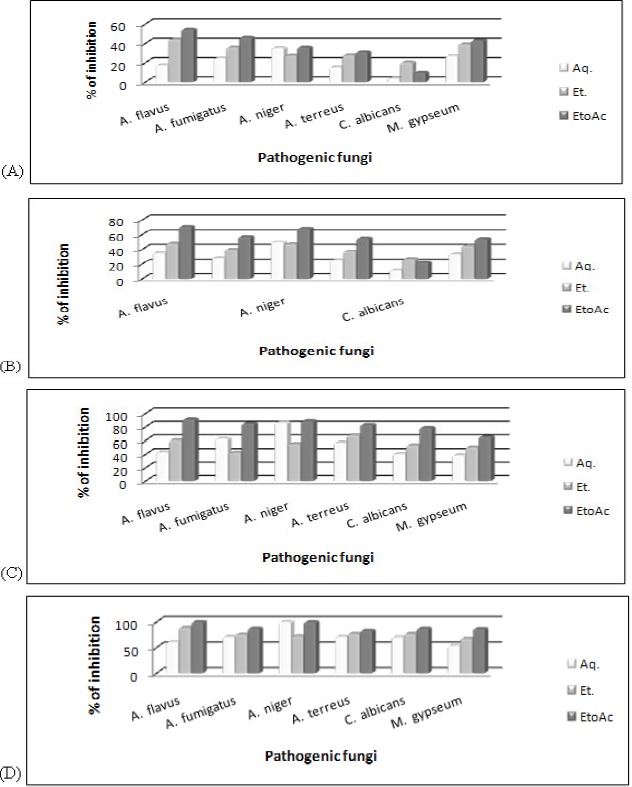
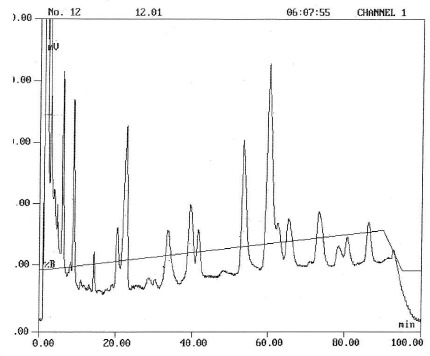
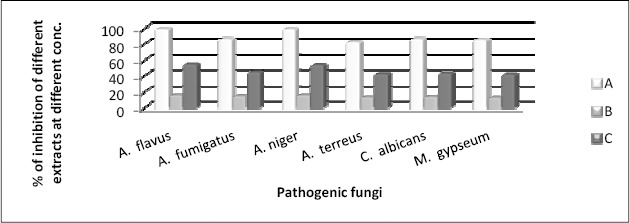
This study was conducted to evaluate the effect of aqueous, ethanolic and ethyl acetate extracts from neem leaves on growth of some human pathogens (Aspergillus flavus, Aspergillus fumigatus, Aspergillus niger, Aspergillus terreus, Candida albicans and Microsporum gypseum) in vitro. Different concentrations (5, 10, 15 and 20%) prepared from these extracts inhibited the growth of the test pathogens and the effect gradually increased with concentration. The 20% ethyl acetate extract gave the strongest inhibition compared with the activity obtained by the same concentration of the other extracts. High Performance Liquid Chromatography (HPLC) analysis of ethyl acetate extract showed the presence of a main component (nimonol) which was purified and chemically confirmed by Nuclear Magnetic Resonance (NMR) spectroscopic analysis. The 20% ethyl acetate extract lost a part of its antifungal effect after pooling out the nimonol and this loss in activity was variable on test pathogens. The purified nimonol as a separate compound did not show any antifungal activity when assayed against all the six fungal pathogens.
Overview
The claims and statistics of this paper haven’t been checked yet.
Run the check — free, no account needed. It reads the open-access text and checks the sources it cites.
Integrity signals
Registry
Cites
Statistics
Figures
Verification
Claims the paper makes
The claims and statistics of this paper haven’t been checked yet.
Run the check — free, no account needed. It reads the open-access text and checks the sources it cites.
Self-check
Percentages, sums and reported differences re-computed from the paper’s own numbers.
The self-check needs the paper’s full text.
Citations
Cites
Identification of antifungal compounds from the seed oil ofAzadirachta Indica
Govindachari, T. R., Suresh, G., Gopalakrishnan, G., Banumathy, B., & Masilamani, S. (1998) · Phytoparasitica · doi:10.1007/bf02980677 · Cited by 145
Research works printed but not linked: 15
- [1]Bhatnagar D. McCormick S.P. The inhibitory effect of neem (Azadirachta indica) leaf extracts on aflatoxin synthesis in Aspergillus parasiticus Journal of the American Oil Chemists’ Society 1988 65 7 1166 1168
- [4]De Resende Ramos A. Ludke Falcao L. Salviano Barbosa G. Helena Marcellino L. Silvano Gander E. Neem (Azadirachta indica A. Juss) components: candidates for control of Crinipellis perniciosa and Phytophthora spp Microbiol. Res. 2007 162 3 238 243 16872817
- [6]Dube S. Tripathi S. Toxicity of some plants against dermatophytes National Academy of Sciences, India, Science Letters 1987 10 2 45 48
- [11]Joshi P.C. Prakash O.M. Prakash O. Tauro P. Narwal S.S. Allelopathic effects of litter extract of some tree species on germination seedling growth of agricultural crops. Proceedings First National Symposium. Allelopathy in agroecosystems (Agriculture & foresty), February 12–14, 1992 held at CCS Haryana Agricultural University 1992 Hisar 125. 004, India 127 128
- [13]Kishore G.K. Pande S. Rao J.N. Control of late leaf spot of groundnut (Arachis hypogaea) by extracts from non-host plant species Plant Pathology Journal 2001 17 5 264 270
- [16]Natarajan V. Pushkala S. Karuppiah V.P. Prasad P.V. Antidermatophytic activity of Azardirachta indica (neem) by invitro study Med Chem Anticancer Agents 2002 5 2 149 6 12785173
- [17]Natarajan V. Venugopal P.V. Menon T. Effect of Azadirachta indica (neem) on the growth pattern of dermatophytes Indian Journal of Medical Microbiology 2003 21 2 98 101 17642990
- [18]Okemo P.O. Mwatha W.E. Chabrab S.C. Fabryc W. The kill kinetics of Azadirachta indica A. juss. (Meliacae) extracts on Staphylococcus aureus, Escherichia coli, Pseudomonas aeruginosa and Candida albicans African Journal of Science and Technology (AJST) Science and Engineering Series 2001 2 2 113 118
- [20]Polaquini S.R. Svidziniski T.I. Kemmelmeier C. Gasparetto A. Effect of aqueous extract from neem (Azadirachta indica A. Juss) on hydrophobicity, biofilm formation and adhesion in composite resin by Candida albicans Arch. Oral Biol. 2006 51 6 482 490 16412377
- [22]Sharma V. Walia S. Kumar J. Nair M.G. Parmar B.S. An efficient method for the purification and characterization of nematicidal azadirachtins A, B, and H, using MPLC and ESIMS J Agric Food Chem. 2003 51 14 3966 72 12822931
- [24]Shivpuri A. Sharma O.P. Jhamaria S.L. Fungitoxic properties of plant extracts against pathogenic fungi Journal of Mycology and Plant Pathology 1997 27 1 29 31
- [26]Subapriya R. Nagini S. Medicinal properties of neem leaves: a review Curr. Med. Chem. Anticancer Agents 2005 5 2 149 160 15777222
- [28]Trish D. Banerjee S. Yadava P.K. Rao A.R. Chemopreventive potential of Azadirachta indica (Neem) leaf extract in murine carcinogenesis model systems Journal of Ethnopharmacology 2004 92 1 23 36 15099843
- [29]Upasana S. Anurag T. Upadhyay A.K. Shukla U. Tewari A. In vitro antimicrobial study of Neem (Azadirachta indica) seed and leaf extracts Indian Journal of Veterinary Medicine 2002 22 2 109 111
- [30]Verma D.K. Tripathi V.J. Rana B.K. Antifungal activity of the seed coat extract of Azadirachta indica Indian journal of Pharmaceutical Science 1998 60 5 305 306
Cited by
Sorted by citations
ALI, J., HUSSAIN, A., IKRAM, M., SIDDIQUE, M., ZAHOOR, M., ULLAH, R., IBRAHIM, M. A., GULFAM, N., & SHAH, A. B. (2025) · Notulae Botanicae Horti Agrobotanici Cluj-Napoca · doi:10.15835/nbha53114086 · Cited by 3
Metadata
- Authors
- Mahmoud, D. A., Hassanein, N. M., Youssef, K. A., & Abou Zeid, M. A.
- Affiliations
- Ain Shams University (EG)
- ORCID
- Hassanein, N.M
- Venue
- Brazilian Journal of Microbiology
- Publisher
- FapUNIFESP (SciELO)
- Published
- 2011-09
- Volume
- 42
- Issue
- 3
- Pages
- 1007-1016
- ISSN
- 1517-8382 (ISSN-L)
- PMC
- PMC3768785
- OpenAlex
- W2065878977
- Cited by
- 141
- References
- 1
- Citations by year
- 2026: 7 · 2025: 14 · 2024: 10 · 2023: 17 · 2022: 25 · 2021: 11 · 2020: 10 · 2019: 12 · 2018: 9 · 2017: 9 · 2016: 5 · 2015: 6 · 2014: 5 · 2013: 1
- FWCI
- 2.81
- Type
- journal article
- Language
- en
- Open access
- hybrid
- doi.org
- Licence
- cc-by-nc
- Locations
- Brazilian Journal of Microbiology (publishedVersion, cc-by-nc)
- Europe PMC (PubMed Central) (publishedVersion, cc-by-nc)
- PubMed Central (publishedVersion, cc-by-nc)
- PubMed (publishedVersion)
- LA Referencia (Red Federada de Repositorios Institucionales de Publicaciones Científicas) (publishedVersion, other-oa)
- Americanae (AECID Library) (submittedVersion, cc-by-nc)
- DOAJ (DOAJ: Directory of Open Access Journals) (submittedVersion, cc-by-sa)
- Topics
- Life Sciences › Agricultural and Biological Sciences › Food Science › Essential Oils and Antimicrobial Activity
- Life Sciences › Pharmacology, Toxicology and Pharmaceutics › Drug Discovery › Phytochemical compounds biological activities
- Health Sciences › Medicine › Infectious Diseases › Antifungal resistance and susceptibility
- Keywords
- neem leaf extract, antifungal activity, human fungal pathogens, Aspergillus, Candida albicans, Microsporum gypseum, ethyl acetate extract, aqueous and ethanolic extracts, structure-activity relationship
About these checks
Registry, retraction, Cites and statistics results are computed, not judged, with one exception: a printed reference that no index lists is read once by a model before it counts as a citation error. Claims are extracted by a model and kept only when their quote appears verbatim in the text; each cited source is then checked, with a model’s help, for whether it says what the claim relies on. Those verdicts can be wrong — read the claim’s quote and the cited source before relying on one.
Statistics and arithmetic are recomputed, not judged.
Confidence bands are shown only for fields calibrated on our annotated test set. None is calibrated yet, so no band is shown.
What counts as a claim ›How we measure confidence ›How we check this ›
Are you an author, or do you see a problem with this page? Request a review
