

The DOI matches its Crossref record; 11 of the 11 references it cites were found in a registry or an index.
Intercropping for Management of Insect Pests of Castor, Ricinus communis , in the Semi—Arid Tropics of India
Open accessAbstract
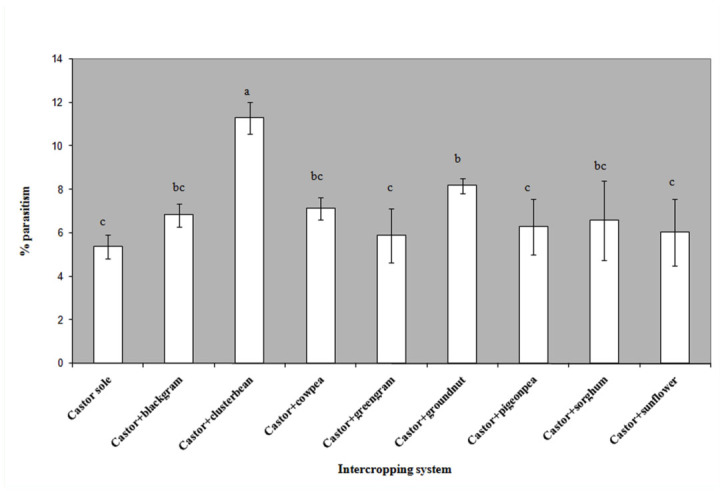
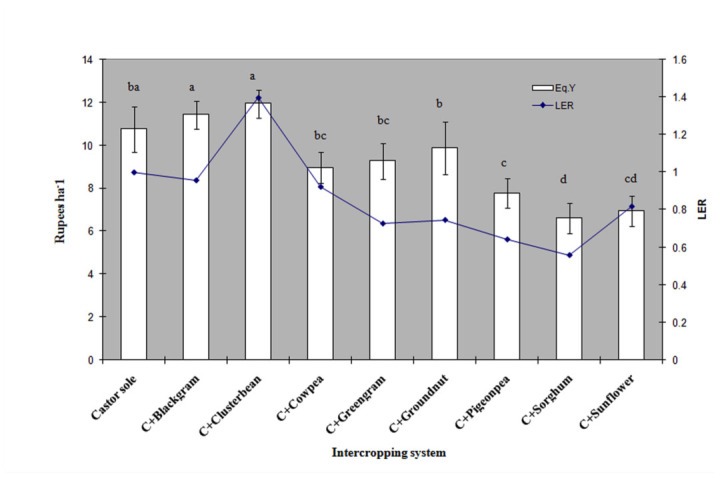
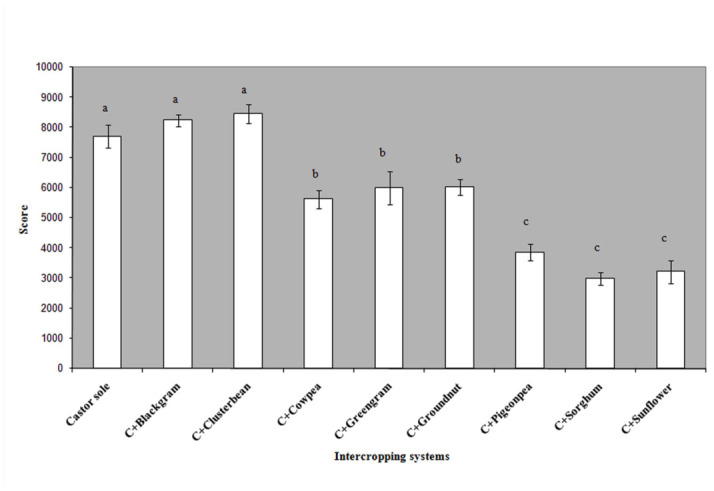
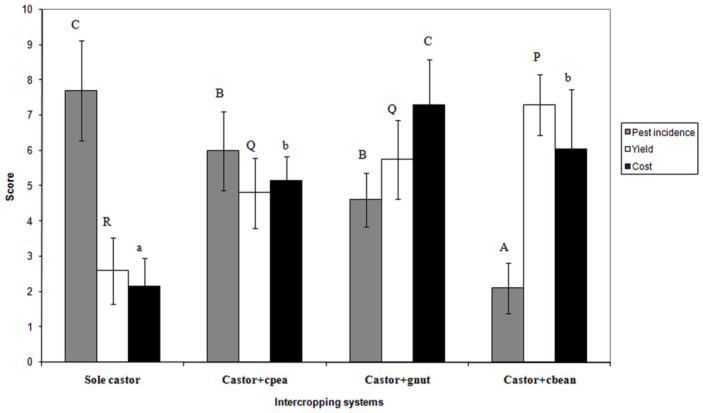
Intercropping is one of the important cultural practices in pest management and is based on the principle of reducing insect pests by increasing the diversity of an ecosystem. On-farm experiments were conducted in villages of semi-arid tropical (SAT) India to identify the appropriate combination of castor (Ricinus communis L.) (Malpighiales: Euphorbiaceae) and intercropping in relation to pest incidence. The diversity created by introducing cluster bean, cowpea, black gram, or groundnut as intercrops in castor (1:2 ratio proportions) resulted in reduction of incidence of insect pests, namely semilooper (Achaea janata L.), leaf hopper (Empoasca flavescens Fabricius), and shoot and capsule borer (Conogethes punctiferalis Guenee). A buildup of natural enemies (Microplitis, coccinellids, and spiders) of the major pests of castor was also observed in these intercropping systems and resulted in the reduction of insect pests. Further, these systems were more efficient agronomically and economically, and were thus more profitable than a castor monocrop.
Overview
The claims and statistics of this paper haven’t been checked yet.
Run the check — free, no account needed. It reads the open-access text and checks the sources it cites.
Integrity signals
Registry
Cites
Statistics
Figures
Verification
Claims the paper makes
The claims and statistics of this paper haven’t been checked yet.
Run the check — free, no account needed. It reads the open-access text and checks the sources it cites.
Claims other papers make about this one
Each is checked against this paper’s own text: does it say what the citing paper says it does?
The cited source says what the claim attributes to it.
In the citing paper
“In addition, some articles have clearly shown how different management aspects, particularly the selection of crop species/varieties or the planting date, can affect final socioeconomic results (Kuntashula et al. 2004; Srinivasa Rao et al. 2012; Sogoba et al. 2020; Severini et al. 2021).”
From The socio-economic performance of agroecology. A review (2024) · cites this paper as Srinivasa Rao et al. 2012
Self-check
Percentages, sums and reported differences re-computed from the paper’s own numbers.
The self-check needs the paper’s full text.
Citations
Cites
A Competitive Ratio for Quantifying Competition Between Intercrops
Willey, R. W., & Rao, M. R. (1980) · Experimental Agriculture · doi:10.1017/s0014479700010802 · Cited by 515
Agroecosystem Diversity and Pest Control: Data, Tentative Conclusions, and New Research Directions
Risch, S. J., Andow, D. A., & Altieri, M. A. (1983) · Environmental Entomology · doi:10.1093/ee/12.3.625 · Cited by 496
Intercropping for the management of pests and diseases
Trenbath, B. R. (1993) · Field Crops Research · doi:10.1016/0378-4290(93)90123-5 · Cited by 328
Insect Science and Its Application
(1985) · International Journal of Tropical Insect Science · doi:10.1017/s1742758400002575 · Cited by 205
Intercropping as cultural pest control: Prospects and limitations
Risch, S. J. (1983) · Environmental Management · doi:10.1007/bf01867035 · Cited by 91
Plant Species Diversity and Crop Pest Control
Baliddawa, C. W. (1985) · International Journal of Tropical Insect Science · doi:10.1017/s1742758400004306 · Cited by 75
(1937) · Annals of the Entomological Society of America · doi:10.1093/aesa/30.4.646 · Cited by 70
Kaitaniemi, P., Riihimäki, J., Koricheva, J., et al. (2007) · Silva Fennica · doi:10.14214/sf.295 · Cited by 61
Songa, J. M., Jiang, N., Schulthess, F., et al. (2007) · Journal of Applied Entomology · doi:10.1111/j.1439-0418.2006.01116.x · Cited by 60
Damage Potential of Achaea Janata Linn, at Different Phenological Stages of Castor
Basappa, H., & Lingappa, S. (2001) · Indian journal of plant protection · Cited by 6
Research works printed but not linked: 5
- Basappa H, 2001, Indian Journal of Plant Protection, 29, 17
- Bureau of Economics and Statistics, 2005, Season and crop report 2004–2005.
- Srinivasa Rao M, 2004, Shashpa, 11, 61
- Subba Reddy G, 2004, Indian Journal of Agriculture Research, 38, 79
- Tahiliani BD, 1985, Pestology, 9, 7
Cited by
Sorted by citations
The socio-economic performance of agroecology. A review
Mouratiadou, I., Wezel, A., Kamilia, K., Marchetti, A., Paracchini, M. L., & Bàrberi, P. (2024) · Agronomy for Sustainable Development · doi:10.1007/s13593-024-00945-9 · Cited by 96
“In addition, some articles have clearly shown how different management aspects, particularly the selection of crop species/varieties or the planting date, can affect final socio-economic results (Kuntashula et al. 2004; Srinivasa Rao et al. 2012; Sogoba et al. 2020; Severini et al. 2021).”
Background
Metadata
- Authors
- Srinivasa Rao, M., Rama Rao, C. A., Srinivas, K., Pratibha, G., Vidya Sekhar, S. M., Sree Vani, G., & Venkateswarlu, B.
- Affiliations
- Central Research Institute for Dryland Agriculture (IN)
- Venue
- Journal of Insect Science
- Publisher
- Oxford University Press (OUP)
- Published
- 2012-02
- Volume
- 12
- Issue
- 14
- Pages
- 1-10
- ISSN
- 1536-2442 (ISSN-L)
- PMC
- PMC3467089
- OpenAlex
- W1996604672
- Cited by
- 32
- References
- 11
- Citations by year
- 2026: 4 · 2024: 2 · 2023: 3 · 2022: 2 · 2021: 5 · 2020: 5 · 2018: 2 · 2017: 2 · 2016: 3 · 2015: 2 · 2014: 2
- FWCI
- 2.57
- Type
- journal article
- Language
- en
- Open access
- gold
- doi.org
- Licence
- cc-by
- Locations
- Journal of Insect Science (publishedVersion, cc-by)
- Europe PMC (PubMed Central) (publishedVersion, cc-by)
- PubMed Central (publishedVersion, cc-by)
- PubMed (publishedVersion)
- BioOne Complete (BioOne) (submittedVersion)
- Funders
- Indian Council of Agricultural Research
- Topics
- Life Sciences › Agricultural and Biological Sciences › Agronomy and Crop Science › Agronomic Practices and Intercropping Systems
- Life Sciences › Agricultural and Biological Sciences › Insect Science › Insect-Plant Interactions and Control
- Life Sciences › Agricultural and Biological Sciences › Plant Science › Insect Pest Control Strategies
- Keywords
- intercropping, castor, Ricinus communis, insect pest management, semilooper, Achaea janata, leafhoppers, Empoasca flavescens, Conogethes punctiferalis, natural enemies, Microplitis, Coccinellidae, spiders, semi-arid tropics, Cyamopsis tetragonoloba, cowpea, Vigna mungo, groundnut, agroecosystem diversity, economic profitability
- MeSH terms
- Animals, Ricinus communis, Desert Climate, India, Insect Control, Insecta, Crops, Agricultural
About these checks
Registry, retraction, Cites and statistics results are computed, not judged, with one exception: a printed reference that no index lists is read once by a model before it counts as a citation error. Claims are extracted by a model and kept only when their quote appears verbatim in the text; each cited source is then checked, with a model’s help, for whether it says what the claim relies on. Those verdicts can be wrong — read the claim’s quote and the cited source before relying on one.
Statistics and arithmetic are recomputed, not judged.
Confidence bands are shown only for fields calibrated on our annotated test set. None is calibrated yet, so no band is shown.
What counts as a claim ›How we measure confidence ›How we check this ›
Are you an author, or do you see a problem with this page? Request a review
