

The DOI matches its Crossref record; 1 of the 1 references it cites were found in a registry or an index.
Who Uses Right-Wing Alternative Online Media? An Exploration of Audience Characteristics
Abstract
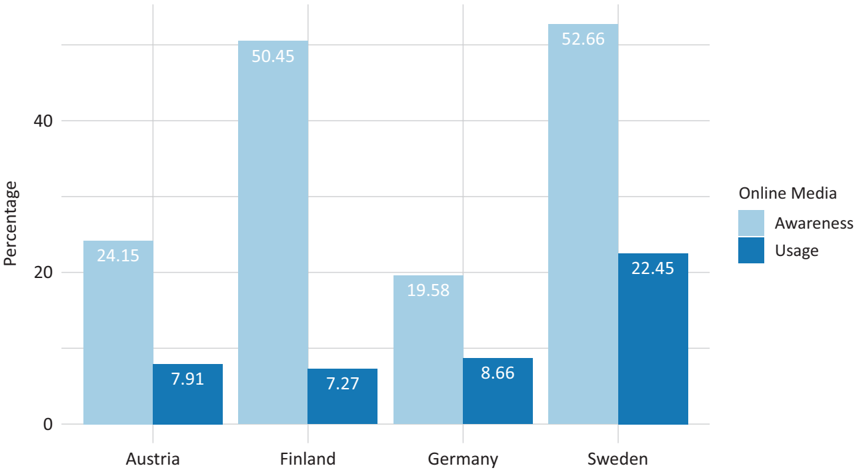
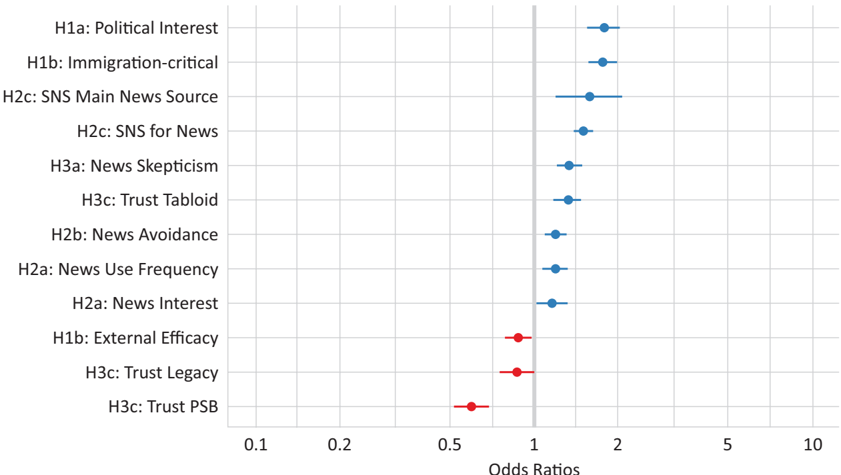
Accompanying the success of the radical right and right-wing populist movements, right-wing alternative online media have recently gained prominence and, to some extent, influence on public discourse and elections. The existing scholarship so far focuses primarily on the role of content and social media distribution and pays little attention to the audiences of right-wing alternative media, especially at a cross-national level and in the European context. The present paper addresses this gap by exploring the characteristics of the audiences of right-wing alternative online media. Based on a secondary data analysis of the 2019 Reuters Digital News Survey, this article presents a cross-national analysis of right-wing alternative media use in Northern and Central Europe. The results indicate a comparatively high prevalence of right-wing alternative online media in Sweden, whereas in Germany, Austria, and Finland, these news websites seem to be far less popular. With regard to audience characteristics, the strongest predictors of right-wing alternative online media use are political interest and a critical stance towards immigration, accompanied by a skeptical assessment of news quality, in general, and distrust, especially in public service broadcasting media. Additionally, the use of social media as a primary news source increases the likelihood of right-wing alternative news consumption. This corroborates the high relevance of social media platforms as distributors and multipliers of right-wing alternative news content. The findings suggest that right-wing alternative online media should not be underestimated as a peripheral phenomenon, but rather have to be considered influential factors for center-right to radical right-leaning politics and audiences in public discourse, with a high mobilizing and polarizing potential.
Overview
The claims and statistics of this paper haven’t been checked yet.
Run the check — free, no account needed. It reads the open-access text and checks the sources it cites.
Integrity signals
Registry
Cites
Statistics
Figures
Verification
Claims the paper makes
The claims and statistics of this paper haven’t been checked yet.
Run the check — free, no account needed. It reads the open-access text and checks the sources it cites.
Claims other papers make about this one
Each is checked against this paper’s own text: does it say what the citing paper says it does?
In the citing paper
“There is also evidence for an association between increased social media use and online right-wing radicalization in Austria, Sweden and Australia135–137.”
From A systematic review of worldwide causal and correlational evidence on digital media and democracy (2022) · cites this paper as [137]
Self-check
Percentages, sums and reported differences re-computed from the paper’s own numbers.
The self-check needs the paper’s full text.
Citations
Cites
Network Propaganda: Manipulation, Disinformation, and Radicalization in American Politics
Benkler, Y., Faris, R., & Roberts, H. (2018) · doi:10.1093/oso/9780190923624.001.0001 · Cited by 1,504 · cited 1×
“However, several studies showed that right-wing audiences, in particular, prefer and build ideologically aligned media repertoires by intentionally avoiding opposing news sources (Benkler et al., 2018; Rauch, 2019).”
Background
Research works printed but not linked: 49
- Atkinson, J. D., & Leon Berg, S. V. (2012). Narrowmobilization and Tea Party activism: A study of right-leaning alternative media. Communication Studies, 63(5), 519–535. https://doi.org/10.1080/10510974.2011.649442 · DOI
- Atton, C. (2006). Far-right media on the internet: Culture, discourse and power. New Media & Society, 8(4), 573–587. · DOI
- Bachl, M. (2018). (Alternative) media sources in AfD-centered Facebook discussions. Studies in Communication and Media, 7(2), 256–270. · DOI
- Brüggemann, M., Engesser, S., Büchel, F., Humprecht, E., & Castro, L. (2014). Hallin and Mancini revisited: Four empirical types of Western media systems. Journal of Communication, 64(6), 1037–1065. · DOI
- de La Brosse, R., & Thinsz, G. (2019). Media coverage of the migratory crisis in Sweden: A revealing of the growing polarization between traditional media and antisystem media? In Ameaças ao ciberjornalismo (pp. 168–180). Porto: Universidade do Porto.
- Downing, J. D. H. (2003). Audiences and readers of alternative media: The absent lure of the virtually unknown. Media, Culture & Society, 25(5), 625–645. · DOI
- Engesser, S., Fawzi, N., & Larsson, A. O. (2017). Populist online communication: Introduction to the special issue. Information, Communication & Society, 20(9), 1279–1292. · DOI
- Farkas, J., & Neumayer, C. (2020). Mimicking news. Nordicom Review, 41(1), 1–17. · DOI
- Fawzi, N. (2019). Untrustworthy news and the media as “enemy of the people?” How a populist worldview shapes recipients’ attitudes toward the media. The International Journal of Press/Politics, 24(2), 146–164. · DOI
- Figenschou, T. U., & Ihlebæk, K. A. (2018). Challenging journalistic authority. Journalism Studies, 20(9), 1221–1237. · DOI
- Figenschou, T. U., & Ihlebæk, K. A. (2019). Media criticism from the far-right: Attacking from many angles. Journalism Practice, 13(8), 901–905. · DOI
- Fletcher, R. (2019). The rise of populism and the consequences for news and media use. In N. Newman, R. Fletcher, A. Kalogeropoulos, & R. K. Nielsen (Eds.), Reuters institute digital news report 2019 (pp. 42–48). Oxford: University of Oxford
- Fletcher, R., & Park, S. (2017). The impact of trust in the news media on online news consumption and participation. Digital Journalism, 5(10), 1281–1299. · DOI
- Frischlich, L., Klapproth, J., & Brinkschulte, F. (2020). Between mainstream and alternative—Co-orientation in right-wing populist alternative news media. In C. Grimme, M. Preuss, F. W. Takes, & A. Waldherr (Eds.), Lecture notes in computer science. Disinformation in open online media (Vol. 12021, pp. 150–167). Cham: Springer International Publishing.
- Garrett, R. K. (2009). Politically motivated reinforcement seeking: Reframing the selective exposure debate. Journal of Communication, 59(4), 676–699. · DOI · Paper page
- Haller, A. (2018). Symbiotische Interdependenzen. Rechtspopulismus und politische Alternativpublizistik [Symbiotic interdependencies. Right-wing populism and alternative political journalism] Communicatio Socialis, 51(2), 143–153.
- Haller, A., Holt, K., & de La Brosse, R. (2019). The ‘other’ alternatives: Political right-wing alternative media. Journal of Alternative and Community Media. https://doi.org/10.20378/irbo-54716 · DOI
- Hallin, D. C., & Mancini, P. (2004). Comparing media systems: Three models of media and politics. Communication, society and politics. Cambridge: Cambridge University Press. · DOI
- Harcup, T. (2016). So many questions: What’s the point of researching and teaching alternative media? Journal of Alternative and Community Media, 1(1), 19-20. · DOI
- Hart, W., Albarracín, D., Eagly, A. H., Brechan, I., Lindberg, M. J., & Merrill, L. (2009). Feeling validated versus being correct: A meta-analysis of selective exposure to information. Psychological Bulletin, 135(4), 555–588. · DOI · Paper page
- Heft, A., Mayerhöffer, E., Reinhardt, S., & Knüpfer, C. (2019). Beyond Breitbart: Comparing right‐wing digital news infrastructures in six Western democracies. Policy & Internet. https://doi.org/10.1002/poi3.219 · DOI
- Holt, K. (2018). Alternative media and the notion of anti-systemness: Towards an analytical framework. Media and Communication, 6(4), 49. · DOI
- Holt, K. (2019). Right-wing alternative media. London and New York, NY: Routledge. · DOI
- Holt, K., & Haller, A. (2017). What does ‘Lügenpresse’ mean? Expressions of media distrust on PEGIDA’s Facebook pages. Politik. https://doi.org/10.7146/politik.v20i4.101534 · DOI
- Holt, K., Ustad Figenschou, T., & Frischlich, L. (2019). Key dimensions of alternative news media. Digital Journalism, 20(9), 1–10. · DOI
- Kalogeropoulos, A., Suiter, J., Udris, L., & Eisenegger, M. (2019). News media trust and news consumption: Factors related to trust in news in 35 countries. International Journal of Communication, 13(2019), 3672–3693.
- Larsson, A. O. (2019). News use as amplification: Norwegian national, regional, and hyperpartisan media on Facebook. Journalism & Mass Communication Quarterly, 96(3), 721–741. · DOI
- Mathes, R., & Pfetsch, B. (1991). The role of the alternative press in the agenda-building process: Spill-over effects and media opinion leadership. European Journal of Communication, 6, 33–62. · DOI
- Müller, P., & Schulz, A. (2019). Alternative media for a populist audience? Exploring political and media use predictors of exposure to Breitbart, Sputnik, and Co. Information, Communication & Society, 4(1), 1–17. · DOI
- Newman, N., Fletcher, R., Kalogeropulos, A., Levy, D. A. L., & Nielsen, R. K. (Eds.). (2018). Reuters institute digital news report 2018. Oxford: University of Oxford.
- Newman, N., Fletcher, R., Kalogeropoulos, A., & Nielsen, R. K. (Eds.). (2019). Reuters institute digital news report 2019. Oxford: University of Oxford.
- Noppari, E., Hiltunen, I., & Ahva, L. (2019). User profiles for populist counter-media websites in Finland. Journal of Alternative and Community Media, 4, 23–37. · DOI
- Nygaard, S. (2019). The appearance of objectivity: How immigration-critical alternative media report the news. Journalism Practice, 13(10), 1147–1163. · DOI
- Nygaard, S. (2020). Boundary work: Intermedia agenda-setting between right-wing alternative media and professional journalism. Journalism Studies. https://doi.org/10.1080/1461670X.2020.1722731 · DOI
- Puschmann, C., Ausserhofer, J., Maan, N., & Hametner, M. (2016). Information laundering and counter-publics: The news sources of islamophobic groups on twitter. Presented at The Workshops of the Tenth International AAAI Conference on Web and Social Media, Cologne.
- Rauch, J. (2007). Activists as interpretive communities: Rituals of consumption and interaction in an alternative media audience. Media, Culture & Society, 29(6), 994–1013. · DOI
- Rauch, J. (2015). Exploring the alternative-mainstream dialectic: what “alternative media” means to a hybrid audience. Communication, Culture & Critique, 8(1), 124–143. · DOI
- Rauch, J. (2019). Comparing progressive and conservative audiences for alternative media and their attitudes towards journalism. In J. D. Atkinson & L. J. Kenix (Eds.), Alternative media meets mainstream politics: Activist nation rising (pp. 19–38). Lanham, MD: Lexington Books.
- Sandberg, L. A. C., & Ihlebaek, K. A. (2019). Start sharing the news: Exploring the link between right-wing alternative media and social media during the Swedish 2018 election. Statsvetenskaplig Tidskrift, 121(3), 421–440.
- Schindler, J., Fortkord, C., Posthumus, L., Obermaier, M., & Reinemann, C. (2018). Woher kommt und wozu führt Medienfeindlichkeit? Zum Zusammenhang von populistischen Einstellungen, Medienfeindlichkeit, negativen Emotionen und Partizipation [Where does media hostility come from and what does it lead to? The connection between populist attitudes, media hostility, negative emotions and participation]. Medien & Kommunikationswissenschaft, 66(3), 283–301. · DOI
- Schulz, A. (2019). Where populist citizens get the news: An investigation of news audience polarization along populist attitudes in 11 countries. Communication Monographs, 86(1), 88–111. · DOI
- Starbird, K. (2017). Examining the alternative media ecosystem through the production of alternative narratives of mass shooting events on Twitter. Paper presented ate Tenth International Conference on Web and Social Media (ICWSM), Montreal, Canada. · DOI
- Stier, S., Kirkizh, N., Froio, C., & Schroeder, R. (2020). Populist attitudes and selective exposure to online news: A cross-country analysis combining web tracking and surveys. The International Journal of Press/Politics. https://doi.org/10.1177/1940161220907018 · DOI
- Strömbäck, J., Djerf-Pierre, M., & Shehata, A. (2013). The dynamics of political interest and news media consumption: A longitudinal perspective. European Journal of Political Research, 25(4), 414–435.
- Tsfati, Y., & Cappella, J. N. (2003). Do people watch what they do not trust? Exploring the association between news media skepticism and exposure. Communication Research, 30(5), 504–529. · DOI
- Tsfati, Y., & Peri, Y. (2006). Mainstream media skepticism and exposure to sectorial and extranational news media: The case of Israel. Mass Communication and Society, 9(2), 165–187. · DOI
- Tucker, J., Guess, A., Barberá, P., Vaccari, C., Siegel, A., Sanovich, S., . . . Nyhan, B. (2018). Social media, political polarization, and political disinformation: A review of the scientific literature. SSRN Electronic Journal. Advance online publication. https://doi.org/10.2139/ssrn.3144139 · DOI · Paper page
- von Nordheim, G., Müller, H., & Scheppe, M. (2019). Young, free and biased: A comparison of mainstream and right-wing media coverage of the 2015–16 refugee crisis in German newspapers. Journal of Alternative and Community Media, 4, 38–56. · DOI
- Ylä-Anttila, T. (2018). Populist knowledge: ‘Post-truth’ repertoires of contesting epistemic authorities. European Journal of Cultural and Political Sociology, 5(4), 356–388. · DOI
Cited by
Sorted by citations
A systematic review of worldwide causal and correlational evidence on digital media and democracy
Lorenz-Spreen, P., Oswald, L., Lewandowsky, S., & Hertwig, R. (2022) · Nature Human Behaviour · doi:10.1038/s41562-022-01460-1 · Cited by 348
Metadata
- Authors
- Schulze, H.
- Venue
- Politics and Governance
- Publisher
- Cogitatio
- Published
- 2020-07-17
- Volume
- 8
- Issue
- 3
- Pages
- 6-18
- ISSN
- 2183-2463
- Cited by
- 81
- References
- 1
About these checks
Registry, retraction, Cites and statistics results are computed, not judged, with one exception: a printed reference that no index lists is read once by a model before it counts as a citation error. Claims are extracted by a model and kept only when their quote appears verbatim in the text; each cited source is then checked, with a model’s help, for whether it says what the claim relies on. Those verdicts can be wrong — read the claim’s quote and the cited source before relying on one.
Statistics and arithmetic are recomputed, not judged.
Confidence bands are shown only for fields calibrated on our annotated test set. None is calibrated yet, so no band is shown.
What counts as a claim ›How we measure confidence ›How we check this ›
Are you an author, or do you see a problem with this page? Request a review
