

The DOI matches its Crossref record; 1 of the 1 references it cites were found in a registry or an index.
Exploring Anxiety and Self-Efficacy in Writing: a Case of an English Preparatory Program
Abstract
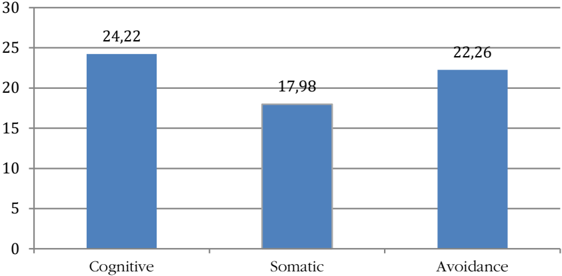
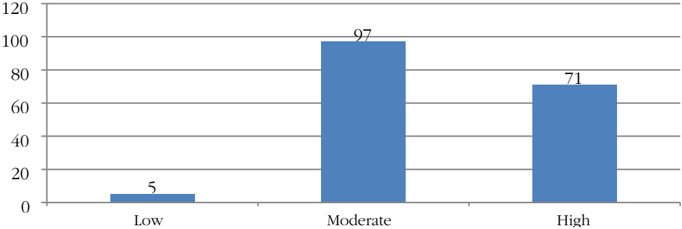
This paper investigates the level and type of writing anxiety among Turkish EFL students along with the causes of the anxiety perceived by them and their instructors. The EFL writing self-efficacy level of the students was examined, and with the findings obtained, the relationship between writing anxiety and writing self-efficacy in EFL classes was investigated. To meet these objectives, 176 (A2, intermediate level) Turkish EFL students and 6 instructors enrolled in a language preparatory program offered by a state university in Istanbul, Turkey participated in the study. The data were gathered both quantitative and qualitatively through the Second Language Writing Anxiety Inventory (SLWAI), Self-efficacy in Writing Scale (SWS), Causes of Writing Anxiety Inventory (CWAI), and semi-structured interviews. The results revealed that the students had either a high or moderate level of writing anxiety in English, and they mostly suffered from cognitive anxiety. Their level of writing self-efficacy was also moderate, and there was a negative correlation between self-efficacy and writing anxiety among the participants. The results of this study suggest implications about coping with anxiety and self-efficacy in writing classes at language preparatory programs.
Overview
The claims and statistics of this paper haven’t been checked yet.
Run the check — free, no account needed. It reads the open-access text and checks the sources it cites.
Integrity signals
Registry
Cites
Statistics
Figures
Verification
Claims the paper makes
The claims and statistics of this paper haven’t been checked yet.
Run the check — free, no account needed. It reads the open-access text and checks the sources it cites.
Claims other papers make about this one
Each is checked against this paper’s own text: does it say what the citing paper says it does?
In the citing paper
“This finding is consistent with Göncü and Mede (2022), who observed that cognitive anxiety was the predominant form of anxiety among students, suggesting that internal psychological stress tends to outweigh physical symptoms or avoidance behaviours during academic writing.”
From Influence of mastery and vicarious experiences on thesis writing anxiety of doctoral students in library and information science, Southwest Nigeria (2025) · cites this paper as Göncü and Mede (2022)
In the citing paper
“Empirical studies underscore the inverse relationship between writing selfefficacy and anxiety.”
From Influence of mastery and vicarious experiences on thesis writing anxiety of doctoral students in library and information science, Southwest Nigeria (2025) · cites this paper as Göncü and Mede (2022)
In the citing paper
“Particularly at the doctoral level, a strong sense of selfefficacy serves as a stabilizing psychological factor that enhances resilience throughout the research process (Beharu, 2018;Göncü & Mede, 2022).”
From Influence of mastery and vicarious experiences on thesis writing anxiety of doctoral students in library and information science, Southwest Nigeria (2025) · cites this paper as Göncü & Mede, 2022
Self-check
Percentages, sums and reported differences re-computed from the paper’s own numbers.
The self-check needs the paper’s full text.
Citations
Cites
The Subtle Effects of Language Anxiety on Cognitive Processing in the Second Language
MacIntyre, P. D., & Gardner, R. C. (1994) · Language Learning · doi:10.1111/j.1467-1770.1994.tb01103.x · Cited by 1,823
Research works printed but not linked: 56
- Al-Ahmad, S. 2003. The impact of collaborative learning on L1 and L2 college students' apprehension about and attitudes toward writing. Unpublished Ph. D. thesis. Indiana University of Pennsylvania, United States.
- Arnold, J. 2011. "Attention to affect in language learning". Online Submission 22 (1): 11-22.
- Atay, D. and Kurt, G. 2006. "Prospective teachers and L2 writing anxiety". Asian EFL Journal 8 (4): 100-118.
- Ateş, S. 2013. Foreign language writing anxiety of prospective EFL teachers: How to reduce their anxiety levels Unpublished master dissertation. Baskent University, Ankara.
- Blasco, J. A. 2016. "The relationship between writing anxiety, writing self-efficacy, and Spanish EFL students' use of metacognitive writing strategies: A case study". Journal of English Studies 14: 7-45.
- Bloom, L. Z. 1985. "Anxious writers in context: Graduate school and beyond". When a writer can`t write. Ed. M. Rose. New York: Guilford Press. 119-133.
- Brown, H. D. 1973. "Affective variables in second language acquisition". Language Learning 23 (2): 231-244.
- Bruning, R. and Horn, C. 2000. "Developing Motivation to Write". Educational Psychologist, 35, 25-37. https://doi.org/10.1207/S15326985EP3501_4 · DOI
- Cheng, Y. S. 2004a. "EFL students' writing anxiety: Sources and implications". English Teaching & Learning 29 (2): 41-62.
- Cheng, Y. S. 2004b. "A measure of second language writing anxiety: Scale development and preliminary validation". Journal of Second Language Writing 13 (4): 313-335.
- Cheng, Y.S., Horwitz, E.K. and Schallert, D.L. 1999. "Language anxiety: Differentiating writing and speaking components". Language learning 49 (3): 417-446.
- Cheng, Y. S. 2002. "Factors associated with foreign language writing anxiety". Foreign Language Annuals 35 (5): 647-56. Retrieved from ERIC Database. (ED 216387). Journal of English Studies, vol. 20 (2022) 137-159
- Creswell, J. W. 2003. Research design: Qualitative, quantitative, and mixed methods approach (2nd ed.). Thousand Oaks: Sage Publications, Inc.
- Dal, N. 2018. An investigation into EFL students' writing anxiety and its relatıonship wıth writing performance: A Study with Freshman-Electrical Electronics Engineering Students in Turkey (Master's thesis). Turkey.
- Daly, J. A. and Miller, M. D. 1975. "The empirical development of an instrument of writing apprehension". Research in the Teaching of English 9 (3): 242-249.
- Ekmekçi, E. 2018. "Exploring Turkish EFL students' writing anxiety". The Reading Matrix: An International Online Journal 18 (1): 158-175.
- Ellis, R. 2006. "Current Issues in the Teaching of Grammar: An SLA Perspective". TESOL Quarterly 40: 83-107.
- Erkan, D. Y. and Saban, A. I. 2011. "Writing performance relative to writing apprehension, self-efficacy in writing, and attitudes towards writing: A correlational study in Turkish tertiary-level EFL". Asian EFL Journal 13 (1): 163- 191.
- Genc, H. E. 2017. The second language writing anxiety: the perceived sources and consequences (Master's thesis). Denizli, Istanbul.
- Guzel, S. and Aydin, S. 2016. "The effect of second life on speaking achievement". Global Journal of Foreign Language Teaching, 6(4): 236-245.
- Han, T., Tanriöver, A.S. and Şahan, Ö. 2016. "EFL students' and teachers' attitudes toward foreign language speaking anxiety: A look at NESTs and Non-NESTs". International Education Studies 9 (3), URL: http://dx.doi.org/10.5539/ies.v9n3p1. · DOI
- Hassan, B. 2001. "The relationship of writing apprehension and self-esteem to the writing quality and quantity of EFL university students". Mansoura Faculty of Education Journal 39: 1-36.
- Hilgard, E. R. 1963. "Ability to resist suggestions within the hypnotic state: Responsiveness to conflicting communications". Psychological Reports 12 (1): 3- 13.
- Horwitz, E. K., Horwitz, M. B. and Cope, J. 1986. "Foreign language classroom anxiety". The Modern Language Journal 70 (2): 125-132.
- Jebreil, N., Azizifar, A., Gowhary, H. and Jamalinesari, A. 2015. "A Study on Writing Anxiety among Iranian EFL Students". International Journal of Applied Linguistics & English Literature 4 (2): 68-72.
- Jones, E. 2008. "Predicting performance in first-semester college basic writers: Revisiting the role of self-beliefs". Contemporary Educational Psychology 33 (2): 209-238.
- Kara, S. 2013. "Writing anxiety: A case study on students' reasons for anxiety in writing classes". Anadolu Journal of Educational Sciences International 3 (1): 103-111.
- Khelalfa, N. 2018. "Writing Anxiety, Self-efficacy, Effort, and Their Roles in Writing Achievement". Proceedings of the 10th International RAIS Conference on Social Sciences and Humanities. Scientia Moralitas Research Institute. 33-37.
- Kırmızı, Ö. and Kırmızı, G. D. 2015. "An investigation of L2 learners' writing self- efficacy, writing anxiety and its causes at higher education in Turkey". International Journal of Higher Education 4 (2): 57-66.
- Kusumaningputri, R., Ningsih, T. A. and Wisasongko, W. 2018. "Second Language Writing Anxiety of Indonesian EFL Students". Lingua Cultura 12 (4): 357-362.
- Lavelle, E. 2006. "Teachers' self-efficacy for writing". Electronic Journal of Research in Educational Psychology 4 (8): 73-84.
- Lin, G. H. C. and Ho, M. M. S. 2009. "An Exploration into Foreign Language Writing Anxiety from Taiwanese University Students' Perspectives". NCUE Fourth Annual Conference on Language, Teaching, Literature, Linguistics, Translations, and Interpretation.
- Liu, M., and Ni, H. 2015. "Chinese University EFL Learners' Foreign Language Writing Anxiety: Pattern, Effect, and Causes". English Language Teaching 8 (3): 46-58.
- MacIntyre, P. D. and Gardner, R. C. 1991. "Language anxiety: Its relationship to other anxieties and processing in native and second languages". Language learning 41 (4): 513-534.
- Magogwe, J. M., Ramoroka, B. T. and Mogana-Monyepi, R. 2015. "Developing Student-Writers' Self-efficacy Beliefs". Journal of Academic Writing 5 (2): 20-28. Journal of English Studies, vol. 20 (2022) 137-159
- Na, Z. 2007. "A study of high school students" English learning anxiety". The Asian EFL Journal 9(3), 22-34.
- Nazzal, N. A. 2008. The relationship of second language writing apprehension, writing self-efficacy beliefs, and the writing performance of EFL AUB students. Ph. D. thesis. American University of Beirut, Lebanon.
- Negari, G. M., and Rezaabadi, O. T. 2012. "Too nervous to write? The relationship between anxiety and EFL writing". Theory and Practice in Language Studies 2 (12): 25-78.
- Olivares-Cuhat, G. 2010. "The relative importance of learning variables on l2 performance". Linguistik Online 43 (3): 99-116.
- Öztürk, G. and Saydam, D. 2014. "Anxiety and self-efficacy in foreign language writing: the case in Turkey". Başkent University Journal of Education, 1(2): 10- 21.
- Pajares, F. 2003. "Self-efficacy beliefs, motivation, and achievement in writing: A review of the literature". Reading & Writing Quarterly 19(2): 139-158.
- Pajares, F. and Cheong, Y. F. 2003. "Achievement goal orientations in writing: A developmental perspective". International Journal of Educational Research 39(4): 437-455.
- Pajares, F. and Johnson, M. J. 1994. "Confidence and competence in writing: The role of self-efficacy, outcome expectancy, and apprehension". Research in the Teaching of English 28 (3): 313-331.
- Pajares, F. and Valiante, G. 1997. "Influence of self-efficacy on elementary students' writing". Journal of Educational Research 90 (6): 353-360.
- Pajares, F., Miller, M. D. and Johnson, M. J. 1999. "Gender differences in writing self- beliefs of elementary school students". Journal of Educational Psychology 91: 50- 61.
- Pajares, F. 2003. "Self-efficacy beliefs, motivation, and achievement in writing: A review of the Literature". Reading & Writing Quarterly 19: 139-158.
- Pajares, F. and Valiante, G. 2006. "Self-efficacy beliefs and motivation in writing development". Handbook of writing research. Eds. C. A. Macarthur, S. Graham and J. Fitzgerald. Guilford Press. 158-170.
- Rankin-Brown, M. 2006. Addressing Writing Apprehension in Adult English Language Learners. In Proceedings of the CATESOL State Conference, Pacific Union College.
- Riffe, D. and Stacks, D. W. 1992. "Student characteristics and writing apprehension". The Journalism Educator 47 (2): 39-49.
- Sabti, A. A., Md Rashid, S., Nimehchisalem, V. and Darmi, R. 2019. "The Impact of writing anxiety, writing achievement motivation and writing self-efficacy on writing performance: A correlational study of Iraqi tertiary EFL Learners". SAGE Open, 9(4): 2158244019894289.
- Schumann, J. H. 1975. "Affective Factors and the Problem of Age in Second Language Acquisition". Language Learning 25 (2): 209-235.
- Shah, P.M., Mahmud, W.H.W., Din, R., Yusof, A. and Pardi, K.M. 2011. "Self-efficacy in the Writing of Malaysian ESL Learners". World Applied Sciences Journal, 15 (Innovation and Pedagogy for Lifelong Learning), ISSN 1818-4952.
- Shehzadi, K. and Krishnasamy, H. 2018. "ESL Writing Anxiety, Writer's Native Language, ESL Writing Self-Efficacy and ESL Writing Performance: Insights into the Literature Pakistan". Journal of Humanities and Social Sciences 6 (2): 221- 247.
- Sparks, R. and Ganschow, L. 1996. "Teachers' perceptions of students' foreign language academic skills and affective characteristics". Journal of Educational Research 89 (3): 172-185.
- Spielberger, C.D. and Barrat, E.S. 1972. Anxiety: Current Trends in Theory and Research (Vol. 1). New York: Academic Press.
- Yavuz-Erkan, D. 2004. Efficacy of cross-cultural e-mail exchange for enhancing EFL writing: A perspective for tertiary-level Turkish EFL learners. Unpublished Dissertation. Çukurova University, The Institute of Social Sciences English Language Teaching. Adana, Turkey.
Cited by
Buraimo, O., Babalola, Y. T., & Haliso, Y. (2025) · Journal of Library Services and Technologies · doi:10.47524/jlst.v7i3.31
Metadata
- Authors
- Göncü, S., & Mede, E.
- ORCID
- Mede, Enisa
- Venue
- Journal of English Studies
- Publisher
- Universidad de la Rioja
- Published
- 2022-12-22
- Volume
- 20
- Pages
- 137-159
- ISSN
- 1695-4300
- 1576-6357
- Cited by
- 3
- References
- 1
About these checks
Registry, retraction, Cites and statistics results are computed, not judged, with one exception: a printed reference that no index lists is read once by a model before it counts as a citation error. Claims are extracted by a model and kept only when their quote appears verbatim in the text; each cited source is then checked, with a model’s help, for whether it says what the claim relies on. Those verdicts can be wrong — read the claim’s quote and the cited source before relying on one.
Statistics and arithmetic are recomputed, not judged.
Confidence bands are shown only for fields calibrated on our annotated test set. None is calibrated yet, so no band is shown.
What counts as a claim ›How we measure confidence ›How we check this ›
Are you an author, or do you see a problem with this page? Request a review
How to cite
Cite CoChat for the checks on this page, and the paper for its own findings.
- This page
- CoChat. (2026). Citation check: Exploring Anxiety and Self-Efficacy in Writing: a Case of an English Preparatory Program. https://app.cochat.ai/papers/10.18172/jes.4746
- The paper
- Göncü, S., & Mede, E. (2022). Exploring Anxiety and Self-Efficacy in Writing: a Case of an English Preparatory Program. Journal of English Studies. https://doi.org/10.18172/jes.4746
