

The DOI matches its Crossref record.
The Classification of Eye State by Using kNN and MLP Classification Models According to the EEG Signals
Open accessAbstract
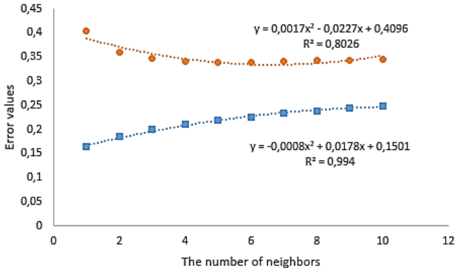
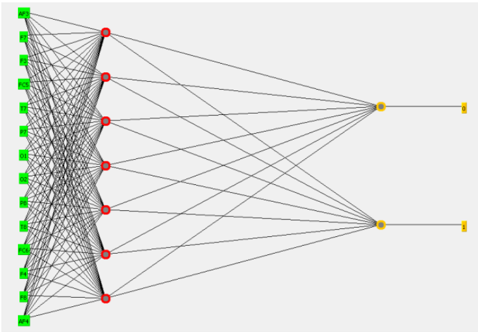
What is widely used for classification of eye state to detect human’s cognition state is electroencephalography (EEG). In this study, the usage of EEG signals for online eye state detection method was proposed. In this study, EEG eye state dataset that is obtained from UCI machine learning repository database was used. Continuous 14 EEG measurements forms the basic of the dataset. The duration of the measurement is 117 seconds (each measurement has14980 sample). Weka (Waikato Environment for Knowledge Analysis) program is used for classification of eye state. Classification success was calculated by using k-Nearest Neighbors algorithm and multilayer perceptron neural networks models. The obtained success of classification methods were compared. The classification success rates were calculated for various number of neurons in the hidden layer of a multilayer perceptron neural network model. The highest classification success rate have been obtained when the number of neurons in the hidden layer was equal to 7. And it was 56.45%. The classification success rates were calculated with k-nearest neighbors algorithm for different neighbourhood values. The highest success was achieved in the classification made with kNN algorithm. In kNN models, the success rate for 3 nearest neighbor were calculated as 84.05%.
Overview
The claims and statistics of this paper haven’t been checked yet.
Run the check — free, no account needed. It reads the open-access text and checks the sources it cites.
Integrity signals
Registry
Cites
Statistics
Figures
Verification
Claims the paper makes
The claims and statistics of this paper haven’t been checked yet.
Run the check — free, no account needed. It reads the open-access text and checks the sources it cites.
Claims other papers make about this one
Each is checked against this paper’s own text: does it say what the citing paper says it does?
In the citing paper
“From application view, KNN has been widely applied in electroencephalogram signal classification tasks [58] to classify health conditions such as rubeosis iridis, breast cancer and diabetes.”
From Integrating AI in engineering education: A comprehensive review and student-informed module design for U.K. students (2025) · cites this paper as [58]
Self-check
Percentages, sums and reported differences re-computed from the paper’s own numbers.
The self-check needs the paper’s full text.
Citations
Cites
Still being checked.
Research works printed but not linked: 15
- [1][1] T. C. Sharma and M. Jain, 'WEKA Approach for Comparative Study of Classification Algorithm', International Journal of Advanced Research in Computer and Communication Engineering Vol. 2, Issue 4, April 2013 -
- [2][2] O. Roesler and D. Suendermann, 'A First Step towards Eye State Prediction Using EEG'. In Proc. of the AIHLS 2013, International Conference on Applied Informatics for Health and Life Sciences, Istanbul, Turkey, September 2013 -
- [4][4] O. Fukuda, T. Tsuji, and M. Kaneko, 'Pattern classification of EEG signals using a log-linearized Gaussian mixture neural network,' inProceedings of the IEEE International Conference on Neural Networks. Part 1 (of 6), pp. 24792484, Perth, Australia, December 1995. -
- [5][5] M. V. M. Yeo, X. Li, K. Shen, and E. P. V. Wilder-Smith, 'Can SVM be used for automatic EEG detection of drowsiness during car driving?' Safety Science, vol. 47, no. 1, pp. 115-124, 2009. -
- [6][6] K. Polat and S. Güneş, 'Classification of epileptiform EEG using a hybrid system based on decision tree classifier and fast Fourier transform,' Applied Mathematics and Computation, vol. 187, no. 2, pp. 327-1026, 2007. -
- [7][7] N. Sulaiman, M. N. Taib, S. Lias, Z. H. Murat, S. A. M. Aris, and N. H. A. Hamid, 'Novel methods for stress features identification using EEG signals,' International Journal of Simulation: Systems, Science and Technology, vol. 12, no. 1, pp. 27-33, 2011. -
- [8][8] M. Hall, E. Frank, G. Holmes, B. Pfahringer, P. Reutemann, and I. H. Witten, 'The WEKA data mining software: an update,' ACM SIGKDD Explorations Newsletter, vol. 11, pp. 10-18, 2009. -
- [11][11] M. Sahu, N. K. Nagwani, S. Verma, and S.Shirke, 'An Incremental Feature Reordering (IFR) Algorithm to Classify Eye State Identification Using EEG', Information Systems Design and Intelligent Applications, Advances in Intelligent Systems and Computing Volume 339, 2015, pp 803-811 -
- [12][12] O. Roesler, L. Bader, J. Forster, Y. Hayashi, S. Hessler, and - D. Suendermann-Oeft, 'Comparison of EEG Devices for Eye State Classification'. In Proc. of the AIHLS 2014, International Conference on Applied Informatics for Health and Life Sciences, Kusadasi, Turkey, October 2014. -
- [13][13] K. Hassani and W.S. Lee, 'An Incremental Framework for Classification of EEG Signals Using Quantum Particle Swarm Optimization', Conference: 2014 IEEE International Conference on Computational Intelligence and Virtual Environments for Measurement Systems and Applications (CIVEMSA) DOI: 10.1109/CIVEMSA.2014.6841436 - · DOI
- [14][14] R. Singla, B. Chambayil, A. Khosla, J, and Santosh, 'Comparison of SVM and ANN for classification of eye events in EEG', J. Biomedical Science and Engineering, 2011, 4, 62-69, doi:10.4236/jbise.2011.41008. - · DOI
- [15][15] T. Razzaghi, O. Roderick, I. Safro, and N. Marko, ' Fast Imbalanced Classification of Healthcare Data with Missing Values' . 2015 arXiv preprint arXiv:1503.06250. - · arXiv
- [18][18] R. Arora and Suman, 'Comparative Analysis of Classification Algorithms on Different Datasets using WEKA', International Journal of Computer Applications (0975-8887) Volume 54- No.13, September 2012. -
- [19][19] J. Wang, P. Neskovic, and L. N. Cooper, 'Improving nearest neighbor rule with a simple adaptive distance measure', Pattern Recognition Letters, 28(2):207-213, 2007 -
- [20][20] Y. Zhou, Y. Li, and S. Xia, 'An improved KNN text classification algorithm based on clustering', Journal of computers, 4(3):230-237, 2009.
Cited by
Sorted by citations
Hao, Y., Liu, Y., Liu, B., Amarantidis, G., & Ghannam, R. (2025) · IEEE Transactions on Education · doi:10.1109/te.2025.3536105 · Cited by 32
“From application view, KNN has been widely applied in electroencephalogram signal classification tasks [58] to classify health conditions, such as rubeosis iridis, breast cancer and diabetes.”
Metadata
- Authors
- Sabancı, K., & Köklü, M.
- Affiliations
- Karamanoğlu Mehmetbey University (TR)
- Selçuk University (TR)
- Corresponding author
- Köklü, Murat
- Venue
- International Journal of Intelligent Systems and Applications in Engineering
- Published
- 2015-12-30
- Volume
- 3
- Issue
- 4
- Pages
- 127
- ISSN
- 2147-6799 (ISSN-L)
- OpenAlex
- W2272053632
- Cited by
- 62
- References
- 0
- Citations by year
- 2026: 2 · 2025: 2 · 2024: 5 · 2023: 9 · 2022: 6 · 2021: 14 · 2020: 6 · 2019: 7 · 2018: 4 · 2017: 4 · 2016: 3
- FWCI
- 2.20
- Type
- journal article
- Language
- en
- Open access
- diamond
- doi.org
- Locations
- International Journal of Intelligent Systems and Applications in Engineering (publishedVersion)
- International Journal of Intelligent Systems and Applications in Engineering (publishedVersion, cc-by-sa)
- DergiPark (Istanbul University) (submittedVersion)
- eArşiv - KMÜ (Karamanoğlu Mehmetbey University) (submittedVersion, cc-by-nc-nd)
- Topics
- Life Sciences › Neuroscience › Cognitive Neuroscience › EEG and Brain-Computer Interfaces
- Physical Sciences › Computer Science › Artificial Intelligence › Emotion and Mood Recognition
- Physical Sciences › Computer Science › Human-Computer Interaction › Gaze Tracking and Assistive Technology
- Keywords
- eye state classification, EEG signals, k-nearest neighbors, multilayer perceptron, hidden neuron number, k-value selection, EEG dataset, cognitive state detection
About these checks
Registry, retraction, Cites and statistics results are computed, not judged, with one exception: a printed reference that no index lists is read once by a model before it counts as a citation error. Claims are extracted by a model and kept only when their quote appears verbatim in the text; each cited source is then checked, with a model’s help, for whether it says what the claim relies on. Those verdicts can be wrong — read the claim’s quote and the cited source before relying on one.
Statistics and arithmetic are recomputed, not judged.
Confidence bands are shown only for fields calibrated on our annotated test set. None is calibrated yet, so no band is shown.
What counts as a claim ›How we measure confidence ›How we check this ›
Are you an author, or do you see a problem with this page? Request a review
How to cite
Cite CoChat for the checks on this page, and the paper for its own findings.
- This page
- CoChat. (2026). Citation check: The Classification of Eye State by Using kNN and MLP Classification Models According to the EEG Signals. https://app.cochat.ai/papers/10.18201/ijisae.75836
- The paper
- Sabancı, K., & Köklü, M. (2015). The Classification of Eye State by Using kNN and MLP Classification Models According to the EEG Signals. International Journal of Intelligent Systems and Applications in Engineering. https://doi.org/10.18201/ijisae.75836
