

Context-aware Reactive Systems based on Runtime Semantic Models (S)
Open accessThe DOI matches its Crossref record; 17 of the 19 references it cites were found in a registry or an index.
Abstract
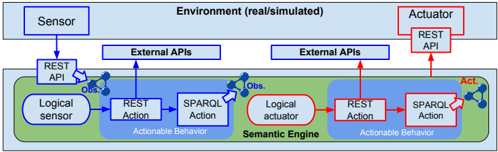
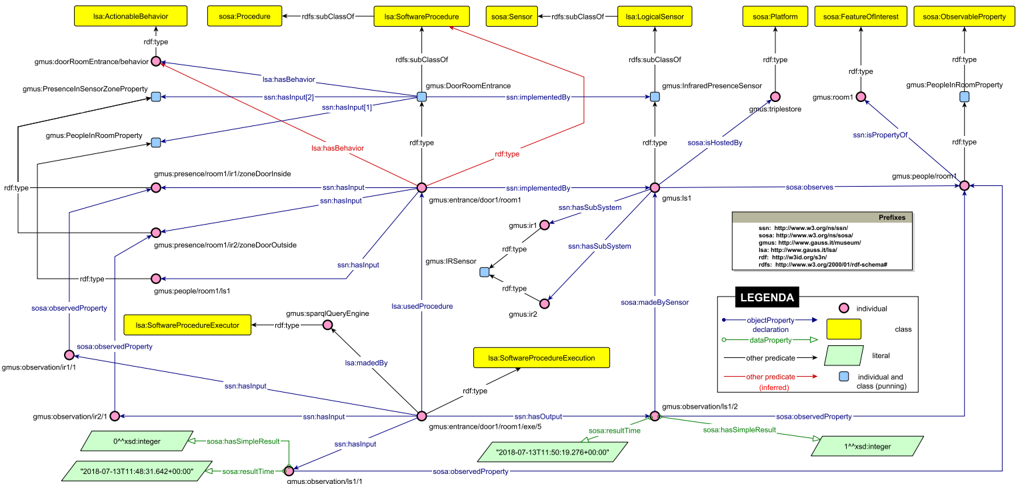
IoT, smart cities, cyber-physical systems and sensor networks are context-aware, highly dynamic and reactive systems.Their implementation should take into account the heterogeneity of their components and make easy the management of events unplanned at design time.According to these requirements, in this paper we propose an ontology-based approach to provide runtime models of the physical entities characterizing context-aware reactive systems.We extend SSN, a W3C standard ontology, to support complex reactive behaviors through the modeling of Logical Sensors and Actuators (LSA ontology); we also present a software architecture in which a knowledge base, structured coherently with this semantic model, is bound to real world entities by grounding (via web services) semantic elements to physical sensors and actuators.To validate the approach we discuss a case study related to smart buildings for cultural heritage preservation.
Overview
The claims and statistics of this paper haven’t been checked yet.
Free: it reads the open-access text and checks the first 5 claims that cite a source we can check. Create a free account to check every claim.
Integrity signals
Registry
Cites
Statistics
Figures

Verification
Claims the paper makes
The claims and statistics of this paper haven’t been checked yet.
Free: it reads the open-access text and checks the first 5 claims that cite a source we can check. Create a free account to check every claim.
Claims other papers make about this one
Each is checked against this paper’s own text: does it say what the citing paper says it does?
The source backs part of the claim, not all of it — or backs it for a different population, condition or comparison.
In the citing paper
“The Semantic Sensor Network (SSN) ontology, proposed by Giallonardo et al. (2019), is an example of how semantic models can support context-aware systems [20]. Their work extends the SSN ontology to create logical sensors and actuators, allowing systems to infer high-level context from raw data.”
From Towards enhanced cybersecurity in industrial control systems: a systematic review of context-based modeling, digital twins, and machine learning approaches (2025) · cites this paper as [20]
Experimental — accuracy not yet measuredThe check wasn’t confident either way, so it gives no verdict — never disputed.
In the citing paper
“Schmidtke (2018) emphasizes that verifying such systems is inherently difficult due to the unpredictability and complexity of real-world environments [20].”
From Towards enhanced cybersecurity in industrial control systems: a systematic review of context-based modeling, digital twins, and machine learning approaches (2025) · cites this paper as [20]
Experimental — accuracy not yet measured
Self-check
Percentages, sums and reported differences re-computed from the paper’s own numbers.
The self-check needs the paper’s full text.
Citations
Cites
Context Aware Computing for The Internet of Things: A Survey
Perera, C., Zaslavsky, A., Christen, P., & Georgakopoulos, D. (2014) · IEEE Communications Surveys & Tutorials · doi:10.1109/surv.2013.042313.00197 · Cited by 2,861
Towards a Better Understanding of Context and Context-Awareness
Abowd, G. D., Dey, A. K., Brown, P. J., Davies, N., Smith, M., & Steggles, P. (1999) · Lecture Notes in Computer Science · doi:10.1007/3-540-48157-5_29 · Cited by 2,634
A survey of context modelling and reasoning techniques
Bettini, C., Brdiczka, O., Henricksen, K., Indulska, J., Nicklas, D., Ranganathan, A., & Riboni, D. (2010) · Pervasive and Mobile Computing · doi:10.1016/j.pmcj.2009.06.002 · Cited by 1,126
SOUPA: standard ontology for ubiquitous and pervasive applications
Chen, H., Perich, F., Finin, T., & Joshi, A. (2004) · The First Annual International Conference on Mobile and Ubiquitous Systems: Networking and Services, 2004. MOBIQUITOUS 2004. · doi:10.1109/mobiq.2004.1331732 · Cited by 562
OWL-S: Semantic Markup for Web Services
Martin, D., Burstein, M. H., Hobbs, J. R., Lassila, O., McDermott, D., McIlraith, S. A., Narayanan, S., Paolucci, M., Bijan Parsia, A., Payne, T. R., et al. (2004) · ePrints Soton (University of Southampton) · Cited by 489
SOSA: A lightweight ontology for sensors, observations, samples, and actuators
Janowicz, K., Haller, A., Cox, S. J. D., Le Phuoc, D., & Lefrançois, M. (2019) · Journal of Web Semantics · doi:10.1016/j.websem.2018.06.003 · Cited by 466
SOUPA: Standard Ontology for Ubiquitous and Pervasive Applications
Chen, H., Perich, F., Finin, T., & Joshi, A. (2005) · Defense Technical Information Center (DTIC) · doi:10.21236/ada439638 · Cited by 157
Semantic Sensor Network Ontology
(2019) · doi:10.62973/16-079 · Cited by 148
Szvetits, M., & Zdun, U. (2013) · Software & Systems Modeling · doi:10.1007/s10270-013-0394-9 · Cited by 117
An ontology for the Business Process Modelling Notation
Rospocher, M., Ghidini, C., & Serafini, L. (2014) · Frontiers in artificial intelligence and applications · doi:10.3233/978-1-61499-438-1-133 · Cited by 97
Research works printed but not linked: 1
- [17]17. F. Poggi, D. Rossi, and P. Ciancarini, "Integrating semantic run-time models for adaptive software systems," To appear in Journal of Web Engineering, 2019.
Cited by
Context Awareness in Cultural Heritage Applications: A Survey
Michalakis, K., & Caridakis, G. (2022) · Journal on Computing and Cultural Heritage · doi:10.1145/3480953 · Cited by 38
“Thus, content storage has lately evolved from traditional relational databases to more complex structures such as ontology-based systems that allow better data representation and correlation [53].”
BackgroundHeritage buildings management: the role of situational awareness and cyber-physical systems
Nota, G., & Petraglia, G. (2024) · Journal of Ambient Intelligence and Humanized Computing · doi:10.1007/s12652-023-04750-2 · Cited by 16
“In the paper by Giallonardo et al. (2019), an ontology-based approach to provide runtime models of physical entities in context-aware reactive systems is proposed and validated using a case study of IB for cultural heritage preservation.”
Model-Based System Engineering of the Internet of Things: A Bibliometric Literature Analysis
Ahmad, E. (2023) · IEEE Access · doi:10.1109/access.2023.3277429 · Cited by 17
Abraham, D., Erceylan, G., Gkioulos, V., & Houmb, S. H. (2025) · International Journal of Information Security · doi:10.1007/s10207-025-01158-1 · Cited by 10
“The Semantic Sensor Network (SSN) ontology, proposed by Giallonardo et al. (2019), is an example of how semantic models can support context-aware systems [20].”
Semantics-Driven Programming of Self-Adaptive Reactive Systems
Giallonardo, E., Poggi, F., Rossi, D., & Zimeo, E. (2020) · International Journal of Software Engineering and Knowledge Engineering · doi:10.1142/s0218194020400082 · Cited by 3
Self-citation
Metadata
- Authors
- Giallonardo, E., Poggi, F., Rossi, D., & Zimeo, E.
- Affiliations
- University of Sannio (IT)
- University of Bologna (IT)
- Venue
- International Conferences on Software Engineering and Knowledge Engineering
- Published
- 2019-07-10
- Volume
- 2019
- Pages
- 301-306
- ISSN
- 2325-9000 (ISSN-L)
- OpenAlex
- W2966249670
- Cited by
- 6
- References
- 19
- Citations by year
- 2025: 1 · 2024: 1 · 2023: 1 · 2022: 1 · 2020: 1 · 2019: 1
- FWCI
- 0.29
- Type
- conference paper
- Language
- en
- Open access
- hybrid
- doi.org
- Licence
- cc-by
- Locations
- Proceedings/Proceedings of the ... International Conference on Software Engineering and Knowledge Engineering (publishedVersion, cc-by)
- Archivio istituzionale della ricerca (Alma Mater Studiorum Università di Bologna) (submittedVersion)
- IRIS UNIMORE (University of Modena and Reggio Emilia) (submittedVersion, cc-by)
- Funders
- Ministero dell’Istruzione, dell’Università e della Ricerca (PRIN 2015)
- Topics
- Physical Sciences › Computer Science › Artificial Intelligence › Semantic Web and Ontologies
- Physical Sciences › Computer Science › Computer Vision and Pattern Recognition › Context-Aware Activity Recognition Systems
- Health Sciences › Health Professions › Health Information Management › Innovation in Digital Healthcare Systems
- Keywords
- context-aware systems, reactive systems, ontology modeling, semantic grounding, knowledge base, web services, smart buildings, cultural heritage preservation, cyber-physical systems, Internet of Things
About these checks
Registry, retraction, Cites and statistics results are computed, not judged, with one exception: a printed reference that no index lists is read once by a model before it counts as a citation error. Claims are extracted by a model and kept only when their quote appears verbatim in the text; each cited source is then checked, with a model’s help, for whether it says what the claim relies on. Those verdicts can be wrong — read the claim’s quote and the cited source before relying on one.
Statistics and arithmetic are recomputed, not judged.
Confidence bands are shown only for fields calibrated on our annotated test set. None is calibrated yet, so no band is shown.
What counts as a claim ›How we measure confidence ›How we check this ›
Are you an author, or do you see a problem with this page? Request a review
How to cite
Cite CoChat for the checks on this page, and the paper for its own findings.
- This page
- CoChat. (2026). Citation check: Context-aware Reactive Systems based on Runtime Semantic Models (S). https://app.cochat.ai/papers/10.18293/seke2019-169
- The paper
- Giallonardo, E., Poggi, F., Rossi, D., & Zimeo, E. (2019). Context-aware Reactive Systems based on Runtime Semantic Models (S). International Conferences on Software Engineering and Knowledge Engineering. https://doi.org/10.18293/seke2019-169
Data sources
Bibliographic data: Semantic Scholar, OpenAlex, Crossref.
Contains information from the Semantic Scholar Academic Graph Datasets, made available under the ODC Attribution License (ODC-BY 1.0).
Semantic Scholar’s data is described in: Kinney, R., et al. (2023). The Semantic Scholar Open Data Platform. arXiv:2301.10140.
