

The DOI matches its Crossref record; 1 of the 1 references it cites were found in a registry or an index.
Analogies minus analogy test: measuring regularities in word embeddings
Open accessAbstract
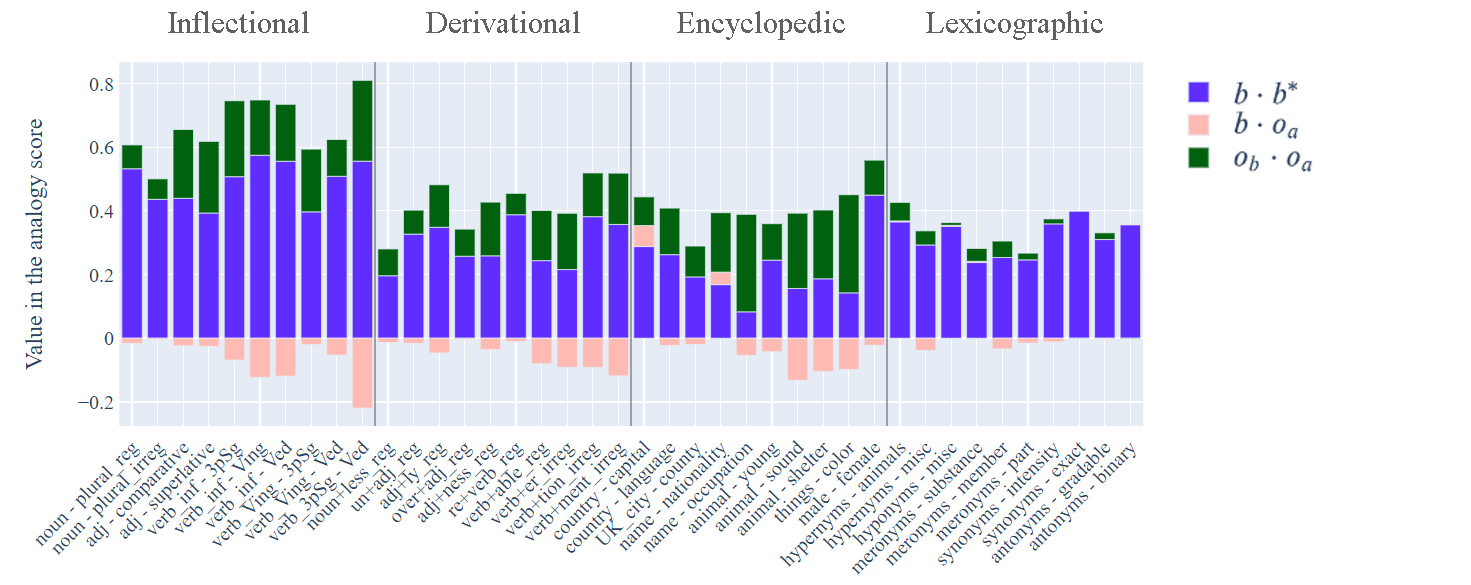
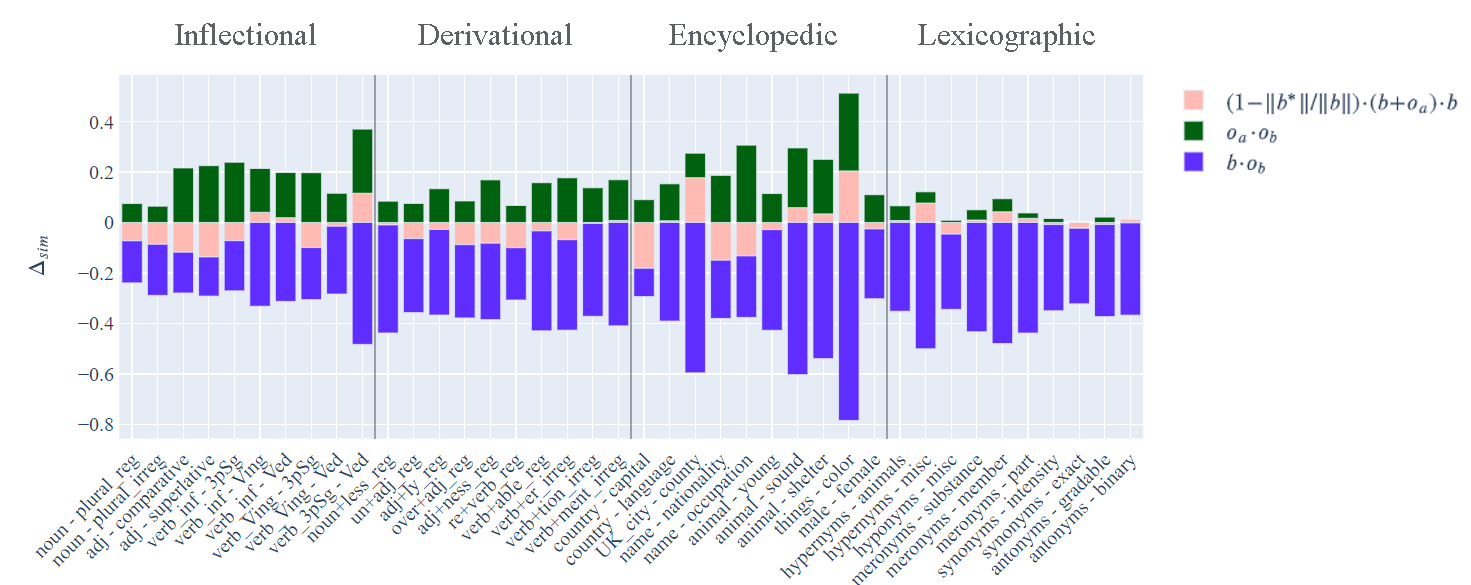
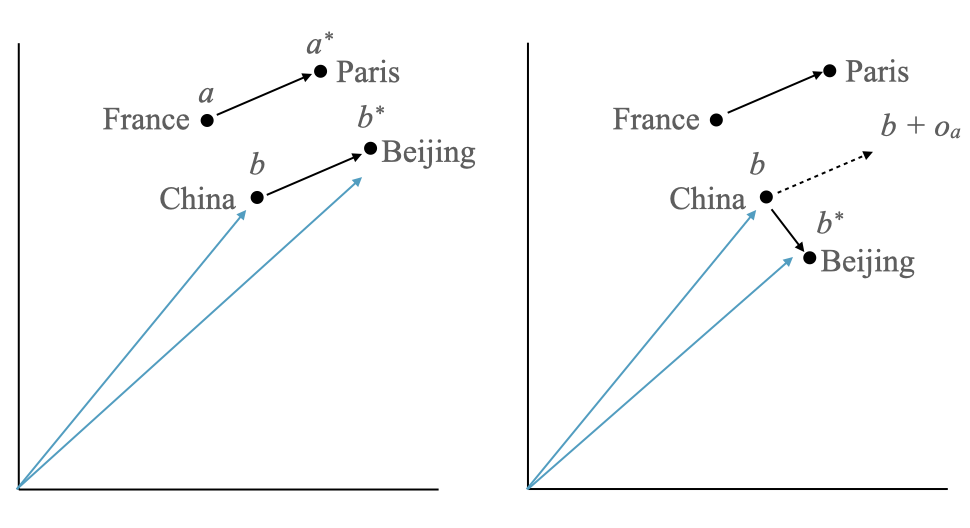
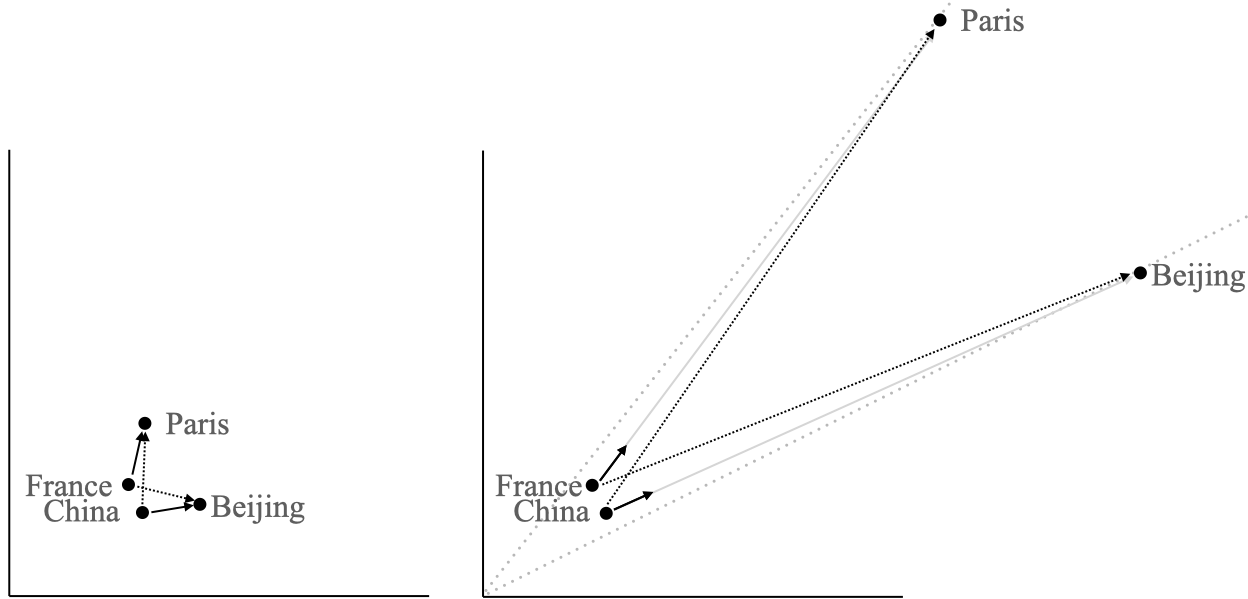
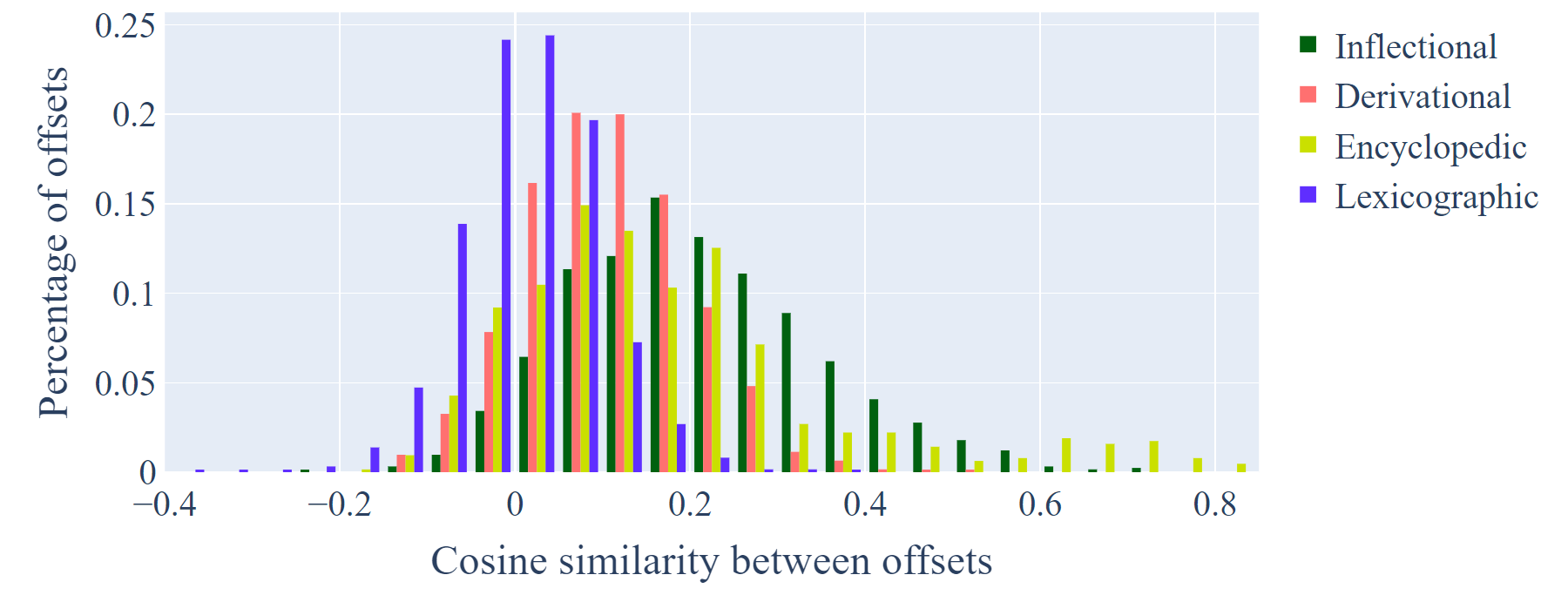
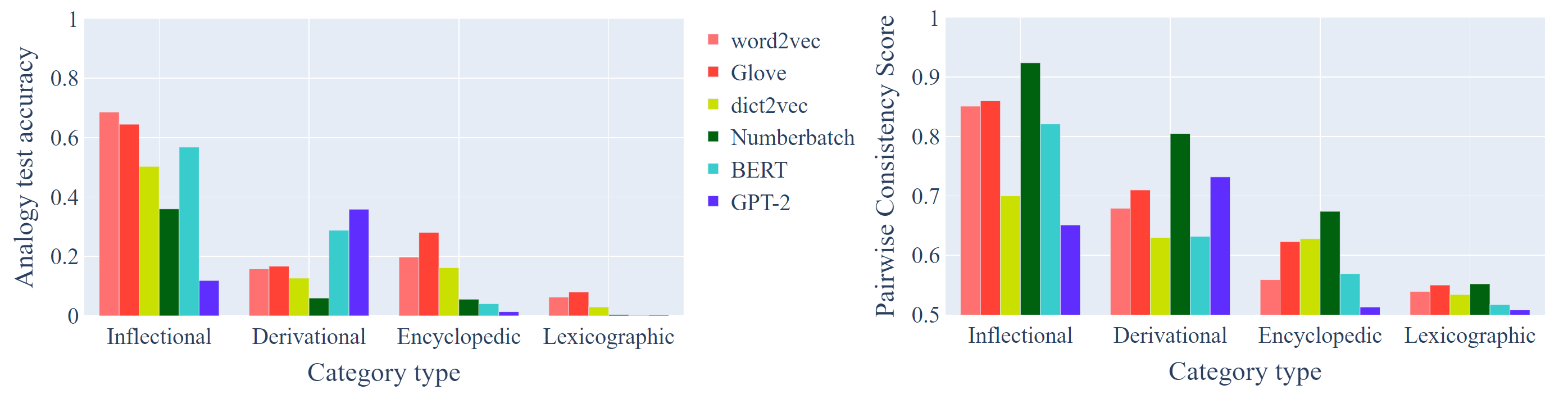
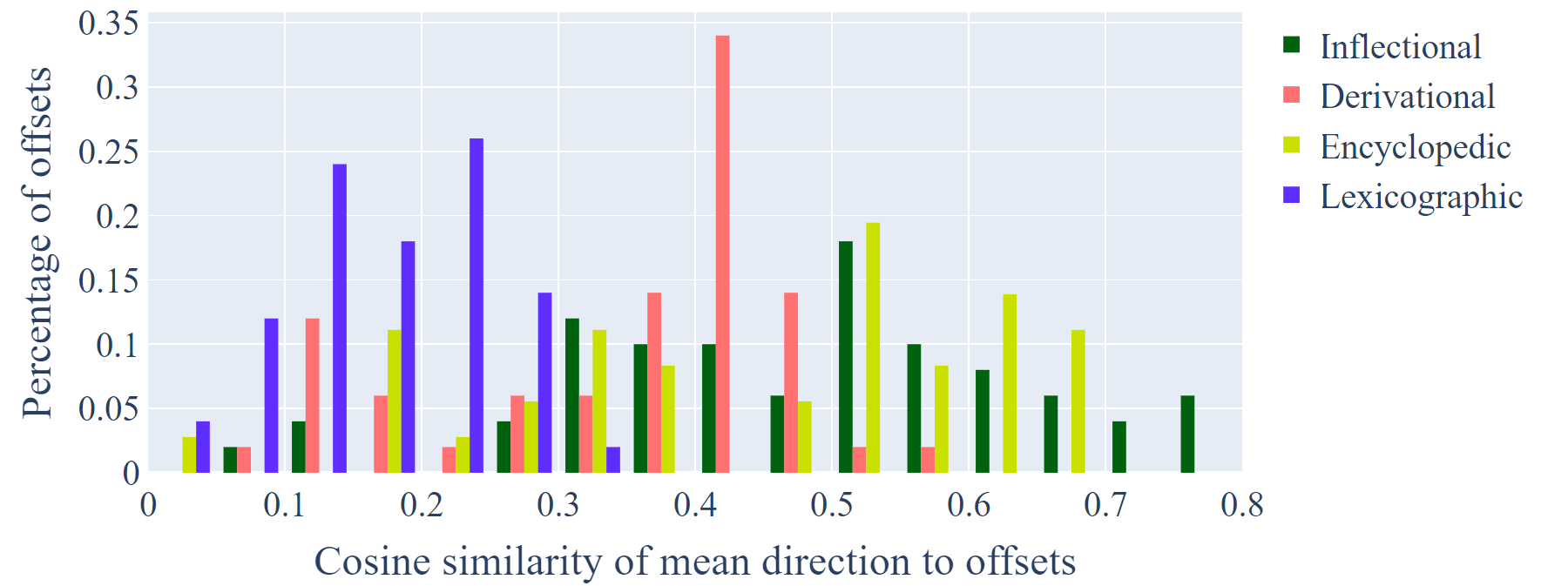
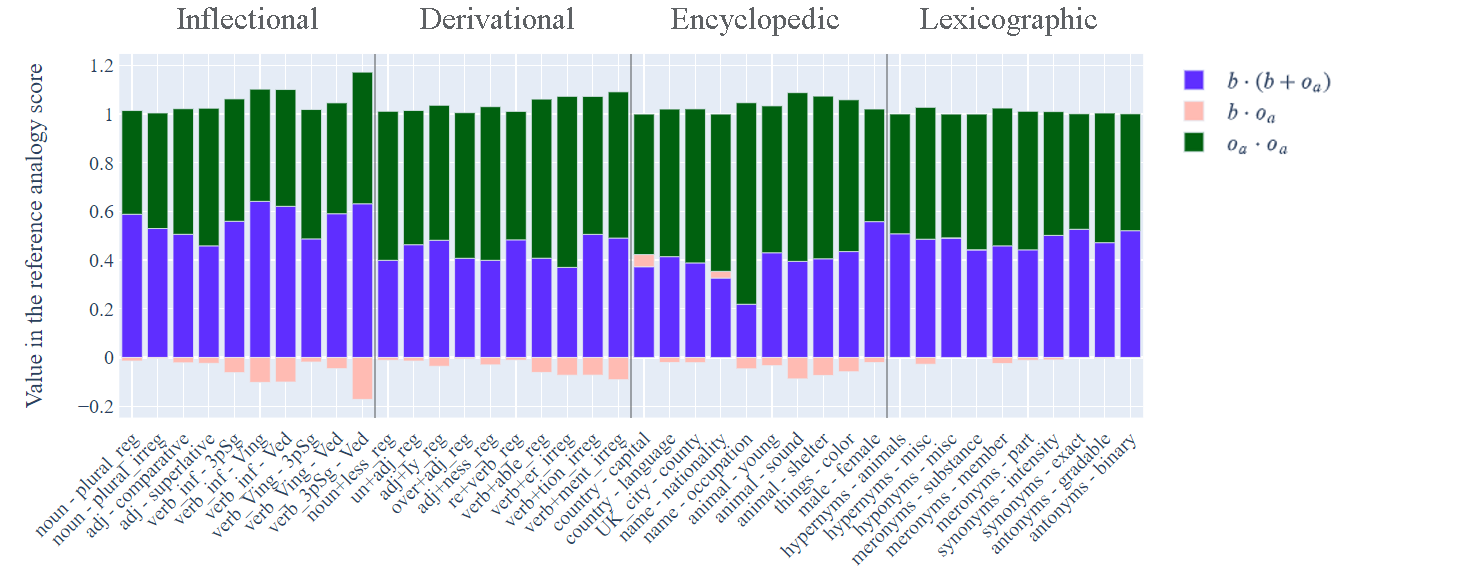
Vector space models of words have long been claimed to capture linguistic regularities as simple vector translations, but problems have been raised with this claim. We decompose and empirically analyze the classic arithmetic word analogy test, to motivate two new metrics that address the issues with the standard test, and which distinguish between class-wise offset concentration (similar directions between pairs of words drawn from different broad classes, such as France--London, China--Ottawa, ...) and pairing consistency (the existence of a regular transformation between correctly-matched pairs such as France:Paris::China:Beijing). We show that, while the standard analogy test is flawed, several popular word embeddings do nevertheless encode linguistic regularities.
Overview
The claims and statistics of this paper haven’t been checked yet.
Run the check — free, no account needed. It reads the open-access text and checks the sources it cites.
Integrity signals
Registry
Cites
Statistics
Figures
Verification
Claims the paper makes
The claims and statistics of this paper haven’t been checked yet.
Run the check — free, no account needed. It reads the open-access text and checks the sources it cites.
Claims other papers make about this one
Each is checked against this paper’s own text: does it say what the citing paper says it does?
The source backs part of the claim, not all of it — or backs it for a different population, condition or comparison.
In the citing paper
“Previous work on word embeddings(Drozd et al., 2016;Fournier et al., 2020) motivate taking the mean to improve the consistency of the concept direction.”
From The Linear Representation Hypothesis and the Geometry of Large Language Models (2023) · cites this paper as Fournier et al., 2020
Experimental — accuracy not yet measured
Self-check
Percentages, sums and reported differences re-computed from the paper’s own numbers.
The self-check needs the paper’s full text.
Citations
Cites
BERT: Pre-training of Deep Bidirectional Transformers for Language Understanding
Devlin, J., Chang, M.-W., Lee, K., & Toutanova, K. (2019) · Proceedings of the 2019 Conference of the North American Chapter of the Association for Computational Linguistics: Human Language Technologies, Volume 1 (Long and Short Papers) · doi:10.18653/v1/n19-1423 · Cited by 54,325
Research works printed but not linked: 20
- Carl Allen and Timothy Hospedales. 2019. Analo- gies Explained: Towards Understanding Word Em- beddings. In Proceedings of the 36th International Conference on Machine Learning, volume 97 of Pro- ceedings of Machine Learning Research, pages 223- 231, Long Beach, California, USA. PMLR.
- Zied Bouraoui, Shoaib Jameel, and Steven Schock- aert. 2018. Relation Induction in Word Embed- dings Revisited. In Proceedings of the 27th Inter- national Conference on Computational Linguistics, pages 1627-1637, Santa Fe, New Mexico, USA. As- sociation for Computational Linguistics.
- Dawn Chen, Joshua C. Peterson, and Thomas L. Grif- fiths. 2017. Evaluating vector-space models of anal- ogy. CoRR, abs/1705.04416. · arXiv
- Aleksandr Drozd, Anna Gladkova, and Satoshi Mat- suoka. 2016. Word Embeddings, Analogies, and Machine Learning: Beyond King -Man + Woman = Queen. In Proceedings of COLING 2016, the 26th International Conference on Computational Linguis- tics: Technical Papers, pages 3519-3530, Osaka, Japan, December 11-17.
- Kawin Ethayarajh, David Duvenaud, and Graeme Hirst. 2019. Towards Understanding Linear Word Analo- gies. In Proceedings of the 57th Annual Meeting of the Association for Computational Linguistics, pages 3253-3262, Florence, Italy. Association for Computational Linguistics. · DOI
- Gregory Finley, Stephanie Farmer, and Serguei Pakho- mov. 2017. What Analogies Reveal about Word Vec- tors and their Compositionality. In Proceedings of the 6th Joint Conference on Lexical and Computa- tional Semantics (*SEM 2017), pages 1-11, Vancou- ver, Canada. Association for Computational Linguis- tics. · DOI
- Anna Gladkova, Aleksandr Drozd, and Satoshi Mat- suoka. 2016. Analogy-Based Detection of Morpho- logical and Semantic Relations with Word Embed- dings: What Works and What Doesn't. In Proceed- ings of the NAACL-HLT SRW, pages 47-54, San Diego, California, June 12-17, 2016. ACL. · DOI
- Omer Levy and Yoav Goldberg. 2014. Linguistic Reg- ularities in Sparse and Explicit Word Representa- tions. In Proceedings of the Eighteenth Confer- ence on Computational Natural Language Learning, pages 171-180, Ann Arbor, Michigan. Association for Computational Linguistics. · DOI
- Tal Linzen. 2016. Issues in Evaluating Semantic Spaces Using Word Analogies. In Proceedings of the First Workshop on Evaluating Vector Space Representations for NLP. Association for Computa- tional Linguistics. · DOI
- Tomas Mikolov, Kai Chen, Greg Corrado, and Jeffrey Dean. 2013a. Efficient Estimation of Word Repre- sentations in Vector Space. In Proceedings of Inter- national Conference on Learning Representations (ICLR).
- Tomas Mikolov, Wen-tau Yih, and Geoffrey Zweig. 2013b. Linguistic Regularities in Continuous Space Word Representations. In Proceedings of NAACL- HLT 2013, pages 746-751, Atlanta, Georgia, 9-14 June 2013.
- Denis Newman-Griffis, Albert Lai, and Eric Fosler- Lussier. 2017. Insights into Analogy Completion from the Biomedical Domain. In BioNLP 2017, pages 19-28, Vancouver, Canada,. Association for Computational Linguistics. · DOI
- Malvina Nissim, Rik van Noord, and Rob van der Goot. 2020. Fair Is Better than Sensational: Man Is to Doc- tor as Woman Is to Doctor. Computational Linguis- tics, 46(2):487-497. · DOI
- Jeffrey Pennington, Richard Socher, and Christopher Manning. 2014. GloVe: Global Vectors for Word Representation. In Proceedings of the 2014 Con- ference on Empirical Methods in Natural Language Processing (EMNLP), pages 1532-1543, Doha, Qatar. Association for Computational Linguistics. · DOI · Paper page
- Alec Radford, Jeffrey Wu, Rewon Child, David Luan, Dario Amodei, and Ilya Sutskever. 2019. Language Models are Unsupervised Multitask Learners. Ope- nAI Blog, 1(8):9.
- Anna Rogers, Aleksandr Drozd, and Bofang Li. 2017. The (Too Many) Problems of Analogical Reasoning with Word Vectors. In Proceedings of the 6th Joint Conference on Lexical and Computational Seman- tics (* SEM 2017), pages 135-148.
- Natalie Schluter. 2018. The Word Analogy Testing Caveat. In Proceedings of the 2018 Conference of the North American Chapter of the Association for Computational Linguistics: Human Language Tech- nologies, Volume 2 (Short Papers), pages 242-246, New Orleans, Louisiana. Association for Computa- tional Linguistics. · DOI
- Robyn Speer, Joshua Chin, and Catherine Havasi. 2017. ConceptNet 5.5: An Open Multilingual Graph of General Knowledge. In Proceedings of the Thirty- First AAAI Conference on Artificial Intelligence, AAAI'17, page 4444-4451. AAAI Press.
- Julien Tissier, Christophe Gravier, and Amaury Habrard. 2017. Dict2vec : Learning Word Em- beddings using Lexical Dictionaries. In Proceed- ings of the 2017 Conference on Empirical Methods in Natural Language Processing, pages 254-263, Copenhagen, Denmark. Association for Computa- tional Linguistics. · DOI
- Ekaterina Vylomova, Laura Rimell, Trevor Cohn, and Timothy Baldwin. 2016. Take and Took, Gaggle and Goose, Book and Read: Evaluating the Utility of Vector Differences for Lexical Relation Learning. In Proceedings of the 54th Annual Meeting of the As- sociation for Computational Linguistics (Volume 1: Long Papers), pages 1671-1682, Berlin, Germany. Association for Computational Linguistics. · DOI
Cited by
Sorted by citations
The Linear Representation Hypothesis and the Geometry of Large Language Models
Park, K., Choe, Y. J., & Veitch, V. (2023) · arXiv · doi:10.48550/arxiv.2311.03658 · Cited by 11
Metadata
- Authors
- Fournier, L., Dupoux, E., & Dunbar, E.
- Affiliations
- Laboratoire de Sciences Cognitives et Psycholinguistique (FR)
- ORCID
- Dunbar, Ewan
- Venue
- Proceedings of the 24th Conference on Computational Natural Language Learning
- Published
- 2020
- Pages
- 365-375
- OpenAlex
- W3092565990
- Cited by
- 19
- References
- 1
- Citations by year
- 2026: 4 · 2025: 2 · 2024: 1 · 2023: 3 · 2022: 4 · 2021: 5
- FWCI
- 0.96
- Type
- conference paper
- Language
- en
- Open access
- hybrid
- doi.org
- Licence
- cc-by
- Locations
- Conference on Computational Natural Language Learning (publishedVersion, cc-by)
- arXiv (Cornell University) (submittedVersion)
- HAL (submittedVersion, other-oa)
- arXiv (Cornell University)
- Funders
- Microsoft Research
- Canadian Institute for Advanced Research (ANR-17-EURE-0017)
- Agence Nationale de la Recherche (ANR-10-LABX-0083, ANR-10-IDEX-0001, ANR-17-EURE-0017, ANR-17-CE28-0009, ANR-19-P3IA-0001, IDEX-0001-02, ANR-18-IDEX-0001)
- Topics
- Physical Sciences › Computer Science › Artificial Intelligence › Topic Modeling
- Physical Sciences › Computer Science › Artificial Intelligence › Natural Language Processing Techniques
- Physical Sciences › Computer Science › Artificial Intelligence › Sentiment Analysis and Opinion Mining
- Keywords
- word embeddings, vector space model, linguistic regularities
About these checks
Registry, retraction, Cites and statistics results are computed, not judged, with one exception: a printed reference that no index lists is read once by a model before it counts as a citation error. Claims are extracted by a model and kept only when their quote appears verbatim in the text; each cited source is then checked, with a model’s help, for whether it says what the claim relies on. Those verdicts can be wrong — read the claim’s quote and the cited source before relying on one.
Statistics and arithmetic are recomputed, not judged.
Confidence bands are shown only for fields calibrated on our annotated test set. None is calibrated yet, so no band is shown.
What counts as a claim ›How we measure confidence ›How we check this ›
Are you an author, or do you see a problem with this page? Request a review
How to cite
Cite CoChat for the checks on this page, and the paper for its own findings.
- This page
- CoChat. (2026). Citation check: Analogies minus analogy test: measuring regularities in word embeddings. https://app.cochat.ai/papers/10.18653/v1/2020.conll-1.29
- The paper
- Fournier, L., Dupoux, E., & Dunbar, E. (2020). Analogies minus analogy test: measuring regularities in word embeddings. Proceedings of the 24th Conference on Computational Natural Language Learning. https://doi.org/10.18653/v1/2020.conll-1.29
