

Different Time, Different Language: Revisiting the Bias Against Non-Native Speakers in GPT Detectors
Open accessThe DOI matches its Crossref record; 32 of the 32 references it cites were found in a registry or an index; none of the 15 sources its claims cite is checked for support yet.
Abstract
LLM-based assistants have been widely popularised after the release of ChatGPT. Concerns have been raised about their misuse in academia, given the difficulty of distinguishing between human-written and generated text. To combat this, automated techniques have been developed and shown to be effective, to some extent. However, prior work suggests that these methods often falsely flag essays from non-native speakers as generated, due to their low perplexity extracted from an LLM, which is supposedly a key feature of the detectors. We revisit these statements two years later, specifically in the Czech language setting. We show that the perplexity of texts from non-native speakers of Czech is not lower than that of native speakers. We further examine detectors from three separate families and find no systematic bias against non-native speakers. Finally, we demonstrate that contemporary detectors operate effectively without relying on perplexity.
Overview
CoChat Summary
TL;DR
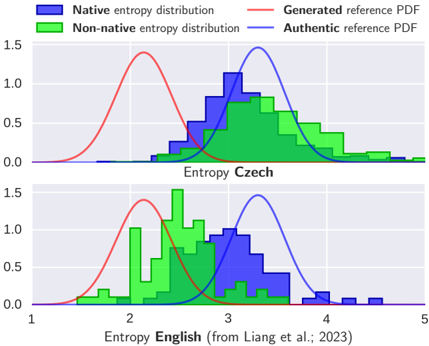
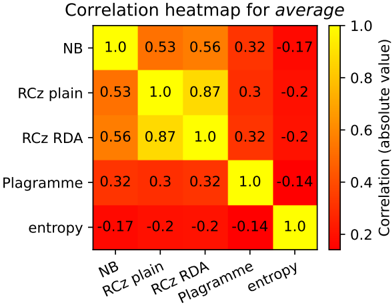
Revisiting Liang et al. (2023) in Czech, the paper finds that non-native Czech essays do not have lower entropy than native peers; moderately proficient non-native essays have higher entropy (p < 10⁻¹⁴). Across three detector families, it finds no systematic bias against non-native Czech speakers, and contemporary detectors’ outputs correlate only weakly with entropy (|ρ| ≤ 0.2).
Key findings
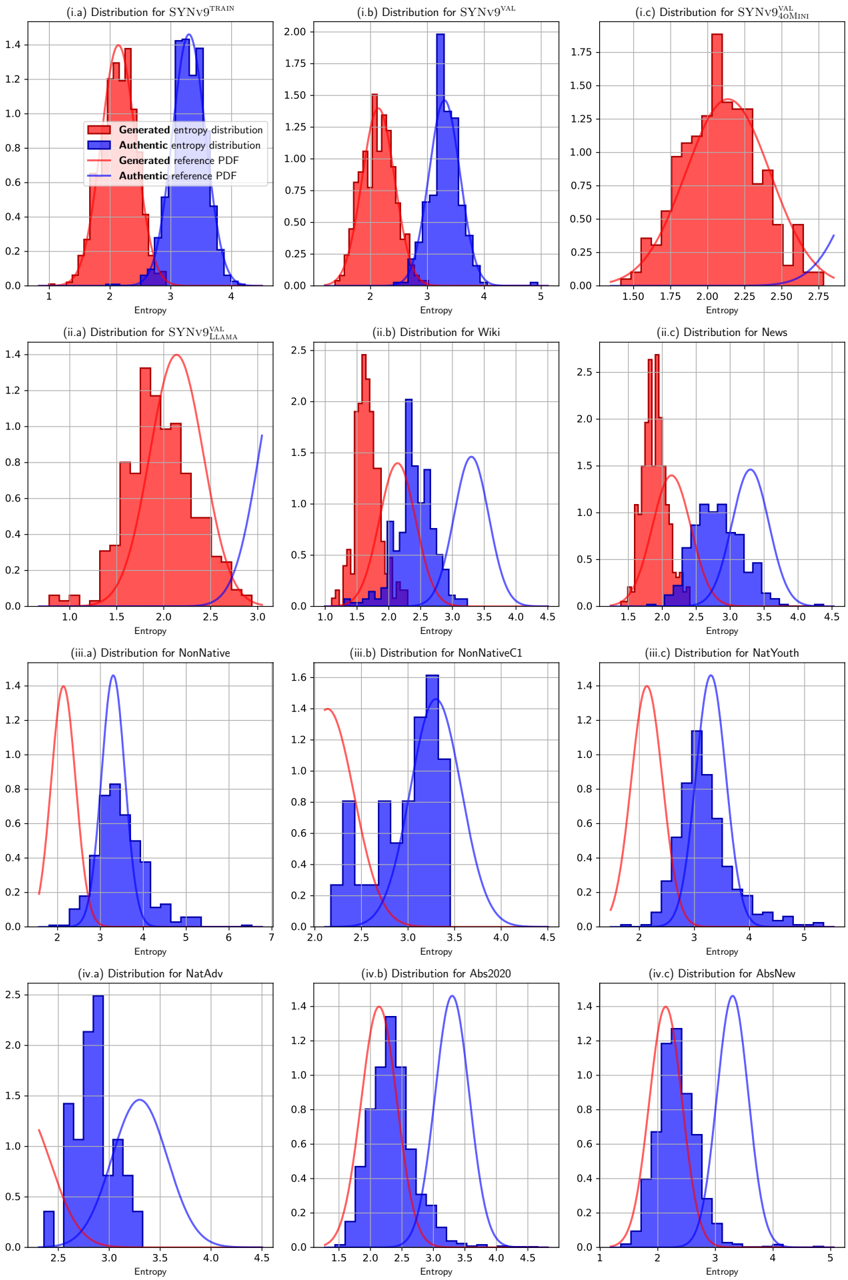
- Non-native Czech essays had greater entropy than native youth essays (NONNATIVE vs. NATYOUTH, p < 10⁻¹⁴), contrary to the English findings of Liang et al. (2023); advanced non-native vs. native advanced essays did not differ significantly (p > 0.19), and entropy decreased as students became more advanced (NONNATIVE vs. NONNATIVEC1, p < 10⁻⁶). Grammar/spelling errors increased entropy, while limited vocabulary decreased it.
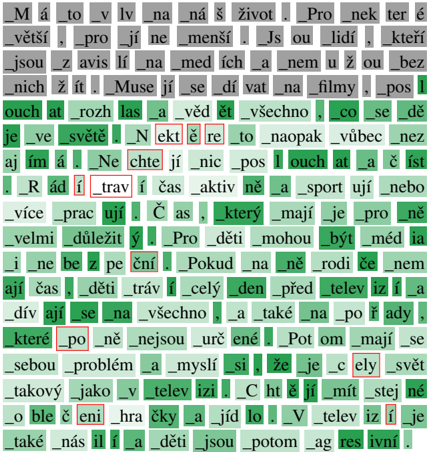
- No detector showed systematic bias against non-native Czech speakers: Naïve Bayes showed no significant native/non-native difference (p > 0.23; p > 0.81); RobeCzech without augmentation appeared better on NATYOUTH, but this was caused by the non-breaking space, and replacing it dropped accuracy from 71.6% to 42.4%, below NONNATIVE; with random data augmentation it performed better on NONNATIVE than NATYOUTH (p < 0.03; ΔFPR = 5.1%) but worse on NONNATIVEC1 than NATADV, not significantly (p > 0.98); commercial Plagramme differences were not significant and inconsistent (p > 0.11; p > 0.15).
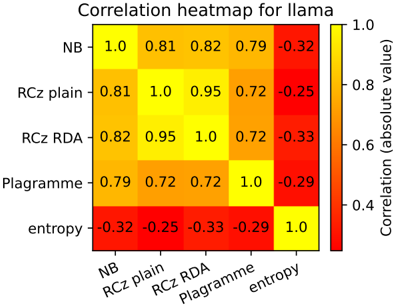
- On the English datasets from Liang et al. (2023), Plagramme’s FPR on non-native TOEFL essays was 23.1% versus 0.0% on native Hewlett essays, an improvement from the reported 61.3% mean or 48% best detector; the correlation between text entropy and detector output was negligible and slightly positive (0 < ρ < 0.04).
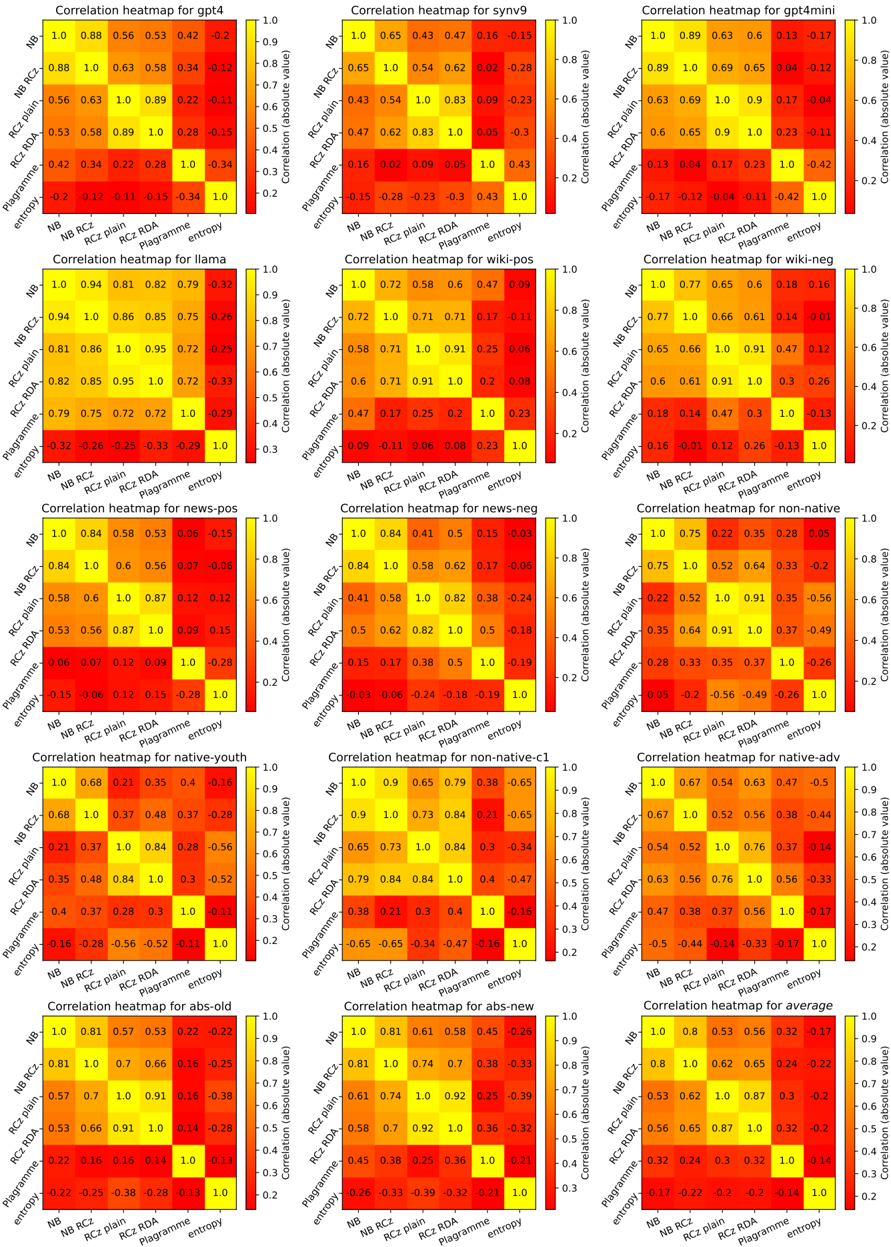
- Per-dataset mean correlation between entropy and all model outputs was negative but very weak (|ρ| ≤ 0.2), suggesting detectors do not largely depend on entropy; custom detectors were not robust across domains or source models, while the commercial detector performed better overall but struggled most on SYNV9 VAL LLAMA.
Methods
- Training used SYNv9 (7,460 Czech texts from 2009–2019, truncated to 2,000 tokens) paired with GPT-4o-generated counterparts; validation included GPT-4o-mini and Llama 3.1 405B generations. Evaluation covered Wikipedia, online news, non-native AKCES 3 essays (NONNATIVE; NONNATIVEC1 with 29 proficient samples), native AKCES 1 youth essays (NATYOUTH/NATADV), and academic abstracts (ABS2020/ABSNEW).
- Entropy was measured with Llama 3.2 1B base as the reference model, using per-token average negative log-likelihood; samples were truncated to 512 tokens and the first 50 tokens were ignored for context stability.
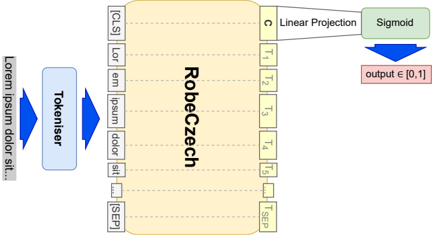
- Three detector families were evaluated: TF-IDF multinomial Naïve Bayes, fine-tuned RobeCzech, and commercial closed-source Plagramme; analyses included accuracy/FPR/FNR across domains and in-class Pearson correlations between entropy and detector outputs.
Limitations
- The paper states limited access to large corpora of proficient non-native Czech, so it used a reasonably sized dataset of moderately proficient speakers (450 documents) with frequent errors and a small dataset of proficient speakers (29 documents); it also used a limited number of source LLMs.
- The paper states its custom detectors did not reach SoTA performance, and the commercial detector’s proprietary nature limited analysis to black-box observations.
- Evident from the text: detectors were not robust across domains or source models; ABSNEW was assumed human-written for simplicity although its generated status is unclear; the main setting is Czech with only a side experiment on English datasets.
Model-written summary. Check it against the paper before relying on it.
Integrity signals
Registry
Cites
Statistics
Figures
Verification
Claims the paper makes
0 Valid · 1 Not valid · 14 Not checked · 56 Own results and interpretations
A check of a cited source is scheduled, or we don’t hold its full text yet; the claim is checked once it runs.
In the paper
“While the accuracy measured on the nonnative dataset was smaller than the native dataset by a non-trivial margin (∆FPR = 23.1%),notable progress has been made since 2023: the FPR improved from the reported 61.3% (mean) or 48% (best detector) to our observed 23.1%.”
§ Different Time, Different Language: Revisiting the Bias Against Non-Native Speakers in GPT Detectors > 5.3 Commercial Detector
What the sources say
- Not checked yetcites Liang et al., 2023 matched to “GPT detectors are biased against non-native English writers” (2023) source
A check is scheduled.
plain- Asserted: passes — The authors put it forward as true.
- Checkable: passes — It can be checked against evidence.
- Load-bearing: passes — The paper’s conclusions depend on it.
- Based: passes — The paper gives a reason why it holds.
- Not checked yet
A result the paper reports from its own data — it cites no other source for it, so there is none to check. The quote shows it is in the paper.
In the paper
“TOEFL-91 (en) Hewlett (en) | 76.9 100.0 | 23.1 0.0 | --”
§ Different Time, Different Language: Revisiting the Bias Against Non-Native Speakers in GPT Detectors > F Entropy Distributions
plain- Asserted: passes — The authors put it forward as true.
- Checkable: passes — It can be checked against evidence.
- Load-bearing: passes — The paper’s conclusions depend on it.
- Based: passes — The paper gives a reason why it holds.
A result the paper reports from its own data — it cites no other source for it, so there is none to check. The quote shows it is in the paper.
In the paper
“We further examine detectors from three separate families and find no systematic bias against non-native speakers.”
- Also stated in: § 5.4 Discussion · plain
“As an answer to question Q2, we find that none of the detectors exhibited a systematic bias against non-native speakers of Czech when compared with their native peers.”
- Also stated in: § 7 Conclusion · boosted
“Nonetheless, our detectors did not consistently exhibit any biases.Moreover, we demonstrate that commercial detectors achieve satisfactory results across all domains without exhibiting bias either.”
§ Different Time, Different Language: Revisiting the Bias Against Non-Native Speakers in GPT Detectors > Abstract
boostedn = 3- Asserted: passes — The authors put it forward as true.
- Checkable: passes — It can be checked against evidence.
- Load-bearing: passes — The paper’s conclusions depend on it.
- Based: passes — The paper gives a reason why it holds.
- Also stated in: § 5.4 Discussion · plain
A result the paper reports from its own data — it cites no other source for it, so there is none to check. The quote shows it is in the paper.
In the paper
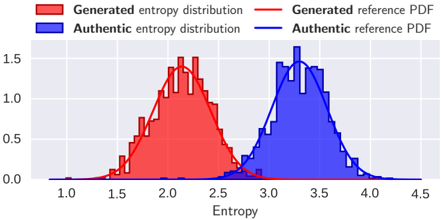
“We further observe that: (1) The entropy distribution does not differ significantly between SYNV9 VAL 4OMINI and SYNV9 GPT4O (p > 0.42).”
§ Different Time, Different Language: Revisiting the Bias Against Non-Native Speakers in GPT Detectors > 4.2 Results
plain- Asserted: passes — The authors put it forward as true.
- Checkable: passes — It can be checked against evidence.
- Load-bearing: unclear — It is unclear whether the paper’s conclusions depend on it.
- Based: passes — The paper gives a reason why it holds.
27 more claims
Create a free account to see all 71 claims and to verify the 14 references still open.
- It may state two separate claims as one. 21
- Probably not a substantial claim. 21
Citations
Cites
BERT: Pre-training of Deep Bidirectional Transformers for Language Understanding
Devlin, J., Chang, M.-W., Lee, K., & Toutanova, K. (2019) · Proceedings of the 2019 Conference of the North American Chapter of the Association for Computational Linguistics: Human Language Technologies, Volume 1 (Long and Short Papers) · doi:10.18653/v1/n19-1423 · Cited by 54,325
PyTorch: An Imperative Style, High-Performance Deep Learning Library
Paszke, A., Gross, S., Massa, F., Lerer, A., Bradbury, J., Chanan, G., Killeen, T., Lin, Z., Gimelshein, N., Antiga, L., et al. (2019) · arXiv · doi:10.48550/arxiv.1912.01703 · Cited by 31,473
RoBERTa: A Robustly Optimized BERT Pretraining Approach
Liu, Y., Ott, M., Goyal, N., Du, J., Joshi, M., Chen, D., Levy, O., Lewis, M., Zettlemoyer, L., & Stoyanov, V. (2019) · arXiv · doi:10.48550/arxiv.1907.11692 · Cited by 16,515
Scikit-learn: Machine Learning in Python
(2011) · Journal of Machine Learning Research · doi:10.5555/1953048.2078195 · Cited by 8,539
GPT detectors are biased against non-native English writers
Liang, W., Yuksekgonul, M., Mao, Y., Wu, E., & Zou, J. (2023) · Patterns · doi:10.1016/j.patter.2023.100779 · Cited by 673
Grattafiori, A., Dubey, A., Jauhri, A., Pandey, A., Kadian, A., Al-Dahle, A., Letman, A., Mathur, A., Schelten, A., Vaughan, A., et al. (2024) · arXiv · doi:10.48550/arxiv.2407.21783 · Cited by 505
GLTR: Statistical Detection and Visualization of Generated Text
Gehrmann, S., Strobelt, H., & Rush, A. (2019) · Proceedings of the 57th Annual Meeting of the Association for Computational Linguistics: System Demonstrations · doi:10.18653/v1/p19-3019 · Cited by 470
Multinomial Naive Bayes for Text Categorization Revisited
Kibriya, A. M., Frank, E., Pfahringer, B., & Holmes, G. (2004) · Lecture Notes in Computer Science · doi:10.1007/978-3-540-30549-1_43 · Cited by 427
Findings of the 2022 Conference on Machine Translation (WMT22)
Kocmi, T., Bawden, R., Bojar, O., Dvorkovich, A., Federmann, C., Fishel, M., Gowda, T., Graham, Y., Grundkiewicz, R., Haddow, B., et al. (2022) · Conference on Machine Translation (WMT) · doi:10.18653/v1/2022.wmt-1.1 · Cited by 356
Release Strategies and the Social Impacts of Language Models
Solaiman, I., Brundage, M., Clark, J., Askell, A., Herbert-Voss, A., Wu, J., Radford, A., Krueger, G., Kim, J. W., Kreps, S., et al. (2019) · arXiv · doi:10.48550/arxiv.1908.09203 · Cited by 292
Research works printed but not linked: 4
- Wissam Antoun, Virginie Mouilleron, Benoît Sagot, and Djamé Seddah. 2023. Towards a robust detection of language model-generated text: Is ChatGPT that easy to detect? In Actes de CORIA-TALN 2023. Actes de la 30e Conférence sur le Traitement Automatique des Langues Naturelles (TALN), volume 1 : travaux de recherche originaux -articles longs, pages 14-27, Paris, France. ATALA.
- Tom B. Brown, Benjamin Mann, Nick Ryder, Melanie Subbiah, Jared Kaplan, Prafulla Dhariwal, Arvind Neelakantan, Pranav Shyam, Girish Sastry, Amanda Askell, Sandhini Agarwal, Ariel Herbert-Voss, Gretchen Krueger, Tom Henighan, Rewon Child, Aditya Ramesh, Daniel M. Ziegler, Jeffrey Wu, Clem- ens Winter, and 12 others. 2020. Language models are few-shot learners. In Proceedings of the 34th International Conference on Neural Information Pro- cessing Systems, NIPS '20, Red Hook, NY, USA.
- Eric Mitchell, Yoonho Lee, Alexander Khazatsky, Chris- topher D. Manning, and Chelsea Finn. 2023. De- tectgpt: zero-shot machine-generated text detection using probability curvature. In Proceedings of the 40th International Conference on Machine Learning, ICML'23. JMLR.org.
- Alec Radford, Jeffrey Wu, Rewon Child, David Luan, Dario Amodei, Ilya Sutskever, and 1 others. 2019. Language models are unsupervised multitask learners. OpenAI blog, 1(8):9.
Cited by
Angelier, V. A. (2026) · AI and Ethics · doi:10.1007/s43681-026-01376-w · Cited by 2
Unchecked or Falsely Accused? Evaluating AI-Generated Text Detectors on KazakhPreprint
Ozaman, M. (2026) · arXiv · doi:10.48550/arxiv.2610.15870 · Cited by 1
Boutier, I. (2026) · Frontiers in Education · doi:10.3389/feduc.2026.1922260
Raichura, P. (2026) · Research Square · doi:10.21203/rs.3.rs-9006491/v1
Meridian: A Bivariate Perplexity Architecture for Trustworthy and Equitable AI Text Detection
Raichura, P. (2026) · Workshop on NLP for Positive Impact (NLP4PI) · doi:10.18653/2026.nlp4pi-1.27
Metadata
- Authors
- Al Ali, A., Helcl, J., & Libovický, J.
- Affiliations
- University of Oslo (NO)
- Charles University (CZ)
- ORCID
- Libovický, Jindřich
- Venue
- Proceedings of the 19th Conference of the European Chapter of the Association for Computational Linguistics (Volume 4: Student Research Workshop)
- Published
- 2026
- Pages
- 277-291
- OpenAlex
- W7140108634
- Cited by
- 9
- References
- 29
- Citations by year
- 2026: 9
- FWCI
- 4.97
- Type
- conference paper
- Language
- en
- Open access
- hybrid
- doi.org
- Licence
- cc-by
- Locations
- Conference of the European Chapter of the Association for Computational Linguistics (publishedVersion, cc-by)
- arXiv (Cornell University) (submittedVersion)
- Funders
- European Commission (101070350, 90254)
- HORIZON EUROPE Framework Programme
- Topics
- Physical Sciences › Computer Science › Artificial Intelligence › Authorship Attribution and Profiling
- Physical Sciences › Computer Science › Artificial Intelligence › Natural Language Processing Techniques
- Social Sciences › Education › Academic integrity and plagiarism
- Keywords
- non-native speakers, language bias, perplexity, Czech language
About these checks
Registry, retraction, Cites and statistics results are computed, not judged, with one exception: a printed reference that no index lists is read once by a model before it counts as a citation error. Claims are extracted by a model and kept only when their quote appears verbatim in the text; each cited source is then checked, with a model’s help, for whether it says what the claim relies on. Those verdicts can be wrong — read the claim’s quote and the cited source before relying on one.
A language model drew the claims from the paper on 2026-11-24, under version 3 of the claim definition (model deepseek-v4.1-flash, prompt extract-v3).
A second model labelled each claim on 2026-11-24 (model jev-1.13-20260917, definition revision gold-guideline-v0.2).
Statistics and arithmetic are recomputed, not judged.
Confidence bands are shown only for fields calibrated on our annotated test set. None is calibrated yet, so no band is shown.
What counts as a claim ›How we measure confidence ›How we check this ›
Are you an author, or do you see a problem with this page? Request a review
Data sources
Bibliographic data: Semantic Scholar, OpenAlex, Crossref.
Contains information from the Semantic Scholar Academic Graph Datasets, made available under the ODC Attribution License (ODC-BY 1.0).
Semantic Scholar’s data is described in: Kinney, R., et al. (2023). The Semantic Scholar Open Data Platform. arXiv:2301.10140.
