

Deep Contextualized Word Representations
Open accessThe DOI matches its Crossref record; 71 of the 71 references it cites were found in a registry or an index; 10 of the 21 sources its claims cite were checked for support.
Abstract
Matthew E. Peters, Mark Neumann, Mohit Iyyer, Matt Gardner, Christopher Clark, Kenton Lee, Luke Zettlemoyer. Proceedings of the 2018 Conference of the North American Chapter of the Association for Computational Linguistics: Human Language Technologies, Volume 1 (Long Papers). 2018.
Overview
CoChat Summary
TL;DR
ELMo introduces deep contextualized word representations computed as task-specific linear combinations of internal states from a pretrained two-layer bidirectional LSTM language model. Adding ELMo to existing models improves the state of the art across six NLP benchmarks, with relative error reductions up to 20%.
Key findings
- ELMo improved every considered task: SQuAD F1 81.1→85.8 (4.7 absolute, 24.9% relative), SNLI 88.0→88.7 ± 0.17 (0.7 / 5.8%), SRL 81.4→84.6 (3.2 / 17.2%), Coref 67.2→70.4 (3.2 / 9.8%), NER 90.15→92.22 ± 0.10 (2.06 / 21%), and SST-5 51.4→54.7 ± 0.5 (3.3 / 6.8%).
- Using all biLM layers outperforms using only the top layer: for SQuAD, the last biLM layer improves development F1 by 3.9% over baseline, averaging all layers adds another 0.3%, and learned layer weights add another 0.2%.
- Intrinsic evaluations show layer-specific information: biLM top-layer WSD F1 is 69.0 versus 67.4 for the first layer, while POS tagging accuracy is higher at the first layer (97.3) than the top layer (96.8).
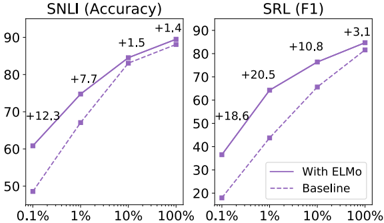
- ELMo increases sample efficiency: the SRL model reaches maximum development F1 after 486 epochs without ELMo, but with ELMo exceeds the baseline maximum at epoch 10, a 98% relative decrease in updates; ELMo with 1% of the training set performs about the same as the baseline with 10%.
Methods
- ELMo is built on a pretrained biLM with two biLSTM layers, 4096 units, 512-dimensional projections, and a residual connection; the context-insensitive type representation uses 2048 character n-gram convolutional filters, two highway layers, and a linear projection to 512 dimensions. The biLM was trained for 10 epochs on the 1B Word Benchmark (approximately 30 million sentences), with average forward/backward perplexity 39.7.
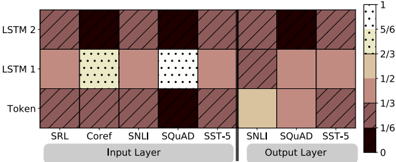
- For downstream tasks, the biLM weights are frozen; all layer representations are recorded, and the task model learns a softmax-normalized linear combination of them. ELMo is concatenated with token embeddings and sometimes also added at the output of the task biRNN, with dropout and sometimes L2 regularization on ELMo weights.
- Evaluation covers six benchmarks—SQuAD, SNLI, SRL, coreference resolution, NER, and SST-5—plus intrinsic WSD on SemCor and POS tagging on PTB.
Limitations
- The paper states no limitations section; no limitations are stated in the paper.
- Evident from the text: evaluation is limited to six benchmark NLP tasks and intrinsic WSD/POS tagging; no other languages or domains are tested.
- Evident from the text: the method depends on a large-scale pretrained biLM and task-specific layer weighting; the paper notes balancing language model perplexity with model size and computational requirements for downstream tasks.
Model-written summary. Check it against the paper before relying on it.
Integrity signals
Registry
Cites
Statistics
Figures
Verification
Claims the paper makes
8 Valid · 3 Not valid · 6 Not checked · 73 Own results and interpretations
Every source the paper cites for this claim was checked and supports it.
In the paper
“For tasks where direct comparisons are possible, ELMo outperforms CoVe (McCann et al., 2017), which computes contextualized representations using a neural machine translation encoder.”
§ Deep contextualized word representations > 1 Introduction
What the sources say
- Supportedcites McCann et al., 2017 matched to “Learned in Translation: Contextualized Word Vectors” (2017) source
The citation identifies CoVe and its method, not the citing authors’ comparison with ELMo. The Abstract (p. 1) describes CoVe as contextualized word vectors produced using an encoder trained for machine translation; Section 4 (p. 4) identifies the encoder’s outputs as context vectors. (LLM, conf=0.90)
plainstates a cause- Asserted: passes — The authors put it forward as true.
- Checkable: passes — It can be checked against evidence.
- Load-bearing: unclear — It is unclear whether the paper’s conclusions depend on it.
- Based: passes — The paper gives a reason why it holds.
- Supported
Every source the paper cites for this claim was checked and supports it.
In the paper
“Unlike most widely used word embeddings (Pennington et al., 2014), ELMo word representations are functions of the entire input sentence, as described in this section.”
§ Deep contextualized word representations > 3 ELMo: Embeddings from Language Models
What the sources say
- Supportedcites Pennington et al., 2014 matched to “Glove: Global Vectors for Word Representation” (2014) source
The citation is offered as an example of the static word embeddings contrasted with ELMo, and our copy of GloVe fits that identification: the Introduction (p. 1) states that semantic vector space models 'represent each word with a real-valued vector' used as features across applications, and the abstract/Introduction describe GloVe as a model that 'trains on global word-word co-occurrence counts' to produce a fixed word vector space (with released trained vectors), i.e. one context-independent vector per word rather than a function of the input sentence. Nothing in our copy makes GloVe representations sentence-dependent, so the contrast the citing sentence draws holds for this source. (LLM, conf=0.85)
plainstates a cause- Asserted: passes — The authors put it forward as true.
- Checkable: passes — It can be checked against evidence.
- Load-bearing: passes — The paper’s conclusions depend on it.
- Based: passes — The paper gives a reason why it holds.
- Supported
The cited sources support only part of this claim — read each source’s verdict below.
In the paper
“However, unlike WSD, accuracies using the first biLM layer are higher than the top layer, consistent with results from deep biL-STMs in multi-task training (Søgaard and Goldberg, 2016;Hashimoto et al., 2017) and MT (Belinkov et al., 2017).”
§ Deep contextualized word representations > POS tagging
What the sources say
- Partly supportedcites Søgaard and Goldberg, 2016 matched to “Deep multi-task learning with low level tasks supervised at lower layers” (2016) sourceExperimental — accuracy not yet measured
Our copy of Søgaard & Goldberg (2016) supports the general direction of the claim: the Experiments and Results section states that 'POS supervision at the lower layer is consistently better than standard MTL' (POS feeding off the inner/1st layer, higher-level task off the outer/3rd), and the Introduction frames the main contribution as 'better performance by having POS task supervision at a lower layer' with supervision of all tasks at the outermost level being 'often suboptimal'. But the accuracy gain the paper reports and quantifies is for the higher-level tasks (CHUNKS F1, CCG supertagging) plus a Rademacher-complexity analysis; no passage in our copy states that POS tagging accuracy itself is higher from the first layer than from the top layer. So the 'lower layer beats top layer' part is supported while the specific attribution to POS-tagging accuracy is not stated in the text we hold. (LLM, conf=0.68)
- Partly supportedcites Hashimoto et al., 2017 matched to “A Joint Many-Task Model: Growing a Neural Network for Multiple NLP Tasks” (2017) sourceExperimental — accuracy not yet measured
Section 2.2 assigns POS tagging to the first bi-LSTM layer, and Section 6 says the model can be used as a POS tagger with only that layer. The paper does not compare POS accuracies from its first and top layers, so it supports the lower-layer connection but not the claimed accuracy advantage. (LLM, conf=0.82)
- Supportedcites Belinkov et al., 2017 matched to “What do Neural Machine Translation Models Learn about Morphology?” (2017) source
The citation is offered for the MT comparison, not as evidence that Belinkov et al. studied biLMs. Section 4.2 reports that first-layer NMT encoder representations outperform second-layer representations on POS tagging, matching the cited comparison. (LLM, conf=0.92)
plainstates an association- Asserted: passes — The authors put it forward as true.
- Checkable: passes — It can be checked against evidence.
- Load-bearing: passes — The paper’s conclusions depend on it.
- Based: passes — The paper gives a reason why it holds.
- Partly supported
The cited sources support only part of this claim — read each source’s verdict below.
In the paper
“The increase of 4.7% with ELMo is also significantly larger then the 1.8% improvement from adding CoVe to a baseline model (McCann et al., 2017).”
§ Deep contextualized word representations > 4 Evaluation
What the sources say
- Partly supportedcites McCann et al., 2017 matched to “Learned in Translation: Contextualized Word Vectors” (2017) sourceExperimental — accuracy not yet measured
The SQuAD results (p. 8, Table 3) support that adding CoVe improved validation performance, but they do not show a 1.8% gain: the listed scores differ by 5.9 points in exact match and 4.3 points in F1. The paper does not compare that gain with ELMo or establish that the difference is significant. (LLM, conf=0.84)
plain- Asserted: passes — The authors put it forward as true.
- Checkable: passes — It can be checked against evidence.
- Load-bearing: passes — The paper’s conclusions depend on it.
- Based: passes — The paper gives a reason why it holds.
- Partly supported
The cited sources support only part of this claim — read each source’s verdict below.
In the paper
“This is competitive with a state-of-the-art WSD-specific supervised model using hand crafted features (Iacobacci et al., 2016) and a task specific biLSTM that is also trained with auxiliary coarse-grained semantic labels and POS tags (Raganato et al., 2017a).”
§ Deep contextualized word representations > 5.3 What information is captured by the biLM's representations?
What the sources say
- Supportedcites Iacobacci et al., 2016 matched to “Embeddings for Word Sense Disambiguation: An Evaluation Study” (2016) source
The Iacobacci et al. citation attaches to the supervised WSD model using hand-crafted features, not to the biLSTM attributed to Raganato et al. Section 4.1 describes the supervised IMS system and its standard POS, context-word, and collocation features; the Conclusions call the standard-feature system state-of-the-art. Page numbers are not supplied in our copy's passages. (LLM, conf=0.92)
- Not matchedcites Raganato et al., 2017a
More than one paper fits this citation.
plain- Asserted: passes — The authors put it forward as true.
- Checkable: passes — It can be checked against evidence.
- Load-bearing: passes — The paper’s conclusions depend on it.
- Based: passes — The paper gives a reason why it holds.
- Supported
51 more claims
Create a free account to see all 90 claims and to verify the 5 references still open.
- It may state two separate claims as one. 23
- Probably not a substantial claim. 13
Claims other papers make about this one
Each is checked against this paper’s own text: does it say what the citing paper says it does?
The source backs part of the claim, not all of it — or backs it for a different population, condition or comparison.
In the citing paper
“In stark contrast, our approach harnesses the potential of Large Language Models (LLMs), particularly their underlying transformer architecture. This modern method enables a more nuanced and contextually aware extraction of meanings at both the word and sentence levels”
From ChatGPT and Deepseek: Can They Predict the Stock Market and Macroeconomy? (2025) · cites this paper as Peters et al., 2018
Experimental — accuracy not yet measuredThe source backs part of the claim, not all of it — or backs it for a different population, condition or comparison.
In the citing paper
“This structure can capture intricate word features, such as synonyms and polysemy, across different linguistic contexts.”
From A Survey of Deep Learning-Based Multimodal Emotion Recognition: Speech, Text, and Face (2023) · cites this paper as [62]
Experimental — accuracy not yet measuredThe source backs part of the claim, not all of it — or backs it for a different population, condition or comparison.
In the citing paper
“we can utilize the technique of fine-tuning pre-trained language models32–35 with family-specific sequences to further improve ProGen’s ability to capture the distribution of local sequence neighborhoods corresponding to the protein family.”
From Large language models generate functional protein sequences across diverse families (2023) · cites this paper as [32]
Experimental — accuracy not yet measuredThe source backs part of the claim, not all of it — or backs it for a different population, condition or comparison.
In the citing paper
“These practical applications of language technology are increasingly reliant on approaches based on trained Large Language Models (LLMs) [23, 41, 104, 111], whereby models are first exposed to as large and varied a collection of language data as possible with the aim of extracting 'general' properties of a language of interest.”
From Data Governance in the Age of Large-Scale Data-Driven Language Technology (2022) · cites this paper as [104]
Experimental — accuracy not yet measuredThe source backs part of the claim, not all of it — or backs it for a different population, condition or comparison.
In the citing paper
“Preliminary work that applied the transfer learning paradigm of pre-training and fine-tuning all of the model's parameters to NLP problems used a causal language modeling objective for pre-training (Dai and Le, 2015; Peters et al., 2018; Radford et al., 2018; Howard and Ruder, 2018).”
From Exploring the Limits of Transfer Learning with a Unified Text-to-Text Transformer (2019) · cites this paper as Peters et al., 2018
Experimental — accuracy not yet measured
17 more claims about this paper
Create a free account to see every claim other papers make about this one.
Self-check
Percentages, sums and reported differences re-computed from the paper’s own numbers.
Each contradiction between two passages listed here was confirmed by an independent check.
Rated minor: it would not touch a result — a value no result rests on, a p-value that stays on the same side of the significance level, or a conflict that is clerical, resolved elsewhere in the paper, or outside its own findings.
In the paper
§ Deep contextualized word representations > 5.6 Contextual vs. sub-word information
“Table 7 summarizes the results for SQuAD, SNLI and SNLI.”
§ Deep contextualized word representations > 6 Conclusion
“Table: 7 Table 7 : Development set ablation analysis for SQuAD, SNLI and SRL comparing different choices for the context-independent type representation and contextual representation.”
Rated minor: it would not touch a result — a value no result rests on, a p-value that stays on the same side of the significance level, or a conflict that is clerical, resolved elsewhere in the paper, or outside its own findings.
In the paper
§ Deep contextualized word representations > 4 Evaluation
“with relative error reductions ranging from 6 -20% over strong base models.”
§ Deep contextualized word representations > 4 Evaluation
“After adding ELMo to the baseline model, test set F 1 improved by 4.7% from 81.1% to 85.8%, a 24.9% relative error reduction over the baseline”
Citations
Cites
Hochreiter, S., & Schmidhuber, J. (1997) · Neural Computation · doi:10.1162/neco.1997.9.8.1735 · Cited by 102,318 · cited 2×
“, 2016) uses a bidirectional Long Short Term Memory (LSTM; Hochreiter and Schmidhuber, 1997) to encode the context around a pivot word.”
MethodAdam: A Method for Stochastic Optimization
Kingma, D. P., & Ba, J. (2014) · arXiv · doi:10.48550/arxiv.1412.6980 · Cited by 98,946
Glove: Global Vectors for Word Representation
Pennington, J., Socher, R., & Manning, C. (2014) · Proceedings of the 2014 Conference on Empirical Methods in Natural Language Processing (EMNLP) · doi:10.3115/v1/d14-1162 · Cited by 34,071
(2014) · Cited by 33,419
Distributed Representations of Words and Phrases and their Compositionality
Mikolov, T., Sutskever, I., Chen, K., Corrado, G., & Dean, J. (2013) · arXiv · doi:10.48550/arxiv.1310.4546 · Cited by 24,533 · cited 3×
“Due to their ability to capture syntactic and semantic information of words from large scale unlabeled text, pretrained word vectors (Turian et al., 2010; Mikolov et al., 2013; Pennington et al., 2014) are a standard component of most state-ofthe-art NLP architectures, including for question answering (Liu et al.”
BackgroundEnriching Word Vectors with Subword Information
Bojanowski, P., Grave, E., Joulin, A., & Mikolov, T. (2017) · Transactions of the Association for Computational Linguistics · doi:10.1162/tacl_a_00051 · Cited by 9,645 · cited 2×
“Previously proposed methods overcome some of the shortcomings of traditional word vectors by either enriching them with subword information (e.g., Wieting et al., 2016; Bojanowski et al., 2017) or learning separate vectors for each word sense (e.”
MethodBuilding a Large Annotated Corpus of English: The Penn Treebank
Marcus, M. (1993) · doi:10.21236/ada273556 · Cited by 7,405
On the Properties of Neural Machine Translation: Encoder–Decoder Approaches
Cho, K., van Merrienboer, B., Bahdanau, D., & Bengio, Y. (2014) · Proceedings of SSST-8, Eighth Workshop on Syntax, Semantics and Structure in Statistical Translation · doi:10.3115/v1/w14-4012 · Cited by 7,099
Recursive Deep Models for Semantic Compositionality Over a Sentiment Treebank
Socher, R., Perelygin, A., Wu, J., Chuang, J., Manning, C. D., Ng, A., & Potts, C. (2013) · Proceedings of the 2013 Conference on Empirical Methods in Natural Language Processing · doi:10.18653/v1/d13-1170 · Cited by 6,878
SQuAD: 100,000+ Questions for Machine Comprehension of Text
Rajpurkar, P., Zhang, J., Lopyrev, K., & Liang, P. (2016) · Proceedings of the 2016 Conference on Empirical Methods in Natural Language Processing · doi:10.18653/v1/d16-1264 · Cited by 6,208 · cited 2×
“Question answering The Stanford Question Answering Dataset (SQuAD) (Rajpurkar et al., 2016) contains 100K+ crowd sourced question-answer pairs where the answer is a span in a given Wikipedia paragraph.”
Background
Research works printed but not linked: 4
- [2]2. Yonatan Belinkov, Nadir Durrani, Fahim Dalvi, Has- san Sajjad, and James R. Glass. 2017. What do neu- ral machine translation models learn about morphol- ogy? In ACL.
- [4]4. Samuel R. Bowman, Gabor Angeli, Christopher Potts, and Christopher D. Manning. 2015. A large an- notated corpus for learning natural language infer- ence. In Proceedings of the 2015 Conference on Empirical Methods in Natural Language Processing (EMNLP). Association for Computational Linguis- tics.
- [36]36. Tomas Mikolov, Ilya Sutskever, Kai Chen, Greg S Cor- rado, and Jeff Dean. 2013. Distributed representa- tions of words and phrases and their compositional- ity. In NIPS.
- [48]48. Prajit Ramachandran, Peter Liu, and Quoc Le. 2017. Improving sequence to sequence learning with unla- beled data. In EMNLP.
Cited by
Items 11,701–11,800 of 12,015
Pooling Attention: Evaluating Pretrained Transformer Embeddings for Deception Classification
Mamtani, S., & Bhure, A. (2025) · Computing, Communications and IoT Applications (ComComAp) · doi:10.1109/comcomap68359.2025.11353127
Zhao, W. X., Zhou, K., Li, J., Tang, T., & Wen, J.-R. (2025) · Artificial intelligence: foundations, theory, and algorithms/Artificial intelligence: Foundations, theory, and algorithms · doi:10.1007/978-981-96-6259-3_1
Zhang, P., Hao, G., Wang, X., et al. (2026) · Communications in computer and information science · doi:10.1007/978-981-95-4788-3_5
Zhao, W. X., Zhou, K., Li, J., Tang, T., & Wen, J.-R. (2025) · Artificial intelligence: foundations, theory, and algorithms/Artificial intelligence: Foundations, theory, and algorithms · doi:10.1007/978-981-96-6259-3_4
Zhao, W. X., Zhou, K., Li, J., Tang, T., & Wen, J.-R. (2025) · Artificial intelligence: foundations, theory, and algorithms/Artificial intelligence: Foundations, theory, and algorithms · doi:10.1007/978-981-96-6259-3_2
From Keywords to Context: An AI Agent for Natural Language Document Lookup in the Enterprise
Ngoc, H. L. (2025) · RIVF International Conference on Computing and Communication Technologies (RIVF) · doi:10.1109/rivf68649.2025.11365175
A Depression Detection Method Based on Emotion-Topic Guided In-Context Learning
Shi, Y., Gan, T., Li, J., et al. (2025) · doi:10.1145/3786484.3786524
Ahmad, P. N., Anwar, M. S., Masood, S., Rehman, A. U., & Zubair, M. (2026) · Big Data · doi:10.1177/2167647x251409135 · Cited by 1
Interpretation Discrimination Model Integrating Statistical Features and Deep Semantic Features
Ge, D., & Gao, J. (2025) · International Conference on Cyber Security and Information Engineering (ICCSIE) · doi:10.1109/iccsie65832.2025.00084
123Bedeutungswandelerkennung in der Computerlinguistik
Schlechtweg, D. (2026) · De Gruyter eBooks · doi:10.1515/9783112240151-008
Yadav, V., Yadav, A. K., Kumar, M., Singh, M. K., & Kushwaha, A. K. (2026) · Communications in computer and information science · doi:10.1007/978-3-032-13757-9_15
A Systematic Approach to Key Phrase Extraction for Turkish: Adapting Embedding-Based Models
Diker, S. N., & Sakar, C. O. (2026) · IEEE Access · doi:10.1109/access.2026.3662520 · Cited by 1
Rate-Splitting Multiple Access for Coexistence of Semantic and Bit Communications
Liu, Y., & Clerckx, B. (2026) · IEEE Transactions on Communications · doi:10.1109/tcomm.2026.3657401
Spatial Role Labeling Based on Dependency Guided Word Embeddings
Moussa, A., Fournier, S., Mahmoudi, K., Espinasse, B., & Faïz, S. (2026) · ACM Transactions on Asian and Low-Resource Language Information Processing · doi:10.1145/3795776
Two-Stage Expert Offloading for Domain-Aware MoE Inference
Kim, H., Woo, H., & Kim, Y. (2026) · IEEE Access · doi:10.1109/access.2026.3665697 · Cited by 1
Domain Adaptation of Large Language Model Tokenizers—A Comparison of Performances
Bogdanović, M., Gligorijević, M. F., Kocić, J., & Stoimenov, L. V. (2026) · Lecture notes in networks and systems · doi:10.1007/978-3-032-04890-5_21
Word Embeddings and Transformers for Marketing Text Analytics
Dan, D., & Reutterer, T. (2025) · Classroom companion: business · doi:10.1007/978-3-032-08086-8_10
Davda, Y., Gaikwad, S., Somkunwar, R., Deshmukh, R. V., & Puranik, B. S. (2026) · IGI Global eBooks · doi:10.4018/979-8-3373-3191-1.ch002
Venerdi, J., Arifin, D., Arifin, H. W., et al. (2025) · IEEE International Conference on Cryptography, Informatics, and Cybersecurity (ICoCICs) · doi:10.1109/icocics68032.2025.11384064
SimNet: A Knowledge Graph for Assisting Various NLP Systems
Parmar, J., & Singh, M. (2025) · International Conference on Innovations and Emerging Technologies in AI & Communication Systems (IETACS) · doi:10.1109/ietacs68750.2025.11385754
Sentiment Analysis of Movie Reviews Using DistilBERT
Berlian, C., Adiputra, J. B., Masaling, N. A. P., & Chowanda, A. (2025) · International Seminar on Research of Information Technology and Intelligent Systems (ISRITI) · doi:10.1109/isriti68345.2025.11393151
Mining social media data to track environmental disaster events
del Gobbo, E., Ippoliti, L., Fontanella, L., & Cafarelli, B. (2026) · Environmental and Ecological Statistics · doi:10.1007/s10651-025-00699-x
Efficient Parameter Estimation by Fine Tuning DistilBERT for Synthetic Text Detection
Sahadh, M. A., & Manimaran, A. (2025) · International Conference on Artificial Intelligence and Signal Processing (AISP) · doi:10.1109/aisp68263.2025.11396249
Zhan, S., Xu, Z., Wang, T., & Li, F. (2026) · Journal of King Saud University - Computer and Information Sciences · doi:10.1007/s44443-026-00555-3
Optimised Data Integration using Transformer Model and Resource Description Framework
Achir, J. A., Abdulkarim, M., & Abdullahi, M. (2026) · Journal of Informatics and Web Engineering · doi:10.33093/jiwe.2026.5.1.8 · Cited by 2
GenBERTplus : A New Approach to Numeracy in Natural Language Processing
Ajay, S., Krishnamurthy, V., & Singh, A. (2025) · IEEE Conference on Information and Communication Technology (CICT) · doi:10.1109/cict67193.2025.11399104
Dictionary-based Byte-Pair Encoding tokenizer for morphologically rich languages
Držík, D. (2025) · International Conference on Electrical and Computer Engineering Researches (ICECER) · doi:10.1109/icecer65523.2025.11401129
Multilingual NLP Models: A Review of Techniques, Tools, and Real-World Use Cases
Kasilingam, N., Kedhlaya, V. S., Moolya, S. S., et al. (2026) · International Conference on Intelligent and Innovative Technologies in Computing, Electrical and Electronics (IITCEE) · doi:10.1109/iitcee67948.2026.11394472
Computational Methods in Empirical Studies on Legal Interpretation: Before Transformers and AfterPreprint
Bystranowski, P., & Tobia, K. P. (2025) · SSRN Electronic Journal · doi:10.2139/ssrn.5097366
A review sentiment analysis techniques on tweets data
Kareem, F. R., & Obaid, A. J. (2026) · AIP conference proceedings · doi:10.1063/5.0318097 · Cited by 1
Is the financial market efficient? An advanced time series analysis
Mao, S., Meng, L.-X., Barbu, A., & Niu, X. (2026) · Financial Innovation · doi:10.1186/s40854-025-00856-y · Cited by 1
Wieczorek, J., Jiang, X., Palade, V., & Trela, J. (2026) · medRxiv · doi:10.64898/2026.02.23.26346928
HelBERT: A BERT-Based Pretraining Model for Public Procurement Tasks in Portuguese
Lima, W. E. M., Silva, V. R. D., da Silva, J. C., Rabêlo, R. A. L., & de Paiva, A. C. (2026) · Journal of the Brazilian Computer Society · doi:10.5753/jbcs.2026.5511 · Cited by 1
Research on deep learning and Morphological Features enhanced method in Kazakh IT term
Niyazbek, M., & Talp, K. (2026) · Multimedia Tools and Applications · doi:10.1007/s11042-026-21418-z
Arista, F. J. M., Rodríguez, D. M., & Morris, D. B. (2025) · IEEE International Conference on Big Data (BigData) · doi:10.1109/bigdata66926.2025.11401566
FI-LoRA: Dynamic and Lightweight Low-Rank Adaptation Guided by Fisher Information
Zeng, C., & Zhao, S. (2026) · IEEE Signal Processing Letters · doi:10.1109/lsp.2026.3673210 · Cited by 1
Issues of Homonyms/Homoforms Automatic Recognition in Applied Linguistics
Meirbekova, A., Fazylzhanova, A., Zhanabekova, A., et al. (2026) · Cuadernos de Investigación Filológica · doi:10.18172/cif.6716
Shi, X., Fei, Z., Nkhata, A., Chen, L., Chen, Z., & Chen, H. (2026) · Scientific Reports · doi:10.1038/s41598-026-44317-7
Jain, S., Sharma, A., Chodhury, D., Bhowmik, S., & Srivastava, K. (2026) · IEEE International Students' Conference on Electrical, Electronics and Computer Science (SCEECS) · doi:10.1109/sceecs68810.2026.11429845
Deep Learning Solutions for Cross-DomainNamed Entity Recognition with BERT and RoBERTa
Gupta, D., Gupta, M., Rathor, G., & Kumar, R. (2025) · International Conference on Advances in Computation, Communication and Information Technology (ICAICCIT) · doi:10.1109/icaiccit68829.2025.11433953
Gonc¸alves, A., Cardoso, H. L., & Reis, L. P. (2026) · IEEE Transactions on Computational Biology and Bioinformatics · doi:10.1109/tcbbio.2026.3676374
Disambiguation of Clinical Abbreviations in EHRs Using Fine-Tuned Biomedical BERT
Joshi, V. K., Nirkhi, S. M., Guda, S., Motghare, M., Singh, Y., & Patil, S. (2025) · International Conference on Artificial Intelligence and Quantum Computation-Based Sensor Application (ICAIQSA) · doi:10.1109/icaiqsa67794.2025.11440614
Dezhboro, A., Ramírez-Márquez, J. E., & Krstikj, A. (2026) · Risk Analysis · doi:10.1111/risa.70214 · Cited by 8
Roy, A., Roy, A., & Shrivallabha, S. (2025) · doi:10.1109/decon67170.2025.11447642
A Framework for Identifying Problem-Solution in Research Articles: Focusing on Social Issue
Kim, M.-S., Shin, H., Chun, H.-W., & Lee, J.-M. (2026) · IEEE Access · doi:10.1109/access.2026.3678862
Fine-Tuning BART with LoRA for Summarization of Indian Judicial Case Documents
Firke, A., Goyal, A., Gavhane, B., Kulkarni, S., & Joshi, P. (2026) · International Conference on Emerging Trends and Innovations in ICT (ICEI) · doi:10.1109/icei65890.2026.11447462
Tiwari, P., Kamatham, K., Saritha, S. K., & Natha, G. S. (2026) · Lecture notes in networks and systems · doi:10.1007/978-3-032-13555-1_38
Convolutional Neural Networks Based on Text Vector Imaging for Sentiment Analysis of Movie Reviews
Lu, W. (2025) · International Conference on Power, Electrical Engineering, Electronics and Control (PEEEC) · doi:10.1109/peeec67807.2025.00177
Extraction d'information dans des documents manuscrits anciens
Granet, A. (2018) · theses.fr (ABES) · doi:10.70675/c1a0e28eza032z4972z90f5z3e42107dd2b7
Multimodal machine learning : complementarity of textual and visual contexts
Zablocki, É. (2019) · theses.fr (ABES) · doi:10.70675/5c353aafz9b11z40d4zb921z3af1e200002a
Question Answering with Hybrid Data and Models
Kamath, S. (2020) · theses.fr (ABES) · doi:10.70675/49d4e33bz05d5z4121z9d7azef3162487087
Learning distributed representations of sentences using neural networks
Conneau, A. (2019) · theses.fr (ABES) · doi:10.70675/b3ecf08ez353ez4532zb829z7c06c26a7e07
Multi-modal representation learning towards visual reasoning
Ben-younes, H. (2019) · theses.fr (ABES) · doi:10.70675/d69497cfzf0c3z418ezaa6azbfef68416b7b
Belkacem, T. (2019) · theses.fr (ABES) · doi:10.70675/f480bd4dz0f08z4e64z9c2fz484276575ac4 · Cited by 1
Marzinotto, G. (2019) · theses.fr (ABES) · doi:10.70675/1d9a30f7z1482z45b6zb594z783f375cd38e · Cited by 1
Rethinking Topic Modeling With Information Bottleneck Principle
Duan, Z., Hu, X., Chen, B., et al. (2026) · IEEE Transactions on Neural Networks and Learning Systems · doi:10.1109/tnnls.2025.3644425
Qualitative evaluation of word embeddings : investigating the instability in neural-based models
Pierrejean, B. (2020) · theses.fr (ABES) · doi:10.70675/a1747243zc752z4da7z86dezf358c5a1d487 · Cited by 9
Analyse automatique par transitions pour l'identification des expressions polylexicales
Saied, H. A. (2019) · theses.fr (ABES) · doi:10.70675/bac8a491z3fdfz47e4z9788z39ad7c65e118
Prise en compte du contexte inter-phrastique pour l'extraction d'événements supervisée
Kodelja, D. (2020) · theses.fr (ABES) · doi:10.70675/1cdf7c4cz5d18z4b68zbcf9z8fb475bf31a5 · Cited by 1
Zhang, Z. (2019) · theses.fr (ABES) · doi:10.70675/df0f1f11z8a2ez45b3z8bf2z660c4be2e250 · Cited by 4
Reconnaissance des procédés de traduction sous-phrastiques : des ressources aux validations
Yuming, Z. (2019) · theses.fr (ABES) · doi:10.70675/73b6fc92z8f22z42fbzb778z94ba5df6148e · Cited by 4
Détection de topiques et leur similarité dans les textes scientifiques
Hernandez, S. D. (2019) · theses.fr (ABES) · doi:10.70675/9e15f936zad3dz4071zb9c4z5e9622bb2d35
Semantic and Discursive Representation for Natural Language Understanding
Sileo, D. (2019) · theses.fr (ABES) · doi:10.70675/06f08c91z80ddz448az8a2dz424ef97b76d2
Toward Automatic Fact-Checking of Statistic Claims
Cao, T. D. (2019) · theses.fr (ABES) · doi:10.70675/418c9e35z59cbz42b6zb554zeadf5190fcba
Vardhan, M. D. M. M. G., Lakshmi, P. P. P. P., & Khan, S. A. (2026) · International Journal of Advanced Research in Science Communication and Technology · doi:10.48175/ijarsct-32361
Assisted authoring for avoiding inadequate claims in scientific reporting
Koroleva, A. (2020) · theses.fr (ABES) · doi:10.70675/f035bb8azddf1z4a7dzbf39zdf86c6947bb9 · Cited by 2
Unsupervised cross-lingual representation modeling for variable length phrases
Liu, J. (2020) · theses.fr (ABES) · doi:10.70675/d93d53a6z857fz47e6z8dc8z85289e135ca6
Apprentissage de représentations pour les traces de mobilité
Tonnelier, E. (2019) · theses.fr (ABES) · doi:10.70675/51a7f890z3abdz4f5bzb2dfz3d19b456a559
Al-Natsheh, H. T. (2019) · theses.fr (ABES) · doi:10.70675/1d5e1008z025cz4044zb2b7z3fdf449ab74a · Cited by 7
Induction non-supervisée de schémas d’évènements à partir de textes journalistiques
Ribeiro, S. (2020) · theses.fr (ABES) · doi:10.70675/5caa05b2z8ba4z448fzb8c1ze1d20848acac
Analyse du discours conversationnel dans le cadre de communications médiées par ordinateur
Auguste, J. (2020) · theses.fr (ABES) · doi:10.70675/60f1f619z22c5z4f5cza402z4ff7f222bb61
Mazoyer, B. (2020) · theses.fr (ABES) · doi:10.70675/44b771a8ze470z4c54zbdd7z1ffa400cfafe · Cited by 3
Modèles neuronaux pour la représentation et l'appariement d'objets géotextuels
Mousset, P. (2020) · theses.fr (ABES) · doi:10.70675/c533c1f4z5674z4c7cz93e9ze76be342daaa
Nguyen, D. (2020) · theses.fr (ABES) · doi:10.70675/90610f0fz5830z4e03z8736z973087b2be54 · Cited by 1
Connaissances a priori pour la Recherche d'Information textuelle basée sur l'apprentissage profond
Frej, J. (2021) · theses.fr (ABES) · doi:10.70675/0b074517z6627z456dz8a41z74cffb195a2b · Cited by 1
Deep Natural Language Processing for User Representation
de Gabriac, C. G. D. F. (2021) · theses.fr (ABES) · doi:10.70675/f1d99786zd4d3z4d46z9b86z5de95a2b3290
Spatial techniques for video understanding
Sydorov, V. (2021) · theses.fr (ABES) · doi:10.70675/ab9825adz1fb8z4f1cz9217zef67d5530022 · Cited by 1
Contextualization and Generalization in Entity and Relation Extraction
Taillé, B. (2022) · theses.fr (ABES) · doi:10.70675/72fea173z5549z4bd5z8332zf81f26d3c2b9
Multimodal and interactive models for visually grounded language learning
Strub, F. (2020) · theses.fr (ABES) · doi:10.70675/565f6b44z5446z433azb85dz57d7ca36bccf
Reconnaissance automatique de chaînes de coréférences en français parlé
Grobol, L. (2020) · theses.fr (ABES) · doi:10.70675/c9117547z94a7z4160zbdb1z14d4782be6d0
Jalalzai, H. (2020) · theses.fr (ABES) · doi:10.70675/ea518c01zea1cz461dza5dczc7c1f97357f4
Hemamou, L. (2021) · theses.fr (ABES) · doi:10.70675/6bf948faza1c0z4e9fza95cze35f40a39ce3 · Cited by 1
Continuous embeddings for large-scale machine learning with DNA sequences
Menegaux, R. (2021) · theses.fr (ABES) · doi:10.70675/bc11fdd1z0c3az45c3z9f9ez65301994b39d
Improving methods to learn word representations for efficient semantic similarites computations
Tissier, J. (2020) · theses.fr (ABES) · doi:10.70675/51ddd47az2857z4d33z867ezc90505e8e222 · Cited by 1
Clickbait detection using multimodel fusion and transfer learning
Rajapaksha, P. (2020) · theses.fr (ABES) · doi:10.70675/862230d2z8e4bz431dz90a9z76ed3351df0f · Cited by 5
Content and data linking leveraging ontological knowledge in data journalism
Vaigh, C. B. E. (2021) · theses.fr (ABES) · doi:10.70675/6d3a4313z8d77z4dddz8cfcz3e88306088d4
Neural Transfer Learning for Domain Adaptation in Natural Language Processing
Meftah, S. (2021) · theses.fr (ABES) · doi:10.70675/9111562bzfa37z4fd8zae6bz2e8ae8d5d403 · Cited by 2
Modèles neuronaux joints de désambiguïsation lexicale et de traduction automatique
Vial, L. (2020) · theses.fr (ABES) · doi:10.70675/d6f5ba79z6379z49cez8a3dz53e632478bc5 · Cited by 3
Détection d'événements géo-chrono-localisés dans les tweets
Seffih, H. (2020) · theses.fr (ABES) · doi:10.70675/12fd4576za03ez4905z9606z47daae719fa7 · Cited by 1
Architectures neuronales multilingues pour le traitement automatique des langues naturelles
Bardet, A. (2021) · theses.fr (ABES) · doi:10.70675/2d4c7cffz41a0z4d87z89aez12232c7475af
Fouille de texte et extraction d'informations dans les données cliniques
Dalloux, C. (2020) · theses.fr (ABES) · doi:10.70675/d09cc9c4z1370z404cz96b2zb4f16b7d15c8 · Cited by 3
Modélisation de la coarticulation multimodale : vers l'animation d'une tête parlante intelligible
Biasutto-Lervat, T. (2021) · theses.fr (ABES) · doi:10.70675/f006f769z5ba3z44a4zb5a7zbdbcff2b82b5
Graphs, geometry, and representations for language models and networks of entities
Khalife, S. (2020) · theses.fr (ABES) · doi:10.70675/f492af33zc626z4cccza6f7zeb9755eee4e0
Müller, B. (2022) · theses.fr (ABES) · doi:10.70675/6984dc63z4731z4eabzb3fazaf5d012fe143
Visual and Textual Common Semantic Spaces for the Analysis of Multimodal Content
Beltrán, L. V. B. (2021) · theses.fr (ABES) · doi:10.70675/a19cbe0dz6c94z4ff6zb70ez024fd8546d17 · Cited by 1
Cadavid, J. P. U. (2021) · theses.fr (ABES) · doi:10.70675/0f7cb972zf73fz47b8zb5c0z172c5f5eee84 · Cited by 2
Méthodes d'apprentissage automatique pour l'analyse de corpus jurisprudentiels
Condevaux, C. (2021) · theses.fr (ABES) · doi:10.70675/a07b8042z06e3z4d21z97fbz209b3ca1618e · Cited by 1
Metadata
- Authors
- Peters, M., Neumann, M., Iyyer, M., Gardner, M., Clark, C., Lee, K., & Zettlemoyer, L.
- Affiliations
- Allen Institute for Artificial Intelligence (US)
- University of Washington (US)
- Venue
- Proceedings of the 2018 Conference of the North American Chapter of the Association for Computational Linguistics: Human Language Technologies, Volume 1 (Long Papers)
- Published
- 2018
- Pages
- 2227-2237
- OpenAlex
- W2787560479
- Semantic Scholar
- 3febb2bed8865945e7fddc99efd791887bb7e14f
- Cited by
- 11,983
- References
- 53
- Citations by year
- 2026: 193 · 2025: 554 · 2024: 783 · 2023: 1395 · 2022: 1667 · 2021: 2573 · 2020: 2552 · 2019: 1977 · 2018: 284
- FWCI
- 754.67
- Type
- conference paper
- Language
- en
- Open access
- hybrid
- doi.org
- Licence
- cc-by
- Locations
- Conference of the North American Chapter of the Association for Computational Linguistics: Human Language Technologies (NAACL-HLT) (publishedVersion, cc-by)
- arXiv (Cornell University) (submittedVersion)
- arXiv (Cornell University)
- Topics
- Physical Sciences › Computer Science › Artificial Intelligence › Topic Modeling
- Physical Sciences › Computer Science › Artificial Intelligence › Natural Language Processing Techniques
- Physical Sciences › Computer Science › Artificial Intelligence › Sentiment Analysis and Opinion Mining
- Keywords
- contextualized word representations, word embeddings, word sense disambiguation
About these checks
Registry, retraction, Cites and statistics results are computed, not judged, with one exception: a printed reference that no index lists is read once by a model before it counts as a citation error. Claims are extracted by a model and kept only when their quote appears verbatim in the text; each cited source is then checked, with a model’s help, for whether it says what the claim relies on. Those verdicts can be wrong — read the claim’s quote and the cited source before relying on one.
The claim verdicts this report counts are experimental: their accuracy is not yet measured.
A language model drew the claims from the paper on 2026-10-23, under version 3 of the claim definition (model deepseek-v4.1-flash, prompt extract-v3).
A second model labelled each claim on 2026-10-23 (model jev-1.13-20260917, definition revision gold-guideline-v0.2).
Cited sources are checked with a language model’s help (gpt-6-sol and qwen3.8-omni-flash).
Statistics and arithmetic are recomputed, not judged.
Confidence bands are shown only for fields calibrated on our annotated test set. None is calibrated yet, so no band is shown.
What counts as a claim ›How we measure confidence ›How we check this ›
Are you an author, or do you see a problem with this page? Request a review
Data sources
Bibliographic data: Semantic Scholar, OpenAlex, Crossref.
Contains information from the Semantic Scholar Academic Graph Datasets, made available under the ODC Attribution License (ODC-BY 1.0).
Semantic Scholar’s data is described in: Kinney, R., et al. (2023). The Semantic Scholar Open Data Platform. arXiv:2301.10140.
