

Deep Contextualized Word Representations
Open accessThe DOI matches its Crossref record; 71 of the 71 references it cites were found in a registry or an index; 10 of the 21 sources its claims cite were checked for support.
Abstract
Matthew E. Peters, Mark Neumann, Mohit Iyyer, Matt Gardner, Christopher Clark, Kenton Lee, Luke Zettlemoyer. Proceedings of the 2018 Conference of the North American Chapter of the Association for Computational Linguistics: Human Language Technologies, Volume 1 (Long Papers). 2018.
Overview
CoChat Summary
TL;DR
ELMo introduces deep contextualized word representations computed as task-specific linear combinations of internal states from a pretrained two-layer bidirectional LSTM language model. Adding ELMo to existing models improves the state of the art across six NLP benchmarks, with relative error reductions up to 20%.
Key findings
- ELMo improved every considered task: SQuAD F1 81.1→85.8 (4.7 absolute, 24.9% relative), SNLI 88.0→88.7 ± 0.17 (0.7 / 5.8%), SRL 81.4→84.6 (3.2 / 17.2%), Coref 67.2→70.4 (3.2 / 9.8%), NER 90.15→92.22 ± 0.10 (2.06 / 21%), and SST-5 51.4→54.7 ± 0.5 (3.3 / 6.8%).
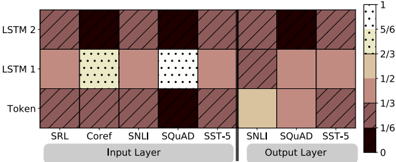
- Using all biLM layers outperforms using only the top layer: for SQuAD, the last biLM layer improves development F1 by 3.9% over baseline, averaging all layers adds another 0.3%, and learned layer weights add another 0.2%.
- Intrinsic evaluations show layer-specific information: biLM top-layer WSD F1 is 69.0 versus 67.4 for the first layer, while POS tagging accuracy is higher at the first layer (97.3) than the top layer (96.8).
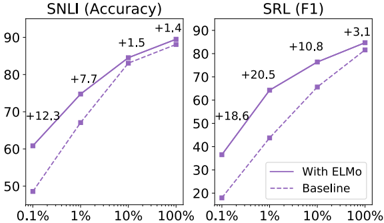
- ELMo increases sample efficiency: the SRL model reaches maximum development F1 after 486 epochs without ELMo, but with ELMo exceeds the baseline maximum at epoch 10, a 98% relative decrease in updates; ELMo with 1% of the training set performs about the same as the baseline with 10%.
Methods
- ELMo is built on a pretrained biLM with two biLSTM layers, 4096 units, 512-dimensional projections, and a residual connection; the context-insensitive type representation uses 2048 character n-gram convolutional filters, two highway layers, and a linear projection to 512 dimensions. The biLM was trained for 10 epochs on the 1B Word Benchmark (approximately 30 million sentences), with average forward/backward perplexity 39.7.
- For downstream tasks, the biLM weights are frozen; all layer representations are recorded, and the task model learns a softmax-normalized linear combination of them. ELMo is concatenated with token embeddings and sometimes also added at the output of the task biRNN, with dropout and sometimes L2 regularization on ELMo weights.
- Evaluation covers six benchmarks—SQuAD, SNLI, SRL, coreference resolution, NER, and SST-5—plus intrinsic WSD on SemCor and POS tagging on PTB.
Limitations
- The paper states no limitations section; no limitations are stated in the paper.
- Evident from the text: evaluation is limited to six benchmark NLP tasks and intrinsic WSD/POS tagging; no other languages or domains are tested.
- Evident from the text: the method depends on a large-scale pretrained biLM and task-specific layer weighting; the paper notes balancing language model perplexity with model size and computational requirements for downstream tasks.
Model-written summary. Check it against the paper before relying on it.
Integrity signals
Registry
Cites
Statistics
Figures
Verification
Claims the paper makes
8 Valid · 3 Not valid · 6 Not checked · 73 Own results and interpretations
Every source the paper cites for this claim was checked and supports it.
In the paper
“For tasks where direct comparisons are possible, ELMo outperforms CoVe (McCann et al., 2017), which computes contextualized representations using a neural machine translation encoder.”
§ Deep contextualized word representations > 1 Introduction
What the sources say
- Supportedcites McCann et al., 2017 matched to “Learned in Translation: Contextualized Word Vectors” (2017) source
The citation identifies CoVe and its method, not the citing authors’ comparison with ELMo. The Abstract (p. 1) describes CoVe as contextualized word vectors produced using an encoder trained for machine translation; Section 4 (p. 4) identifies the encoder’s outputs as context vectors. (LLM, conf=0.90)
plainstates a cause- Asserted: passes — The authors put it forward as true.
- Checkable: passes — It can be checked against evidence.
- Load-bearing: unclear — It is unclear whether the paper’s conclusions depend on it.
- Based: passes — The paper gives a reason why it holds.
- Supported
Every source the paper cites for this claim was checked and supports it.
In the paper
“Unlike most widely used word embeddings (Pennington et al., 2014), ELMo word representations are functions of the entire input sentence, as described in this section.”
§ Deep contextualized word representations > 3 ELMo: Embeddings from Language Models
What the sources say
- Supportedcites Pennington et al., 2014 matched to “Glove: Global Vectors for Word Representation” (2014) source
The citation is offered as an example of the static word embeddings contrasted with ELMo, and our copy of GloVe fits that identification: the Introduction (p. 1) states that semantic vector space models 'represent each word with a real-valued vector' used as features across applications, and the abstract/Introduction describe GloVe as a model that 'trains on global word-word co-occurrence counts' to produce a fixed word vector space (with released trained vectors), i.e. one context-independent vector per word rather than a function of the input sentence. Nothing in our copy makes GloVe representations sentence-dependent, so the contrast the citing sentence draws holds for this source. (LLM, conf=0.85)
plainstates a cause- Asserted: passes — The authors put it forward as true.
- Checkable: passes — It can be checked against evidence.
- Load-bearing: passes — The paper’s conclusions depend on it.
- Based: passes — The paper gives a reason why it holds.
- Supported
The cited sources support only part of this claim — read each source’s verdict below.
In the paper
“However, unlike WSD, accuracies using the first biLM layer are higher than the top layer, consistent with results from deep biL-STMs in multi-task training (Søgaard and Goldberg, 2016;Hashimoto et al., 2017) and MT (Belinkov et al., 2017).”
§ Deep contextualized word representations > POS tagging
What the sources say
- Partly supportedcites Søgaard and Goldberg, 2016 matched to “Deep multi-task learning with low level tasks supervised at lower layers” (2016) sourceExperimental — accuracy not yet measured
Our copy of Søgaard & Goldberg (2016) supports the general direction of the claim: the Experiments and Results section states that 'POS supervision at the lower layer is consistently better than standard MTL' (POS feeding off the inner/1st layer, higher-level task off the outer/3rd), and the Introduction frames the main contribution as 'better performance by having POS task supervision at a lower layer' with supervision of all tasks at the outermost level being 'often suboptimal'. But the accuracy gain the paper reports and quantifies is for the higher-level tasks (CHUNKS F1, CCG supertagging) plus a Rademacher-complexity analysis; no passage in our copy states that POS tagging accuracy itself is higher from the first layer than from the top layer. So the 'lower layer beats top layer' part is supported while the specific attribution to POS-tagging accuracy is not stated in the text we hold. (LLM, conf=0.68)
- Partly supportedcites Hashimoto et al., 2017 matched to “A Joint Many-Task Model: Growing a Neural Network for Multiple NLP Tasks” (2017) sourceExperimental — accuracy not yet measured
Section 2.2 assigns POS tagging to the first bi-LSTM layer, and Section 6 says the model can be used as a POS tagger with only that layer. The paper does not compare POS accuracies from its first and top layers, so it supports the lower-layer connection but not the claimed accuracy advantage. (LLM, conf=0.82)
- Supportedcites Belinkov et al., 2017 matched to “What do Neural Machine Translation Models Learn about Morphology?” (2017) source
The citation is offered for the MT comparison, not as evidence that Belinkov et al. studied biLMs. Section 4.2 reports that first-layer NMT encoder representations outperform second-layer representations on POS tagging, matching the cited comparison. (LLM, conf=0.92)
plainstates an association- Asserted: passes — The authors put it forward as true.
- Checkable: passes — It can be checked against evidence.
- Load-bearing: passes — The paper’s conclusions depend on it.
- Based: passes — The paper gives a reason why it holds.
- Partly supported
The cited sources support only part of this claim — read each source’s verdict below.
In the paper
“The increase of 4.7% with ELMo is also significantly larger then the 1.8% improvement from adding CoVe to a baseline model (McCann et al., 2017).”
§ Deep contextualized word representations > 4 Evaluation
What the sources say
- Partly supportedcites McCann et al., 2017 matched to “Learned in Translation: Contextualized Word Vectors” (2017) sourceExperimental — accuracy not yet measured
The SQuAD results (p. 8, Table 3) support that adding CoVe improved validation performance, but they do not show a 1.8% gain: the listed scores differ by 5.9 points in exact match and 4.3 points in F1. The paper does not compare that gain with ELMo or establish that the difference is significant. (LLM, conf=0.84)
plain- Asserted: passes — The authors put it forward as true.
- Checkable: passes — It can be checked against evidence.
- Load-bearing: passes — The paper’s conclusions depend on it.
- Based: passes — The paper gives a reason why it holds.
- Partly supported
The cited sources support only part of this claim — read each source’s verdict below.
In the paper
“This is competitive with a state-of-the-art WSD-specific supervised model using hand crafted features (Iacobacci et al., 2016) and a task specific biLSTM that is also trained with auxiliary coarse-grained semantic labels and POS tags (Raganato et al., 2017a).”
§ Deep contextualized word representations > 5.3 What information is captured by the biLM's representations?
What the sources say
- Supportedcites Iacobacci et al., 2016 matched to “Embeddings for Word Sense Disambiguation: An Evaluation Study” (2016) source
The Iacobacci et al. citation attaches to the supervised WSD model using hand-crafted features, not to the biLSTM attributed to Raganato et al. Section 4.1 describes the supervised IMS system and its standard POS, context-word, and collocation features; the Conclusions call the standard-feature system state-of-the-art. Page numbers are not supplied in our copy's passages. (LLM, conf=0.92)
- Not matchedcites Raganato et al., 2017a
More than one paper fits this citation.
plain- Asserted: passes — The authors put it forward as true.
- Checkable: passes — It can be checked against evidence.
- Load-bearing: passes — The paper’s conclusions depend on it.
- Based: passes — The paper gives a reason why it holds.
- Supported
51 more claims
Create a free account to see all 90 claims and to verify the 6 references still open.
- It may state two separate claims as one. 23
- Probably not a substantial claim. 13
Claims other papers make about this one
Each is checked against this paper’s own text: does it say what the citing paper says it does?
The source backs part of the claim, not all of it — or backs it for a different population, condition or comparison.
In the citing paper
“In stark contrast, our approach harnesses the potential of Large Language Models (LLMs), particularly their underlying transformer architecture. This modern method enables a more nuanced and contextually aware extraction of meanings at both the word and sentence levels”
From ChatGPT and Deepseek: Can They Predict the Stock Market and Macroeconomy? (2025) · cites this paper as Peters et al., 2018
Experimental — accuracy not yet measuredThe source backs part of the claim, not all of it — or backs it for a different population, condition or comparison.
In the citing paper
“This structure can capture intricate word features, such as synonyms and polysemy, across different linguistic contexts.”
From A Survey of Deep Learning-Based Multimodal Emotion Recognition: Speech, Text, and Face (2023) · cites this paper as [62]
Experimental — accuracy not yet measuredThe source backs part of the claim, not all of it — or backs it for a different population, condition or comparison.
In the citing paper
“we can utilize the technique of fine-tuning pre-trained language models32–35 with family-specific sequences to further improve ProGen’s ability to capture the distribution of local sequence neighborhoods corresponding to the protein family.”
From Large language models generate functional protein sequences across diverse families (2023) · cites this paper as [32]
Experimental — accuracy not yet measuredThe source backs part of the claim, not all of it — or backs it for a different population, condition or comparison.
In the citing paper
“These practical applications of language technology are increasingly reliant on approaches based on trained Large Language Models (LLMs) [23, 41, 104, 111], whereby models are first exposed to as large and varied a collection of language data as possible with the aim of extracting 'general' properties of a language of interest.”
From Data Governance in the Age of Large-Scale Data-Driven Language Technology (2022) · cites this paper as [104]
Experimental — accuracy not yet measuredThe source backs part of the claim, not all of it — or backs it for a different population, condition or comparison.
In the citing paper
“Preliminary work that applied the transfer learning paradigm of pre-training and fine-tuning all of the model's parameters to NLP problems used a causal language modeling objective for pre-training (Dai and Le, 2015; Peters et al., 2018; Radford et al., 2018; Howard and Ruder, 2018).”
From Exploring the Limits of Transfer Learning with a Unified Text-to-Text Transformer (2019) · cites this paper as Peters et al., 2018
Experimental — accuracy not yet measured
17 more claims about this paper
Create a free account to see every claim other papers make about this one.
Self-check
Percentages, sums and reported differences re-computed from the paper’s own numbers.
Each contradiction between two passages listed here was confirmed by an independent check.
Rated minor: it would not touch a result — a value no result rests on, a p-value that stays on the same side of the significance level, or a conflict that is clerical, resolved elsewhere in the paper, or outside its own findings.
In the paper
§ Deep contextualized word representations > 5.6 Contextual vs. sub-word information
“Table 7 summarizes the results for SQuAD, SNLI and SNLI.”
§ Deep contextualized word representations > 6 Conclusion
“Table: 7 Table 7 : Development set ablation analysis for SQuAD, SNLI and SRL comparing different choices for the context-independent type representation and contextual representation.”
Rated minor: it would not touch a result — a value no result rests on, a p-value that stays on the same side of the significance level, or a conflict that is clerical, resolved elsewhere in the paper, or outside its own findings.
In the paper
§ Deep contextualized word representations > 4 Evaluation
“with relative error reductions ranging from 6 -20% over strong base models.”
§ Deep contextualized word representations > 4 Evaluation
“After adding ELMo to the baseline model, test set F 1 improved by 4.7% from 81.1% to 85.8%, a 24.9% relative error reduction over the baseline”
Citations
Cites
Hochreiter, S., & Schmidhuber, J. (1997) · Neural Computation · doi:10.1162/neco.1997.9.8.1735 · Cited by 102,318 · cited 2×
“, 2016) uses a bidirectional Long Short Term Memory (LSTM; Hochreiter and Schmidhuber, 1997) to encode the context around a pivot word.”
MethodAdam: A Method for Stochastic Optimization
Kingma, D. P., & Ba, J. (2014) · arXiv · doi:10.48550/arxiv.1412.6980 · Cited by 98,946
Glove: Global Vectors for Word Representation
Pennington, J., Socher, R., & Manning, C. (2014) · Proceedings of the 2014 Conference on Empirical Methods in Natural Language Processing (EMNLP) · doi:10.3115/v1/d14-1162 · Cited by 34,071
(2014) · Cited by 33,419
Distributed Representations of Words and Phrases and their Compositionality
Mikolov, T., Sutskever, I., Chen, K., Corrado, G., & Dean, J. (2013) · arXiv · doi:10.48550/arxiv.1310.4546 · Cited by 24,533 · cited 3×
“Due to their ability to capture syntactic and semantic information of words from large scale unlabeled text, pretrained word vectors (Turian et al., 2010; Mikolov et al., 2013; Pennington et al., 2014) are a standard component of most state-ofthe-art NLP architectures, including for question answering (Liu et al.”
BackgroundEnriching Word Vectors with Subword Information
Bojanowski, P., Grave, E., Joulin, A., & Mikolov, T. (2017) · Transactions of the Association for Computational Linguistics · doi:10.1162/tacl_a_00051 · Cited by 9,645 · cited 2×
“Previously proposed methods overcome some of the shortcomings of traditional word vectors by either enriching them with subword information (e.g., Wieting et al., 2016; Bojanowski et al., 2017) or learning separate vectors for each word sense (e.”
MethodBuilding a Large Annotated Corpus of English: The Penn Treebank
Marcus, M. (1993) · doi:10.21236/ada273556 · Cited by 7,405
On the Properties of Neural Machine Translation: Encoder–Decoder Approaches
Cho, K., van Merrienboer, B., Bahdanau, D., & Bengio, Y. (2014) · Proceedings of SSST-8, Eighth Workshop on Syntax, Semantics and Structure in Statistical Translation · doi:10.3115/v1/w14-4012 · Cited by 7,099
Recursive Deep Models for Semantic Compositionality Over a Sentiment Treebank
Socher, R., Perelygin, A., Wu, J., Chuang, J., Manning, C. D., Ng, A., & Potts, C. (2013) · Proceedings of the 2013 Conference on Empirical Methods in Natural Language Processing · doi:10.18653/v1/d13-1170 · Cited by 6,878
SQuAD: 100,000+ Questions for Machine Comprehension of Text
Rajpurkar, P., Zhang, J., Lopyrev, K., & Liang, P. (2016) · Proceedings of the 2016 Conference on Empirical Methods in Natural Language Processing · doi:10.18653/v1/d16-1264 · Cited by 6,208 · cited 2×
“Question answering The Stanford Question Answering Dataset (SQuAD) (Rajpurkar et al., 2016) contains 100K+ crowd sourced question-answer pairs where the answer is a span in a given Wikipedia paragraph.”
Background
Research works printed but not linked: 4
- [2]2. Yonatan Belinkov, Nadir Durrani, Fahim Dalvi, Has- san Sajjad, and James R. Glass. 2017. What do neu- ral machine translation models learn about morphol- ogy? In ACL.
- [4]4. Samuel R. Bowman, Gabor Angeli, Christopher Potts, and Christopher D. Manning. 2015. A large an- notated corpus for learning natural language infer- ence. In Proceedings of the 2015 Conference on Empirical Methods in Natural Language Processing (EMNLP). Association for Computational Linguis- tics.
- [36]36. Tomas Mikolov, Ilya Sutskever, Kai Chen, Greg S Cor- rado, and Jeff Dean. 2013. Distributed representa- tions of words and phrases and their compositional- ity. In NIPS.
- [48]48. Prajit Ramachandran, Peter Liu, and Quoc Le. 2017. Improving sequence to sequence learning with unla- beled data. In EMNLP.
Cited by
Items 5,801–5,900 of 12,015
Knowledge-Enabled Diagnosis Assistant Based on Obstetric EMRs and Knowledge Graph
Zhang, K., Zhao, X., Zhuang, L., Xie, Q., & Zan, H. (2020) · Lecture notes in computer science · doi:10.1007/978-3-030-63031-7_32 · Cited by 8
General Purpose Text Embeddings from Pre-trained Language Models for Scalable Inference
Du, J., Ott, M., Li, H., Zhou, X., & Stoyanov, V. (2020) · Findings of the Association for Computational Linguistics: EMNLP (Findings of EMNLP) · doi:10.18653/v1/2020.findings-emnlp.271 · Cited by 14
Affective Event Classification with Discourse-enhanced Self-training
Zhuang, Y., Jiang, T., & Riloff, E. (2020) · Conference on Empirical Methods in Natural Language Processing (EMNLP) · doi:10.18653/v1/2020.emnlp-main.452 · Cited by 8
An ontology-improved vector space model for semantic retrieval
Tang, M., Chen, J., Chen, H., Xu, Z.-Y., Wang, Y., Xie, M., & Lin, J. (2020) · The Electronic Library · doi:10.1108/el-04-2020-0081 · Cited by 8
Describing Textures Using Natural Language
Wu, C., Timm, M., & Maji, S. (2020) · Lecture notes in computer science · doi:10.1007/978-3-030-58452-8_4 · Cited by 11
Fu, M., Guan, J., Zheng, X., Zhou, J., Lu, J., Zhang, T., Zhuo, S., Zhan, L., & Yang, J. Y. (2020) · Lecture notes in computer science · doi:10.1007/978-3-030-65310-1_26 · Cited by 14
Pre-trained Language Model Based Active Learning for Sentence Matching
Bai, G., He, S., Liu, K., Zhao, J., & Nie, Z. (2020) · International Conference on Computational Linguistics · doi:10.18653/v1/2020.coling-main.130 · Cited by 9
Improving Sequence-to-Sequence Pre-training via Sequence Span Rewriting
Zhou, W., Ge, T., Xu, C., Xu, K., & Wei, F. (2021) · Conference on Empirical Methods in Natural Language Processing (EMNLP) · doi:10.18653/v1/2021.emnlp-main.45 · Cited by 16
Extended Study on Using Pretrained Language Models and YiSi-1 for Machine Translation Evaluation
Lo, C.-K. (2020) · Conference on Machine Translation (WMT) · doi:10.18653/v1/2020.wmt-1.99 · Cited by 8
Anisienia, A., Mueller, R. M., Kupfer, A., & Staake, T. (2021) · Hawaii International Conference on System Sciences (HICSS) · doi:10.24251/hicss.2021.737 · Cited by 7
Sandhan, J., Krishna, A., Gupta, A., Behera, L., & Goyal, P. (2021) · Conference of the European Chapter of the Association for Computational Linguistics: Student Research Workshop (EACL SRW) · doi:10.18653/v1/2021.eacl-srw.16 · Cited by 10
Questions and Answers on Legal Texts Based on BERT-BiGRU
Zhang, N., & Xing, Y. (2021) · Journal of Physics Conference Series · doi:10.1088/1742-6596/1828/1/012035 · Cited by 10
Merchant Category Identification Using Credit Card Transactions
Yeh, C. M., Zhuang, Z., Zheng, Y., Wang, L., Wang, J., & Zhang, W. E. (2020) · IEEE International Conference on Big Data (BigData) · doi:10.1109/bigdata50022.2020.9378417 · Cited by 13
Hierarchical matching network for multi-turn response selection in retrieval-based chatbots
Ma, H., Wang, J., Lin, H., & Zhang, Y. (2021) · Soft Computing · doi:10.1007/s00500-021-05699-0 · Cited by 8
A BERT-Based Two-Stage Model for Chinese Chengyu Recommendation
Tan, M., Jiang, J., & Dai, B. (2021) · ACM Trans. Asian Low Resour. Lang. Inf. Process. · doi:10.1145/3453185 · Cited by 10
Chekalina, V. A., Bondarenko, A., Biemann, C., Beloucif, M., Logacheva, V., & Panchenko, A. (2021) · Conference of the European Chapter of the Association for Computational Linguistics · doi:10.18653/v1/2021.eacl-demos.36 · Cited by 16
Dave, B., Bhat, S., & Majumder, P. (2021) · Cited by 8
Bourdois, L., Avalos, M., Chenais, G., Thiessard, F., Revel, P., Gil‐Jardine, C., & Lagarde, E. (2021) · Proceedings of the ... International Florida Artificial Intelligence Research Society Conference · doi:10.32473/flairs.v34i1.128480 · Cited by 10
Learning Neural Textual Representations for Citation Recommendation
Kieu, B. T., Unanue, I. J., Pham, S. B., Phan, X.-H., & Piccardi, M. (2020) · UTS ePRESS (University of Technology Sydney) · Cited by 8
Domain-oriented Language Modeling with Adaptive Hybrid Masking and Optimal Transport Alignment
Zhang, D., Yuan, Z., Liu, Y., Liu, H., Zhuang, F., Xiong, H., & Chen, H. (2021) · ACM SIGKDD Conference on Knowledge Discovery and Data Mining (KDD) · doi:10.1145/3447548.3467215 · Cited by 11
Stay Together: A System for Single and Split-antecedent Anaphora Resolution
Yu, J., Moosavi, N. S., Paun, S., & Poesio, M. (2021) · Conference of the North American Chapter of the Association for Computational Linguistics: Human Language Technologies (NAACL-HLT) · doi:10.18653/v1/2021.naacl-main.329 · Cited by 16
On Commonsense Cues in BERT for Solving Commonsense Tasks
Cui, L., Cheng, S., Wu, Y., & Zhang, Y. (2021) · Findings of the Association for Computational Linguistics: ACL (Findings of ACL) · doi:10.18653/v1/2021.findings-acl.61 · Cited by 46
Pre-training Universal Language Representation
Li, Y., & Zhao, H. (2021) · doi:10.18653/v1/2021.acl-long.398 · Cited by 12
A deep learning account of how language affects thought
Luo, X., Sexton, N. J., & Love, B. C. (2021) · Language Cognition and Neuroscience · doi:10.1080/23273798.2021.2001023 · Cited by 12
Deep Learning in Biomedical Text Mining: Contributions and Challenges
Alam, T., & Schmeier, S. (2021) · Lecture notes in bioengineering · doi:10.1007/978-3-030-67303-1_14 · Cited by 11
Revisiting Negation in Neural Machine Translation
Tang, G., Rönchen, P., Sennrich, R., & Nivre, J. (2021) · Transactions of the Association for Computational Linguistics · doi:10.1162/tacl_a_00395 · Cited by 13
Cross-Domain Slot Filling as Machine Reading Comprehension
Yu, M., Liu, J., Chen, Y., Xu, J., & Zhang, Y. (2021) · International Joint Conference on Artificial Intelligence · doi:10.24963/ijcai.2021/550 · Cited by 12
Full-Abstract Biomedical Relation Extraction with Keyword-Attentive Domain Knowledge Infusion
Zhu, X., Zhang, L., Du, J., & Xiao, Z. (2021) · Applied Sciences · doi:10.3390/app11167318 · Cited by 8
Nopember, I. T. S., Suhariyanto, S., Abdullah, R., et al. (2021) · International journal of intelligent engineering and systems · doi:10.22266/ijies2021.1031.17 · Cited by 8
Friends Recommendation Based on KBERT-CNN Text Classification Model
Pan, N., Yao, W., & Li, X. (2021) · International Joint Conference on Neural Networks (IJCNN) · doi:10.1109/ijcnn52387.2021.9533618 · Cited by 11
Boost Transformer with BERT and copying mechanism for ASR error correction
Li, W., Di, H., Wang, L., Ouchi, K., & Lu, J. J. (2021) · International Joint Conference on Neural Networks (IJCNN) · doi:10.1109/ijcnn52387.2021.9533504 · Cited by 11
An Approach to Extractive Bangla Question Answering Based On BERT-Bangla And BQuAD
Saha, A. K., Noor, M. I., Fahim, S. R., Sarker, S. K., Badal, F. R., & Das, S. K. (2021) · International Conference on Automation, Control and Mechatronics for Industry 4.0 (ACMI) · doi:10.1109/acmi53878.2021.9528178 · Cited by 9
A hierarchical and parallel framework for End-to-End Aspect-based Sentiment Analysis
Xiao, D., Ren, F., Pang, X., Cai, M., Wang, Q., He, M. X., Peng, J., & Fu, H. (2021) · Neurocomputing · doi:10.1016/j.neucom.2021.09.021 · Cited by 8
Keyword Extraction in Economics Literatures using Natural Language Processing
Kim, S., Choi, S., & Seok, J. (2021) · International Conference on Ubiquitous and Future Networks · doi:10.1109/icufn49451.2021.9528546 · Cited by 11
Augmenting Semantic Lexicons Using Word Embeddings and Transfer Learning
Alshaabi, T., Oort, C. M. V., Fudolig, M. I., Arnold, M., Danforth, C. M., & Dodds, P. S. (2022) · Frontiers in Artificial Intelligence · doi:10.3389/frai.2021.783778 · Cited by 13
Attention Augmented Convolutional Transformer for Tabular Time-series
Shankaranarayana, S. M., & Runje, D. (2021) · IEEE ... International Conference on Data Mining workshops · doi:10.1109/icdmw53433.2021.00071 · Cited by 11
Evaluation of taxonomic and neural embedding methods for calculating semantic similarity
Yang, D., & Yin, Y. (2021) · Natural Language Engineering · doi:10.1017/s1351324921000279 · Cited by 10
Detection of Semantic Changes in Russian Nouns with Distributional Models and Grammatical Features
Ryzhova, A., Александровна, Р. Д., & Соченков, И. В. (2021) · Computational Linguistics and Intellectual Technologies · doi:10.28995/2075-7182-2021-20-597-606 · Cited by 7
BERT-KG: A Short Text Classification Model Based on Knowledge Graph and Deep Semantics
Zhong, Y., Zhang, Z., Zhang, W., & Zhu, J. (2021) · Lecture notes in computer science · doi:10.1007/978-3-030-88480-2_58 · Cited by 10
Colors of Artificial Intelligence
Lin, H.-Y. (2021) · Computer · doi:10.1109/mc.2021.3102359 · Cited by 8
GOWSeqStream: an integrated sequential embedding and graph-of-words for short text stream clustering
Vo, T. (2021) · Neural Computing and Applications · doi:10.1007/s00521-021-06563-w · Cited by 9
Conformal Prediction for Text Infilling and Part-of-Speech Prediction
Dey, N., Ding, J., Ferrell, J., Kapper, C., Lovig, M., Planchon, E., & Williams, J. (2022) · The New England Journal of Statistics in Data Science · doi:10.51387/22-nejsds8 · Cited by 23
Rethinking Denoised Auto-Encoding in Language Pre-Training
Luo, F., Yang, P., Li, S., Ren, X., Sun, X., Huang, S., & Huang, F. (2021) · Conference on Empirical Methods in Natural Language Processing (EMNLP) · doi:10.18653/v1/2021.emnlp-main.232 · Cited by 9
Neural coreference resolution for Slovene language
Klemen, M., & Žitnik, S. (2022) · Computer Science and Information Systems · doi:10.2298/csis201120060k · Cited by 8
Zero-Shot Cross-Lingual Transfer in Legal Domain Using Transformer Models
Shaheen, Z., Wohlgenannt, G., & Mouromtsev, D. I. (2021) · International Conference on Computational Science and Computational Intelligence (CSCI) · doi:10.1109/csci54926.2021.00145 · Cited by 9
Sboev, A. G., Selivanov, A., Александрович, М. И., Борисович, Р. Р., Gryaznov, A. V., Sboeva, S., & Rylkov, G. (2022) · Big Data and Cognitive Computing · doi:10.3390/bdcc6010010 · Cited by 9
WindTunnel: towards differentiable ML pipelines beyond a single model
Yu, G.-I., Amizadeh, S., Kim, S., Pagnoni, A., Zhang, C., Chun, B.-G., Weimer, M., & Interlandi, M. (2021) · Proceedings of the VLDB Endowment · doi:10.14778/3485450.3485452 · Cited by 16
Leung, K.-C., Lin, Y.-T., Hong, D.-Y., Tsai, C., Huang, C., & Fu, L. (2021) · Conference proceedings/Conference proceedings - IEEE International Conference on Systems, Man, and Cybernetics · doi:10.1109/smc52423.2021.9658729 · Cited by 8
Michel, M., Djurica, D., & Mendling, J. (2022) · Hawaii International Conference on System Sciences (HICSS) · doi:10.24251/hicss.2022.757 · Cited by 12
Pérez‐Pérez, M., Ferreira, T., Igrejas, G., & Fdez‐Riverola, F. (2022) · Expert Systems with Applications · doi:10.1016/j.eswa.2022.116616 · Cited by 9
Chen, L., Wang, Y., & Mo, S. (2022) · Expert Systems with Applications · doi:10.1016/j.eswa.2022.116754 · Cited by 10
Improving lab-of-origin prediction of genetically engineered plasmids via deep metric learning
Soares, I. M., Camargo, F. H. F., Marques, A., & Crook, O. M. (2022) · Nature Computational Science · doi:10.1038/s43588-022-00234-z · Cited by 9
Analyzing Scientific Publications using Domain-Specific Word Embedding and Topic Modelling
Singhal, T., Liu, J., Blessing, L. T. M., & Lim, K. H. (2021) · IEEE International Conference on Big Data (BigData) · doi:10.1109/bigdata52589.2021.9671598 · Cited by 9
Same Cause; Different Effects in the Brain
Toneva, M., Williams, J. R., Bollu, A., Dann, C., & Wehbe, L. (2022) · PubMed · doi:10.48550/arxiv.2202.10376 · Cited by 19
Effective use of BERT in graph embeddings for sparse knowledge graph completion
Liu, X., Hussain, H., Razouk, H., & Kern, R. (2022) · ACM Symposium on Applied Computing · doi:10.1145/3477314.3507031 · Cited by 12
Chen, P., Li, H., Bhowmick, S. S., Joty, S., & Wang, W. (2022) · ACM SIGMOD International Conference on Management of Data (SIGMOD) · doi:10.1145/3514221.3520165 · Cited by 8
Kryeziu, L., & Shehu, V. (2022) · Mediterranean Conference on Embedded Computing (MECO) · doi:10.1109/meco55406.2022.9797081 · Cited by 10
Multi-channel word embeddings for sentiment analysis
Lin, J.-W., Thanh, T. D., & Chang, R. (2022) · Soft Computing · doi:10.1007/s00500-022-07267-6 · Cited by 11
Interactive Visualizations of Word Embeddings for K-12 Students
Bandyopadhyay, S., Xu, J., Pawar, N., & Touretzky, D. S. (2022) · Proceedings of the AAAI Conference on Artificial Intelligence · doi:10.1609/aaai.v36i11.21548 · Cited by 11
MINIMAL: Mining Models for Universal Adversarial Triggers
Kumar, Y., Parekh, S., Singh, S., Chen, C., Krishnamurthy, B., & Shah, R. R. (2022) · Proceedings of the AAAI Conference on Artificial Intelligence · doi:10.1609/aaai.v36i10.21384 · Cited by 16
Span-Based Semantic Role Labeling with Argument Pruning and Second-Order Inference
Jia, Z., Yan, Z., Wu, H., & Tu, K. (2022) · Proceedings of the AAAI Conference on Artificial Intelligence · doi:10.1609/aaai.v36i10.21328 · Cited by 16
Li, Y., Nair, P., Pelrine, K., & Rabbany, R. (2022) · Findings · doi:10.18653/v1/2022.findings-acl.225 · Cited by 11
Data-Centric and Model-Centric Approaches for Biomedical Question Answering
Yoon, W., Yoo, J., Seo, S., Sung, M., Jeong, M., Kim, G., & Kang, J. (2022) · Lecture notes in computer science · doi:10.1007/978-3-031-13643-6_16 · Cited by 10
A multi-head adjacent attention-based pyramid layered model for nested named entity recognition
Cui, S., & Joe, I. (2022) · Neural Computing and Applications · doi:10.1007/s00521-022-07747-8 · Cited by 12
Jacobs, C. L., & MacDonald, M. C. (2022) · Cognition · doi:10.1016/j.cognition.2022.105265 · Cited by 14
Building a Closed-Domain Question Answering System for a Low-Resource Language
Tran, P., Nguyen, D. M.-T., Tran, H.-A., Nguyen, T. P., & Tran, T. (2022) · ACM Transactions on Asian and Low-Resource Language Information Processing · doi:10.1145/3566123 · Cited by 9
Wan, L., An, Q., & Su, H. (2022) · Journal of the Franklin Institute · doi:10.1016/j.jfranklin.2022.09.045 · Cited by 9
Semi-NOMA enabled Coexisting Semantic and Bit Communications
Mu, X., & Liu, Y. (2022) · International Symposium on Wireless Communication Systems · doi:10.1109/iswcs56560.2022.9940394 · Cited by 8
A Survey of Machine Reading Comprehension Methods
Xu, X., Tohti, T., & Hamdulla, A. (2022) · International Conference on Asian Language Processing · doi:10.1109/ialp57159.2022.9961260 · Cited by 8
Computational Stylistics in Poetry, Prose, and Drama
Bories, A.-S., Plecháč, P., & Fabo, P. R. (2022) · De Gruyter eBooks · doi:10.1515/9783110781502 · Cited by 13
VLSP 2021 - vnNLI Challenge: Vietnamese and English-Vietnamese Textual Entailment
Ngo, Q. T., Hoang, A. T., Nguyen, H. T. M., & Nguyen, L. (2022) · VNU Journal of Science Computer Science and Communication Engineering · doi:10.25073/2588-1086/vnucsce.363 · Cited by 14
Chavali, S. T., Kandavalli, C. T., Sugash, T. M., & Gupta, D. (2022) · International Conference on Computing, Communication and Networking Technologies (ICCCNT) · doi:10.1109/icccnt54827.2022.9984220 · Cited by 8
Neural Knowledge Transfer for Sentiment Analysis in Texts with Figurative Language
Karamouzas, D., Mademlis, I., & Pitas, I. (2022) · Machine learning for signal processing ... · doi:10.1109/mlsp55214.2022.9943314 · Cited by 8
A BERT-based Deep Learning Approach for Reputation Analysis in Social Media
Rahman, M. W. U., Shao, S., Satam, P., Hariri, S., Padilla, C., Taylor, Z., & Nevarez, C. (2022) · IEEE/ACS International Conference on Computer Systems and Applications (AICCSA) · doi:10.1109/aiccsa56895.2022.10017489 · Cited by 13
Examining the effect of whitening on static and contextualized word embeddings
Sasaki, S., Heinzerling, B., Suzuki, J., & Inui, K. (2023) · Information Processing & Management · doi:10.1016/j.ipm.2023.103272 · Cited by 10
Improving Low-Resource Cross-lingual Parsing with Expected Statistic Regularization
Effland, T., & Collins, M. (2023) · Transactions of the Association for Computational Linguistics · doi:10.1162/tacl_a_00537 · Cited by 13
Lialin, V., Rawls, S., Chan, D., Ghosh, S., Rumshisky, A., & Hamza, W. (2023) · IEEE/CVF Winter Conference on Applications of Computer Vision Workshops (WACVW) · doi:10.1109/wacvw58289.2023.00043 · Cited by 11
Shashirekha, H. L., Balouchzahi, F., Anusha, M. D., & Sidorov, G. (2022) · Acta Polytechnica Hungarica · doi:10.12700/aph.19.10.2022.10.8 · Cited by 21
Aduragba, O. T., Yu, J., Cristea, A. I., & Long, Y. (2023) · International World Wide Web Conference (WWW) · doi:10.1145/3543507.3583877 · Cited by 12
Biomedical named entity recognition based on fusion multi-features embedding
Li, M., Yang, H., & Liu, Y. (2023) · Technology and Health Care · doi:10.3233/thc-236011 · Cited by 11
The Definition, Presentation and Automatic Generation of Contextual Data in Lexicography
Vázquez, M. J. D., & Gouws, R. H. (2023) · International Journal of Lexicography · doi:10.1093/ijl/ecac020 · Cited by 13
Graph Component Contrastive Learning for Concept Relatedness Estimation
Ma, Y., Song, Z., Hu, X., Li, J., Zhang, Y., & King, I. (2023) · Proceedings of the AAAI Conference on Artificial Intelligence · doi:10.1609/aaai.v37i11.26568 · Cited by 20
Automation of Short Answer Grading Techniques: Comparative Study using Deep Learning Techniques
Divya, A., Haridas, V., & Narayanan, J. (2023) · International Conference on Electrical, Computer and Communication Technologies (ICECCT) · doi:10.1109/icecct56650.2023.10179759 · Cited by 17
Swati, S., Grobelnik, A. M., Mladenić, D., & Grobelnik, M. (2023) · Knowledge-Based Systems · doi:10.1016/j.knosys.2023.110838 · Cited by 9
Aracena, C., Villena, F., Rojas, M. S., & Dunstan, J. (2022) · International Workshop on Health Text Mining and Information Analysis (LOUHI) · doi:10.18653/v1/2022.louhi-1.22 · Cited by 11
Recurrent Attention Networks for Long-text Modeling
Li, X., Li, Z., Luo, X., Xie, H., Lee, X. Z., Zhao, Y., Wang, F. L., & Li, Q. (2023) · Findings of the Association for Computational Linguistics: ACL (Findings of ACL) · doi:10.18653/v1/2023.findings-acl.188 · Cited by 24
ADEPT: Adapter-based Efficient Prompt Tuning Approach for Language Models
Shah, A., Thapa, S., Jain, A., & Huang, L. (2023) · Workshop on Simple and Efficient Natural Language Processing (SustaiNLP) · doi:10.18653/v1/2023.sustainlp-1.8 · Cited by 8
Rim, K., Tu, J., Ye, B., Verhagen, M., Holderness, E., & Pustejovsky, J. D. (2023) · Findings of the Association for Computational Linguistics: ACL (Findings of ACL) · doi:10.18653/v1/2023.findings-acl.788 · Cited by 19
Rethinking the Authorship Verification Experimental Setups
Brad, F., Manolache, A., Burceanu, E., Bărbălau, A., Ionescu, R. T., & Popescu, M. (2022) · Conference on Empirical Methods in Natural Language Processing (EMNLP) · doi:10.18653/v1/2022.emnlp-main.380 · Cited by 28
Compact BERT-Based Multi-Models for Efficient Fake News Detection
Rana, V., Garg, V., Mago, Y., & Bhat, A. (2023) · International Conference on Intelligent Technologies (CONIT) · doi:10.1109/conit59222.2023.10205773 · Cited by 8
Personalized Query Expansion with Contextual Word Embeddings
Bassani, E., Tonellotto, N., & Pasi, G. (2023) · ACM Transactions on Information Systems · doi:10.1145/3624988 · Cited by 17
SPT: Learning to Selectively Insert Prompts for Better Prompt Tuning
Zhu, W., & Tan, M. (2023) · Conference on Empirical Methods in Natural Language Processing (EMNLP) · doi:10.18653/v1/2023.emnlp-main.727 · Cited by 30
Label-aware debiased causal reasoning for Natural Language Inference
Zhang, K., Zhang, D., Wu, L., Hong, R., Zhao, Y., & Wang, M. (2024) · AI Open · doi:10.1016/j.aiopen.2024.02.001 · Cited by 11
Biś, D., Zhang, C., Liu, X., & He, Z. (2018) · IEEE International Conference on Bioinformatics and Biomedicine (BIBM) · doi:10.1109/bibm.2018.8621383 · Cited by 8
Generating Emotional Controllable Response Based on Multi-Task and Dual Attention Framework
Xu, W., Gu, X., & Chen, G. (2019) · IEEE Access · doi:10.1109/access.2019.2922336 · Cited by 8
A Lightweight Recurrent Network for Sequence Modeling
Zhang, B., & Sennrich, R. (2019) · Proceedings of the conference - Association for Computational Linguistics. Meeting · doi:10.18653/v1/p19-1149 · Cited by 14
Benballa, M., Collet, S., & Picot-Clémente, R. (2019) · International Workshop on Semantic Evaluation (SemEval) · doi:10.18653/v1/s19-2083 · Cited by 10
Mixture of Expert/Imitator Networks: Scalable Semi-Supervised Learning Framework
Kiyono, S., Suzuki, J., & Inui, K. (2019) · Proceedings of the AAAI Conference on Artificial Intelligence · doi:10.1609/aaai.v33i01.33014073 · Cited by 9
Memorizing All for Implicit Discourse Relation Recognition
Munir, K., Bai, H., Zhao, H., & Zhao, J. (2021) · ACM Transactions on Asian and Low-Resource Language Information Processing · doi:10.1145/3485016 · Cited by 10
A Visual Analytics Framework for Adversarial Text Generation
Laughlin, B., Collins, C. M., Sankaranarayanan, K., & El‐Khatib, K. (2019) · IEEE Symposium on Visualization for Cyber Security (VIZSEC) · doi:10.1109/vizsec48167.2019.9161563 · Cited by 10
Metadata
- Authors
- Peters, M., Neumann, M., Iyyer, M., Gardner, M., Clark, C., Lee, K., & Zettlemoyer, L.
- Affiliations
- Allen Institute for Artificial Intelligence (US)
- University of Washington (US)
- Venue
- Proceedings of the 2018 Conference of the North American Chapter of the Association for Computational Linguistics: Human Language Technologies, Volume 1 (Long Papers)
- Published
- 2018
- Pages
- 2227-2237
- OpenAlex
- W2787560479
- Semantic Scholar
- 3febb2bed8865945e7fddc99efd791887bb7e14f
- Cited by
- 11,983
- References
- 53
- Citations by year
- 2026: 193 · 2025: 554 · 2024: 783 · 2023: 1395 · 2022: 1667 · 2021: 2573 · 2020: 2552 · 2019: 1977 · 2018: 284
- FWCI
- 754.67
- Type
- conference paper
- Language
- en
- Open access
- hybrid
- doi.org
- Licence
- cc-by
- Locations
- Conference of the North American Chapter of the Association for Computational Linguistics: Human Language Technologies (NAACL-HLT) (publishedVersion, cc-by)
- arXiv (Cornell University) (submittedVersion)
- arXiv (Cornell University)
- Topics
- Physical Sciences › Computer Science › Artificial Intelligence › Topic Modeling
- Physical Sciences › Computer Science › Artificial Intelligence › Natural Language Processing Techniques
- Physical Sciences › Computer Science › Artificial Intelligence › Sentiment Analysis and Opinion Mining
- Keywords
- contextualized word representations, word embeddings, word sense disambiguation
About these checks
Registry, retraction, Cites and statistics results are computed, not judged, with one exception: a printed reference that no index lists is read once by a model before it counts as a citation error. Claims are extracted by a model and kept only when their quote appears verbatim in the text; each cited source is then checked, with a model’s help, for whether it says what the claim relies on. Those verdicts can be wrong — read the claim’s quote and the cited source before relying on one.
The claim verdicts this report counts are experimental: their accuracy is not yet measured.
A language model drew the claims from the paper on 2026-10-23, under version 3 of the claim definition (model deepseek-v4.1-flash, prompt extract-v3).
A second model labelled each claim on 2026-10-23 (model jev-1.13-20260917, definition revision gold-guideline-v0.2).
Cited sources are checked with a language model’s help (gpt-6-sol and qwen3.8-omni-flash).
Statistics and arithmetic are recomputed, not judged.
Confidence bands are shown only for fields calibrated on our annotated test set. None is calibrated yet, so no band is shown.
What counts as a claim ›How we measure confidence ›How we check this ›
Are you an author, or do you see a problem with this page? Request a review
Data sources
Bibliographic data: Semantic Scholar, OpenAlex, Crossref.
Contains information from the Semantic Scholar Academic Graph Datasets, made available under the ODC Attribution License (ODC-BY 1.0).
Semantic Scholar’s data is described in: Kinney, R., et al. (2023). The Semantic Scholar Open Data Platform. arXiv:2301.10140.
